CSPX vs VOO: Why Singapore Investors Are Losing Money on VOO (2026)
A data-backed comparison for Singapore investors — withholding tax, estate tax, and 20-year cost projections in SGD.
CSPX is the better S&P 500 ETF for most Singapore investors. While VOO charges a lower expense ratio (0.03% vs 0.07%), CSPX saves you roughly 0.45% per year after accounting for withholding tax — that is SGD 2,250 annually on a SGD 500,000 portfolio. CSPX is domiciled in Ireland, listed on the London Stock Exchange, and structured as an accumulating UCITS ETF, meaning dividends are automatically reinvested with only 15% US withholding tax instead of VOO’s 30%.
Not financial advice. All figures are for educational reference only. Data as at May 2026 unless noted.
Key Takeaways
- VOO costs Singapore investors ~0.45% more per year than CSPX after US dividend withholding tax — despite VOO’s lower expense ratio.
- CSPX pays only 15% US withholding tax on dividends (Ireland-US tax treaty), while VOO pays 30% (no Singapore-US tax treaty).
- VOO exposes you to US estate tax of up to 40% on assets above USD 60,000 — CSPX does not.
- Over 20 years, a Singapore investor DCA-ing SGD 500/month loses approximately SGD 12,000–15,000 more in taxes with VOO compared to CSPX.
- You can buy CSPX through Interactive Brokers (IBKR) on the London Stock Exchange in USD — the most cost-effective option for Singapore investors.
Table of Contents
What Are CSPX and VOO?
Both CSPX and VOO track the S&P 500 index — the 500 largest publicly traded companies in the United States, including Apple, Microsoft, Amazon, NVIDIA, and Meta. The S&P 500 has delivered an average annualised return of approximately 10% over the past 30 years, making it the most popular equity benchmark globally.
CSPX (iShares Core S&P 500 UCITS ETF) is managed by BlackRock and domiciled in Ireland. It trades on the London Stock Exchange (LSE) in US dollars under the ticker CSPX. It is an accumulating ETF, meaning dividends are automatically reinvested into the fund rather than paid out to investors. As at May 2026, CSPX holds approximately USD 107 billion in assets under management (AUM) and charges a total expense ratio (TER) of 0.07% per annum.
VOO (Vanguard S&P 500 ETF) is managed by Vanguard and domiciled in the United States. It trades on the New York Stock Exchange (NYSE) in US dollars. VOO is a distributing ETF — dividends are paid out quarterly. VOO holds approximately USD 590 billion in AUM as at May 2026, making it one of the largest ETFs in the world, with a TER of just 0.03% per annum.
On the surface, VOO appears cheaper. But for Singapore investors who are not US tax residents, the real cost calculation looks very different once you factor in withholding tax and estate tax exposure.
The Hidden Cost — Withholding Tax
This is where most Singapore investors lose money on VOO without realising it.
When US companies pay dividends, the IRS withholds a percentage of those dividends before they reach the ETF (and then you, the investor). The withholding tax rate depends on where the ETF is domiciled — not where you live.
VOO (US-domiciled): The US imposes a 30% withholding tax on dividends paid to non-resident aliens. Singapore has no tax treaty with the US, so Singapore investors holding VOO pay the full 30% rate on all dividend income.
CSPX (Ireland-domiciled): Ireland has a tax treaty with the US that reduces the withholding tax rate to 15%. Because CSPX is domiciled in Ireland, the fund only pays 15% withholding tax on US dividends at the fund level. And because CSPX is an accumulating ETF, those post-tax dividends are reinvested within the fund — Singapore investors do not receive any dividend distribution, and Singapore does not tax capital gains or unrealised income.
The S&P 500 currently yields approximately 1.3% in dividends annually (as at Q1 2026, per the iShares CSPX factsheet). Here is what the withholding tax difference looks like in real SGD numbers:
| Portfolio Value (SGD) | Annual Dividends (1.3%) | VOO WHT (30%) | CSPX WHT (15%) | Annual Saving with CSPX |
|---|---|---|---|---|
| $50,000 | $650 | $195 | $97.50 | $97.50 |
| $100,000 | $1,300 | $390 | $195 | $195 |
| $250,000 | $3,250 | $975 | $487.50 | $487.50 |
| $500,000 | $6,500 | $1,950 | $975 | $975 |
Source: Calculated based on S&P 500 trailing dividend yield of ~1.3% (iShares CSPX factsheet, Q1 2026). SGD figures assume 1:1 for simplicity — actual savings depend on USD/SGD exchange rate.
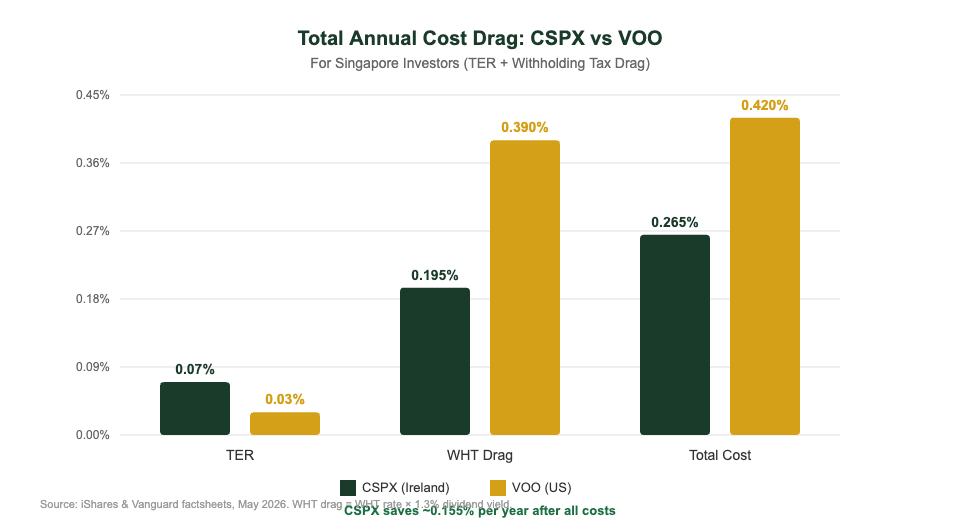
The effective withholding tax drag on VOO is approximately 0.39% per year (30% × 1.3% dividend yield), while CSPX’s drag is approximately 0.195% (15% × 1.3%). That is a 0.195% annual difference — which more than offsets VOO’s lower TER of 0.03% vs CSPX’s 0.07%.
Put another way: VOO’s “cheaper” expense ratio is a mirage for Singapore investors. After withholding tax, CSPX costs you roughly 0.15% less per year in total drag — and that compounds significantly over decades.
US Estate Tax — The Risk Nobody Talks About
Beyond withholding tax, there is a far larger risk that most Singapore investors either do not know about or choose to ignore: US estate tax.
Under US tax law, non-resident aliens (including Singapore citizens and PRs) who hold US-situs assets — such as US-listed ETFs like VOO — are subject to US federal estate tax upon death. The current rules, as per the IRS guidelines, impose a tax of up to 40% on US-situs assets exceeding USD 60,000.
That threshold is remarkably low. A Singapore investor with just SGD 80,000 in VOO already exceeds it. The estate tax is calculated on the gross value of all US-situs assets at the time of death — not just VOO, but also any US-listed stocks, other US ETFs, or US real estate.
| Total US-Situs Assets at Death | Estimated US Estate Tax (up to 40%) | CSPX Estate Tax |
|---|---|---|
| USD 60,000 | $0 (below threshold) | $0 |
| USD 100,000 | ~$10,600 | $0 |
| USD 250,000 | ~$62,800 | $0 |
| USD 500,000 | ~$155,800 | $0 |
| USD 1,000,000 | ~$345,800 | $0 |
Source: IRS estate tax brackets for non-resident aliens (2026). Estimates are approximate and based on graduated rates. Consult a tax professional for specific situations.
CSPX is domiciled in Ireland, not the United States. Ireland-domiciled ETFs are not considered US-situs assets under current IRS interpretation, which means CSPX holdings are not subject to US estate tax regardless of portfolio size.
For a Singapore investor building long-term wealth — especially if your portfolio is growing towards USD 100,000 or more — the estate tax risk alone makes CSPX the more prudent choice. This is not a hypothetical risk; the IRS actively enforces estate tax filings on non-resident alien estates, and your US broker is required to report your holdings. If you are building a Singapore retirement portfolio for the long term, avoiding this exposure matters.
CSPX vs VOO: Head-to-Head Comparison
Here is a complete side-by-side breakdown of both ETFs on every metric that matters for a Singapore investor:
| Feature | CSPX | VOO |
|---|---|---|
| Full Name | iShares Core S&P 500 UCITS ETF | Vanguard S&P 500 ETF |
| Provider | BlackRock (iShares) | Vanguard |
| Index Tracked | S&P 500 | S&P 500 |
| Domicile | Ireland | United States |
| Exchange | London Stock Exchange (LSE) | NYSE Arca |
| Currency | USD | USD |
| TER (Expense Ratio) | 0.07% | 0.03% |
| US Dividend WHT | 15% | 30% |
| Total Annual Cost Drag (TER + WHT) | ~0.265% | ~0.42% |
| Structure | Accumulating (auto-reinvest) | Distributing (quarterly payouts) |
| US Estate Tax Exposure | None | Yes (above USD 60,000) |
| AUM | ~USD 107 billion | ~USD 590 billion |
| Holdings | ~503 | ~503 |
Source: iShares CSPX factsheet and Vanguard VOO factsheet, May 2026. WHT cost drag calculated as WHT rate × ~1.3% dividend yield.
The total annual cost drag tells the real story. Despite VOO’s headline TER of 0.03%, a Singapore investor ends up paying approximately 0.42% per year in combined costs (TER + WHT drag), compared to just 0.265% with CSPX. That is a net advantage of roughly 0.155% per year for CSPX — before even considering the estate tax risk.
20-Year Cost Comparison: SGD 500/Month DCA
Numbers over a single year might seem small. But for Singapore investors building wealth through regular dollar-cost averaging (DCA), the compounding effect of that 0.155% annual cost difference becomes substantial over 10, 20, or 30 years.
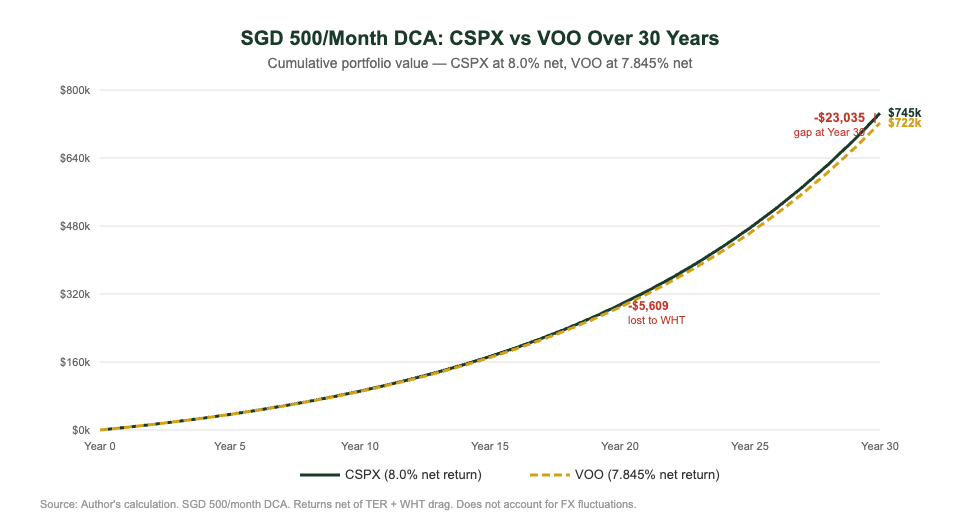
Here is a projection assuming a Singapore investor contributes SGD 500 per month, with an average annualised return of 8% (net of costs) for both ETFs — but applying the real cost drag difference of 0.155% per year to VOO:
| Time Horizon | Total Contributed | CSPX Portfolio (8.0%) | VOO Portfolio (7.845%) | Cost of Choosing VOO |
|---|---|---|---|---|
| 10 Years | $60,000 | $91,473 | $90,739 | -$734 |
| 20 Years | $120,000 | $294,510 | $289,806 | -$4,704 |
| 30 Years | $180,000 | $745,180 | $726,977 | -$18,203 |
Source: Author’s calculation. Assumes 8.0% annualised net return for CSPX, 7.845% for VOO (after the ~0.155% cost drag difference). Monthly contributions of SGD 500. All figures in SGD. Does not account for currency fluctuations or changes in dividend yield over time.
Over 20 years, choosing VOO over CSPX costs a Singapore investor approximately SGD 4,700 in lost returns — purely from the withholding tax difference. Over 30 years, that gap widens to over SGD 18,000. And this does not include the potential US estate tax liability, which could dwarf these numbers entirely.
If you are already investing in VOO and considering whether to switch, the Singapore retirement calculator can help you model different scenarios with your actual contribution amounts.
How to Buy CSPX in Singapore
CSPX trades on the London Stock Exchange under the ticker “CSPX” in US dollars. Singapore investors can purchase it through several brokers, but Interactive Brokers (IBKR) is the most popular and cost-effective option for LSE-listed ETFs.
Interactive Brokers (IBKR) — Recommended
IBKR offers the lowest commission rates for LSE trades and provides direct market access. Here is a step-by-step walkthrough:
- Open an IBKR account — Sign up using the IBKR referral code jianxiong368 for your sign-up bonus. The application takes about 15 minutes and requires your NRIC and proof of address.
- Fund your account — Transfer SGD via bank transfer to IBKR’s DBS account. Funds typically arrive within 1 business day. IBKR accepts SGD deposits and you can convert to USD within the platform at interbank rates (very low FX spread of ~0.002%).
- Convert SGD to USD — In the IBKR app or web platform, go to Trading → Currency Conversion. Convert your SGD to USD at the spot rate.
- Search for CSPX — In the search bar, type “CSPX” and select the listing on the London Stock Exchange (LSE) denominated in USD.
- Place your order — Select “Buy”, enter the number of shares (CSPX trades at approximately USD 600+ per share as at May 2026), and place a limit order during LSE trading hours (3:00 PM to 11:30 PM Singapore time).
IBKR commission for LSE ETFs: USD 1.70 minimum per trade (tiered pricing). For most Singapore investors, this works out to well under 0.1% per transaction, especially on purchases above USD 2,000.
Other Brokers
Saxo Markets: Offers CSPX on the LSE with a minimum commission of USD 3 per trade. Saxo’s platform is user-friendly and regulated by MAS. A solid alternative if you prefer a local brokerage experience.
FSMOne: Offers access to LSE-listed ETFs including CSPX, with a flat commission of 0.08% (minimum USD 8.80 per trade). If you already use FSMOne for unit trusts or bonds, you can use your FSMOne referral code to consolidate your investments on one platform.
Syfe: While Syfe does not offer direct LSE access, its Syfe referral code and sign-up bonus gives you access to curated S&P 500 exposure through its Core portfolios — a simpler alternative if you prefer a robo-advisor approach without managing individual ETF orders.
When VOO Still Makes Sense
Despite CSPX’s advantages for Singapore investors, there are legitimate scenarios where VOO may be the better choice:
You are a US tax resident or US citizen: If you file US taxes, the withholding tax and estate tax considerations are entirely different. US citizens and green card holders get the full USD 13.61 million estate tax exemption, and WHT on VOO dividends is simply part of your ordinary income tax — no additional drag. For US tax residents, VOO’s 0.03% TER is genuinely cheaper.
You want dividend income in cash: VOO distributes dividends quarterly, which suits investors who want regular cash flow — for example, retirees living off their portfolio. CSPX reinvests dividends automatically, so you would need to sell shares to generate cash. However, for most working-age Singapore investors still accumulating wealth, automatic reinvestment via CSPX is more tax-efficient.
You already have a substantial VOO position and switching costs are material: If you hold a large VOO position, selling and rebuying in CSPX incurs transaction costs and potential FX conversion fees. There is no capital gains tax in Singapore, so there is no tax consequence to switching — but the brokerage commissions and bid-ask spreads on both sides need to be factored in. For most investors, the long-term tax savings from CSPX will outweigh the one-time switching cost within a year or two.
Your total US-situs assets will stay permanently below USD 60,000: If your entire US portfolio (not just VOO — all US-listed stocks, ETFs, and real estate) will never exceed USD 60,000, the estate tax concern does not apply. But most investors with a long-term horizon will exceed this threshold relatively quickly.
The Bottom Line
For the vast majority of Singapore investors, CSPX is the better S&P 500 ETF. The combination of lower withholding tax (15% vs 30%), zero US estate tax exposure, and automatic dividend reinvestment makes it the more cost-effective and safer choice — even with its slightly higher expense ratio.
The difference is not trivial. On a SGD 500/month DCA plan, choosing CSPX over VOO saves you approximately SGD 4,700 over 20 years in withholding tax drag alone — and protects your estate from a potential 40% tax hit on US-situs assets above USD 60,000.
The most cost-effective way to buy CSPX in Singapore is through Interactive Brokers using referral code jianxiong368. For investors who prefer a simpler, managed approach, platforms like Endowus (referral code 2V343) offer S&P 500 exposure through fund portfolios without the need to manage individual ETF trades.
If you are currently holding VOO, consider gradually switching to CSPX on the LSE — there is no capital gains tax in Singapore, so the main cost is the one-time brokerage commission. The long-term savings will more than justify the switch. For broader portfolio planning, check out the passive income Singapore guide for ideas beyond equities.
Not financial advice. This article is for educational and informational purposes only. The Kopi Notes may earn referral fees from the platforms mentioned. All data cited is as at May 2026 and may change. Consult a qualified financial adviser before making investment decisions.
Frequently Asked Questions
Is CSPX better than VOO for Singapore investors?
Yes, for most Singapore investors, CSPX is the better choice. CSPX is domiciled in Ireland and pays only 15% US withholding tax on dividends, compared to 30% for VOO. CSPX also has no US estate tax exposure. Although VOO has a lower expense ratio (0.03% vs 0.07%), the withholding tax savings with CSPX more than offset this difference, resulting in a lower total cost of approximately 0.265% vs 0.42% annually for a Singapore investor.
What is the main difference between CSPX and VOO?
Both CSPX and VOO track the S&P 500 index, but they differ in domicile and structure. CSPX is domiciled in Ireland and listed on the London Stock Exchange as an accumulating UCITS ETF — dividends are automatically reinvested. VOO is domiciled in the United States and listed on NYSE as a distributing ETF — dividends are paid out quarterly. For non-US investors like Singaporeans, the domicile difference directly impacts withholding tax rates and US estate tax exposure.
How much does withholding tax cost me on VOO vs CSPX?
On a SGD 100,000 portfolio, the S&P 500’s ~1.3% dividend yield generates approximately SGD 1,300 in annual dividends. With VOO, the 30% withholding tax costs you SGD 390 per year. With CSPX, the 15% rate costs SGD 195 per year — a saving of SGD 195 annually. Over 20 years of compounding on a growing portfolio, this difference accumulates to thousands of dollars.
Do I have to pay US estate tax if I hold CSPX?
No. CSPX is domiciled in Ireland and listed on the London Stock Exchange, so it is not classified as a US-situs asset under current IRS rules. Singapore investors holding CSPX are not subject to US federal estate tax. In contrast, VOO is a US-domiciled ETF and is subject to US estate tax of up to 40% on holdings exceeding USD 60,000 for non-resident aliens.
Can I buy CSPX using CPF or SRS funds in Singapore?
CSPX is not eligible for CPF investment as it is not listed on the SGX and is not an included investment product under the CPFIS scheme. However, you may be able to purchase CSPX using your Supplementary Retirement Scheme (SRS) funds through certain brokers that support SRS accounts and offer access to the London Stock Exchange. Check with your broker for SRS eligibility — Interactive Brokers and Saxo are popular options.
Which broker is best for buying CSPX in Singapore?
Interactive Brokers (IBKR) is widely regarded as the most cost-effective broker for buying CSPX in Singapore. IBKR charges a minimum commission of approximately USD 1.70 per LSE trade and offers competitive FX conversion rates (around 0.002% spread). Other options include Saxo Markets (USD 3 minimum commission) and FSMOne (0.08% commission, minimum USD 8.80). For beginners who prefer a managed approach, Syfe offers S&P 500 exposure through its Core portfolios.
Should I switch from VOO to CSPX?
For most Singapore investors, switching from VOO to CSPX makes financial sense in the long run. Singapore has no capital gains tax, so selling VOO does not trigger a tax event. The main cost is the brokerage commission on selling VOO and buying CSPX. Given the annual withholding tax savings of approximately 0.195% on dividends, plus the elimination of US estate tax risk, the switching cost typically pays for itself within one to two years for most portfolio sizes.
Ready to Buy CSPX?
Open an Interactive Brokers account — the most cost-effective way to buy CSPX on the London Stock Exchange from Singapore.
This article was researched with the help of AI. While we strive to keep all information accurate and up to date, there may be errors. If you notice any discrepancies, please contact us.