With the June 2026 T-bill auction approaching and CPF interest rates confirmed for Q2 2026, many Singapore investors are asking the same question: should I put my money in T-bills or leave it in my CPF Ordinary Account (OA)?
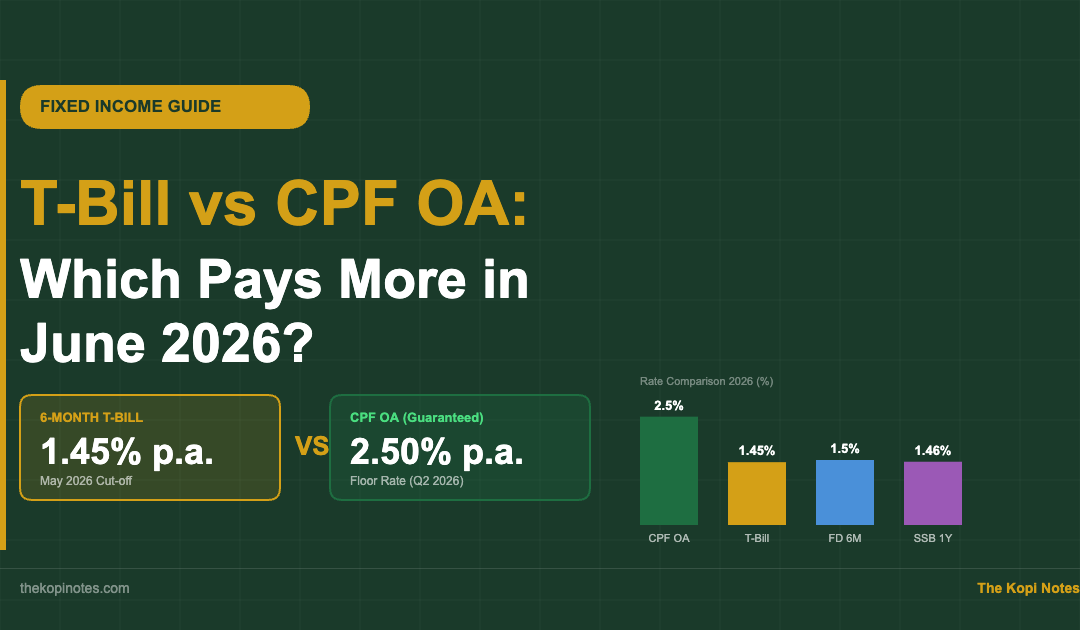
The latest 6-month T-bill (BS26110S) cut-off yield came in at 1.45% p.a. on 21 May 2026 — a bounce from the 1.40% held across April and early May. Meanwhile, CPF OA continues to pay a guaranteed 2.50% p.a. floor rate through June 2026.
At face value, CPF OA wins. But the comparison is more nuanced than a single number. This guide breaks down every angle — yield, liquidity, CPF investment rules, opportunity cost, and what to expect for the June 2026 T-bill auction — so you can make the right call for your money.
Table of Contents
- Current Rates: T-Bill vs CPF OA (May–June 2026)
- How Singapore T-Bills Work
- How CPF OA Interest Works
- Key Differences: Liquidity, Lock-in & Risk
- Buying T-Bills With CPF OA via CPFIS
- Full Comparison Table
- June 2026 T-Bill Auction: What to Expect
- Verdict: Which Is Better for You?
- Where to Invest Your Cash in 2026
- Frequently Asked Questions
1. Current Rates: T-Bill vs CPF OA (May–June 2026)
Here is where things stand as of late May 2026:
| Instrument | Rate (p.a.) | Tenor | Guarantee |
|---|---|---|---|
| 6-Month T-Bill (May 21) | 1.45% | 6 months | Singapore Govt (AAA) |
| CPF Ordinary Account (OA) | 2.50% | Ongoing | Government-backed, floor rate |
| Best 6-Month Fixed Deposit | ~1.50% | 6 months | SDIC up to S$75K |
| Singapore Savings Bond (SSB) 1-Year | 1.46% | Up to 10 yrs | Singapore Govt (AAA) |
| CPF Special Account (SA) | 4.00% | Ongoing | Floor rate (closed to new top-ups) |
Sources: MAS T-bill auction results, CPF Board Q2 2026 announcement. T-bill yield is cut-off yield — not guaranteed for future auctions.
Bottom line on rates: CPF OA’s 2.50% is nearly 70 basis points above the current T-bill yield of 1.45%. In the environment of 2026, where the Fed has paused cuts and Singapore short-term rates have drifted lower, T-bills no longer hold the yield premium they did in 2022–2023.
2. How Singapore T-Bills Work
Singapore Treasury Bills (T-bills) are short-term debt securities issued by the Singapore Government through the Monetary Authority of Singapore (MAS). They are issued at a discount to face value, and you receive the full face value at maturity — the difference is your return.
Key T-bill facts for 2026:
- Tenors available: 6-month and 1-year
- Minimum investment: S$1,000 (in multiples of S$1,000)
- Auction frequency: Every 2 weeks (6-month); monthly (1-year)
- How to apply: ATM, internet banking (DBS/OCBC/UOB), or CPF Investment Scheme (CPFIS) for OA/SA funds
- Yield type: Cut-off yield is determined at auction — not fixed in advance. You bid competitive or non-competitive
- Non-competitive bids: Always allotted at the cut-off yield — best for retail investors
- Issuance size (May 2026): S$8.5 billion — the largest 6-month T-bill issuance to date
- Applications (May 21 auction): S$18.0 billion applied for S$8.5 billion — oversubscribed ~2.1x
T-bills are considered one of the safest investments in the world — backed by the Singapore Government’s AAA credit rating. Capital is fully protected as long as you hold to maturity.
3. How CPF OA Interest Works
Your CPF Ordinary Account earns interest at the higher of either the 3-month average of major local banks’ savings rates, or the legislated floor of 2.50% p.a. Since local bank rates have remained well below 2.50%, the floor rate has applied every quarter since 1999 — making CPF OA one of the most consistently reliable savings rates in Singapore.
Q2 2026 CPF interest rates (1 April – 30 June 2026):
- Ordinary Account (OA): 2.50% p.a. (floor rate)
- Special Account (SA): 4.00% p.a. (floor rate; closed to new voluntary top-ups since Jan 2025)
- MediSave Account (MA): 4.00% p.a.
- Retirement Account (RA): 4.00% p.a.
- Extra 1% interest: On first S$60,000 of combined CPF balances (capped at S$20,000 from OA)
- Extra 2% interest: On first S$30,000 of combined CPF balances for members aged 55 and above
CPF OA interest is compounded monthly and credited annually. Crucially, money in CPF OA cannot be withdrawn freely — it is restricted to housing, education, investment (via CPFIS), and insurance. This is a key distinction from cash T-bills.
4. Key Differences: Liquidity, Lock-in & Risk
| Factor | T-Bill (6-Month) | CPF OA |
|---|---|---|
| Current yield | 1.45% p.a. | 2.50% p.a. |
| Rate certainty | Fixed at auction | Quarterly review (floor 2.50%) |
| Liquidity | Cash accessible at maturity (6M) | Restricted (housing/education/CPFIS) |
| Early exit | Sell on secondary market (small discount possible) | No early withdrawal (until age 55 / housing use) |
| Tax treatment | Tax-exempt for individuals | Tax-exempt |
| Capital protection | 100% at maturity | 100% (government-backed) |
| Min. investment | S$1,000 | N/A (ongoing) |
| Admin effort | Apply every 2 weeks; reinvest manually | Automatic — no action needed |
| Best for | Cash savings seeking safety | Retirement savings already in CPF |
Important note: You cannot move CPF OA funds to cash T-bills freely — the comparison only applies if you are choosing between (a) buying T-bills with cash vs. leaving that cash unused, or (b) investing CPF OA funds in T-bills via CPFIS. These are two very different decisions.
5. Buying T-Bills With CPF OA via CPFIS
If you have excess CPF OA funds that you are not using for housing or education, you can invest them in T-bills via the CPF Investment Scheme (CPFIS-OA). Here is what you need to know:
CPFIS-OA T-bill rules:
- You must have a CPFIS-OA investment account (opened with DBS/OCBC/UOB)
- Only funds above S$20,000 in your OA can be invested (the first S$20,000 must remain in OA)
- CPF OA application deadlines differ by bank:
- DBS: closes 9pm, 1 business day before auction
- OCBC: closes 9pm, 1 business day before auction
- UOB: closes 9pm, 2 business days before auction
- After the T-bill matures, proceeds return automatically to your CPF OA
Should you invest CPF OA funds in T-bills?
Right now, no — it doesn’t make financial sense. The current T-bill yield of 1.45% is significantly below the CPF OA floor rate of 2.50%. Investing your OA in T-bills means you would give up 1.05 percentage points of guaranteed return per year. On S$50,000, that is S$525 in foregone interest over 6 months — before even factoring in transaction costs.
The math only works in your favour if T-bill yields exceed 2.50%. This was the case in 2022–2023 when T-bills yielded 3.7–4.2%. In today’s environment, CPFIS T-bill investing makes sense mainly as a strategy to beat the OA rate — which it currently does not.
For a full guide to optimising your CPF investments, see our CPF Investment Strategy Guide and CPF LIFE Payout Calculator.
6. Full Comparison Table: T-Bill vs CPF OA vs Alternatives
| Instrument | Rate | Tenor | Liquidity | Risk |
|---|---|---|---|---|
| CPF SA (existing balances) | 4.00% | Ongoing | Very Low | None |
| CPF OA | 2.50% | Ongoing | Very Low | None |
| 6-Month T-Bill (May 2026) | 1.45% | 6 months | High (cash) | None (hold) |
| SSB (Jun 2026 issue) | 1.46% (1Y avg) | Up to 10 yrs | High (monthly redemption) | None |
| Best 6M Fixed Deposit | ~1.50% | 6 months | Low (penalty for early withdrawal) | Very Low (SDIC) |
| Best Savings Account | ~1.40–2.00% | Flexible | Very High | Very Low (SDIC) |
| Endowus Cash Smart / Money Market Fund | ~2.5–3.0%* | Flexible | High (T+1 to T+3) | Very Low |
*Money market fund yields are variable and not guaranteed. Past performance not indicative of future returns.
7. June 2026 T-Bill Auction: What to Expect
The next 6-month T-bill auction after 21 May 2026 is scheduled for 4 June 2026 (issue date 5 June). Here is what the data suggests:
Recent 6-month T-bill cut-off yields (2026):
| Auction Date | Cut-off Yield | Total Applications | Notes |
|---|---|---|---|
| 9 April 2026 | 1.47% | — | 2026 year-to-date high |
| 23 April 2026 | 1.40% | S$19.2B | Sharp drop; demand soared |
| 7 May 2026 | 1.40% | S$17.5B | Yield held; demand eased |
| 21 May 2026 | 1.45% | S$18.0B | Yield bounced; demand recovered |
Source: MAS auction results, Growbeansprout.com
For the upcoming June auction, yields are likely to remain in the 1.40%–1.55% range, driven by:
- US Treasury yields edging higher — the 10-year UST was at 4.46% as of mid-May, pushing global short-term rates slightly up
- Singapore 10-year SGS bond at ~2.07% — stable domestic rates provide an anchor
- Large issuance size maintained — S$8.5B helps absorb demand without pushing yield too low
- Continued strong retail demand — Singaporeans are still oversubscribing T-bills ~2x
Even if June yields tick up modestly to ~1.50%, CPF OA’s 2.50% guarantee remains significantly more attractive for CPF funds specifically.
8. Verdict: Which Is Better for You?
The honest answer depends on whose money you are comparing:
If you are comparing cash savings:
T-bills are a legitimate, safe option for your emergency fund or short-term cash allocation. At 1.45%, they are roughly in line with fixed deposits and SSBs. If you want a fully government-guaranteed instrument with no bank exposure and a fixed 6-month lock-in, T-bills make sense. However, a high-yield savings account offering 1.8–2.0% or a money market fund at ~2.5–3.0% currently beats T-bills on yield for cash.
If you are comparing CPF OA funds:
Leave your OA earning 2.50%. With T-bills at 1.45%, investing CPF OA into T-bills via CPFIS costs you 1.05 percentage points per year — a guaranteed loss of return. The CPFIS T-bill strategy is only worth revisiting when T-bill yields exceed 2.50%.
If you are planning for retirement:
Consider using your CPF OA to fund your retirement planning, invest in S-REITs via CPFIS for higher potential yields, or explore robo-advisors for CPF-eligible portfolios. Our Singapore Retirement Calculator can help you model CPF drawdown scenarios.
9. Where to Invest Your Cash in Singapore (2026)
If T-bills at 1.45% feel underwhelming, here are higher-yielding options for your cash and CPF in 2026:
For cash savings:
- Money Market Funds via Endowus or Syfe Cash+ — flexible, ~2.5–3.0% yield, redeemable T+1 to T+3. Start with Endowus (referral link — S$20 fee credit) or Syfe Cash+ (referral link)
- High-yield savings accounts — some accounts still offer 1.8–2.0% p.a. for crediting salary
- Singapore Savings Bonds (SSBs) — 1.46% for 1-year, 2.11% average over 10 years, fully flexible redemption
For CPF OA (CPFIS-eligible):
- S-REITs via CPF OA — higher potential yield (5–7%) but with market risk. See our Best S-REITs Singapore 2026 guide
- S-REIT ETFs — diversified exposure to Singapore REITs via a single ETF purchase. See our Singapore REIT ETF Guide
- Endowus CPF portfolio — professionally managed, low-cost, CPF-eligible. Use our Endowus referral for S$20 fee credit
For retirement optimisation:
- Check your CPF Retirement Sum Calculator to see if you are on track for BRS/FRS/ERS
- Model your CPF LIFE payout options with our CPF LIFE Payout Calculator
- Use the T-Bill vs SSB vs FD Comparison Calculator to run your own yield scenarios
10. Frequently Asked Questions
Is T-bill yield higher than CPF OA in 2026?
Can I use my CPF OA to buy T-bills?
What is the cut-off yield for the latest Singapore T-bill?
When is the next T-bill auction in June 2026?
Should I invest my emergency fund in T-bills?
Are T-bill gains taxable in Singapore?
What happens to my T-bill when it matures?
Is CPF OA 2.50% guaranteed for the rest of 2026?
This article was researched with the help of AI. While we strive to keep all information accurate and up to date, there may be errors. If you notice any discrepancies, please contact us.