How to Apply for a Credit Card in Singapore (2026): Income Rules, Documents and Step-by-Step Guide
Eligibility, MAS credit limit rules, the documents banks ask for, and the exact steps to get approved in 2026.
To apply for a credit card in Singapore, you must be at least 21 and, as a Singaporean or PR aged 55 and below, earn at least S$30,000 a year under MAS rules (S$15,000 if above 55). Foreigners typically need S$45,000. Apply online with Singpass Myinfo for the fastest approval; credit limits are capped at four months of income below S$120,000.
Not financial advice. Data verified as at 26 November 2026 against the MAS, DBS, OCBC and ABS pages linked in this article.
Table of Contents
Contents — Click to expand
- Who Can Apply for a Credit Card in Singapore?
- MAS Income Rules and Credit Limits Explained
- Documents You Need to Apply
- How to Apply for a Credit Card in Singapore: 7 Steps
- Worked Example: What Credit Limit Will You Get?
- What to Do If Your Application Is Rejected
- Which Card Should You Apply For First?
- Frequently Asked Questions
Who Can Apply for a Credit Card in Singapore?
Every bank in Singapore runs its own credit checks, but they all sit on top of the same regulatory floor set by the Monetary Authority of Singapore. Before you even look at cashback rates or miles, check three things: your age, your residency status and your annual income. If you fail one of them, the online form will usually stop you before you submit.
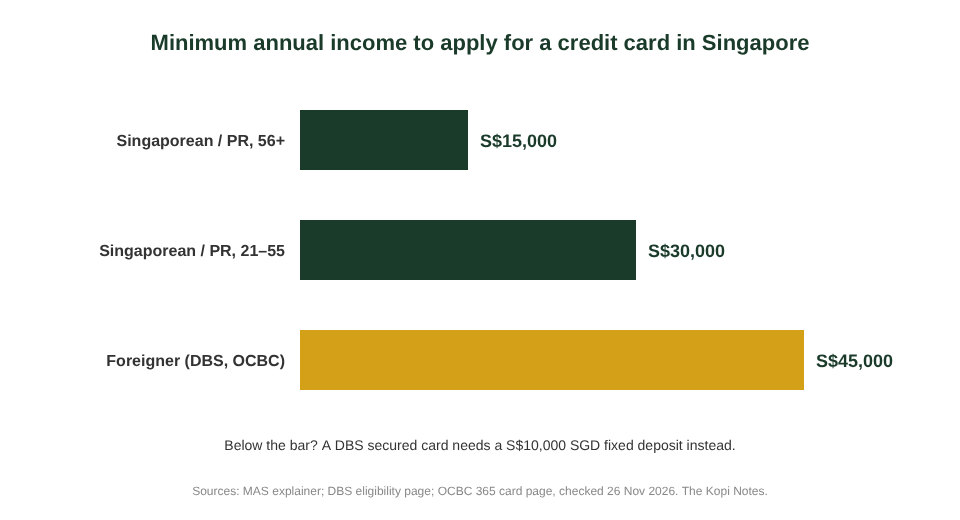
Age is the simplest filter. Per the DBS card eligibility page, a principal cardholder must be 21 to 75 years old, while a supplementary cardholder must be at least 18. OCBC also states a minimum age of 21 for its 365 Credit Card. Income is the filter that trips most people up, and the threshold depends on whether you are a Singaporean or PR, how old you are, and whether you are a foreigner on a work pass.
| Applicant type | Minimum annual income | Where it comes from |
|---|---|---|
| Singaporean / PR, aged 55 and below | S$30,000 | MAS rule; DBS and OCBC apply the same figure |
| Singaporean / PR, aged above 55 | S$15,000 | MAS rule for over-55s; DBS and OCBC apply the same figure |
| Foreigner on an eligible work pass | S$45,000 | Bank policy (DBS, OCBC 365), not an MAS minimum |
| No income, but net personal assets above S$2 million | No income test | MAS alternative criterion |
| No income, but net financial assets above S$1 million | No income test | MAS alternative criterion |
| Below the income bar (DBS secured card) | S$10,000 SGD fixed deposit | DBS secured card alternative |
Source: MAS Issuing Credit Cards explainer; DBS card eligibility page; OCBC 365 card page. Data verified 26 November 2026.
For foreigners, DBS lists the eligible passes as the Employment Pass, S Pass, Personalised Employment Pass, Long Term Visit Pass with Letter of Consent, Tech.Pass and International Organisation Pass. If you are on one of these passes, our guide to the credit card options for foreigners in Singapore compares the banks that accept them.
MAS Income Rules and Credit Limits Explained
The S$30,000 floor is not something banks invented to keep customers out. It comes from MAS rules on unsecured credit. According to the MAS explainer on issuing credit cards, a borrower aged 55 and below qualifies for an unsecured credit card with one of: an annual income of at least S$30,000, net personal assets exceeding S$2 million, or net financial assets exceeding S$1 million. MAS notes that income can include non-employment income such as rental income.
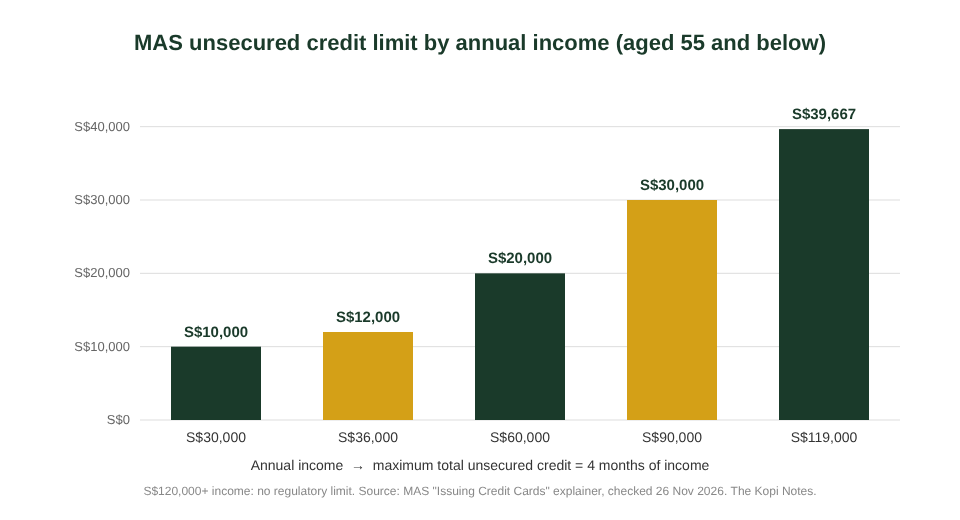
The same rules cap how much unsecured credit a bank can extend to you. If your annual income is at least S$30,000 but below S$120,000, the regulatory limit is up to four months of income. Once your income reaches S$120,000, or your net personal assets exceed S$2 million, there is no regulatory limit, and the bank sets the limit on its own credit judgement.
| Your profile | Regulatory unsecured credit limit |
|---|---|
| Aged 55 and below, income S$30,000 to below S$120,000 | Up to 4 months of income |
| Aged 55 and below, income S$120,000 or more | No regulatory limit |
| Net personal assets above S$2m or net financial assets above S$1m | No regulatory limit |
| Above 55, income above S$15,000 and below S$30,000 | Up to 2 months of income |
| Above 55, income S$30,000 to below S$120,000 | Up to 4 months of income |
| Above 55, income S$15,000 or less with net personal assets of S$750,000 to S$2m | Up to S$2,500 |
Source: MAS Issuing Credit Cards explainer. Data verified 26 November 2026.
Two details matter here. First, the Association of Banks in Singapore FAQ on unsecured credit rules describes the four-months-of-income cap as a per-bank limit, so holding cards with two banks does not automatically halve your limit at each. Second, the same FAQ sets an aggregate rule across all banks: if your interest-bearing unsecured debt exceeds your annual income for three consecutive months, banks must suspend your cards and credit lines, and you cannot get new cards or limit increases until the debt falls below your annual income and fresh checks are done. The ABS FAQ dates from 2014, when the rules were introduced, so read it alongside the current MAS page.
For Singaporeans above 55, MAS also allows a card with annual income of at least S$15,000, net personal assets above S$750,000, or a guarantor earning at least S$30,000.
Documents You Need to Apply
The fastest way to apply is with Singpass. DBS says that if you use Myinfo through Singpass to pre-fill the form, you can get real-time approval on your chosen card; Myinfo fills in your personal and income details from government records so you do not have to upload them. If you apply without Myinfo, you will need to upload documents. Based on the DBS list of required documents, the typical requirements are:
- Salaried employees with more than 3 months of service: NRIC (front and back), plus your latest 3 months of computerised payslips (minimum 1 month) or 3 months of salary-crediting bank statements. The latest Income Tax Notice of Assessment is optional.
- Employees with less than 3 months of service: NRIC, plus your latest computerised payslip, or a company letter certifying your employment and salary with a copy of your staff pass.
- Commission earners and the self-employed: NRIC plus your latest Income Tax Notice of Assessment.
- Foreigners: a passport with at least 6 months of validity and your work pass (front and back, at least 6 months of validity). New-to-bank customers also need proof of residential address dated within the last 3 months.
- Applicants aged 56 and above: NRIC plus one of several income proofs, such as a Notice of Assessment showing dividend, rental or interest income, or CPF payout statements.
Requirements differ slightly by bank, so treat this as a checklist rather than a guarantee.
How to Apply for a Credit Card in Singapore: 7 Steps
Step 1: Confirm you meet the income and age rules
Use the eligibility table above. If you earn S$2,500 a month or more as a Singaporean aged 21 to 55, you clear the S$30,000 floor. Foreigners generally need S$3,750 a month to clear the S$45,000 bar that DBS and OCBC apply.
Step 2: Check your credit report
Banks check your record with a credit bureau such as Credit Bureau Singapore before approving you. If you have missed payments on loans, other cards or even a phone contract that went to collections, fix those first. A clean report matters more than the card you pick.
Step 3: Pick a card that fits how you spend
Choose between cashback, miles and no-frills cards based on your monthly spend, not the sign-up gift. Our best credit card in Singapore comparison for 2026 breaks down the main options. Check the annual fee too: the OCBC 365 card page, for example, lists a principal card fee of S$196.20 including GST, waived for the first two years.
Step 4: Gather your documents
If you can use Singpass, you may need nothing else. If not, scan your NRIC or passport and work pass, and have payslips or your Notice of Assessment ready as PDFs.
Step 5: Apply online with Myinfo
Apply through the bank’s website or app and choose the Singpass/Myinfo option. This pre-fills your personal and income details and is the route banks use for instant or same-day approval. Digital banks such as Trust Bank and MariBank run their card applications entirely in-app, which suits people who already bank with them. If you sign up for Trust, our Trust Bank referral code (HTWYQP95) page explains the current welcome offer, and MariBank users can see the MariBank referral code 2DCT80WQ.
Step 6: Wait for approval and activate the card
Myinfo applications can be approved in real time, while manual document reviews take longer. Once approved, activate the card in the bank’s app, set your PIN, and add it to Apple Pay or Google Pay if you want to use it straight away.
Step 7: Set up auto-payment of the full balance
Set a GIRO or in-app instruction to pay the full statement balance every month. Paying only the minimum triggers interest charges that wipe out any cashback you earn. Our credit card interest calculator shows how quickly an unpaid balance grows.
Worked Example: What Credit Limit Will You Get?
Take Wei Ling, a 27-year-old Singaporean earning S$4,000 a month, or S$48,000 a year. She clears the S$30,000 income floor. Under the MAS rule, the most any one bank can give her in unsecured credit is four months of income: S$4,000 × 4 = S$16,000. That cap covers her card limit plus any other unsecured credit line at the same bank, such as a personal credit line.
If she later opens a second card with another bank, that bank can also extend up to S$16,000. However, under the aggregate rule in the ABS FAQ, if her interest-bearing unsecured debt across all banks stays above S$48,000 (her annual income) for three straight months, every bank must suspend her credit. The banks’ own credit scoring may also approve her for less than the regulatory cap, especially on her first card.
Now compare Arjun, who earns S$130,000 a year. Because he is above S$120,000, there is no regulatory limit at all, and his limit depends purely on the bank’s own assessment.
What to Do If Your Application Is Rejected
Rejections usually come down to income below the threshold, documents that do not match the declared income, or a weak credit report. Do not reapply for several cards in a row, as each application shows up as an enquiry on your credit report.
If your income is below S$30,000, a secured card is the most direct route. DBS lets you get a card by maintaining a SGD fixed deposit of at least S$10,000, and our secured credit card Singapore guide covers how these cards work. Students and fresh graduates who do not yet meet the income bar can read our student credit card guide for alternatives such as supplementary cards and debit cards.
Which Card Should You Apply For First?
For a first card, a simple cashback card with an annual fee waiver usually beats a premium miles card. You learn how to manage a statement cycle without paying for perks you will not use. Look for cards with low or no minimum spend, and check how the bank handles the annual fee after the waiver period ends; our credit card annual fee waiver guide explains how to ask for it.
Whatever you pick, the rule is the same: spend only what you would have spent anyway, and pay the full balance every month.
Not financial advice. Eligibility rules, fees and limits are set by MAS and individual banks and may change. Always check the bank’s own page before applying.
Frequently Asked Questions
How do I apply for a credit card in Singapore?
Check you meet the age (21+) and income rules, pick a card, then apply online through the bank’s website or app using Singpass Myinfo. Myinfo pre-fills your NRIC and income details, and DBS says this route can give real-time approval.
What is the minimum income for a credit card in Singapore?
Under MAS rules, Singaporeans and PRs aged 55 and below need an annual income of at least S$30,000, and those above 55 need at least S$15,000. Foreigners face bank-set minimums; DBS and OCBC ask for S$45,000.
Can I get a credit card with no income in Singapore?
Yes, in two ways. MAS allows a card if your net personal assets exceed S$2 million or your net financial assets exceed S$1 million. Otherwise, a secured card backed by a fixed deposit (S$10,000 at DBS) works without an income check.
How much credit limit will I get?
If you earn S$30,000 to below S$120,000 a year, MAS caps the unsecured credit at up to four months of income per bank. Above S$120,000 there is no regulatory limit, and the bank decides.
Can foreigners apply for a credit card in Singapore?
Yes, if you hold an eligible work pass such as an Employment Pass or S Pass and meet the bank’s income bar, which is S$45,000 at DBS and OCBC. You need a passport and work pass with at least 6 months of validity.
What documents do I need to apply for a credit card?
With Singpass Myinfo, usually none. Otherwise, Singaporeans need their NRIC plus recent payslips or an Income Tax Notice of Assessment; foreigners need a passport, work pass and, for new bank customers, proof of address.
What is the minimum age for a credit card in Singapore?
You must be at least 21 to hold a principal card. DBS sets the range at 21 to 75. Supplementary cardholders at DBS must be at least 18.
What happens if my debt is more than my annual income?
Under the unsecured credit rules described by the Association of Banks in Singapore, if your interest-bearing unsecured debt exceeds your annual income for three consecutive months, banks must suspend your cards and credit lines until you bring it below that level.
Building Your Banking Setup?
Compare Singapore’s digital banks before you pick where your card and savings live.
This article was researched and drafted with AI assistance and checked against official MAS, bank and ABS sources as at 26 November 2026. It is general information, not financial advice. The Kopi Notes may earn referral rewards from some links. Rules and fees can change; confirm with the bank before applying.
This article was researched with the help of AI. While we strive to keep all information accurate and up to date, there may be errors. If you notice any discrepancies, please contact us.