GXS Bank vs Standard Chartered BonusSaver 2026: Which Savings Account Wins?
No salary credit, no card spend, no fuss — or earn up to 7.35% if you can hit every bonus tier. We run the numbers on both accounts so you can pick the right one for your lifestyle.
TL;DR — Quick Verdict
GXS Bank and Standard Chartered BonusSaver serve very different savers. GXS Bank is the clear winner for simplicity: its Main Account earns 0.88% p.a. with zero conditions, and Saving Pockets currently offer a promotional 1.2% p.a. — no salary credit, no card spend, no insurance policy required. SC BonusSaver can reach a headline 7.35% p.a. for Singaporeans who salary-credit, hit a monthly card spend, and purchase qualifying insurance and investments — but realistic take-home for most employed savers is about 1.85% p.a. If you just want your spare cash to work harder without lifestyle changes, GXS Bank wins. If you already bank with SC and hit the bonus thresholds naturally, BonusSaver can outperform.
Not financial advice. All figures are for educational reference only. Data as at November 2026 unless noted. Always verify current rates directly at gxs.com.sg and sc.com/sg.
GXS Bank Savings Account: Overview
GXS Bank is Singapore’s first digital bank, launched by a consortium of Grab and Singtel in August 2022. It holds a full digital banking licence from the Monetary Authority of Singapore (MAS) and is a full member of the Singapore Deposit Insurance Corporation (SDIC), meaning deposits up to S$100,000 per depositor are protected.
Unlike traditional banks, GXS is built around simplicity. There is no monthly fee, no minimum balance, and no requirement to salary-credit or meet a card spend before you earn interest. The rate you see is the rate you get from day one.
GXS Bank Account Types
GXS offers two ways to save:
Main Account (Base Savings): Earns 0.88% p.a. on your full balance. No lock-in, full liquidity, withdraw anytime. This is your everyday float — park your emergency fund here and earn something without thinking about it.
Saving Pockets: Separate pots within the app, each earning a promotional rate. As at November 2026, Saving Pockets earn a promotional 1.2% p.a. These pockets are liquid (you can close and redeem them anytime), but are most suitable for medium-term goals — holiday funds, renovation funds, or a year’s worth of expenses.
Boost Pocket: A fixed-term savings product paying up to 2.0% p.a. over an 18-month tenure. Early withdrawal may forfeit accrued interest, so only commit funds you won’t need urgently. As of late November 2026, GXS is running a Holiday Boost promotion offering rates up to 2.4% p.a. — but this promotion closes on 30 November 2026.
| Product | Rate (% p.a.) | Lock-in? | Conditions |
|---|---|---|---|
| Main Account | 0.88% | None | None |
| Saving Pockets | 1.2% (promo) | None | None |
| Boost Pocket | Up to 2.0% | 18 months | None |
| Holiday Boost (promo) | Up to 2.4% | See terms | Ends 30 Nov 2026 |
Source: GXS Bank official website (gxs.com.sg), November 2026. Rates are promotional and subject to change without notice.
One important note: GXS Bank is currently open only to Singaporeans, Permanent Residents, and certain eligible foreigners — you apply via the GXS app (available on iOS and Android). There is no physical branch; all banking is done through the app. If you want to sign up, use our GXS referral code YONG477 for any applicable sign-up bonuses.
Standard Chartered BonusSaver: Overview
Standard Chartered BonusSaver is a current account — not a savings account — that layers bonus interest on top of a very low base rate. It is designed for committed SC customers who already use the bank for multiple financial products: a credit card, salary crediting, insurance, and investments. When you tick all the boxes, the headline rate is impressive. When you tick just one or two, it is underwhelming.
The base rate is 0.05% p.a. — the floor you earn even if you do nothing. From there, bonus interest tiers stack up:
| Bonus Action | Additional Rate | Requirement |
|---|---|---|
| Base rate | 0.05% | No conditions |
| Salary credit | +0.80% | ≥ S$3,000/month |
| SC card spend | +1.00% | ≥ S$1,000/month |
| Insurance purchase | +2.00% | ≥ S$24,000 annual premium |
| Unit trust investment | +2.00% | ≥ S$30,000 invested |
| Online trading | +1.50% | ≥ S$30,000 invested |
| Maximum total | 7.35% p.a. | All tiers, first S$100k |
Source: Standard Chartered BonusSaver terms (sc.com/sg), November 2026. Rates apply on the first S$100,000 of balance. The 7.35% maximum requires all bonus tiers to be fulfilled in the same calendar month.
The key caveat: BonusSaver bonus interest applies only on the first S$100,000 of your account balance. Funds above that threshold earn a much lower rate. The account also has no minimum balance requirement, but falling below S$3,000 triggers a S$5 monthly fall-below fee (waived if you hold any other SC product).
Unlike GXS Bank, Standard Chartered BonusSaver is a full-service traditional bank with branches, ATMs, and a comprehensive suite of credit cards, home loans, and investment products — a meaningful advantage for those who want one relationship for all their banking.
Interest Rate Comparison
To make a fair comparison, we model four realistic scenarios: a saver with no product requirements, an employed saver with salary and card spend, someone who also takes advantage of GXS promos or SC insurance, and someone who maxes out every available bonus.
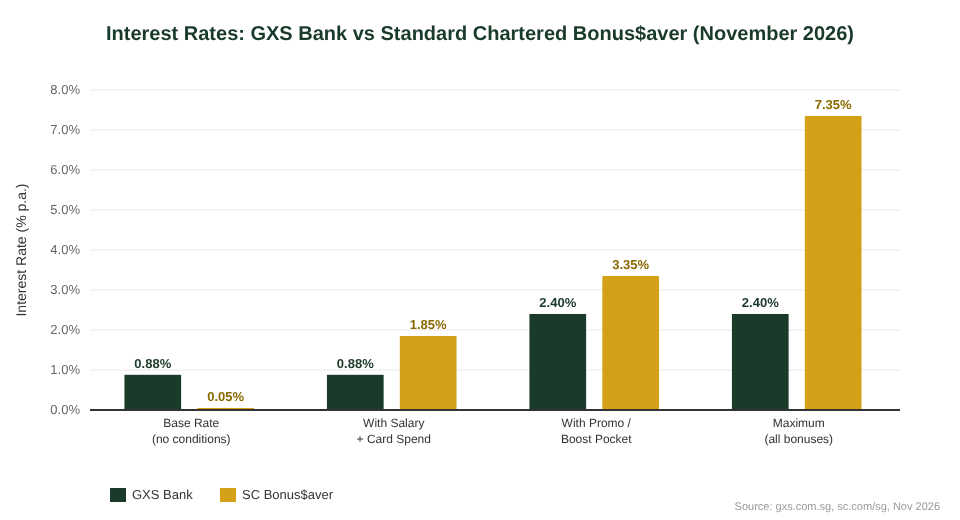
Scenario 1 — Base rate (no conditions): GXS Bank wins convincingly. 0.88% p.a. versus SC’s 0.05% p.a. — a 17x difference just for parking your money. For a S$50,000 balance, that is S$440 versus S$25 in annual interest. The GXS advantage here is unambiguous.
Scenario 2 — Salary credit + card spend: With a monthly salary of at least S$3,000 and S$1,000 in card spend, SC BonusSaver pulls ahead at 1.85% p.a. versus GXS’s flat 0.88% (or 1.2% if you use Saving Pockets). For the typical employed Singaporean, SC’s conditional rate starts to make sense — if you are already happy to salary-credit and use an SC card.
Scenario 3 — Promotional / boosted rate: GXS’s Holiday Boost (ends 30 Nov 2026) offers up to 2.4% p.a., narrowing the gap. Post-promo, GXS’s highest accessible rate reverts to Boost Pocket at 2.0% p.a. with an 18-month commitment. At this tier, adding SC insurance (≥S$24k/yr premium) pushes BonusSaver to 3.35% — but that insurance hurdle is out of reach for most savers.
Scenario 4 — Maximum rate: SC BonusSaver’s 7.35% p.a. ceiling is genuinely impressive — but requires salary crediting, S$1,000/month card spend, purchasing insurance with ≥S$24,000 in annual premiums, and investing ≥S$30,000 in unit trusts. For most Singaporeans, especially younger savers, those thresholds are steep. GXS caps out at 2.4% (promo) or 2.0% (standard Boost Pocket).
The honest bottom line on rates: For the typical Singapore saver without complex product commitments, GXS Bank’s 0.88–1.2% p.a. earned on a fully liquid balance often beats the effort required to squeeze marginal extra interest from BonusSaver’s lower tiers. If you are already a committed SC customer earning close to 1.85%, the incremental comparison narrows.
If your goal is passive income in Singapore without tying up capital, it is also worth comparing savings accounts against Singapore T-bills in 2026, which currently offer 3–3.5% p.a. on 6-month tenures — a meaningful premium over both GXS and BonusSaver for those comfortable with a short lock-in period.
Requirements at a Glance
The simplest way to decide between these two accounts is to look at what each one actually demands from you. Here is a side-by-side breakdown of every material condition and feature:
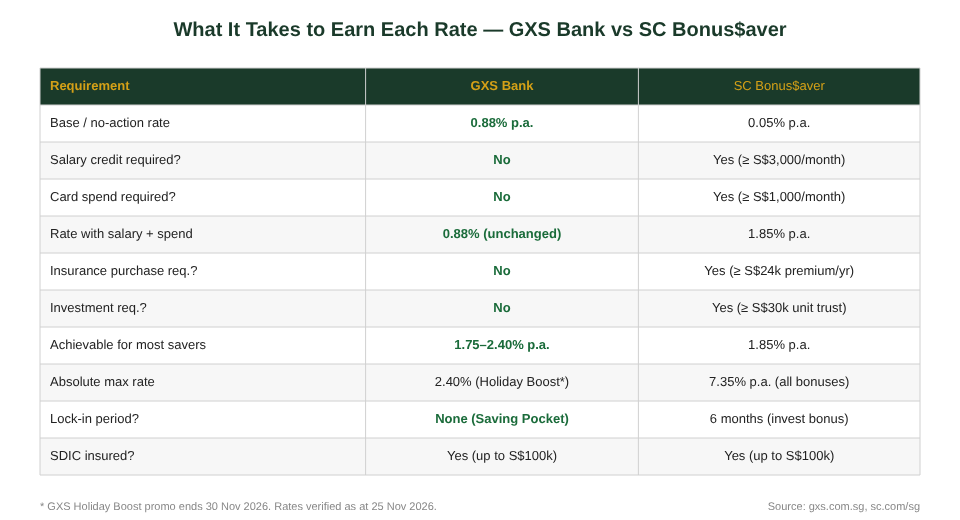
Reading through the requirements table above, the core difference becomes clear: GXS Bank charges you nothing — not in product commitments, not in lifestyle constraints — to earn its headline rates. Standard Chartered BonusSaver is a loyalty programme dressed as a savings account. Its top rates reward savers who have already centralised their financial lives at SC: salary, spending, insurance, and investments all under one roof.
The fall-below fee is worth calling out: SC BonusSaver charges S$5/month if your average daily balance drops below S$3,000 and you hold no other SC product. For savers who keep balances below S$3,000 or whose cash flow fluctuates, GXS is effectively free, while SC has a hidden cost floor.
Both accounts are SDIC-insured to S$100,000 per depositor — your money is equally protected at either bank under Singapore’s deposit insurance scheme. Deposits beyond S$100,000 at a single bank are uninsured, so high-net-worth savers with large cash balances should spread across institutions regardless of which they choose.
Who Should Choose GXS Bank?
GXS Bank is a strong fit if any of the following describe you:
You want simplicity over complexity. No product bundling, no bonus tracking, no calendar reminders to hit your card spend before month-end. You open the account, transfer cash, and earn interest. It is the digital bank equivalent of a fixed deposit — without the lock-in.
You are self-employed, a freelancer, or have irregular income. SC BonusSaver’s salary-credit bonus requires a minimum S$3,000 credited monthly — that is straightforward for a salaried employee but may exclude gig workers, business owners, or those between jobs. GXS Bank places no such restriction: your savings account earns the same rate regardless of your employment type or income pattern.
You want a dedicated “savings pot” separate from daily spending. GXS’s Saving Pockets function exactly like labelled jars — a holiday fund, a renovation fund, an emergency fund — each earning the promo rate separately. This mental-accounting framework helps many savers avoid dipping into savings impulsively.
You are catching the Holiday Boost before it expires. If you are reading this before 30 November 2026, GXS Bank’s Holiday Boost is an unusually competitive promotional rate. Locking in a Boost Pocket before the deadline lets you secure a higher rate — verify exact terms on the GXS app. Sign up with GXS referral code YONG477.
You already bank at DBS/POSB, OCBC, or UOB and do not want to switch your primary banking relationship. GXS works well as a secondary savings account layered on top of your existing bank — no need to migrate salary or credit cards.
Who Should Choose SC BonusSaver?
Standard Chartered BonusSaver makes the most sense for a specific type of saver:
You already salary-credit at SC and use an SC credit card. If you are already earning the 1.85% p.a. tier naturally — without changing any habits — BonusSaver is competitive. At S$100,000 in savings, the difference between 0.88% (GXS base) and 1.85% (SC salary + card) is about S$970 per year. That delta justifies the account for committed SC customers.
You are building comprehensive wealth at SC. If you plan to hold SC insurance, invest through SC’s unit trusts, and trade equities via SC Online Trading — the full BonusSaver ecosystem — the headline rate of 7.35% p.a. on your first S$100,000 is a genuine differentiator. At that level, BonusSaver generates S$7,350 in annual interest on a S$100,000 balance — dramatically more than GXS’s S$880–S$2,400 range.
You want branch access and relationship banking. GXS is app-only. SC has physical branches across Singapore, wealth advisors, and a full suite of lending products. For more complex financial needs — a home loan, wealth management, letters of credit — SC’s physical presence and product breadth are real advantages GXS cannot match.
If you are comparison-shopping across digital banks, our analyses of GXS Bank vs Trust Bank and GXS Bank vs MariBank may also be useful — each covers a different corner of the Singapore digital banking landscape.
For those who prefer a more hands-off approach to growing savings and are open to investing, robo-advisors like Syfe and Endowus may be worth exploring as well — check our Syfe referral code and sign-up bonus and Endowus referral code for current promotions. For medium-term capital with a risk-free return, the Singapore Savings Bonds guide covers how to ladder SSBs for guaranteed, government-backed returns.
Use our Singapore retirement calculator to see how different savings rates affect your long-term wealth accumulation — a 1% rate difference compounds meaningfully over decades.
Our Verdict: GXS Bank vs SC BonusSaver
| Criteria | GXS Bank | SC BonusSaver |
|---|---|---|
| Base rate (no conditions) | ✅ 0.88% | 0.05% |
| Realistic employed rate | 0.88–1.2% | ✅ 1.85% |
| Maximum achievable rate | 2.4% (promo) | ✅ 7.35% |
| Simplicity (no conditions) | ✅ Winner | Complex tiers |
| SDIC insured | ✅ Yes | ✅ Yes |
| Branch / ATM access | App only | ✅ Yes |
| Best for freelancers / irregular income | ✅ Yes | No (salary required) |
TKN editorial verdict based on publicly available rates as at 25 November 2026. Not financial advice.
Our pick for most savers: GXS Bank. The simplicity premium is real. Earning 0.88% p.a. with zero conditions beats the mental tax of tracking five bonus tiers every month. If you can reach GXS’s Saving Pockets at 1.2% p.a. or catch the Holiday Boost at 2.4% before 30 November, the value proposition only strengthens. For committed SC power-users who already salary-credit and spend heavily on an SC card, BonusSaver’s 1.85% p.a. tier is legitimate competition — but anything beyond that requires a product commitment most Singaporeans will not make purely for savings interest.
Frequently Asked Questions
Is GXS Bank safe? Is it MAS-licensed?
What is the SC BonusSaver maximum interest rate in 2026?
Does GXS Bank require a minimum balance?
When does the GXS Holiday Boost promo end?
Can I have both a GXS Bank account and a SC BonusSaver account?
Is GXS Bank available to foreigners in Singapore?
How does GXS Bank compare to MariBank and Trust Bank?
This article was researched with the help of AI. While we strive to keep all information accurate and up to date, there may be errors. If you notice any discrepancies, please contact us.