Child Savings Account Singapore (2026): 5 Kids Accounts and the CDA Compared
Junior accounts from POSB, OCBC, UOB, CIMB and Standard Chartered side by side with the government-backed Child Development Account, with every rate read from the bank’s own page.
The best child savings account in Singapore for most families is the Child Development Account (CDA), because the government adds a S$5,000 First Step Grant and matches your deposits. For spare money outside the CDA, CIMB Junior Saver pays the most of the junior accounts we checked (1.28% to 1.58% p.a.), while POSB and OCBC suit small balances with no minimum.
Not financial advice. Data verified as at 25 November 2026 against each bank’s official website and LifeSG. Rates can change without notice; confirm with the bank before opening an account.
Table of Contents
Contents — Click to expand
Child Savings Accounts in Singapore at a Glance
A child savings account in Singapore is usually a joint account held by a parent or guardian and the child. Banks design them for small balances: low or no initial deposit, no fall-below fee, and sometimes a reward for saving a fixed amount each month. The trade-off is that most of them pay very little interest, often 0.05% p.a., which is the same as an ordinary savings account.
Singapore citizen children also have a second, quite different option: the Child Development Account, or CDA. It is a special savings account opened under the government’s Baby Bonus Scheme, and it is where the real free money sits. We read each bank’s product page and LifeSG on 25 November 2026 and only kept figures we could see there. Where a bank does not publish the interest rate on its product page, we say so rather than quote a third-party number.
| Account | Child’s age | Interest (p.a.) | Initial deposit | Fall-below fee |
|---|---|---|---|---|
| POSB My Account (Kids) | Below 16 | 0.05% on all balances | None | None; S$2/month paper-statement fee waived for holders 16 and below |
| OCBC Mighty Savers | Below 16 | Up to 0.30% (with S$50 monthly deposit, no withdrawals, and OCBC CDA) | S$0 | No minimum balance |
| UOB Junior Savers | 16 and below | Not shown on product page | S$500 | S$2 if monthly average balance is below S$500 |
| CIMB Junior Saver | 16 and below | 1.28% up to S$25,000; 1.58% on next S$25,000; 0.50% above S$50,000 | S$1,000 | None |
| Standard Chartered e$aver Kids | Below 18 (trust account) | Not shown on product page | S$0 | S$0; needs S$50+ monthly GIRO or standing instruction |
| POSB Smiley CDA (government scheme) | Until 31 Dec of year child turns 12* | 1.00% on first S$10,000; 2.00% on next S$40,000; 0.05% above S$50,000 | None | n/a |
Source: POSB, OCBC, UOB, CIMB and Standard Chartered product pages, DBS deposit rates page and LifeSG CDA page, checked 25 November 2026. *Children born on or after 1 January 2015 keep the CDA open until the end of the year they turn 16 under the SG Child Support Package.
Two accounts that often appear in online lists, Maybank’s and Citibank’s junior accounts, are left out because we could not confirm their current terms on the banks’ own pages for this update.
Start With the CDA: Free Government Money
If your child is a Singapore citizen, open the CDA before any junior account. According to the LifeSG Baby Bonus CDA page, the government pays a one-off First Step Grant into the CDA within two weeks of the account opening, with no deposit needed from you. After that, every dollar you save is matched dollar for dollar up to a cap that depends on the child’s birth order. The CDA is opened with a bank such as POSB, OCBC or UOB.
| Birth order | CDA First Step Grant | Max government co-matching | Total government money |
|---|---|---|---|
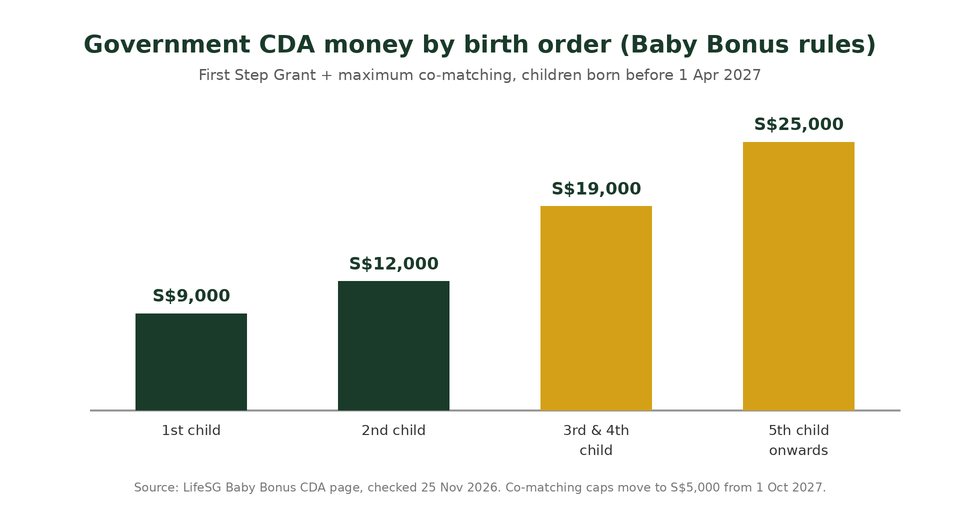
| 1st child | S$5,000 | S$4,000 | S$9,000 |
| 2nd child | S$5,000 | S$7,000 | S$12,000 |
| 3rd and 4th child | S$10,000** | S$9,000 | S$19,000 |
| 5th child onwards | S$10,000** | S$15,000 | S$25,000 |
Source: LifeSG Baby Bonus CDA page, checked 25 November 2026. Applies to Singapore citizen children born on or after 24 March 2016 (1 September 2016 for children of single unwed parents). **The S$10,000 First Step Grant applies to third and subsequent children born from 18 February 2025; it was S$5,000 before that.
The money can only be spent at approved institutions on approved uses: childcare and kindergarten fees, childminding, medical services and prescribed medicine, assistive technology devices, and special education or early intervention. It cannot be withdrawn as cash.
What changes in 2027 under the SG Child Support Package
The SG Child Support Package announced at the 2026 National Day Rally replaces the Baby Bonus Scheme. For children born on or after 1 April 2027, the CDA First Step Grant is S$5,000 and government co-matching has a uniform cap of S$5,000. For children born from 1 January 2015 to 31 March 2027, the existing co-matching caps stay until 30 September 2027, and all caps move to S$5,000 from 1 October 2027.
The practical point: if you have a second, third or later child, their current cap (S$7,000 to S$15,000) is higher than the new S$5,000. Saving up to the full cap by 30 September 2027 keeps the extra matching. A first child’s cap rises from S$4,000 to S$5,000, so there is no rush there. The package also extends the CDA for children born on or after 1 January 2015 until the end of the year they turn 16, after which unused money moves to the child’s Post-Secondary Education Account (PSEA), up to the PSEA cap.
CDA interest: POSB Smiley CDA
The CDA also earns interest. On the DBS deposit rates page, the POSB Smiley CDA pays 1.00% p.a. on the first S$10,000, 2.00% p.a. on the next S$40,000, and 0.05% p.a. above S$50,000. That is higher than most junior accounts, but remember the money is ring-fenced for approved spending, so it is not a replacement for a general savings account.
Junior Savings Accounts Reviewed
Once the CDA is set up, a junior account holds the ang bao money, birthday gifts and pocket-money savings that you want to keep flexible. Here is what each bank’s own page says.
POSB My Account (Kids)
The POSB My Account (Kids) is the simplest option. The child must be below 16 and the parent 18 or older. There is no initial deposit and no minimum balance, and POSB adds a S$1 gift deposit when you open the account. The DBS rates page lists My Account at 0.05% p.a. on all balances. The S$2 monthly paper-statement fee is waived while the holder is 16 or below. At 12 the child can apply for an ATM card, and at 16 a DBS Visa Debit card. This works best as a first account for young children whose parents already bank with DBS or POSB.
OCBC Mighty Savers
OCBC Mighty Savers is for children below 16, with a parent or guardian as joint holder, both living in Singapore. There is no initial deposit or minimum balance. OCBC advertises up to 0.30% p.a. on the whole balance, made up of base interest, a 0.05% p.a. bonus for any month in which you deposit at least S$50 and make no withdrawals, and an extra 0.20% p.a. if you hold an OCBC CDA (for up to two accounts). The bonus is credited on the first business day of the following month. It rewards a monthly saving habit, which makes it a good teaching tool even if the rate is modest.
UOB Junior Savers
The UOB Junior Savers Account is a joint account for children aged 16 and below. It needs a S$500 initial deposit, and a S$2 fee applies in any month the average balance falls below S$500. UOB’s page says interest is calculated daily but does not show the rate, so check with UOB before opening. Its distinctive feature is free insurance coverage of up to 100% of the account balance, based on the average daily balance. Choose it if you already bank with UOB and will keep at least S$500 in the account.
CIMB Junior Saver
The CIMB Junior Saver Account pays the highest rates among the junior accounts we checked. CIMB’s page lists 1.28% p.a. on the first S$25,000 (shown as two tiers of S$5,000 and S$20,000), 1.58% p.a. on the next S$25,000, and 0.50% p.a. above S$50,000, with no lock-in and no fall-below fee. The child must be 16 or below, and you need S$1,000 to open it. Interest is accrued daily and credited monthly. CIMB is also running a S$50 ActionCity voucher for online sign-ups that keep their balance for three months; read the terms on CIMB’s page first. One caution: CIMB’s page carries two different “accurate as at” dates, so confirm the rate before moving a large sum.
Standard Chartered e$aver Kids
Standard Chartered e$aver Kids is set up as a trust account: the parent (21 or older) is the trustee and the child (below 18) is the beneficiary. The key charges table shows S$0 for the initial deposit, minimum balance, fall-below fee and early closure fee. You do need a GIRO or standing instruction of at least S$50 a month from a bank account in the trustee’s name. The rate is not shown on the product page. Its longer age limit, up to 18, suits parents who want one account to last through secondary school.
Worked Example: What Your Child’s Savings Earn
To make the rates concrete, here is the yearly interest on three balances, assuming the balance stays constant for 12 months and using the standard rates above. OCBC is shown at its maximum, which needs the S$50 monthly deposit, no withdrawals and an OCBC CDA.
| Balance | POSB My Account (Kids) 0.05% | OCBC Mighty Savers max 0.30% | POSB Smiley CDA | CIMB Junior Saver |
|---|---|---|---|---|
| S$2,000 | S$1 | S$6 | S$20 | S$25.60 |
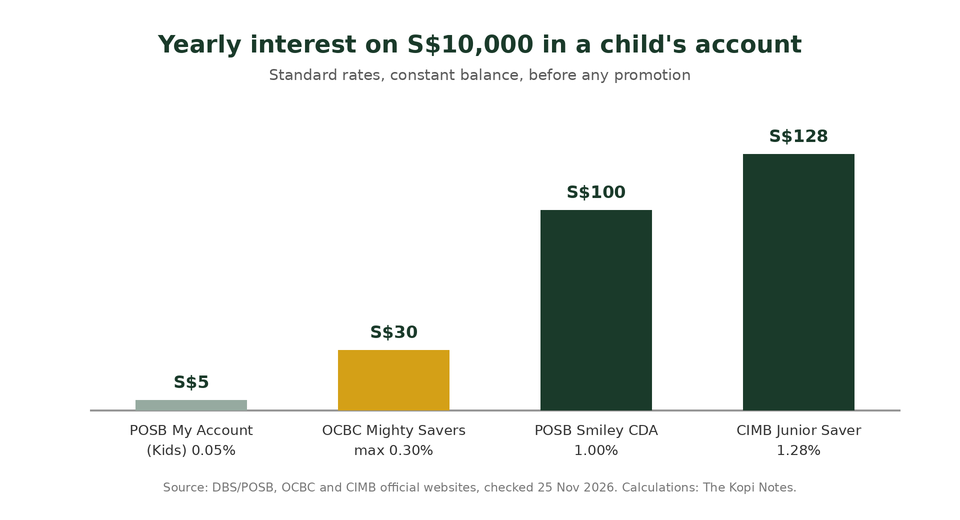
| S$10,000 | S$5 | S$30 | S$100 | S$128 |
| S$30,000 | S$15 | S$90 | S$500 | S$399 |
Source: calculations by The Kopi Notes using rates from DBS/POSB, OCBC and CIMB official pages, checked 25 November 2026. Simple interest, constant balance, no promotions.
On S$10,000, CIMB pays about S$128 a year against S$5 at POSB My Account (Kids). On S$30,000, the POSB Smiley CDA edges ahead (S$100 on the first S$10,000 plus S$400 on the next S$20,000), but only money you will spend on approved uses should sit in the CDA. For a typical family, a sensible split is: fill the CDA up to the co-matching cap, keep a few hundred dollars in a no-minimum account for the child to watch grow, and park larger gift money in the higher-paying junior account.
How to Choose a Child Savings Account
Four questions settle it for most parents.
1. Is the CDA maxed out? Government matching is a 100% instant return, which no bank account can match. If you have not saved up to your child’s cap, do that first.
2. How much will sit in the account? Under S$1,000, choose an account with no initial deposit and no fall-below fee, such as POSB My Account (Kids), OCBC Mighty Savers or SC e$aver Kids. Above S$1,000, CIMB Junior Saver’s rate starts to make a real difference.
3. Do you want to build a habit? OCBC’s no-withdrawal bonus and SC’s S$50 monthly instruction both nudge the family to save every month. That habit matters more than the rate when balances are small.
4. Where do you already bank? Transfers, joint access and card upgrades at 12 or 16 are easier when the child’s account sits with the parent’s main bank.
All of these are SGD deposits with SDIC scheme members, which are insured up to S$100,000 per depositor per bank. If you are also comparing accounts for yourself, see our guide to the best savings accounts in Singapore without salary credit, and our high yield savings account comparison for the adult bonus-interest accounts.
Beyond a Savings Account: Longer-Term Options
A savings account is the right home for money your child may need within a few years. For money meant for university fees 10 to 15 years away, a 0.05% to 1.58% savings rate is unlikely to keep pace with rising costs. Parents often look at three other routes, each with different risks.
The first is Singapore Savings Bonds, which are government-backed and can be redeemed in any month; our Singapore Savings Bonds guide explains how to apply. The second is a regular investment in a diversified fund, which we cover in our guide to building a child education fund in Singapore. The third is an endowment plan, which locks money in for a fixed term in exchange for a guaranteed portion; see our endowment plans for children review before committing, as early surrender usually loses money.
Whatever you pick, run the numbers on how much you will need. Our retirement planning calculator works just as well for estimating how a monthly sum grows over 15 years.
Frequently Asked Questions
What is the best child savings account in Singapore?
For Singapore citizen children, the Child Development Account comes first because the government adds a First Step Grant and matches your deposits. For flexible savings, CIMB Junior Saver paid the highest rate of the junior accounts we checked on 25 November 2026, at 1.28% p.a. on the first S$25,000 and 1.58% p.a. on the next S$25,000, with a S$1,000 initial deposit.
Which kids savings account has no minimum balance?
POSB My Account (Kids), OCBC Mighty Savers and Standard Chartered e$aver Kids all have no minimum balance and no fall-below fee. SC e$aver Kids needs a monthly GIRO or standing instruction of at least S$50.
How much does the government give in the CDA?
Under the Baby Bonus Scheme, a first child gets a S$5,000 First Step Grant plus up to S$4,000 of co-matching, a total of S$9,000. Second children can get S$12,000, third and fourth children S$19,000, and fifth and later children S$25,000. Third and later children born before 18 February 2025 received a S$5,000 grant rather than S$10,000.
What happens to the CDA in 2027?
Under the SG Child Support Package, children born on or after 1 April 2027 get a S$5,000 First Step Grant and a uniform S$5,000 co-matching cap. Existing children keep their current caps until 30 September 2027, and all caps become S$5,000 from 1 October 2027.
Can my child withdraw money from the CDA?
No. CDA money cannot be withdrawn as cash. It can only be used at approved institutions for things like childcare, kindergarten, medical bills and early intervention. Unused money is moved to the child’s Post-Secondary Education Account when the CDA closes.
At what age can a child open a bank account in Singapore?
Most junior accounts can be opened from birth as a joint account with a parent or guardian. The upper age limit is below 16 for POSB and OCBC, 16 and below for UOB and CIMB, and below 18 for Standard Chartered e$aver Kids.
Is money in a child's savings account protected?
Yes. SGD deposits in savings accounts with SDIC scheme member banks are insured up to S$100,000 in aggregate per depositor per scheme member, as stated on the POSB and CIMB product pages. Check that the bank is an SDIC scheme member before opening.
Disclaimer: This article is for general information only and is not financial advice. Rates and scheme details were read from each bank’s official website and LifeSG on 25 November 2026 and can change at any time. Calculations are illustrative, assume a constant balance and standard rates, and ignore compounding. Always confirm terms with the bank or the relevant agency. The Kopi Notes may earn referral fees from some links on this site. This article was researched and drafted with the help of AI tools and reviewed against primary sources.
Saving for the Whole Family?
Compare Singapore’s digital banks for your own savings, and plan the long game with our calculator.
This article was researched with the help of AI. While we strive to keep all information accurate and up to date, there may be errors. If you notice any discrepancies, please contact us.