Is There a Bank ETF in Singapore? Why the STI ETF Is Really a DBS, OCBC & UOB Bet (2026 Guide)
There is no standalone Singapore bank ETF — but the STI ETF puts you almost two-thirds into financials anyway. Here is the concentration data, and how to fix it.
Singapore has no dedicated “bank ETF.” Instead, most local investors get bank exposure through the STI ETF (ES3, G3B, GAB), which is 61.6% weighted to Financials as at 31 October 2026 — with DBS, OCBC and UOB alone making up 58.4% of the index. If you think you own a diversified 30-stock fund, you actually own a leveraged bet on three Singapore banks.
Not financial advice. All figures are for educational reference only. Data verified as at 23 November 2026 against the State Street SPDR STI ETF factsheet (31 Oct 2026) and FTSE Russell index data unless otherwise noted.
Table of Contents
Contents — Click to expand
- Why “Bank ETF Singapore” Searches Don’t Find a Bank ETF
- How Concentrated Is the STI ETF, Really?
- STI ETF Sector Breakdown (2026 Data)
- Why the STI Ends Up This Bank-Heavy
- Is Bank Concentration a Problem for You?
- How to Diversify Away From the Banks
- Who Should Still Buy the STI ETF?
- Frequently Asked Questions
Why “Bank ETF Singapore” Searches Don’t Find a Bank ETF
If you search for a “Singapore bank ETF,” you won’t find one. Unlike the US, where sector-specific funds such as the Financial Select Sector SPDR (XLF) or SPDR S&P Bank ETF (KBE) exist precisely so investors can isolate banking-sector exposure, SGX has no single-sector ETF for financials. The closest Singapore-listed products that give you heavy bank exposure are the three STI ETFs — SPDR Straits Times Index ETF (ES3), Nikko AM Singapore STI ETF (G3B) and Amova Singapore STI ETF (GAB) — which all track the same 30-stock Straits Times Index (STI).
These funds are marketed and generally understood as broad-market, diversified Singapore equity ETFs. In practice, because DBS, OCBC and UOB are by far the largest companies on the Singapore Exchange by market capitalisation, the STI’s free-float-weighted methodology pushes an outsized share of the fund into those three names. A Singapore investor buying “the STI ETF for diversification” is, whether they realise it or not, buying a concentrated bank fund with a tail of 27 other stocks attached.
How Concentrated Is the STI ETF, Really?
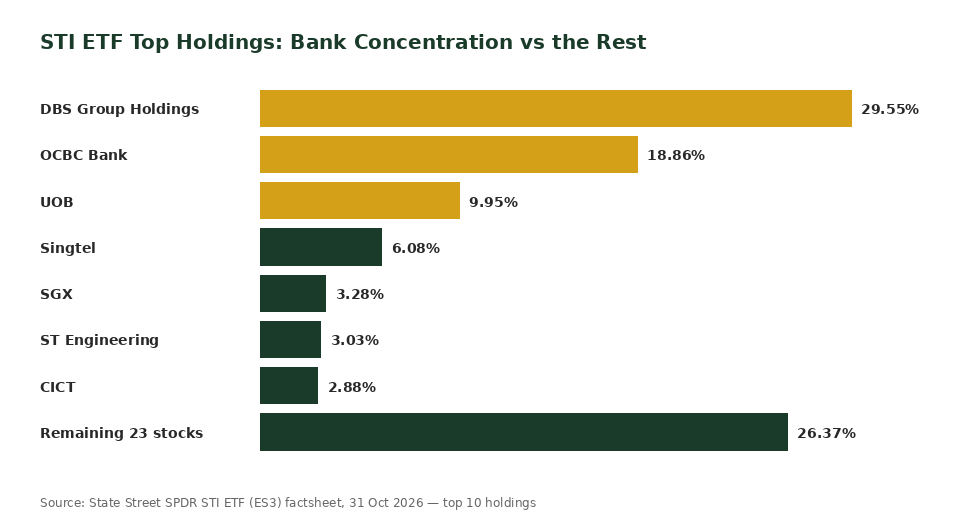
| Holding | Weight in STI (31 Oct 2026) |
|---|---|
| DBS Group Holdings | 29.55% |
| Oversea-Chinese Banking Corp (OCBC) | 18.86% |
| United Overseas Bank (UOB) | 9.95% |
| Three banks combined | 58.36% |
| Singapore Exchange (SGX) added | 61.64% |
Source: State Street SPDR STI ETF (ES3) factsheet, 31 October 2026.
At 29.55%, DBS alone is roughly nine times the 3.3% weight it would hold if the STI’s 30 stocks were equally weighted. Including SGX — itself a financial exchange operator whose earnings are tied to local trading activity — four financial-sector names account for close to two-thirds of the index. These weights move with share prices, so check the issuer’s latest factsheet before investing; the three-bank total has been reported as high as roughly 59% by other data providers using slightly different snapshot dates.
STI ETF Sector Breakdown (2026 Data)
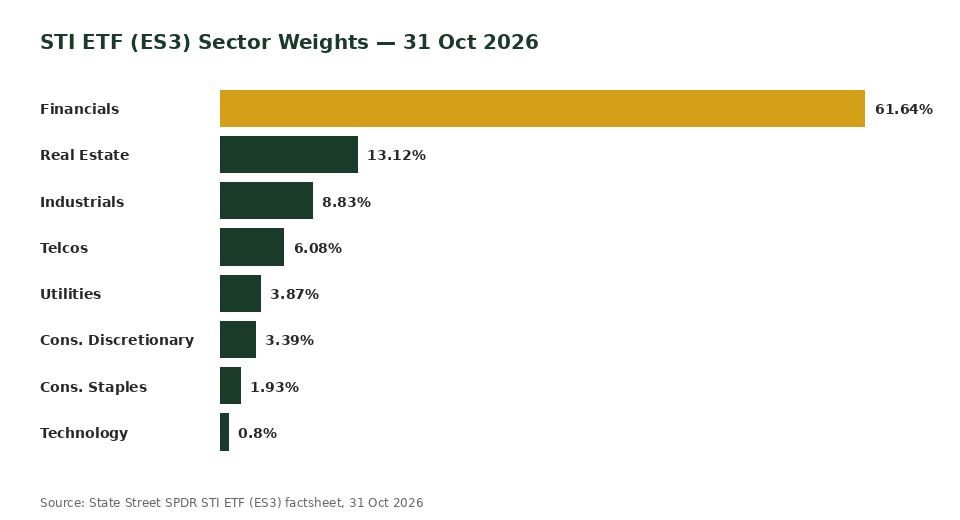
| Sector | Weight |
|---|---|
| Financials | 61.64% |
| Real Estate (S-REITs) | 13.12% |
| Industrials | 8.83% |
| Telecommunications | 6.08% |
| Utilities | 3.87% |
| Consumer Discretionary | 3.39% |
| Consumer Staples | 1.93% |
| Technology | 0.80% |
Source: State Street SPDR STI ETF (ES3) factsheet, 31 October 2026. Sector allocations exclude futures; cash is included in total portfolio value so allocations may not sum to 100%.
For context, the STI ETF’s technology weight of under 1% compares with roughly a third of the S&P 500 (as tracked by CSPX) and a meaningful double-digit slice of global ETFs like VWRA. If you hold the STI ETF for your Singapore “core” allocation, your Singapore REIT ETF guide exposure and your banking exposure are both already represented inside the same fund — worth remembering before you also buy a separate S-REIT ETF on top.
Why the STI Ends Up This Bank-Heavy
The STI uses FTSE’s free-float market-capitalisation weighting methodology: each of the 30 constituent stocks is weighted by the value of its shares that are actually available for public trading, not by company size alone or by sector. DBS, OCBC and UOB are Singapore’s three largest listed companies, with free floats in the tens of billions of SGD, far exceeding most of the other 27 constituents such as industrials, telcos and REITs. The index does not cap any single stock or sector, so as bank share prices rise — as they broadly have through 2025–2026 on the back of higher net interest margins and strong capital return programmes — their index weight compounds further.
This is structurally different from the S&P 500, which is also free-float weighted but spreads across 500 companies and 11 GICS sectors, capping the influence any single stock can realistically have. With only 30 constituents, the STI has nowhere near the same natural diversification ceiling.
Is Bank Concentration a Problem for You?
Whether 58% bank exposure is a problem depends on what you already hold and what you believe about Singapore banks specifically. For a Singapore resident, three additional factors are worth weighing:
- Correlation with your own income. If you work in banking, finance, or a Singapore-dependent sector, your salary and your largest equity holding move together — a downturn hits both at once.
- Correlation with your property. DBS, OCBC and UOB earnings are tied to Singapore mortgage lending and property-related fee income, which also drives your HDB or condo’s value. STI concentration can quietly double up on a property-heavy balance sheet.
- Interest rate sensitivity. Bank net interest margins expand when rates are high and compress when rates fall, so a rate-cut cycle can weigh on close to two-thirds of your STI ETF at the same time, even while other sectors are unaffected.
None of this means the STI ETF is a bad holding — Singapore banks have strong capital ratios, consistent dividend policies and sit under MAS supervision. It means the fund is doing a different job than “diversified Singapore equities” might suggest.
How to Diversify Away From the Banks
If you want genuine diversification rather than a concentrated bank-and-telco fund, three practical options:
- Pair the STI ETF with a global ETF. Adding a globally diversified ETF bought on the London Stock Exchange, such as a world or S&P 500 tracker, dilutes the bank weight at the total-portfolio level without needing to sell your STI holding.
- Size the STI ETF as a satellite, not the core. Many Singapore investors use a core-satellite structure where a global ETF forms 70–80% of equities and the STI ETF is a smaller, deliberate Singapore tilt — rather than the default “home bias” holding.
- Underweight if you already hold bank shares directly. If you separately hold DBS, OCBC or UOB shares (or a CPFIS or SRS unit trust weighted toward them), your effective bank exposure is higher than your STI ETF allocation alone suggests — account for this when sizing positions via the CPF investment strategy framework.
| Fund | Top Sector Weight | Holdings | TER | Best For |
|---|---|---|---|---|
| STI ETF (ES3) | Financials 61.6% | 30 | 0.28% | Deliberate Singapore/bank tilt |
| CSPX (S&P 500) | Technology ~32% | ~500 | 0.07% | Diluting bank concentration globally |
| VWRA (FTSE All-World) | Technology ~24% | ~3,600 | 0.14% | Maximum diversification, one fund |
Source: Issuer factsheets, 2026. Sector weights are approximate and change over time — verify against the current factsheet before investing.
Who Should Still Buy the STI ETF?
The STI ETF still makes sense if you deliberately want Singapore bank and REIT exposure — for example, as part of a dividend-income strategy, since DBS, OCBC and UOB together pay some of the most consistent dividends on SGX, or if you are using it for passive income Singapore purposes alongside S-REITs. It is also CPFIS-OA eligible, which many global ETFs are not, making it one of the few genuinely low-cost, broad-exposure options inside your CPF Ordinary Account.
Consider pairing it with a globally diversified fund, through Syfe or FSMOne, if your goal is a retirement portfolio rather than a specific bet on Singapore financials — use the Singapore retirement calculator to see how different equity splits affect your retirement number.
Frequently Asked Questions
Is there a dedicated bank ETF listed in Singapore?
No. SGX does not list a single-sector financials or bank ETF the way US exchanges list funds like XLF or KBE. Singapore investors who want bank exposure typically buy DBS, OCBC or UOB shares directly, or get indirect exposure through the STI ETF, which is 61.64% weighted to financials as at 31 October 2026.
How much of the STI ETF is actually DBS, OCBC and UOB?
As at the 31 October 2026 factsheet, DBS Group Holdings is 29.55%, OCBC is 18.86% and UOB is 9.95% of the Straits Times Index, for a combined 58.36%. Adding Singapore Exchange (SGX) brings financial-sector-adjacent weight to roughly 61.6%. These figures shift with share prices, so always check the latest factsheet.
Is STI ETF bank concentration a bad thing?
Not necessarily. It simply means the STI ETF behaves more like a Singapore bank-and-REIT fund than a broadly diversified equity fund. It can be a deliberate, reasonable choice for dividend income or CPFIS-OA investing, but it should not be your only equity holding if you want genuine sector diversification.
Can I buy a bank ETF using my CPF or SRS funds?
There is no standalone bank ETF to buy, but the STI ETF (ES3) is CPFIS-OA approved, so you can buy it using your CPF Ordinary Account savings. SRS funds can be used to buy the STI ETF or globally diversified LSE-listed ETFs through brokers that support SRS trading, such as FSMOne.
How do I check the STI ETF's current bank weighting myself?
Download the latest monthly factsheet from the issuer’s website — State Street for ES3, Nikko AM for G3B, or Amova for GAB — and look at the “Top 10 Holdings” and “Top Sectors” tables. These are updated monthly and are the most reliable primary source, since third-party sites sometimes lag by weeks.
What is the alternative to a Singapore bank ETF if I want sector exposure?
Since SGX has no standalone financials ETF, investors wanting pure bank-sector exposure without the rest of the STI typically buy DBS, OCBC and UOB shares directly in the proportions they want, rather than relying on an index fund to do it for them.
Build a Portfolio That Isn’t Secretly All Banks
Pair your STI ETF with globally diversified funds, or let a robo-advisor handle the balance for you.
This article was researched with the help of AI. While we strive to keep all information accurate and up to date, there may be errors. If you notice any discrepancies, please contact us.