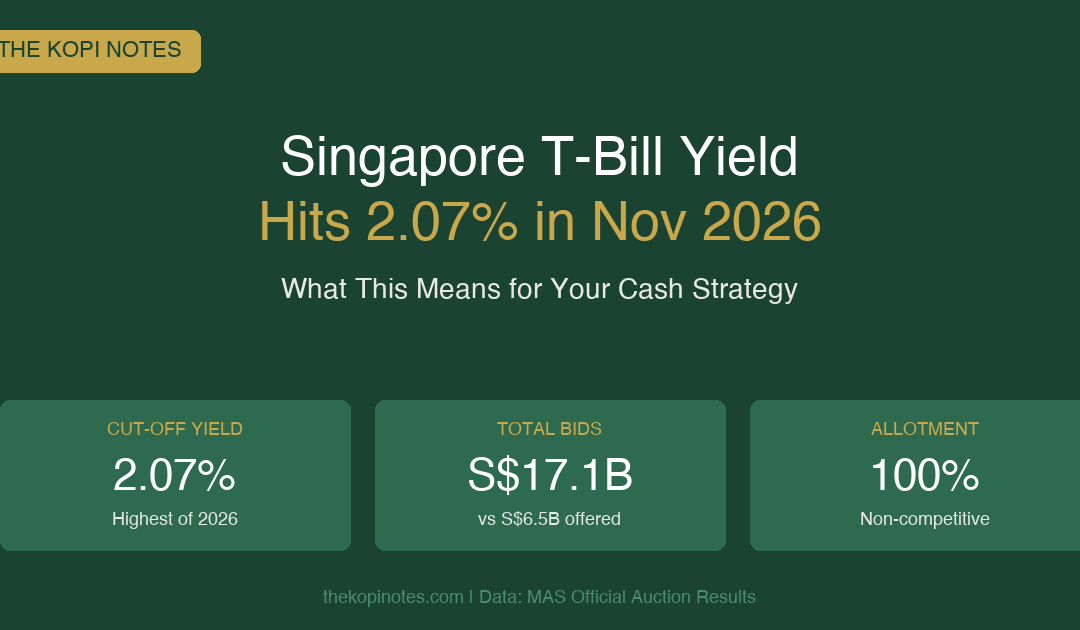
Singapore’s latest 6-month T-bill auction on 19 November 2026 delivered a cut-off yield of 2.07% — a 21-basis-point jump from the previous auction’s 1.86%, marking the highest T-bill yield of 2026 so far. With S$17.1 billion in total applications chasing S$6.5 billion on offer and a bid-to-cover ratio of 1.99x, demand was robust. Here is what this means for your cash strategy heading into year-end.
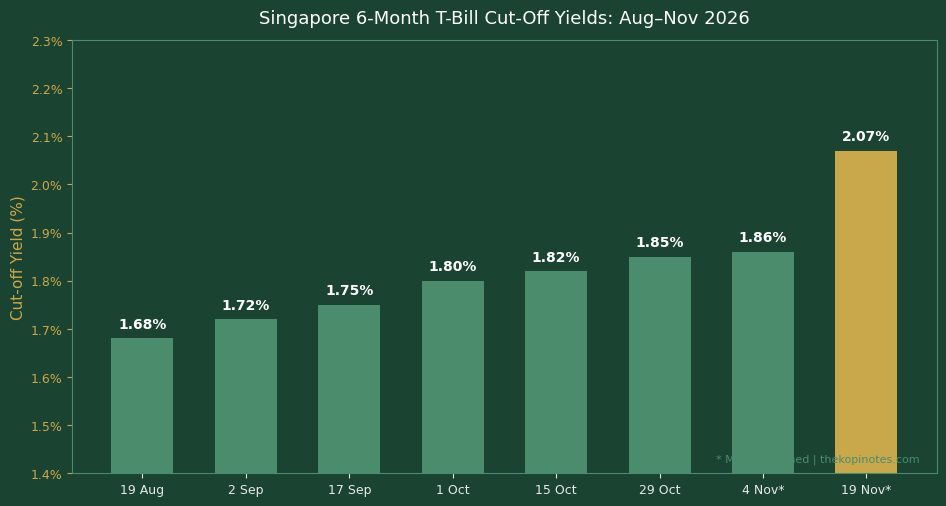
Singapore 6-Month T-Bill Cut-Off Yields: Steady climb to 2.07% in Nov 2026
What Happened at the 19 November T-Bill Auction
The Monetary Authority of Singapore (MAS) issued S$6.5 billion in 6-month Treasury bills (issue code BS26123A) on 19 November 2026 with a maturity date of 24 November 2026 for the settlement and 23 May 2027 for maturity. The cut-off yield came in at 2.07%, and the cut-off price was S$98.97 per S$100 face value. Non-competitive applications received a 100% allotment, meaning those who applied for T-bills without specifying a yield got everything they asked for.
Total applications reached S$17.1 billion — nearly double the S$6.5 billion on offer — producing a bid-to-cover ratio of 1.99x. That level of oversubscription signals that investors view T-bills as an attractive safe-harbour for cash, especially with global rate uncertainties still lingering into the year-end.
Why Did Yields Jump 21 Basis Points?
The 2.07% result is a significant step up from recent auctions, which had been trending in the 1.68–1.86% range throughout 2026. Several factors drove this shift:
- End-of-year liquidity positioning: Institutions and retail investors alike tend to park short-term cash before December, boosting demand and pushing yields up.
- Expectation of a holding pattern on rates: With the US Federal Reserve signalling a more cautious approach to cuts, Singapore’s domestic rates have adjusted upward in sympathy.
- Strong competition from bank deposits tightening: Some of Singapore’s highest-yield savings accounts have trimmed their promotional rates, making T-bills relatively more attractive.
How Does 2.07% Compare to Other Options?
For Singapore retail investors with idle cash, here is how the 19 November T-bill stacks up against common alternatives as of late November 2026:
| Instrument | Rate / Yield | Notes |
|---|---|---|
| High-Yield Savings Account | Up to 1.80% | Promotional; conditions apply |
| SSB Dec 2026 (Year 1) | 1.83% | Flexible redemption; S$200K cap |
| 6-Month T-bill (Nov 19) | 2.07% | MAS confirmed; 100% non-comp. allotment |
| Fixed Deposit (BOC, min S$200K) | 2.30% | High minimum; limited accessibility |
| SSB Dec 2026 (10-yr avg) | 2.39% | Requires 10-year hold for full benefit |
| CPF-OA (Guaranteed) | 2.50% | Locked in CPF; conditions apply |
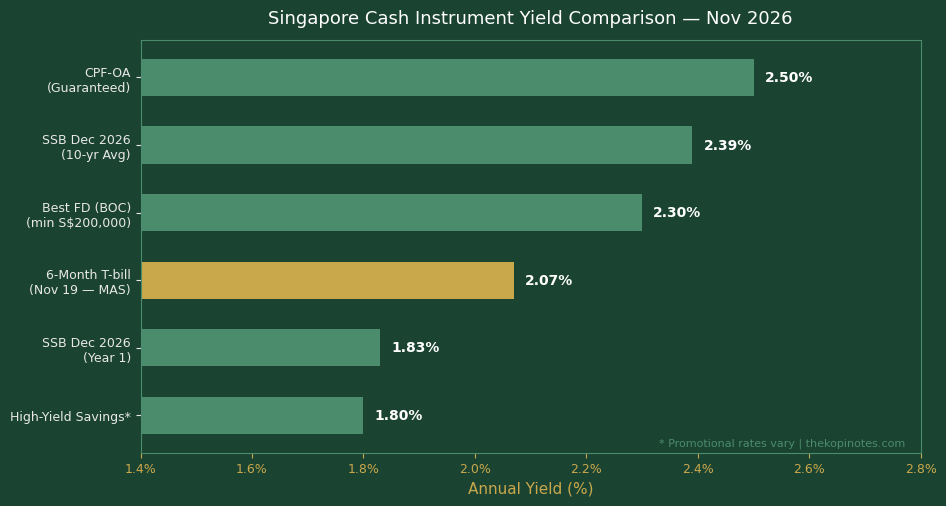
Singapore Cash Instrument Yield Comparison — Nov 2026 (Higher is better)
The T-bill comes out ahead of High-Yield Savings Accounts and SSB Year 1 rates, without the complexity of BOC’s high minimum deposits. If you have S$10,000–S$200,000 to park for six months and are not chasing CPF-OA’s locked-in return, the T-bill at 2.07% is worth serious consideration.
Should You Apply for the Next T-Bill?
The next 6-month T-bill auction is likely scheduled for early December 2026. Based on the current trajectory, yields could remain elevated or edge slightly higher if demand stays strong and global rate signals remain hawkish. Here are the key considerations:
- Apply if: You have idle cash sitting in a regular savings account earning under 1.5%. Even after CPF OA considerations, 2.07% on a 6-month instrument is competitive for low-risk capital.
- Consider SSB instead if: You want flexibility to redeem early without penalty. Singapore Savings Bonds allow full redemption any month with the interest accrued to that point.
- Consider fixed deposits instead if: You have S$200,000 or more and can lock it in for a specific tenure — BOC’s 2.30% beats the T-bill at that tier.
How to Apply for Singapore T-Bills
Retail investors can apply for T-bills through the following channels:
- DBS/POSB, OCBC, or UOB internet banking — Look for “Singapore Government Securities” or “T-bills” in the investment/savings tab.
- SCB, Citibank (Axos), or Maybank — Specific steps vary; use the bank’s official guide.
- CPF Investment Scheme (CPFIS) — Available for OA funds, though the 2.5% floor rate makes this less compelling unless the T-bill yield consistently beats it.
- SRS (Supplementary Retirement Scheme) — Eligible for SRS funds held at DBS, OCBC, or UOB.
Applications typically open two to three weeks before the auction date and close a few days before the auction. The upcoming December auction date will be posted on the MAS website.
Bottom Line
At 2.07%, the November 2026 T-bill is a compelling parking spot for short-term cash — the best yield of 2026 on this instrument. If you have idle funds and can lock them up for six months, the T-bill beats most savings accounts and SSB year-one rates with zero credit risk (backed by the Singapore government). Watch the December auction closely; if yields hold at this level or improve, it could be one of the best cash-management moves for the year-end.
Frequently Asked Questions
What is the cut-off yield for the 19 November 2026 T-bill?
The cut-off yield for the 6-month T-bill (BS26123A) auctioned on 19 November 2026 is 2.07%. This is the highest T-bill cut-off yield of 2026.
Did non-competitive applicants receive full allotment?
Yes. Non-competitive applications received 100% allotment at the 19 November 2026 T-bill auction. This means retail investors who applied without specifying a yield target received their full requested amount.
What was the total demand at the November 2026 T-bill auction?
Total applications were S$17.1 billion against S$6.5 billion on offer, producing a bid-to-cover ratio of 1.99x — indicating nearly double the demand relative to supply.
How does the 2.07% T-bill yield compare to Singapore Savings Bonds?
The SSB December 2026 Year-1 rate is 1.83%, which is below the 2.07% T-bill yield. However, SSBs offer flexibility to redeem early any month, while T-bills lock your funds until maturity (approximately 6 months).
Can I use CPF-OA money to invest in T-bills?
Yes, CPF-OA funds can be used to invest in Singapore Government Securities including T-bills through the CPF Investment Scheme (CPFIS). However, since CPF-OA already guarantees 2.5%, a T-bill at 2.07% would actually yield less than leaving your CPF-OA funds as-is. Consider this carefully before moving CPF funds.
Is there SDIC protection on T-bills?
T-bills are direct obligations of the Singapore Government and do not require SDIC (Singapore Deposit Insurance Corporation) coverage. They carry sovereign credit risk, which is considered the lowest risk available in Singapore. SDIC covers bank deposits up to S$100,000 per depositor per bank.
When is the next 6-month T-bill auction?
The next 6-month T-bill auction is expected in early December 2026. Check the MAS Auctions & Issuance Calendar for the exact date and to track upcoming T-bill auctions.
How do I apply for T-bills in Singapore?
You can apply via DBS/POSB, OCBC, or UOB internet banking under the Singapore Government Securities section. Applications typically open 2–3 weeks before the auction date. You need a CDP (Central Depository) account linked to your bank account.
Are T-bill yields expected to stay at 2% in December 2026?
While we cannot predict future yields, the strong demand and elevated global rate environment suggest yields could remain at or near the 2% level. Watch the MAS auction results page and monitor global central bank signals for indicators.
Disclaimer: This article is for informational and educational purposes only and does not constitute financial advice. T-bill yields fluctuate with each auction; past yields are not indicative of future results. Please consult a licensed financial adviser before making investment decisions. All yield data sourced from official MAS auction results.
This article was researched with the help of AI. While we strive to keep all information accurate and up to date, there may be errors. If you notice any discrepancies, please contact us.