Endowment Plan vs Singapore Savings Bonds 2026: Which Wins for Your 3–5 Year Goals?
Both endowment plans and Singapore Savings Bonds (SSBs) offer capital-safe, risk-free returns in Singapore — but they serve very different goals. SSBs give you full flexibility to redeem anytime at no penalty, while endowment plans deliver higher guaranteed IRRs (up to 3.5% for 10-year tenors) in exchange for locking up your capital. If flexibility matters, SSBs win. If you can commit for 5+ years, the right endowment plan beats SSB returns. Here’s the full side-by-side.
Not financial advice. All figures are for educational reference only. Data verified as at November 2026 unless noted.
Quick Comparison: Endowment Plan vs SSB at a Glance
| Feature | Endowment Plan | Singapore Savings Bonds |
|---|---|---|
| Issuer / Backing | Life insurer (SDIC up to S$100K) | Singapore Government (AAA) |
| Typical Returns | 2.2–3.5% guaranteed IRR (5–10yr) | ~2.70% avg (10yr step-up) |
| Flexibility | Low — surrender penalties apply | High — redeem any month, no penalty |
| Capital Protection | 100% at maturity (guaranteed sum) | 100% anytime (face value) |
| Maximum Investment | No limit (varies by insurer) | S$200,000 per person |
| Income Tax on Returns | Tax-free (IRAS) | Tax-free (IRAS) |
| Death Benefit | Yes (insurance component) | No |
| Best For | Committed 5–10 year goals | Flexible 1–10 year savings |
Source: MAS SSB programme, representative endowment product illustrations, Nov 2026
Table of Contents
Jump to Section
What Are Endowment Plans and SSBs?
Singapore Savings Bonds (SSB)
SSBs are issued monthly by the Singapore Government and backed by the full faith and credit of the AAA-rated Singapore state. Each bond has a 10-year tenure with interest that steps up annually (the longer you hold, the higher the blended yield), but you can redeem any amount at face value with one month’s notice at no penalty. The maximum outstanding balance per person is S$200,000, and you can apply through DBS/POSB, OCBC, or UOB ATMs or internet banking using your SRS or cash savings.
Endowment Plans
Endowment plans are life insurance policies that combine a savings element with a death benefit. You pay premiums (single or regular) over a fixed term — typically 5 to 25 years — and receive a guaranteed maturity sum plus non-guaranteed bonuses (for par plans) at the end. The guaranteed IRR for 5-year plans typically runs from 2.5% to 3.0%, while 10-year plans can deliver 3.2% to 3.5% guaranteed. Crucially, early surrender attracts a surrender penalty, and you may receive less than what you paid in if you exit in the first 2–3 years. Major Singapore insurers offering endowment plans include AIA, Manulife, Prudential, Great Eastern, Singlife, Income Insurance, and NTUC Income.
Returns Comparison: Who Wins on Yield?
The chart below compares representative guaranteed IRRs for endowment plans against the Singapore Savings Bond 10-year average yield across matching tenors.
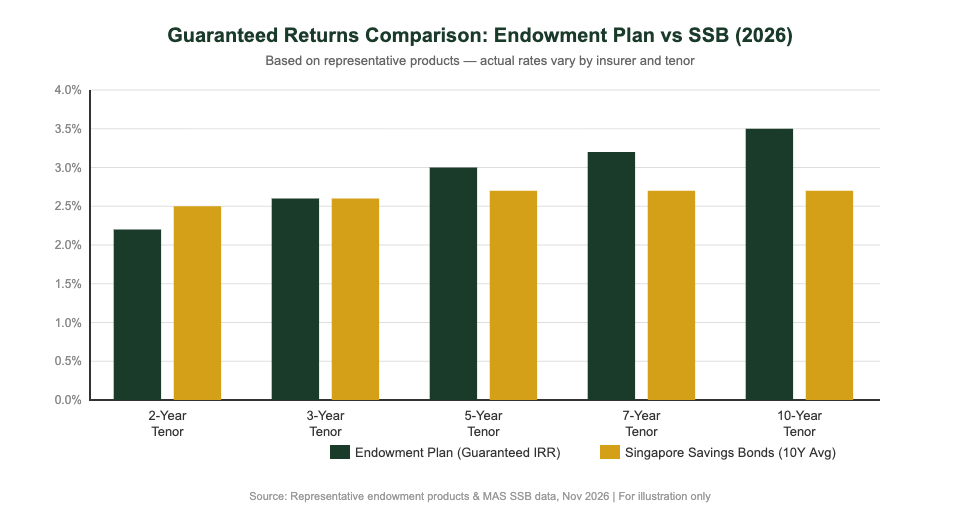
Source: Representative endowment product illustrations & MAS SSB programme data, Nov 2026 | For illustration only — actual rates vary
Key takeaway: For short tenors (2–3 years), SSBs are broadly competitive with or slightly ahead of endowment plans. Beyond 5 years, committed endowment savers pull ahead — a 10-year endowment from a major insurer can deliver a guaranteed IRR of 3.5%, versus the SSB’s approximate 2.70% 10-year step-up average. That difference compounds meaningfully:
| S$50,000 invested for 10 years | Endowment (3.5% IRR) | SSB (2.70% avg) |
|---|---|---|
| Maturity value (guaranteed) | S$70,560 | S$65,370 |
| Total gain | S$20,560 | S$15,370 |
| Difference (endowment advantage) | S$5,190 more from endowment plan | |
Illustrative only. Endowment IRR and SSB step-up yields vary by product and tranche. Non-guaranteed bonuses on par endowment plans could add further returns.
However, this comparison only holds if you hold the endowment plan to maturity. Early surrender flips the equation entirely — which brings us to the most important difference.
Flexibility: Redeem Anytime or Locked In?
This is where SSBs win decisively. The chart below shows how much of your capital you can recover if you need to exit early, comparing the SSB redemption guarantee against a typical endowment plan surrender schedule.
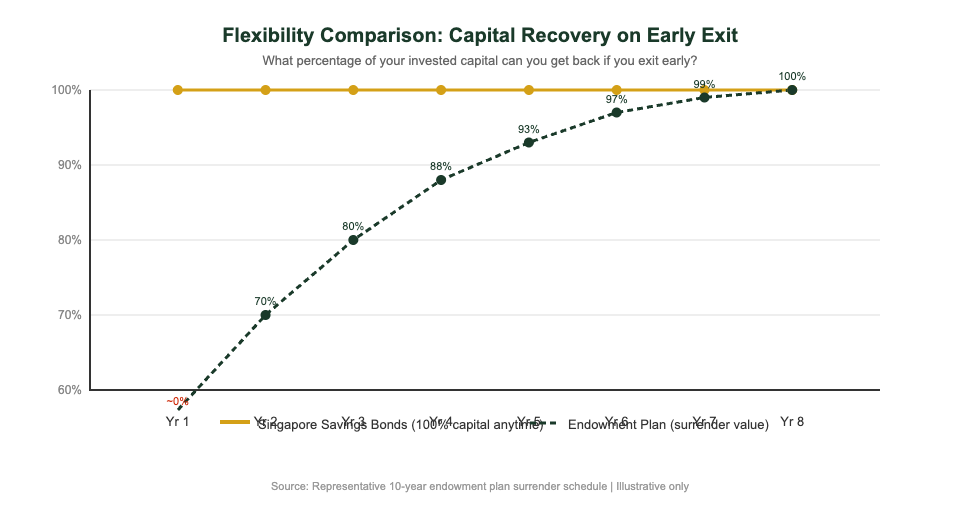
Source: Representative 10-year endowment plan surrender schedule | Illustrative only — actual surrender values vary significantly by product
With an SSB, you always get 100% of your principal back — there is no surrender charge, no exit fee, no loss of interest already earned. With an endowment plan, surrendering in Year 1 or early Year 2 means you recover little or nothing of your premiums. Most 10-year plans only break even on surrender value around Year 7–8.
Practical implications for Singapore savers:
- Wedding fund or BTO deposit? If your timeline is uncertain — you’re not sure exactly when you’ll need the money — SSB is safer. An unexpected change in plans won’t cost you principal.
- Fixed retirement target at age 65? If you have a known, committed time horizon, an endowment plan’s higher guaranteed IRR compounds more favourably.
- Emergency reserve? Never use an endowment plan for emergency savings. Use SSBs (or Singapore T-bills for 6-month liquidity) instead.
One important nuance: some insurers now offer endowment plans with premium holiday provisions or partial withdrawal features after a holding period. These features reduce the flexibility gap but don’t eliminate it entirely. See our guide on endowment plan premium holidays for details.
Capital Safety: SDIC vs Singapore Government Backing
Both instruments are very safe, but their protection mechanisms differ.
| Protection | Endowment Plan | Singapore Savings Bond |
|---|---|---|
| Backstop | SDIC (Singapore Deposit Insurance Corporation) | Singapore Government (Ministry of Finance) |
| Coverage limit | S$100,000 per life insured per insurer | No limit (full government guarantee) |
| Credit risk | Insurer solvency risk (mitigated by MAS regulation) | Near-zero (AAA sovereign) |
| Applicable for amounts above limit | No additional cover (spread across insurers) | 100% covered regardless of size |
Source: SDIC Singapore, MAS SSB programme terms, Nov 2026
For most retail investors with under S$100,000 in a single endowment plan from a MAS-licensed insurer, both instruments are effectively equivalent in safety terms. If you’re investing more than S$100,000 in endowment plans, consider spreading across two or more insurers to stay within the SDIC limit per insurer. With SSBs, the S$200,000 per-person cap is the only practical constraint — there’s no coverage ceiling.
For a full breakdown of SDIC protection on endowment plans, see our detailed endowment plan SDIC protection guide.
Tax Treatment and Estate Planning
Both instruments are entirely tax-free in Singapore. IRAS does not tax:
- SSB interest payments received
- Endowment plan maturity proceeds (guaranteed sum + bonuses)
- Endowment plan surrender payouts
Singapore does not impose capital gains tax, inheritance tax, or estate duty (abolished in 2008), so the full maturity proceeds from either instrument pass to your estate or beneficiaries untaxed.
Estate Planning Edge: Endowment Wins Here
Endowment plans have a meaningful estate planning advantage: you can nominate a beneficiary under Section 49M (revocable) or Section 73 (irrevocable trust) of the Insurance Act. Death proceeds paid to a nominated beneficiary bypass the estate entirely — no probate, no delay, and in an S.73 trust, the proceeds are also protected from creditors of the life assured. SSBs do not offer this nomination mechanism; proceeds form part of the estate and are subject to the standard CPF/estate distribution process.
For Singapore couples building a joint legacy plan or for parents earmarking wealth for children, the nomination feature makes endowment plans distinctly more useful than SSBs from an estate planning perspective. See our endowment plan tax treatment guide for a full breakdown of the IRAS rules.
Best Use Cases for Each
Choose SSBs When:
- Your timeline is uncertain. You might need the money in 2 years, or 7 — you don’t know. SSBs let you decide later.
- You’re building an emergency reserve. SSBs are the highest-yielding, fully-liquid savings vehicle the Singapore government offers. They beat fixed deposits and standard savings accounts at equivalent risk.
- You’re close to your savings goal. Within 2–3 years of a major spending event (wedding, BTO completion, overseas education), SSBs protect your capital without penalty risk.
- You want to invest above S$200,000. SSBs cap at S$200K per person; for larger amounts, consider spreading into endowment plans or other fixed income.
- You’re in the SRS accumulation phase. SSBs are eligible SRS investments and offer full flexibility with tax-deferred returns. For a comparison of SRS options, use our Singapore retirement calculator.
Choose Endowment Plans When:
- You can commit for 5–10 years. The higher guaranteed IRR only pays off if you hold to maturity. If you’re confident in your timeline, endowment beats SSB on yield.
- You want estate planning features. The Section 73 trust nomination gives endowment plans a unique wealth transfer advantage SSBs cannot match.
- You need a death benefit alongside savings. Endowment plans provide life insurance coverage during the savings period — SSBs do not.
- You want to invest more than S$200,000 in safe savings. Spread across multiple insurers (staying within SDIC limits per insurer) to hold large capital safely.
- You’re using SRS for retirement. Endowment plans bought with SRS funds benefit from both the tax deduction at contribution and tax-free proceeds at maturity. For the full CPF and SRS angle, see our guide on CPFIS vs endowment plans.
Can You Use Both? The Dual Strategy
Many Singapore savers don’t have to choose — they use SSBs and endowment plans as a two-rung ladder. Here’s how it works for a saver aged 35 with S$150,000 in spare savings:
| Bucket | Instrument | Amount | Purpose |
|---|---|---|---|
| Liquid reserve (1–3yr) | Singapore Savings Bonds | S$50,000 | Emergency fund, flexible short-term goals |
| Medium-term locked (5–10yr) | Endowment Plan (SRS or cash) | S$100,000 | Retirement supplement, children’s education |
Illustrative allocation — not personalised advice. Adjust based on your own cash flow and risk profile.
This two-rung approach gives you the best of both instruments: SSBs provide a liquid buffer so you never need to surrender the endowment plan early, while the endowment plan compounds at a higher guaranteed rate on capital you don’t need for 5+ years. For more on how to structure this within your overall retirement plan, try our Singapore retirement planning calculator.
For Singapore investors looking for even higher long-term growth potential alongside these safe instruments, our guide on passive income strategies in Singapore 2026 covers how S-REITs and dividend ETFs fit into the broader portfolio picture.
Frequently Asked Questions
Is SSB better than an endowment plan in 2026?
Can I invest in both an endowment plan and SSB at the same time?
What happens if I need to surrender my endowment plan early?
Are SSBs covered by SDIC?
Can I use my SRS account to buy both SSBs and endowment plans?
What is the SSB interest rate in 2026?
Final Verdict: SSB vs Endowment Plan
If you value flexibility above all else, Singapore Savings Bonds are the clear winner — full capital redemption anytime, government-backed, and competitive short-term yields. If you can commit for 5–10 years and want higher guaranteed compounding plus estate planning benefits, endowment plans outperform SSBs on returns and add features SSBs simply don’t offer. The optimal approach for most Singapore savers is to use SSBs as your liquid safety net and endowment plans for committed medium-term goals — running both in parallel rather than treating it as an either/or choice.
Want to explore your endowment plan options? Talk to a MAS-licensed financial adviser, or use the resources on TKN to compare products. If you’re considering Endowus (use code 2V343) or Syfe (use code SRPRFFFCD) for managed fixed-income alternatives, both platforms offer access to bond funds and cash management products that complement an SSB + endowment laddering strategy.
Get Free Insurance Advice
Speak with a licensed insurance advisor. No obligation, no cost.
By submitting this form, you agree to our Privacy Policy.
This article was researched with the help of AI. While we strive to keep all information accurate and up to date, there may be errors. If you notice any discrepancies, please contact us.