Term Life Insurance for Singles Singapore 2026: Do You Actually Need It?
Everything about coverage as a single — DPS limits, the 9× income rule, and why waiting costs more than you think.
As a single person in Singapore, you may assume term life insurance is only for those with a spouse or young children. That assumption is worth questioning. The Dependants’ Protection Scheme (DPS) covers only S$70,000 — well below the LIA benchmark of 9x annual income for most earners — and ends at age 65. If you have elderly parents who rely on you, an HDB mortgage, or outstanding debts, the financial gap you would leave behind matters more than your marital status.
Not financial advice. All figures are for educational reference only. Data verified as at November 2026 unless noted.
When Skipping Coverage Makes Sense
Not every single person needs life insurance. If you have no dependants, no outstanding debts, and significant liquid savings that would cover your final expenses, you may genuinely be able to skip it — or at least delay. The key question is: who would bear a financial burden if you were gone? If the honest answer is “nobody”, coverage is optional. But very few Singaporeans fall into that category for long.
Singapore’s high property prices, the culture of supporting elderly parents, and the prevalence of HDB mortgages mean most singles have at least one meaningful financial dependency by their early 30s. For a full overview of insurance types, see the Singapore life insurance guide.
5 Reasons Singles Should Consider Term Life Insurance
1. Elderly Parents as Financial Dependants
If you are the primary financial support for one or both parents, your death creates an immediate income shock. The Maintenance of Parents Act gives this real legal weight in Singapore. CPF nominations allow you to direct savings to parents, but processing takes time and CPF balances may not cover long-term elder care costs. A term life policy with parents named as beneficiaries fills this gap cleanly and cost-effectively.
2. Outstanding Debts (HDB, Personal Loans, Guarantor Obligations)
HDB flat ownership is common among singles aged 35 and above. An outstanding housing loan does not disappear upon death — it becomes an estate liability settled before assets are distributed. Without coverage, your parents or siblings may inherit the debt burden. The Mortgage Reducing Term Assurance (MRTA) covers only the loan; a standalone term policy offers flexibility to allocate the payout across multiple needs.
3. Lock In Cheaper Premiums While Young and Healthy
Term life insurance is priced on your age and health at application. A 25-year-old non-smoker pays roughly half the annual premium of a 40-year-old for identical coverage. Any health condition diagnosed after you buy locks in your current rate — a cancer or Type 2 diabetes diagnosis later would make a new policy very expensive or uninsurable. Buying young locks in your lowest possible rate for the entire policy term.
4. The DPS Coverage Gap Is Larger Than Most Realise
All CPF members between 21 and 65 are automatically enrolled in the Dependants’ Protection Scheme (DPS), administered by Great Eastern Life. DPS provides S$70,000 for members under age 60 and S$55,000 for those aged 60 to 65, auto-deducted from CPF OA.
The problem: S$70,000 is significantly below what most Singaporeans need. The LIA Singapore recommends a minimum of 9x annual income. For someone earning S$5,000 per month (S$60,000 annually), that is S$540,000 — leaving a gap of S$470,000 that DPS does not cover. DPS also provides no critical illness coverage. For the full coverage calculation methodology, see our guide on how to calculate the right term life coverage.
5. Business Guarantors and Personal Guarantees
If you have signed as a personal guarantor for a business loan, credit line, or property, that liability survives your death and attaches to your estate. This matters for self-employed singles, freelancers operating via sole proprietorship, and those who have co-signed loans for family. A term policy sized to cover these guarantees provides a clean resolution without burdening surviving relatives.
How Much Coverage Does a Single Person Need?
The LIA Singapore recommends a minimum of 9x annual income as a starting baseline. As a single, you can adjust downward if you have no major debts and financially independent parents — or upward if you are the sole provider for ageing parents with significant care needs.
Coverage = (9 x Annual Income) + Outstanding Debts + 5-Year Parent Support Estimate − Liquid Assets − DPS (S$70,000)
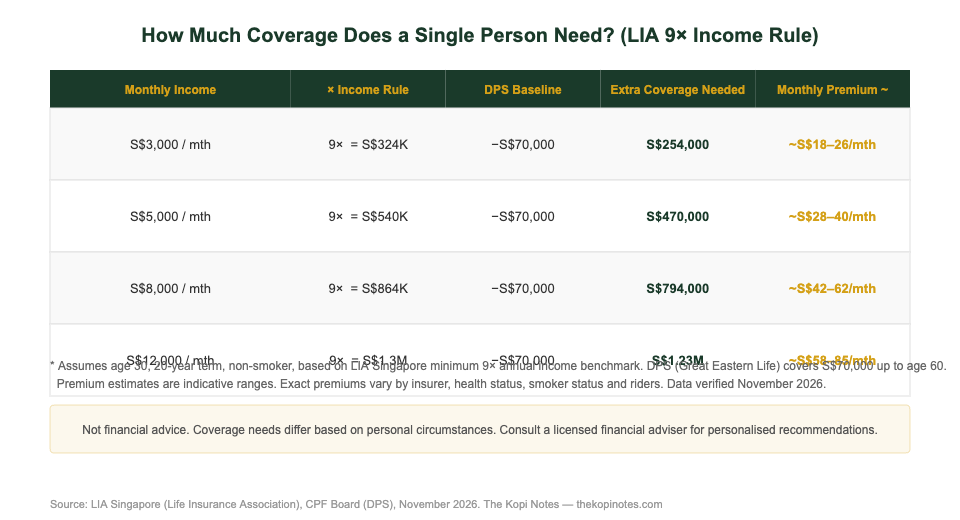
Source: LIA Singapore income benchmark, CPF Board (DPS benefits), November 2026. Premium estimates are indicative ranges from MAS-licensed Singapore insurers.
The table shows how the gap between DPS and your actual need grows with income. At S$3,000 a month, DPS covers only about 22% of the LIA minimum. At S$8,000 a month, it covers barely 8%. DPS is a floor, not a plan. To model your own retirement and savings gap, try the Singapore retirement planning calculator.
DPS vs Term Life Insurance: Key Differences
| Feature | DPS (Great Eastern Life) | Standalone Term Life |
|---|---|---|
| Coverage Amount | S$70,000 (under 60); S$55,000 (60–65) | Customisable — S$100K to S$2M+ |
| Premium Payment | CPF OA (automatic) | Cash or CPF OA (varies) |
| Coverage Period | Age 21 to 65 (auto-terminates) | Fixed term or to age 65/70/99 |
| Critical Illness Cover | None | Optional rider available |
| Payout Trigger | Death or TPD only | Death, TPD, and optional CI |
| Direct Nomination | Via CPF nomination only | Direct policy nomination (faster) |
Source: CPF Board, MAS, Great Eastern Life (DPS contract expires September 2028). Data verified November 2026.
What to Look For in a Policy as a Single
Policy Term: 20–30 Years vs Whole Life Conversion
A 20-year term policy purchased at 30 covers you to age 50. If your parents may still be alive and dependent on you past that point, consider a 30-year term — or a policy with guaranteed conversion options (the right to convert to whole life without re-underwriting). Conversion rights are especially valuable because your health may change over time, locking you out of new applications later.
Should You Add a Critical Illness Rider?
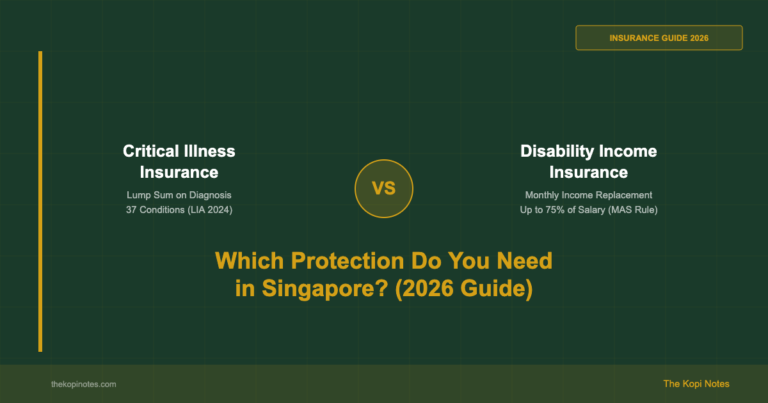
As a single, you are likely the sole earner in your household. A major illness diagnosis — cancer, heart attack, stroke — typically means 6–12 months of reduced or zero income during treatment. A critical illness rider pays a lump sum on diagnosis, covering lost income and treatment costs while you are still alive. For singles without a partner’s income as a backstop, CI coverage is often as important as the death benefit.
Direct Nomination: Bypass Probate for Faster Payouts
Unlike CPF nominations, a direct policy nomination allows the insurer to pay the beneficiary without going through estate administration. For a single person whose parents are elderly and may urgently need funds, this is significantly faster than a CPF-routed DPS payout — which must wait for estate processes to complete.
The Best Time to Buy (Cost of Waiting)
The chart below shows indicative annual premiums for a S$300,000, 20-year term policy for a healthy non-smoker at different ages. Waiting from age 30 to 40 roughly doubles the annual premium for identical coverage.
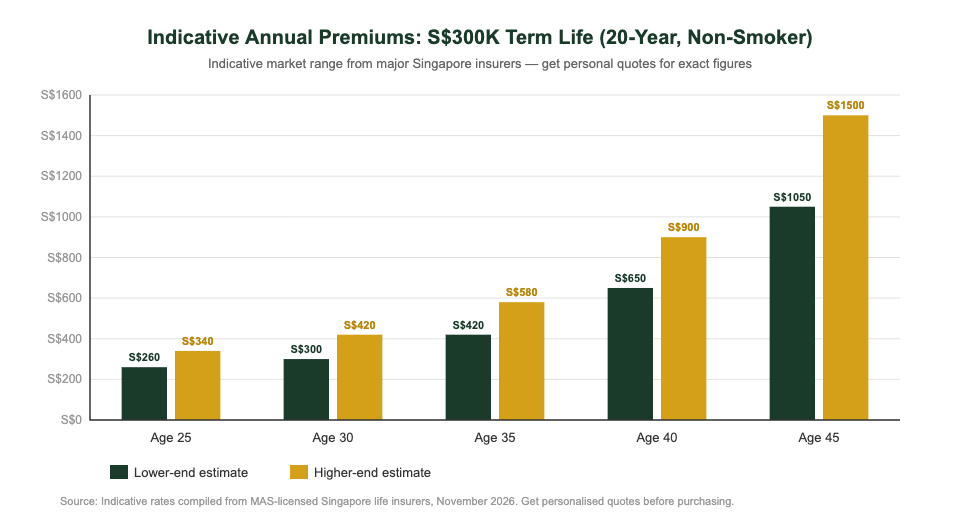
Source: Indicative ranges from MAS-licensed Singapore life insurers, November 2026. Actual premiums vary by health, insurer, and terms. Get personalised quotes.
Over a 20-year policy, the difference compounds: a S$300,000 policy at age 30 might cost S$6,000–8,400 total; the same policy at 40 could cost S$13,000–18,000. There is also an insurability risk — a diabetes or hypertension diagnosis between now and your intended purchase date leads to premium loadings, exclusions, or declines. Buying before a diagnosis is always preferable to buying after.
Once you have the right coverage in place, consider building your investment portfolio alongside it. The Syfe referral code and Endowus referral code offer sign-up bonuses for two of Singapore’s leading robo-advisors.
Frequently Asked Questions
Do singles really need life insurance in Singapore?
Is DPS enough for a single person?
At what age should a single person buy term life insurance?
Can I use CPF to pay for term life insurance?
What happens to my DPS when I turn 65?
Should I add a critical illness rider as a single?
Get Free Insurance Advice
Speak with a licensed insurance advisor. No obligation, no cost.
By submitting this form, you agree to our Privacy Policy.
This article was researched with the help of AI. While we strive to keep all information accurate and up to date, there may be errors. If you notice any discrepancies, please contact us.