Endowment Plan vs CPFIS Singapore 2026: Where Should Your CPF OA Go?
A data-backed breakdown of your three CPF OA options — stay put at 2.5%, invest via a CPFIS endowment plan, or go into the market.
Your CPF Ordinary Account earns a guaranteed 2.5% per annum — but through the CPF Investment Scheme (CPFIS), you can direct surplus OA funds into endowment plans, ETFs, or unit trusts. The question is whether these alternatives consistently outperform the risk-free 2.5% floor. This guide breaks down all three options with real numbers, so you can make a decision that fits your goals and risk tolerance.
Not financial advice. All figures are for educational reference only. Data verified as at November 2026.
What Is CPFIS?
The CPF Investment Scheme (CPFIS) allows eligible Singapore residents to invest their CPF Ordinary Account (OA) and Special Account (SA) savings in a range of approved instruments, including stocks, unit trusts, endowment plans, bonds, and Exchange Traded Funds (ETFs). It was introduced to give members the opportunity to potentially earn returns above the CPF interest rates.
To invest via CPFIS-OA, you must meet the following conditions (source: CPF Board):
- Be at least 18 years old and not an undischarged bankrupt
- Have more than S$20,000 in your OA — only the amount above S$20,000 is investable
- Have completed the CPF Investment Scheme Self-Awareness Questionnaire
As of September 2025, there were 458,000 CPFIS-OA members with a combined S$16.6 billion invested through the scheme. This tells you it is widely used — but whether it is right for you depends entirely on the instrument you choose.
Once your CPFIS-OA is set up, you essentially face three decisions: keep the money in CPF OA, channel it into a CPFIS-approved endowment plan, or invest it in market-linked instruments like ETFs or unit trusts. For a deeper look at how the CPF OA endowment plan mechanic works, see our endowment plan CPF OA guide.
Option 1: Keep Your CPF OA at 2.5%
The simplest choice is to do nothing. Your CPF OA currently earns 2.5% per annum — and that rate is guaranteed by the Singapore Government. The market-linked rate fell to 0.32% for the May–July 2026 quarter, well below the 2.5% floor, which means members are protected. This rate is reviewed quarterly and has remained at the floor rate for many years.
There is an additional benefit for OA balances. CPF members under 55 earn an extra 1% per annum on the first S$60,000 of combined CPF balances (with the OA portion capped at S$20,000). This means up to S$20,000 of your OA earns an effective 3.5% per annum.
Keeping your money in the CPF OA gives you: zero risk, full principal protection, quarterly-compounded growth, and the flexibility to use the funds for housing, education, or CPF Life contributions. The only real downside is that you are capped at 2.5% on amounts above S$20,000.
For comparison, our Singapore Savings Bonds guide shows SSBs are currently yielding around 2.70% — only marginally better and without the housing and loan flexibility that the CPF OA offers.
Option 2: CPFIS Endowment Plans
Some life insurers offer endowment policies that are CPFIS-approved, meaning you can purchase them using funds from your CPF OA. These are participating (par) or non-par plans that offer a guaranteed return plus (for par plans) a non-guaranteed bonus component.
However, there is a critical catch: CPFIS-approved endowment plans typically have lower guaranteed rates than their cash equivalents. Research across published product summaries shows that the guaranteed component on CPFIS endowment plans commonly falls in the range of 1.75% to 2.25% per annum — meaning the guaranteed return is often below the CPF OA floor rate of 2.5%.
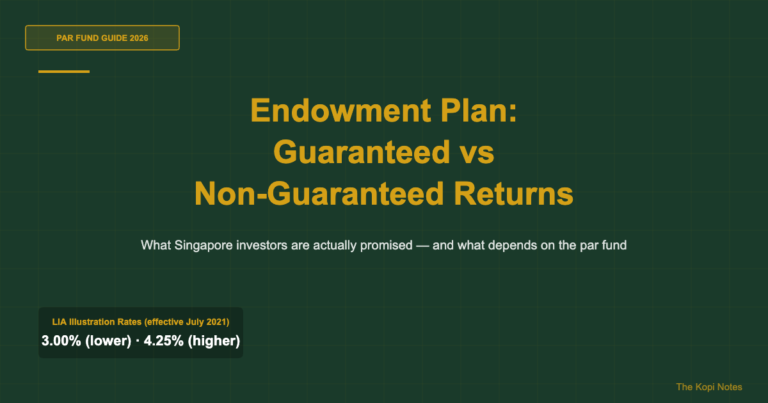
For the total return (guaranteed plus projected non-guaranteed bonuses) to justify using CPFIS for an endowment plan, the insurer’s par fund must perform well enough to lift the blended rate above 2.5%. The Life Insurance Association of Singapore (LIA) caps illustrated returns at an upper rate of 4.25% p.a. and a lower rate of 3.00% p.a. — but only the guaranteed portion is contractual.
| Feature | CPFIS Endowment Plan | Cash Endowment Plan |
|---|---|---|
| Funded by | CPF OA (above S$20,000) | Cash / SRS |
| Guaranteed rate | ~1.75–2.25% p.a. | ~2.0–3.5% p.a. |
| LIA upper illustrated rate | 4.25% p.a. | 4.25% p.a. |
| Liquidity | Low (surrender penalties apply) | Low (same) |
| SDIC protection | Yes (up to S$100,000 per life) | Yes (same) |
Source: LIA Singapore; CPF Board product information. November 2026.
The key question for CPFIS endowment plans: does the non-guaranteed bonus reliably push your return above 2.5%? Based on par fund performance data, some insurers achieve this — but it is not guaranteed, and you sacrifice liquidity for years to find out. For a detailed breakdown of how endowment plan returns are structured, see our guide on endowment plan vs CPF Singapore.
Option 3: CPFIS Market Investments
The third option is using CPFIS-OA to invest in market-linked instruments: ETFs, unit trusts, or individual stocks. This is where the upside potential is highest — but so is the volatility.
CPF’s own published statistics are illuminating. Based on cumulative performance from 2016 to 2024, 71% of CPFIS-OA investors made cumulative total profits above 2.5% per annum (source: CPF Board, September 2025 statistics). That means roughly 29% of active investors underperformed the risk-free CPF OA rate after all fees and costs.
The instruments available under CPFIS-OA include CPF-approved ETFs tracking indices like the STI, as well as a broad range of unit trusts across risk classes. For CPF OA investing via a robo-advisor platform, Endowus is an MAS-licensed option that invests CPF funds in institutional-grade, low-cost portfolios. See our CPF investment strategy guide for a full breakdown of platform options.
Market investments offer the highest potential return over the long term — but unlike the CPF OA’s 2.5% floor, there is no guarantee. A prolonged market downturn could mean your CPFIS account underperforms the OA rate for years. Use our Singapore retirement calculator to model different return scenarios before committing.
3-Way Comparison at a Glance
Here is a side-by-side view of all three options on key decision factors. Use this to identify which approach fits your situation before diving deeper.
| Factor | CPF OA (No Invest) | CPFIS Endowment | CPFIS Market |
|---|---|---|---|
| Guaranteed return | 2.5% p.a. ✅ | 1.75–2.25% p.a. ⚠️ | None ❌ |
| Projected return | 2.5% p.a. (capped) | 3.0–4.25% p.a. (illustrated) | 4–8%+ p.a. (variable) |
| Risk level | Zero | Low | Medium–High |
| Liquidity | High (use for housing/education) | Low (locked in for 2–10 yrs) | Medium (can sell, timing risk) |
| Admin complexity | None | Low | Medium |
| Best for | Near-term housing, low risk tolerance | Conservative long-term savers | Investors with 10+ year horizon |
Source: CPF Board, LIA Singapore, insurer product summaries. Data as at November 2026.
Who Should Choose What?
There is no universal right answer — the best option depends on your goals, timeline, and risk tolerance. Here is a practical framework:
- Keep CPF OA if: You plan to use the funds for housing within 5 years, you are risk-averse, or your OA balance is below S$30,000 (the extra 1% benefit is significant at this level).
- CPFIS Endowment Plan if: You want slightly higher projected returns than 2.5% with minimal risk, have a 3–10 year horizon, and are comfortable locking the funds away. Verify that the total projected return (not just guaranteed) exceeds 2.5% before committing by reviewing the insurer’s par fund track record.
- CPFIS Market Investments if: You have a 10+ year horizon, can tolerate market volatility, and have already maximised your SA contributions (since the SA earns 4% — a higher guaranteed rate that CPFIS markets must beat to be worthwhile). Dollar-cost averaging into a CPF-approved low-cost index fund or ETF has historically been the strongest approach for long-term investors.
One important note: if you are still planning for housing or have a property purchase within the next 3–5 years, maintaining OA liquidity typically outweighs marginal return gains. Never invest CPFIS funds you may need for a property purchase — there is a mandatory wait time to withdraw back to the OA after selling CPFIS investments.
CPFIS Update: New Passive Investment Scheme in 2028
In Budget 2026, the Singapore Government announced a new, simplified CPF investment scheme designed for members who want long-term market exposure without active fund selection. This new scheme is slated to launch in 2028 and will offer a curated, low-cost investment option (expected to be a broad index fund or similar) that members can opt into automatically.
CPFIS will remain available until then. The upcoming scheme is relevant context because it signals that the Government believes the current CPFIS setup — where many members underperform by picking individual stocks or high-fee unit trusts — can be simplified. If you are evaluating CPFIS market investments today, the 2028 scheme may be worth factoring in depending on your timeline.
Our Verdict
For most Singapore residents, the hierarchy is straightforward:
- First, top up your SA to earn 4% (guaranteed, before considering CPFIS at all)
- Second, use OA for housing if needed within 5 years
- Third, if you have excess OA funds above S$20,000 and a long horizon, evaluate CPFIS
- Within CPFIS, CPFIS endowment plans are only worth it if the total projected return reliably exceeds 2.5% — verify the insurer’s par fund track record. CPFIS market investments in low-cost ETFs have outperformed 2.5% for 71% of investors over 2016–2024, but past results do not guarantee future returns.
The key takeaway: the CPF OA’s 2.5% floor is deceptively strong. It is fully government-backed, zero-risk, and offers housing-linked flexibility that no CPFIS product can replicate. Any CPFIS decision should be evaluated strictly on whether the return premium justifies the risk and liquidity trade-off.
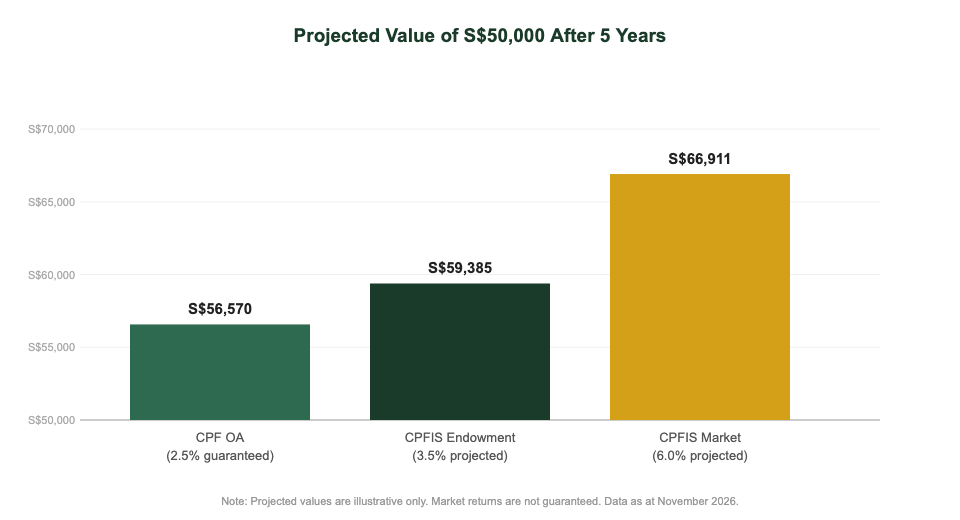
Chart: Projected CPF OA Growth — 3 Scenarios (S$50,000 Over 5 Years)
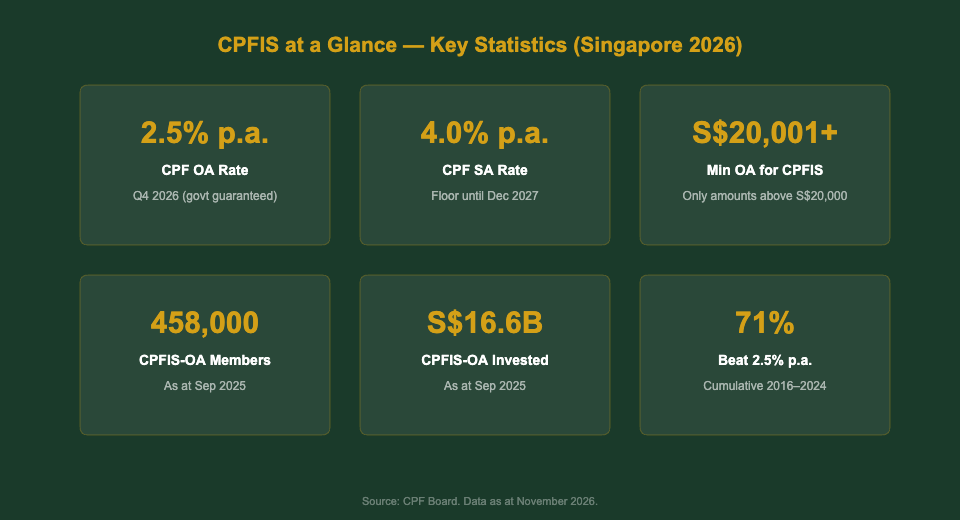
CPFIS vs CPF OA: Key Statistics at a Glance
Want to invest your CPF OA in low-cost institutional-grade funds? Endowus is an MAS-licensed platform that lets you invest CPF OA, SRS, and cash funds in well-diversified portfolios.
Use the Endowus referral code 2V343 for a fee rebate when you sign up.
Frequently Asked Questions
Can I use my CPF OA to buy an endowment plan?
Yes, but only if the endowment plan is CPFIS-approved. Not all endowment plans qualify — you must purchase through a CPFIS-approved agent and use a CPFIS-linked investment account. Check the CPF Board’s list of approved products before proceeding.
Is the guaranteed return on a CPFIS endowment plan better than the CPF OA rate?
Typically, no. Most CPFIS-approved endowment plans offer a guaranteed component of approximately 1.75% to 2.25% per annum — below the 2.5% CPF OA floor. The total projected return including non-guaranteed bonuses may exceed 2.5%, but this is not contractually guaranteed.
What is the minimum CPF OA balance required for CPFIS?
You must have more than S$20,000 in your CPF OA. Only the amount above S$20,000 can be invested via CPFIS. The first S$20,000 must remain in the OA at all times and cannot be invested.
How have CPFIS-OA investors performed historically?
According to CPF Board statistics (September 2025), 71% of CPFIS-OA investors achieved cumulative total profits above 2.5% per annum over the 2016–2024 period. However, approximately 29% underperformed the risk-free CPF OA rate after fees. Past performance does not guarantee future results.
What is the new CPF investment scheme launching in 2028?
Budget 2026 announced a new, simplified investment scheme for CPF members who want long-term market exposure without active fund selection. Expected to launch in 2028, it will offer a low-cost, passively managed option. CPFIS remains available until the new scheme is introduced.
Should I invest CPFIS funds in endowment plans or ETFs?
It depends on your risk tolerance and time horizon. CPFIS endowment plans offer lower volatility but their guaranteed rates are often below 2.5%. CPFIS market investments in ETFs or unit trusts have higher upside potential over a 10+ year horizon but come with market risk. For risk-averse investors with shorter timelines, leaving funds in the CPF OA is often the most sensible choice.
Get Free Insurance Advice
Speak with a licensed insurance advisor. No obligation, no cost.
By submitting this form, you agree to our Privacy Policy.
This article was researched with the help of AI. While we strive to keep all information accurate and up to date, there may be errors. If you notice any discrepancies, please contact us.