Term Life Insurance Payout in Singapore: What You Receive, Exclusions & How to Protect Your Family (2026)
A practical guide to how term life insurance payouts work in Singapore — the sum assured, what triggers it, what’s excluded, and how nomination determines who actually receives the money.
A term life insurance payout in Singapore is a lump-sum death benefit equal to the sum assured you chose when you bought the policy. If the insured person dies within the policy term, the insurer pays that full amount — typically S$200,000 to S$1 million or more — directly to the nominated beneficiary. There is no cash value component; the payout is pure protection. Under the LIA Code of Life Insurance Practice, most straightforward claims in Singapore are paid within 14 to 35 days of submitting complete documentation.
Not financial advice. All figures are for educational reference only. Data verified as at November 2026.
Table of Contents
Contents — Click to expand
What Is a Term Life Insurance Payout?
A term life insurance policy pays out a lump sum — called the death benefit or sum assured — when the life assured (the insured person) passes away during the policy term. If the insured survives to the end of the term, no payout is made and the policy simply expires. This is what makes term life insurance so affordable compared to whole life: you are paying purely for protection, with no savings or investment component.
Most Singapore term life policies also include a Total and Permanent Disability (TPD) benefit, which triggers the same lump-sum payout if the insured becomes totally and permanently disabled before the policy expiry. Some policies extend this to include Terminal Illness (TI), where the payout is made early upon diagnosis of a terminal illness with a prognosis of less than 12 months to live.
Term life insurance in Singapore is regulated by the Monetary Authority of Singapore (MAS) under the Insurance Act. All life insurers are members of the Life Insurance Association Singapore (LIA), which sets industry standards for claims handling, disclosure, and consumer protection. When something goes wrong with a claim, the Financial Industry Disputes Resolution Centre (FIDReC) provides a free adjudication service for disputes up to S$100,000.
How Much Will You Receive?
The payout amount is exactly the sum assured you selected when you purchased the policy. If you bought a S$500,000 term life policy and the insured passes away in year 10 of a 30-year term, the payout is S$500,000 — no more, no less. The amount does not grow with inflation, does not accumulate interest, and is not affected by how long the policy has been in force.
This is an important point that many Singaporeans miss: the sum assured you pick at application is locked in. If your financial responsibilities grow significantly — for example, you upgrade from an HDB flat to a condominium, or your household income increases substantially — your existing coverage may no longer be adequate. It is good practice to review your coverage every three to five years, or after major life events such as marriage, the birth of a child, or a significant increase in liabilities.
Payout is tax-free in Singapore. There is no estate duty (abolished in 2008), no personal income tax on life insurance proceeds, and no capital gains tax. The full S$500,000 (or whatever your sum assured) goes to your beneficiary, with no deductions.
If a valid nomination is in place (see below), the payout bypasses your estate entirely and is paid directly to the nominated beneficiary. This means the money is typically available within weeks — not months — without needing a Grant of Probate.
How Much Coverage Do You Actually Need?
The Life Insurance Association Singapore (LIA) recommends a death coverage target of 9 to 10 times your annual income as a starting rule of thumb. This is designed to give your dependants enough capital to replace your income stream for approximately a decade while they rebuild their financial footing.
For many Singaporeans, this means the sum assured should be in the range of S$450,000 to S$1 million or more, depending on income. Use the chart below as a quick reference:
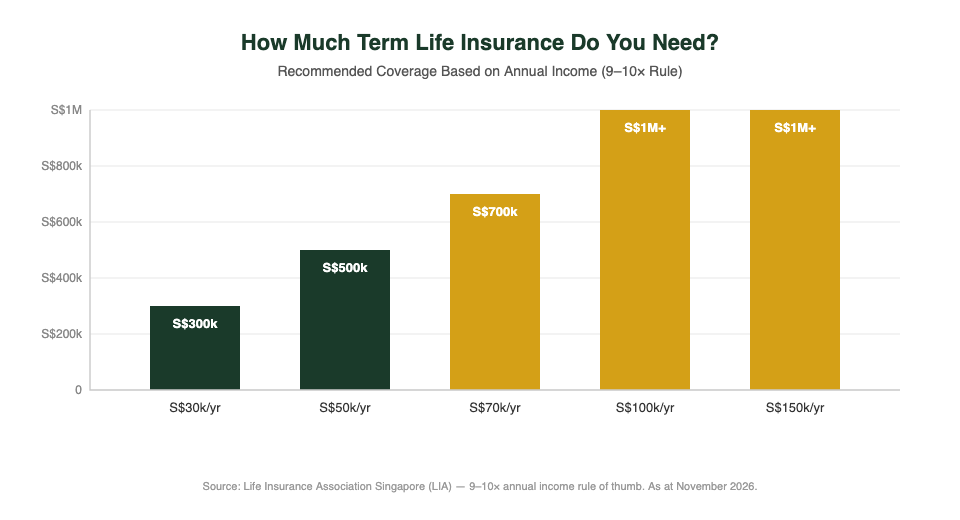
Source: Life Insurance Association Singapore (LIA) — 9–10× annual income rule of thumb. As at November 2026.
Beyond the 9–10× rule, you should also factor in outstanding liabilities — particularly your home loan. If you have a S$600,000 HDB mortgage outstanding, that amount alone should be covered. Add your income replacement target on top of that. If you are self-employed, the calculation is more nuanced; read our guide on term life insurance for self-employed Singapore for a detailed walkthrough.
You can also use our Singapore retirement calculator to model how much capital your family would need to sustain their lifestyle without your income.
What the Payout Covers — and What It Doesn’t
Term life insurance in Singapore covers death from almost any cause: illness, heart attack, cancer, accident, and most natural causes. However, all policies contain standard exclusions. Understanding these in advance is essential — a rejected claim at the time your family needs it most is a devastating outcome that can often be avoided with the right planning.
| Exclusion | Details | What to Do |
|---|---|---|
| Suicide (1st year) | Most Singapore policies exclude suicide within the first 12 months of the policy | Check your specific policy wording; some extend to 2 years |
| Non-disclosure of health conditions | If you failed to declare a pre-existing condition at application and it contributed to your death, the insurer may reject the claim | Disclose everything at application, even minor conditions; MAS requires insurers to prove materiality before rejecting |
| War and terrorism | Most policies exclude death directly caused by war, invasion, or acts of terrorism | Some insurers offer add-on riders; check your policy wording |
| Dangerous activities | Skydiving, motor racing, mountaineering, and similar extreme activities may be excluded unless a specific rider is added | Declare any high-risk hobbies at application; your underwriter can include them with an adjusted premium |
| Policy lapse | If you miss premium payments and the policy lapses, there is no payout | Set up GIRO / auto-payment; most insurers provide a 30-day grace period before lapsing |
Source: LIA Singapore Code of Practice; standard Singapore life insurance policy exclusions. November 2026.
Non-disclosure is the most common reason for claims disputes in Singapore. When you apply for term life insurance, you are required to answer health and lifestyle questions truthfully and completely. If you omit a diagnosed condition — even if you do not think it is relevant — and the insurer can demonstrate that this information would have affected their underwriting decision, they can dispute the claim. Under MAS guidelines, however, insurers must prove that the non-disclosed information was material to the underwriting outcome; they cannot reject a claim simply because something was not disclosed if it had no bearing on the cause of death.
For more context on the claims dispute process, see our related article on how to claim life insurance in Singapore.
Nomination: Who Actually Receives the Money?
Making a valid nomination is arguably the most important thing you can do to ensure your term life insurance payout reaches your family quickly and without legal complications. Without a nomination, your payout goes into your estate and must pass through the probate process — which can take months to years — before your family receives a single dollar.
Under the Insurance Act, Singapore policyholders can make three types of nominations:
| Nomination Type | What It Does | Key Feature | Best For |
|---|---|---|---|
| Revocable Nomination | Names beneficiaries who receive the payout; policyholder can change nominees at any time | Flexible; payout still goes through estate if no nominees survive you | Most general cases |
| Irrevocable Nomination | Nominees are locked in; policyholder cannot change without written consent from all nominees | Provides certainty to nominees; limits policyholder’s flexibility | Divorce settlements or formal agreements |
| Trust Nomination | Creates a statutory trust under the Insurance Act in favour of spouse and/or children | Payout bypasses estate entirely; creditors cannot claim it; fastest route to family | Best option for most married Singaporeans with children |
Source: Insurance Act (Singapore); LIA Singapore nomination guidelines. As at November 2026.
The trust nomination is typically the most powerful option for Singaporeans with a spouse and/or children. Because it creates a statutory trust, the proceeds are legally owned by the trust (not by you) from the moment you make the nomination. This means creditors cannot access it in bankruptcy proceedings, and probate is not required — the payout goes directly to the trustee (usually your spouse) for the benefit of your named beneficiaries.
If you are unsure which type of nomination is right for your situation, consult a licensed financial adviser. For couples navigating joint protection planning, our guide on critical illness insurance for couples in Singapore covers related nomination and beneficiary considerations.
How to File a Claim and What to Expect
Under the LIA Code of Life Insurance Practice, the claims process in Singapore follows a structured timeline designed to ensure fair and timely payouts. Here is what your nominee should expect:
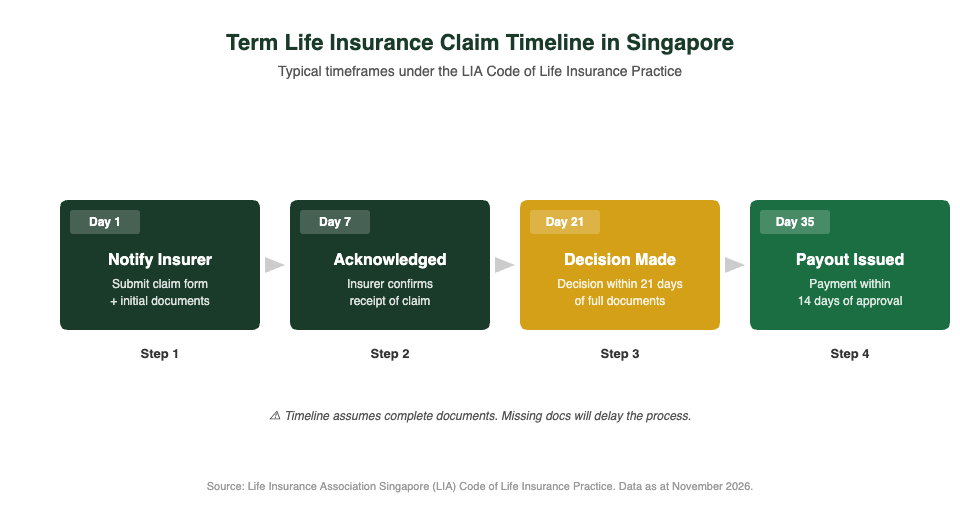
Source: Life Insurance Association Singapore (LIA) Code of Life Insurance Practice. Data as at November 2026.
The standard documents required when making a death claim include:
- Completed claim form from the insurer
- Original death certificate (from the Registry of Births and Deaths Singapore)
- Original policy document
- NRIC/passport of the deceased and the claimant
- Attending Physician’s Statement (for policies in force less than 5 years, or for deaths due to illness)
- Proof of relationship to the deceased (e.g. marriage certificate, birth certificate)
If no valid nomination was made, the insurer will additionally require a Grant of Probate or Letters of Administration from the courts before releasing the funds. This is why making a nomination at the time you buy the policy is so important — it removes this bottleneck entirely.
If you disagree with an insurer’s decision to reject or reduce a claim, you must first exhaust the insurer’s internal complaints process. After that, you can escalate to the Financial Industry Disputes Resolution Centre (FIDReC) for independent adjudication at no cost (for claims up to S$100,000).
5 Steps to Ensure a Smooth Payout
Taking these steps now — while you are healthy and the policy is active — will make an enormous difference to your family when they need to make a claim:
- Make a nomination immediately. Do not leave the policy unnominated. For most Singaporeans with a spouse and children, a trust nomination under the Insurance Act is the most protective option.
- Disclose everything at application. Be thorough and honest about your health history, smoking status, occupation, and hobbies. Non-disclosure is the most common grounds for claim disputes in Singapore.
- Keep your premiums paid. Set up GIRO or automated payments. A lapsed policy is worthless. Most insurers provide a 30-day grace period, but do not rely on it.
- Tell your family where the policy is. Keep a copy of your policy document, the insurer’s customer service number, and your policy number in a place your family can find. Many valid claims go unclaimed simply because families do not know the policy exists.
- Review coverage every 3–5 years. As your income grows, your liabilities change (new mortgage, new child), and your coverage requirements shift. Use the 9–10× income rule as a check at every major life milestone. Our how much critical illness insurance do you need Singapore guide offers a complementary framework for your overall protection planning.
Frequently Asked Questions
How long does a term life insurance payout take in Singapore?
Under the LIA Code of Life Insurance Practice, insurers must acknowledge receipt of a claim within 7 days and make a decision within 21 days of receiving all required documents. Once approved, payment is typically issued within 14 days. For straightforward claims with a valid nomination and complete documentation, the total process usually takes 4–6 weeks. Claims that require a Grant of Probate (because there is no valid nomination) take considerably longer — often several months.
Is a term life insurance payout taxable in Singapore?
No. Life insurance proceeds in Singapore are not subject to personal income tax. Singapore also abolished estate duty in 2008, so there is no inheritance tax on payouts either. The full sum assured is paid to your nominee with no tax deductions. This makes term life insurance payouts one of the most tax-efficient ways to transfer wealth to your family in Singapore.
Can creditors claim my term life insurance payout?
It depends on the type of nomination. If you have made a trust nomination under the Insurance Act in favour of your spouse and/or children, the payout is held in a statutory trust and is generally protected from creditors. If you have made a standard revocable nomination and the payout passes through your estate, creditors can make claims against your estate before the remaining assets are distributed to beneficiaries. This is one of the strongest reasons to make a trust nomination if you have dependants.
What happens if I miss a premium payment on my term life insurance?
Most Singapore term life insurance policies provide a grace period of 30 days after the premium due date. If you pay within this period, the policy remains in force. If you miss the grace period entirely, the policy lapses and coverage ends immediately — no payout will be made if you die while the policy is lapsed. Reinstatement is possible (subject to fresh underwriting and a satisfactory health declaration) but is not guaranteed. Set up GIRO auto-payments to avoid this risk.
Does term life insurance pay out for TPD?
Most term life insurance policies in Singapore include a Total and Permanent Disability (TPD) benefit that triggers the same lump-sum payout as a death benefit. The definition of TPD varies by insurer and policy but typically covers inability to perform any occupation, loss of two or more limbs, loss of sight in both eyes, and similar conditions. Some policies also include an Accelerated Death Benefit for terminal illness — allowing an early payout if the insured is diagnosed with a terminal illness and given less than 12 months to live. Check your specific policy schedule to confirm which events are covered.
Can I increase my sum assured after buying term life insurance?
Changing the sum assured on an existing policy requires you to effectively apply for a new policy or a new coverage layer with a fresh underwriting assessment. Some insurers offer a Guaranteed Insurability Benefit (GIB) rider that allows you to increase coverage at specific life events (marriage, birth of a child) without further medical underwriting. If your insurer does not offer this and you need more coverage, the most common approach is to buy an additional policy from the same or a different insurer to stack coverage. Singapore law allows you to hold multiple term life policies from different insurers simultaneously.
Get Free Insurance Advice
Speak with a licensed insurance advisor. No obligation, no cost.
By submitting this form, you agree to our Privacy Policy.
This article was researched with the help of AI. While we strive to keep all information accurate and up to date, there may be errors. If you notice any discrepancies, please contact us.