CSPX Withholding Tax: Why It’s 15%, Not 30% (2026 Guide)
How Ireland’s tax treaty with the US cuts CSPX’s dividend withholding tax rate, and what it is worth to a Singapore investor in real dollars.
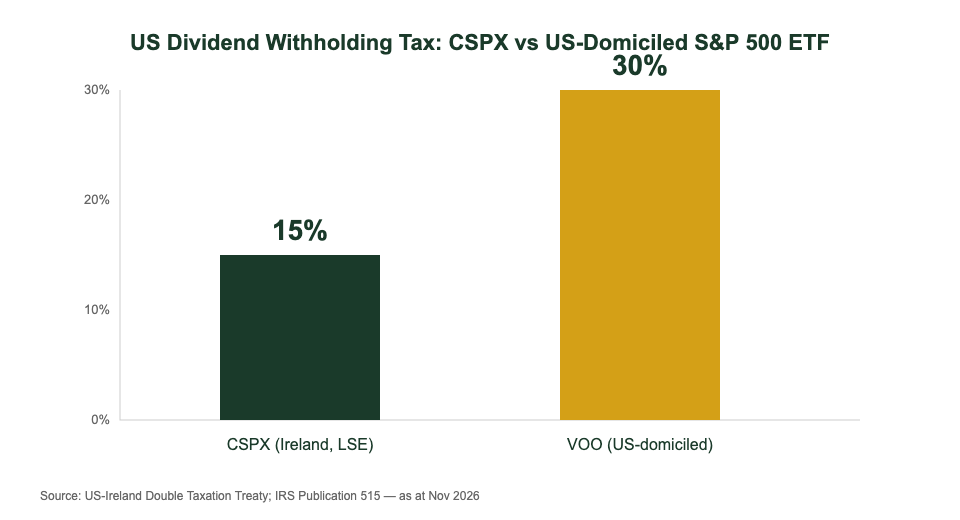
CSPX’s withholding tax rate on US-sourced dividends is 15%, not the 30% that US-domiciled ETFs like VOO charge non-US investors, because CSPX is domiciled in Ireland under the US-Ireland tax treaty. For a Singapore investor, that is a permanent annual return boost of roughly 0.15-0.20%, on top of avoiding US estate tax exposure entirely.
Not financial advice. All figures are for educational reference only. Data as at November 2026 unless noted.
Table of Contents
Contents — Click to expand
What Is Withholding Tax on US Dividends?
When a US company pays a dividend, the IRS collects a slice of it before the payment ever reaches the shareholder. This is withholding tax (WHT), and the standard rate for a non-US person holding US shares directly, or holding a US-domiciled fund, is 30% under IRS rules for non-resident aliens. For a Singapore investor buying the S&P 500 through a US-listed ETF like VOO, that 30% comes off every dividend before it is reinvested or paid out — there is no way to reclaim it, because Singapore has no tax treaty with the US that reduces this rate for individual investors.
CSPX (the iShares Core S&P 500 UCITS ETF) sidesteps most of this. It is not a US fund — it is domiciled in Ireland and listed on the London Stock Exchange (LSE). Because Ireland has a double taxation treaty with the US, dividends flowing from US companies into CSPX are taxed at the fund level at 15%, not 30%, before being reinvested inside the ETF (CSPX is accumulating, so Singapore investors never see a cash dividend — it compounds inside the fund’s net asset value).
How the Ireland-US Tax Treaty Cuts CSPX’s Rate to 15%
The mechanism is straightforward once you see it: the US-Ireland tax treaty sets a reduced withholding rate of 15% on dividends paid to Irish-resident entities, including Irish-domiciled UCITS funds like CSPX. BlackRock (the fund manager) applies for this treaty rate on the fund’s behalf — individual investors in Singapore do nothing and cannot claim it themselves on a US-domiciled fund, because the treaty benefit sits at the fund’s country of domicile, not the investor’s country of residence.
This is also why Ireland is where almost every UCITS ETF offered to Asian and European investors is domiciled, rather than Luxembourg or elsewhere — the US-Ireland treaty rate is one of the most favourable available to a fund structure, and it is the single biggest reason CSPX, VWRA, IWDA and similar London Stock Exchange-listed ETFs cost Singapore investors less in tax drag than their US-listed equivalents, even when the headline expense ratio looks similar or higher.
| ETF | Domicile | US Dividend WHT | US Estate Tax Risk |
|---|---|---|---|
| CSPX (LSE) | Ireland | 15% | None |
| VOO (NYSE Arca) | USA | 30% | Yes, above USD 60,000 |
| SPY / IVV (US) | USA | 30% | Yes, above USD 60,000 |
Source: US-Ireland Double Taxation Treaty; IRS Publication 515, as at November 2026.
CSPX vs VOO: The Real Dollar Impact
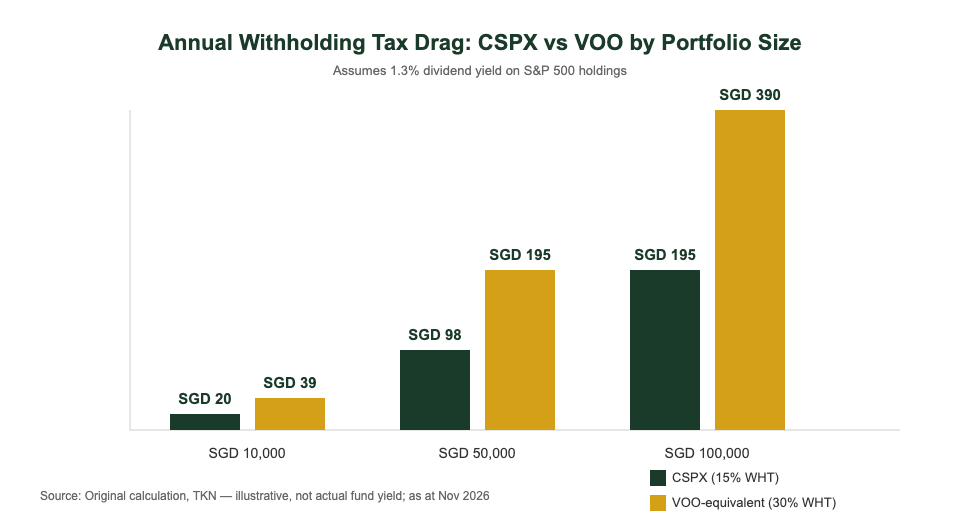
CSPX’s 0.07% total expense ratio (TER) is slightly higher than VOO’s 0.03% (per iShares and Vanguard factsheets, as at October 2026) — a difference of 0.04% a year. But that gap is more than offset by the withholding tax saving. On a S&P 500 dividend yield of roughly 1.3%, the 15-percentage-point WHT difference works out to about 0.15-0.20% of extra annual return for CSPX, net of the slightly higher TER. In practice this means CSPX typically delivers a comparable or better net total return than VOO for a Singapore investor, despite the “higher fee” headline.
Here is what that looks like in SGD terms for a Singapore investor, assuming a 1.3% dividend yield on the underlying index:
| Portfolio Size | WHT Paid via CSPX (15%) | WHT Paid via VOO (30%) | Annual Saving |
|---|---|---|---|
| SGD 10,000 | SGD 19.50 | SGD 39.00 | SGD 19.50 |
| SGD 50,000 | SGD 97.50 | SGD 195.00 | SGD 97.50 |
| SGD 100,000 | SGD 195.00 | SGD 390.00 | SGD 195.00 |
Source: Original calculation, The Kopi Notes — illustrative based on a 1.3% dividend yield assumption, not a guaranteed fund yield; as at November 2026.
On a SGD 100,000 portfolio held for 20 years, that SGD 195 a year in avoided withholding tax compounds into a meaningfully larger balance than the “cheaper” US-domiciled alternative — on top of the estate tax exposure VOO carries and CSPX does not.
Singapore Context: Estate Tax, CPF and SRS
The withholding tax rate is only half the picture for a Singapore investor choosing between a US-domiciled ETF and an Ireland-domiciled one. US-domiciled funds like VOO also expose non-US holders to US estate tax on the US-situated portion of their estate above a USD 60,000 exemption — a figure that has not changed in decades and is not indexed to inflation, according to the IRS guidance for nonresident estates. CSPX, being Irish-domiciled, falls outside this regime entirely, because the underlying shares are held by the fund, not the individual. For readers who want the full mechanics of how this works, we cover it in our CSPX total return and tax-drag breakdown.
Within Singapore itself there is no dividend tax and no capital gains tax on either ETF, so the WHT and estate tax differences are the only tax drags that matter. Neither CSPX nor VOO is CPF-investable, since both are listed outside SGX, but CSPX can be bought through SRS funds at brokers that support LSE trading — worth factoring into a CPF investment strategy that leans on overseas index funds for the equity sleeve, or into a broader retirement planning calculator projection where small annual tax drags compound over a 20-30 year horizon.
Does This Apply to VWRA and Other UCITS ETFs?
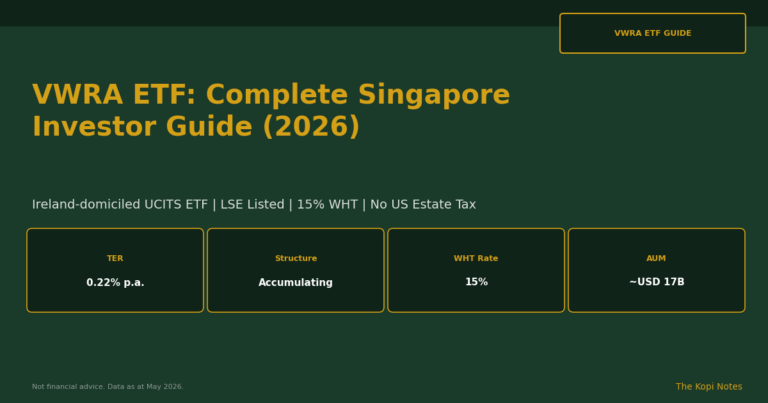
Yes. Every Ireland-domiciled UCITS ETF that holds US equities benefits from the same 15% treaty rate on the US-sourced portion of its dividends, including VWRA (global equities, roughly 60-65% US-weighted) and IWDA (developed markets, similarly US-heavy). The size of the benefit scales with how much of the fund’s dividend income originates in the US — CSPX, being 100% S&P 500, gets the full effect; VWRA gets a proportionally smaller version because a slice of its dividends come from non-US markets that are taxed differently.
| ETF | US Equity Weight | Effective WHT Benefit | Domicile |
|---|---|---|---|
| CSPX | 100% | Full 15pp saving on all dividends | Ireland |
| VWRA | ~63% | Partial — scaled to US weight | Ireland |
| IWDA | ~70% | Partial — scaled to US weight | Ireland |
Source: iShares and Vanguard factsheets, as at October 2026.
What Singapore Investors Should Do
If the goal is pure S&P 500 exposure, CSPX on the London Stock Exchange is the more tax-efficient route for a Singapore investor than a US-listed equivalent like VOO, once the withholding tax and estate tax differences are accounted for — not just the headline TER. This is covered in more depth in our side-by-side CSPX vs VOO comparison and our broader CSPX buying guide, which walks through opening a brokerage account and placing the order step by step.
Investors can buy CSPX through brokers that offer LSE access, including Interactive Brokers, Saxo Markets, and Syfe, which also runs a sign-up bonus for new accounts. The tax advantage is automatic — there is nothing to file or claim — so the only decision is whether the slightly higher TER and FX conversion into GBP/USD at the point of purchase are worth the lower effective tax drag. For most long-term, buy-and-hold Singapore investors building a core equity position, the answer is yes.
Other Costs That Interact With the Tax Difference
The withholding tax rate is not the only variable that determines total cost. Buying CSPX on the LSE means converting SGD into GBP or USD at your broker’s FX rate, which typically runs 0.1-0.5% depending on the platform — brokerage cost comparisons are worth checking before committing to a platform. VOO, by contrast, is bought in USD on a US exchange, so the FX conversion step is similar in practice since most Singapore brokers quote USD-denominated accounts anyway — the FX cost difference between the two routes is usually small and broker-dependent rather than structural.
Bid-ask spreads are another small factor: CSPX, with roughly USD 161 billion in net assets as at October 2026 according to the iShares CSPX factsheet, trades with tight spreads comparable to VOO’s. Vanguard’s own S&P 500 products, listed on its Vanguard UK product pages, follow the same Ireland-domicile logic for its UCITS range, which is why VUAA (Vanguard’s own LSE-listed S&P 500 UCITS ETF) carries the same 15% withholding tax treatment as CSPX. The domicile, not the fund manager, is what determines the tax rate.
None of this changes the core conclusion: for a buy-and-hold Singapore investor accumulating US equity exposure over a 10-20 year horizon, the withholding tax and estate tax advantages of an Ireland-domiciled, LSE-listed ETF like CSPX typically outweigh a 0.04 percentage point TER difference and any minor FX cost variation between brokers.
Frequently Asked Questions
What is CSPX's withholding tax rate on dividends?
CSPX’s US-sourced dividends are taxed at 15% at the fund level, under the US-Ireland double taxation treaty, because CSPX is domiciled in Ireland. This compares with the 30% rate that applies to non-US investors holding US-domiciled ETFs such as VOO directly.
Does a Singapore investor need to do anything to claim the lower rate?
No. The 15% treaty rate is applied automatically at the fund level by BlackRock, the fund manager, before the dividend is reinvested inside CSPX (which is an accumulating ETF). A Singapore investor does not file anything or claim a refund — the benefit comes simply from choosing an Ireland-domiciled fund over a US-domiciled one.
Is CSPX's withholding tax advantage bigger than its higher expense ratio?
Generally yes. CSPX’s TER of 0.07% is about 0.04 percentage points higher than VOO’s 0.03%, but the 15-percentage-point withholding tax saving on a roughly 1.3% dividend yield is worth about 0.15-0.20% a year — more than enough to offset the fee difference for most Singapore investors.
Does the same withholding tax benefit apply to VWRA?
Yes, but proportionally smaller. VWRA is also Ireland-domiciled and gets the 15% treaty rate on the roughly 63% of its holdings that are US equities. Because VWRA holds non-US markets too, the overall withholding tax benefit is smaller in percentage terms than CSPX’s, which is 100% S&P 500.
Can I buy CSPX using my SRS funds in Singapore?
Yes, if your SRS-linked brokerage account supports trading on the London Stock Exchange. CSPX is not CPF-investable, since it is not listed on SGX, but several SRS-compatible brokers do offer LSE access for ETFs like CSPX and VWRA.
What happens to the withholding tax if I switch from VOO to CSPX?
Switching does not recover withholding tax already paid on past VOO dividends, but every dividend CSPX earns going forward is taxed at 15% instead of 30%. Investors should also weigh any capital gains or transaction costs from selling VOO before moving — Singapore does not tax capital gains, but brokerage fees and FX spreads still apply.
Ready to Start Investing Tax-Efficiently?
Open a brokerage account with LSE access and buy CSPX or VWRA with the full 15% treaty rate working in your favour.
This article was researched with the help of AI. While we strive to keep all information accurate and up to date, there may be errors. If you notice any discrepancies, please contact us.