Medisave Limit 2026: How to Check Your Remaining Balance Before Year-End
A practical guide to checking your BHS, AWL and CDMP figures before 31 December — and what to do with what you find.
Your Medisave balance resets its annual spending limits on 1 January each year — but your account balance itself does not. Now is the ideal window to check three things: your CDMP limit remaining, your ISP premium Additional Withdrawal Limit (AWL) used so far, and whether your balance is below the $79,000 Basic Healthcare Sum (BHS) cap. A voluntary top-up before 31 December 2026 can unlock free government matching under the Matched MediSave Scheme.
Not financial advice. All figures are for educational reference only. Data verified as at October 2026. Always check cpf.gov.sg for the latest official rates.
Table of Contents
Contents — Click to expand
Why Year-End Is the Critical Window
Unlike your bank savings account, your Medisave Account operates under a dual-layer system: a balance limit (the Basic Healthcare Sum, or BHS) and a set of annual spending limits that apply to different treatment categories. These two layers are independent of each other, and they reset or adjust at different points in time.
Your Medisave balance does not reset at year-end — it carries over indefinitely. But your annual usage limits for outpatient programmes such as the Chronic Disease Management Programme (CDMP) do reset on 1 January each year. Any unused CDMP allowance from 2026 does not roll over to 2027. If you managed a chronic condition this year but did not fully utilise your CDMP limit, those unspent claims are simply gone once January arrives.
November and December are also the window for a different decision: whether to make a voluntary cash top-up to your Medisave Account before year-end. In 2026, this decision carries extra weight because of the Matched MediSave Scheme (MMSS) — a government initiative that matches your voluntary top-ups dollar-for-dollar, up to $1,000 per year, for eligible Singapore Citizens aged 55 to 70. The MMSS deadline is 31 December 2026.
Before you can make smart decisions about any of these, you need to know where you actually stand. This guide walks you through exactly how to check your Medisave balance and usage figures, and what to do with that information before the year closes.
What “Medisave Limit” Actually Means in Practice
The phrase “Medisave limit” is used loosely to refer to several distinct caps, and confusing them leads to poor planning decisions. Here is a clear breakdown of the three most important limits:
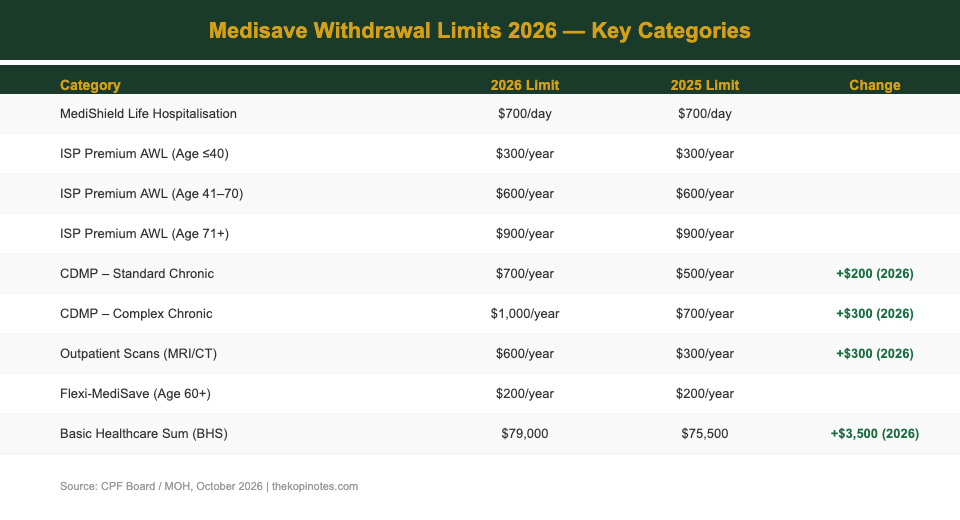
1. The Basic Healthcare Sum (BHS) — $79,000 in 2026
This is the ceiling on how much money can sit in your Medisave Account at any point in time. Once your MA balance hits $79,000, any new CPF contributions that would normally go to Medisave are redirected to your Ordinary Account (if you are under 55) or your Retirement Account (if you are 55 or older). The BHS is not an annual limit — it is a standing balance cap. It increases each year for members under 65. For the 2026 Medisave limit complete guide, see our detailed Medisave limit 2026 overview.
2. The Additional Withdrawal Limit (AWL) — $300 to $900/year
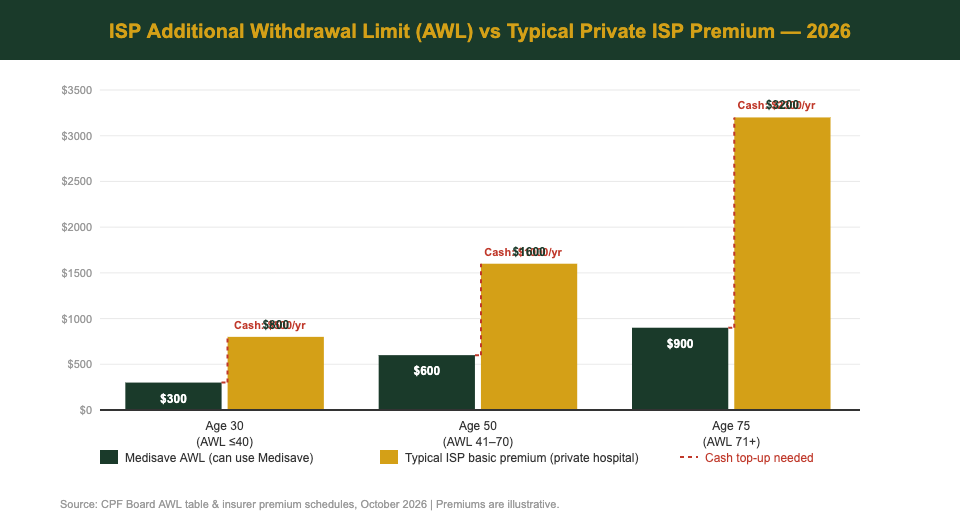
This is the annual cap on how much Medisave you can use to pay the private insurer component of your Integrated Shield Plan (ISP) premium. The AWL varies by your age at next birthday. If you are between 41 and 70, your AWL is $600 per year. Any ISP premium above your AWL must be paid in cash. Your AWL does not “run out” mid-year in the way a credit card limit would — it simply caps how much can be charged to Medisave across all ISP premium payments in the calendar year.
3. Annual Spending Limits for Outpatient Programmes
These are per-year caps on what you can use for specific outpatient treatments. The CDMP cap ($700/year for standard chronic conditions, $1,000/year for complex conditions) resets on 1 January. The outpatient scan cap ($600/year) similarly resets annually. Once you hit the cap in a given year, the remaining cost must be paid in cash — even if you have a large Medisave balance.
Understanding which limit is most relevant to your situation determines what you should actually be checking before year-end. For most working-age Singaporeans with a private hospital ISP, the AWL and the BHS are the two most important figures to track. For those managing a chronic condition under CDMP, the annual CDMP limit takes priority.
How to Check Your Medisave Balance (Step-by-Step)
Checking your Medisave balance takes under five minutes once you have your SingPass login ready. There are two main methods:
Method 1: CPF Website (cpf.gov.sg)
- Go to cpf.gov.sg → Member Login and log in with SingPass.
- On the dashboard, click “My CPF” in the top navigation.
- Under “My Account Summary”, your four CPF account balances are displayed — Ordinary Account (OA), Special Account (SA), Medisave Account (MA), and Retirement Account (RA) if applicable.
- Click on your Medisave Account balance for a detailed breakdown, including year-to-date transactions and outgoing premium payments.
- For CDMP usage specifically, click on “Healthcare” in the top menu, then “View my Medisave transactions” to see all outpatient claims made under your CDMP limit this year.
Method 2: My CPF Mobile App
- Download the My CPF app from the App Store or Google Play if you have not already.
- Log in with your SingPass Face Verification or Singpass app.
- Tap “Account Balance” on the home screen — your Medisave balance appears immediately.
- For transaction history, tap “Transactions” and filter by “Medisave Account”.
- To check CDMP usage year-to-date, tap “Healthcare” and select “Medisave transaction history”.
There is also a third route for ISP-specific AWL checks: contact your ISP insurer directly (AIA, Prudential, NTUC Income, Singlife, Great Eastern, or HSBC Life). They can tell you exactly how much AWL has been used for your current policy year’s premium, and what the remaining Medisave component is. This is particularly useful if your ISP anniversary falls mid-year and you have already paid one premium instalment.
For a full walkthrough on topping up your account once you know your balance, see our guide on how to top up Medisave in 2026.
Four Key Figures to Note When You Check
Once you are logged in to CPF, make a note of these four specific numbers. They determine every action on the checklist in the next section.
Figure 1: Your Medisave Account Balance
Note this number and compare it to the 2026 BHS of $79,000. If your balance is below the BHS — say, $55,000 — there is a gap of $24,000 that you could theoretically top up over time (subject to annual top-up considerations). The BHS acts as your healthcare savings “target”. For a detailed breakdown of what the BHS means for your ISP premiums, see our guide on Medisave cap and BHS explained.
Figure 2: Your ISP Premium AWL Remaining
If your ISP premium is collected annually, this has likely already been deducted for the year. If it is collected monthly or quarterly, there may still be further Medisave deductions before 31 December. Check with your insurer to confirm the premium schedule. If your ISP premium exceeds your AWL, the gap is paid in cash — you cannot carry unused AWL forward to the next year.
Figure 3: CDMP Limit Used Year-to-Date
Under the CDMP, you can use up to $700/year (standard chronic conditions) or $1,000/year (complex conditions) for approved outpatient treatments at CHAS GPs and polyclinics. If you have only used $300 of your $700 CDMP limit this year, there is still $400 you could potentially use before 31 December — provided you have outstanding CDMP-eligible visits or medication refills.
Figure 4: Gap to BHS
Subtract your current MA balance from $79,000. This is the maximum additional contribution that would be absorbed by your Medisave Account rather than overflowing to your OA or SA. If you are eligible for the MMSS (SC aged 55–70), this gap also represents the theoretical ceiling for your top-up, though the MMSS grant is capped at $1,000/year.
| What to Check | Where to Find It | 2026 Benchmark |
|---|---|---|
| Medisave Account Balance | CPF website or app → Account Summary | Target: $79,000 (BHS cap) |
| ISP Premium AWL Used | CPF transactions / insurer statement | $300–$900/yr depending on age |
| CDMP Usage Year-to-Date | CPF → Healthcare → Medisave Transactions | Up to $700/$1,000/yr (resets Jan) |
| Gap to BHS ($79,000) | $79,000 minus your MA balance | Top-up potential (MMSS eligible up to $1,000/yr) |
Source: CPF Board, cpf.gov.sg — October 2026
Year-End Medisave Action Checklist
Here is a concrete action plan based on what you find when you check your balance. Work through these in order — the actions are ranked by time-sensitivity, with 31 December as the hard deadline for several of them.
Action 1: Use remaining CDMP allowance if you have chronic conditions
If you manage a CDMP condition — diabetes, hypertension, high cholesterol, asthma, or any of the other 23 eligible conditions — and have not used your full $700 or $1,000 annual limit, book a follow-up appointment or medication refill at your CHAS GP before 31 December. There is no mechanism to roll unused CDMP funds forward. For a household with one partner managing a complex condition, a December review appointment that claims $400 from the $1,000 limit effectively costs you nothing more than time.
Action 2: Confirm your ISP premium has been correctly charged
Check your CPF Medisave transaction history against your ISP premium schedule. Occasionally, insurers charge premiums on a slightly different date than expected, particularly during year-end processing. If your premium schedule is annual and you have not seen the deduction this year, contact your insurer — a processing delay could mean the premium defaults to cash collection if Medisave is not confirmed in time. For a full breakdown of how the Medisave withdrawal limits apply to ISP premiums, see our guide on Medisave withdrawal limits for ISP premiums.
Action 3: Check your MA balance against the $79,000 BHS
If your Medisave balance is significantly below the BHS — say, under $40,000 — this signals that regular contributions alone may not be sufficient to cover premiums once you enter your 60s and 70s, when ISP premiums rise steeply. Now is a good time to use our Singapore retirement calculator to model your expected healthcare costs in retirement and assess whether voluntary top-ups make sense as part of your broader CPF strategy.
Action 4: If eligible, make your MMSS voluntary top-up
If you are a Singapore Citizen aged 55 to 70, and your Medisave balance is below the $79,000 BHS, you may be eligible for the Matched MediSave Scheme. The top-up window runs until 31 December 2026. See the dedicated section below for how this works.
Action 5: Review if a plan switch or downgrade is on the cards
If you are considering switching ISP tiers — for example, moving from a private hospital plan to a Class A plan to reduce premiums — year-end is the right time to act. Most insurers process tier downgrades on the policy anniversary date, and initiating the process in November or December gives the insurer sufficient lead time. Downgrading your rider is a separate decision and carries its own considerations around future cash co-payments. Check our CPF investment strategy guide for how ISP choices fit into your broader CPF planning.
| Action | Deadline | Who It Applies To |
|---|---|---|
| Use remaining CDMP allowance | 31 Dec 2026 | Anyone with a CDMP chronic condition |
| Confirm ISP premium deducted | Dec 2026 (before anniversary) | All ISP holders |
| Make voluntary MA top-up (MMSS) | 31 Dec 2026 | SC aged 55–70, MA below BHS |
| Request ISP plan tier change | Before policy anniversary | Anyone reconsidering coverage level |
| Use Flexi-MediSave outpatient visits (60+) | 31 Dec 2026 | Members aged 60 and above |
Source: CPF Board / MOH — October 2026
The MMSS Opportunity: Double Your Top-Up Before 31 December
The Matched MediSave Scheme (MMSS) is a five-year pilot programme running from 2026 to 2030. The government allocates it specifically to help older Singaporeans build a stronger Medisave buffer before retirement, when healthcare costs typically accelerate.
How the MMSS works: For every dollar you voluntarily top up to your Medisave Account (in cash, not a CPF transfer), the government adds a matching dollar — up to a maximum grant of $1,000 per year. This means a $1,000 top-up results in a $2,000 credit to your MA.
Eligibility criteria (all must be met):
- Singapore Citizen (Permanent Residents are not eligible)
- Aged 55 to 70 in the year of top-up
- Assessed by CPF Board as having lower Medisave savings (CPF assesses this automatically; you do not need to apply)
- Your MA must be below the 2026 BHS of $79,000
Important note on tax relief: MMSS-matched top-ups do not qualify for income tax relief. If you make a top-up that attracts the MMSS grant, you cannot claim the standard Medisave top-up tax relief (of up to $8,000/year for self) on the matched portion. However, a top-up that does not attract the MMSS grant — because you are not eligible, or because you have already received the maximum grant — does still qualify for tax relief. Speak with a tax adviser if you are managing both objectives simultaneously.
For a step-by-step walkthrough of the top-up process itself — including how to submit the payment via the CPF portal — see our detailed guide on how to top up Medisave in 2026.
Worked example — MMSS for a 58-year-old Singapore Citizen:
Assume Ah Wei is 58, has a Medisave balance of $52,000 (gap to BHS: $27,000), and is assessed as eligible for MMSS. He makes a voluntary cash top-up of $1,000 before 31 December 2026. CPF adds a matching $1,000 grant. His MA balance rises to $54,000. He does not claim income tax relief on this top-up (the MMSS grant is the benefit instead). Net cost to Ah Wei: $1,000 cash. Net healthcare savings benefit: $2,000 in his MA — a 100% immediate return on his contribution.
Not financial advice. Individual eligibility for MMSS is assessed by CPF Board. Check your eligibility at cpf.gov.sg or via the My CPF app.
Frequently Asked Questions
How do I check my Medisave balance in 2026?
Log in to cpf.gov.sg with your SingPass and click “My CPF” → “Account Summary”. Your Medisave Account (MA) balance is displayed alongside your OA, SA and RA balances. Alternatively, open the My CPF mobile app and tap “Account Balance” on the home screen. For a breakdown of individual transactions — including ISP premium deductions and CDMP claims — click into the MA details or filter transactions by account type.
What is the Medisave limit for 2026?
There are several “Medisave limits” in 2026, each applying to a different purpose. The Basic Healthcare Sum (BHS) — the ceiling on your Medisave balance — is $79,000. The ISP premium Additional Withdrawal Limit (AWL) is $300/year for members aged 40 and below, $600/year for those aged 41–70, and $900/year for those aged 71 and above. The CDMP outpatient limit is $700/year for standard chronic conditions and $1,000/year for complex chronic conditions. The outpatient scan limit is $600/year.
What happens to unused Medisave CDMP allowance at year-end?
Unused CDMP allowance does not roll over to the following year. If you have managed a chronic condition under the CDMP but have only used, say, $300 of your $700 annual limit, the remaining $400 of allowance simply resets to zero on 1 January 2027. Your Medisave balance itself is not affected — the unused allowance is not deducted, it just cannot be reclaimed in a future year. For this reason, it is worth scheduling a December review visit with your CHAS GP if you have remaining CDMP allowance.
Who is eligible for the Matched MediSave Scheme (MMSS) in 2026?
The MMSS is available to Singapore Citizens (not PRs) aged 55 to 70 who have lower Medisave savings, as assessed automatically by the CPF Board. You do not need to apply separately — CPF will notify you if you are eligible. The government matches your voluntary cash top-ups to your MA dollar-for-dollar, up to a maximum grant of $1,000 per calendar year. MMSS-matched top-ups do not qualify for income tax relief, so you choose between the MMSS benefit and the tax deduction depending on which is worth more to you financially.
Can I check how much AWL I have used on my ISP this year?
Yes. Log in to cpf.gov.sg and navigate to your Medisave transaction history. Look for any transactions from your ISP insurer — these will be labelled with the insurer’s name (e.g. AIA, Prudential, NTUC Income, Singlife, Great Eastern or HSBC Life). The Medisave portion deducted corresponds to the AWL used. Alternatively, contact your ISP insurer directly and ask them to confirm the Medisave and cash breakdown of your last premium payment. The remaining AWL for the year is your full annual AWL minus what has already been deducted.
Does my Medisave balance reset at the start of each year?
No. Your Medisave Account balance carries over indefinitely from one year to the next — it does not reset. What resets on 1 January each year are the annual spending limits for specific treatment categories, such as the CDMP limit, the outpatient scan limit, and the Flexi-MediSave allowance for those aged 60 and above. Your core MA balance grows through regular CPF contributions (and voluntary top-ups) and shrinks only when you make approved withdrawals for healthcare expenses or ISP premiums.
Plan Your Healthcare and Retirement Together
Your Medisave balance is one piece of your retirement puzzle. Use our calculator to model the full picture — CPF, ISP, and long-term healthcare costs.
Get Free Insurance Advice
Speak with a licensed insurance advisor. No obligation, no cost.
By submitting this form, you agree to our Privacy Policy.
This article was researched with the help of AI. While we strive to keep all information accurate and up to date, there may be errors. If you notice any discrepancies, please contact us.