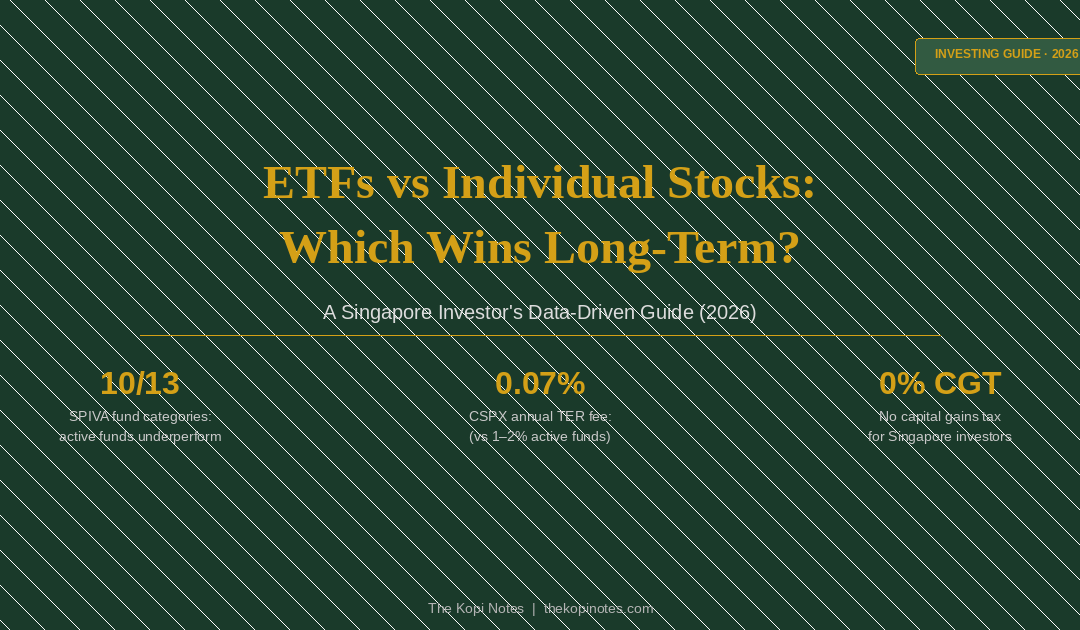
How to Invest in Singapore: ETFs vs Individual Stocks — Which Wins Long-Term? (2026 Guide)
Updated 27 October 2026 · The Kopi Notes
For most Singapore investors, a low-cost index ETF consistently outperforms a self-built stock portfolio over 10 years or more. The S&P SPIVA Asia ex-Japan Year-End 2025 report found that in 10 of 13 fund categories, a majority of professionally managed active funds underperformed their benchmarks — and retail stock pickers typically fare even worse. ETFs like CSPX (TER: 0.07% p.a.) deliver instant diversification across 500+ companies at a fraction of the cost of building your own portfolio.
Not financial advice. All figures are for educational reference only. Data verified as at 27 October 2026 unless noted.
Table of Contents
The Core Question: ETFs or Individual Stocks?
When you start investing in Singapore, one of the first decisions you face is deceptively simple: should you buy an ETF that tracks an entire index, or pick individual stocks you believe in?
Both approaches can build wealth. Both have passionate advocates. But the evidence strongly favours ETFs for the vast majority of investors — not because stock picking is impossible, but because the odds, costs, and time commitment are stacked against it in ways most retail investors underestimate.
This guide breaks down both approaches with real data from Singapore’s investing landscape, so you can make an informed decision — not one based on what sounds exciting.
The Promise of Each Approach
ETF investing is built on a simple thesis: financial markets are broadly efficient over the long run, and the average active manager cannot consistently beat the index after fees. Instead of trying to pick winners, you own the entire market at near-zero cost and earn the market’s return.
Stock picking promises something more exciting: the ability to outperform — to find the next DBS before it doubles, or exit before a company’s earnings collapse. The appeal is real. The results, however, are far more mixed.
How ETF Investing Works in Singapore
An Exchange-Traded Fund (ETF) is a fund that holds a basket of securities — typically tracking an index like the S&P 500 or the FTSE All-World — and trades on a stock exchange just like a share.
For Singapore investors, the two most popular ETF choices are:
- CSPX (iShares Core S&P 500 UCITS ETF) — listed on the London Stock Exchange (LSE), Ireland-domiciled, tracks 503 US large-cap companies, TER: 0.07% p.a.
- VWRA (Vanguard FTSE All-World UCITS ETF ACC) — listed on LSE, Ireland-domiciled, tracks ~3,700 companies in 50+ countries, TER: 0.22% p.a.
Why buy ETFs on the LSE? Ireland-domiciled ETFs benefit from a 15% withholding tax (WHT) rate on US dividends under the US-Ireland tax treaty — compared to 30% for US-domiciled ETFs (like VOO or SPY) held by non-US investors. For a Singapore investor receiving USD dividends, this difference compounds significantly over decades.
The ETF Investing Process
Getting started with ETFs in Singapore takes four steps:
- Open a brokerage account — IBKR (Interactive Brokers) is the preferred platform for LSE ETFs due to low commissions (~USD 1.70 per trade) and multi-currency accounts
- Fund your account — transfer SGD, convert to GBP or USD via IBKR’s Forex at spot rates
- Buy the ETF on LSE — search for CSPX or VWRA on the London Stock Exchange tab
- DCA monthly (optional) — many investors set a fixed monthly amount to buy, removing timing stress
Alternatively, platforms like Syfe referral code and sign-up bonus and Endowus referral code offer regular savings plans (RSPs) with monthly automatic investing from as little as SGD 50/month — ideal for beginners who want automation over manual trading.
You can also invest through your SRS (Supplementary Retirement Scheme) account via Endowus, giving you an additional tax deduction of up to SGD 15,300/year (citizens and PRs) while your ETF portfolio compounds.
How Individual Stock Picking Works
Individual stock picking means selecting specific companies you believe will outperform — buying shares in DBS, Apple, Sea Limited, or any other company whose business you understand and whose growth you’re confident in.
The standard process involves:
- Fundamental analysis — reading annual reports, studying earnings, assessing competitive moats, and evaluating management quality
- Valuation — determining whether the stock is cheap or expensive relative to its fundamentals (P/E ratio, free cash flow, book value)
- Portfolio construction — deciding how much to allocate to each position, typically 5–20 stocks
- Ongoing monitoring — tracking quarterly earnings, news, sector developments, and thesis checks
On the SGX, blue-chip Singapore stocks like DBS, OCBC, UOB, Singtel, and CapitaLand can be bought through CDP (Central Depository) accounts via local brokers. US stocks are accessible through IBKR, Moomoo, or Tiger Brokers.
The Honest Appeal of Stock Picking
Stock picking is genuinely engaging. Following companies teaches you business fundamentals, sharpens analytical skills, and — when it works — delivers returns that are viscerally satisfying. For some investors, the intellectual engagement is itself valuable.
The risks, however, are real and often underestimated: concentration risk, emotional bias, survivorship bias (we remember our winners, not our losers), and the very real cost of getting macro or sector timing wrong.
And then there’s the most overlooked cost of all: time. Doing stock picking properly requires 10–20 hours per week for research. That time has a value — and for most Singapore investors, it’s better spent building their career, spending time with family, or simply resting.
What the Data Shows: Active Management vs Passive (SPIVA 2025)
Opinions and anecdotes are everywhere in investing. The data is more sobering.
The S&P SPIVA (S&P Indices Versus Active) Scorecard is the most comprehensive, independent audit of active vs passive fund performance globally. The Asia ex-Japan Year-End 2025 SPIVA report found:
“In 10 of 13 fund categories reported, a majority of active funds underperformed their respective benchmark indices. Underperformance rates generally increase for longer time horizons.”
— S&P SPIVA Asia ex-Japan Year-End 2025 Scorecard
Among the specific markets with the highest active fund underperformance over 5 years:
- Thailand Large-Cap: 83.0% of active funds underperformed their benchmark
- Malaysia Large-Cap: 68.3% underperformed
- Korea US Equity Funds: 77.0% underperformed the S&P 500 benchmark (in KRW)
These are professional fund managers — people with research teams, institutional access, Bloomberg terminals, and decades of experience — and the majority still underperform a simple index ETF after fees.
Retail investors face compounding headwinds beyond what professional funds deal with: higher brokerage costs per trade, limited research access, concentration in far fewer stocks, and the emotional challenge of watching positions move with no analyst team to confer with.
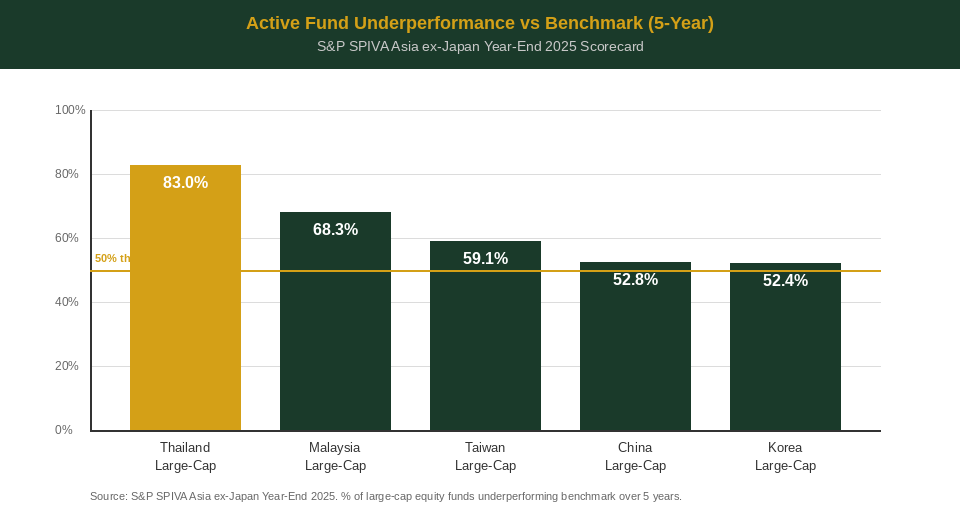
Source: S&P SPIVA Asia ex-Japan Year-End 2025 Scorecard. Percentage of large-cap equity funds that underperformed their benchmark over 5 years.
Why Does This Happen?
The underperformance of active managers is well-explained by costs: every basis point in management fees, transaction costs, and research overheads is a direct drag on returns. An index ETF has no research costs, trades infrequently, and charges as little as 0.07% per year.
There’s also the mathematical reality: for every investor who outperforms, another must underperform — the market is a zero-sum game before costs, and negative-sum after costs. Active managers compete against each other, not against the index, and collectively they cannot beat the aggregate market.
Singapore-Specific Factors: What Changes the Equation Here
Beyond the global data, Singapore investors have several unique considerations that further tilt the balance toward ETFs in many (but not all) scenarios.
1. Capital Gains Tax: The Great Equaliser
Singapore has no capital gains tax — profits from selling both ETFs and individual stocks are completely tax-free for investors. This is a major advantage that makes equity investing especially attractive versus most other countries.
2. Withholding Tax: Where ETFs Win Decisively
For investors holding US-listed assets, withholding tax (WHT) on dividends matters enormously over decades:
| Investment Type | WHT on US Dividends | Annual Cost on SGD 100k (1.2% yield) |
|---|---|---|
| CSPX, VWRA (Ireland-domiciled LSE ETF) | 15% | SGD 180 (WHT on SGD 1,200 dividends) |
| VOO, SPY (US-domiciled ETFs) | 30% | SGD 360 (WHT on SGD 1,200 dividends) |
| Direct US stocks (Apple, Nvidia, etc.) | 30% | 30% of dividends received |
| Singapore stocks (DBS, OCBC, etc.) | 0% | SGD 0 (but lower dividend yields generally) |
Source: US-Ireland Tax Treaty, IRS Notice 2007-41. Assumes 1.2% annual dividend yield on a SGD 100,000 portfolio. October 2026.
The 15% WHT advantage of Ireland-domiciled ETFs vs US-domiciled ETFs saves SGD 180 per year on a SGD 100,000 portfolio — and this difference compounds in accumulating ETFs where dividends are reinvested gross within the fund structure.
3. US Estate Tax: A Risk Many Ignore
Non-US persons holding US-situs assets (US stocks, US-domiciled ETFs) worth over USD 60,000 face potential US estate tax of up to 40% on the excess — payable before the estate can be distributed to heirs.
Ireland-domiciled ETFs (CSPX, VWRA) are not US-situs assets, so they are outside the US estate tax net for Singapore investors — a potentially enormous estate planning advantage as portfolios grow into six or seven figures.
4. SRS and CPF: The Tax Wrapper Question
Two government tax-advantaged schemes change the calculation:
- SRS (Supplementary Retirement Scheme): Contributions reduce your taxable income by up to SGD 15,300/year. You can invest SRS funds in ETFs via Endowus referral code (ETF portfolios) or individual SGX-listed stocks. LSE ETFs cannot be bought with SRS funds.
- CPFIS (CPF Investment Scheme): Allows investing CPF OA funds in approved SGX-listed securities — including the STI ETF and individual CPFIS-approved Singapore stocks, but not LSE ETFs. See our CPF investment strategy guide for details.
If building a passive income stream in Singapore is your goal, combining dividend-paying Singapore stocks (via CDP) with accumulating global ETFs (via IBKR) and SRS optimisation through Endowus gives you the best of all worlds.
Full Comparison: ETFs vs Individual Stocks for Singapore Investors
| Factor | ETF Investing (CSPX/VWRA) | Individual Stock Picking |
|---|---|---|
| Diversification | 500–3,700 companies instantly | Typically 5–20 stocks |
| Annual Fee (TER) | 0.07%–0.22% | 0% TER; brokerage fees per trade |
| Time Required | <1 hour/month (DCA) | 10–20+ hours/month |
| WHT on US Dividends | 15% (Ireland domicile) | 30% (direct US stock holdings) |
| Capital Gains Tax (SG) | None | None |
| US Estate Tax Exposure | None (Ireland-domiciled) | Yes, on US stocks above USD 60k |
| SRS Eligible | Yes (via Endowus, Syfe) | Yes (SGX-listed only) |
| CPF (CPFIS) Eligible | STI ETF only; not LSE ETFs | Yes (CPFIS-approved SGX stocks) |
| 10-Year Outperformance Odds | Tracks market (guaranteed) | <50% (SPIVA data) |
| Best For | Most investors; beginners to intermediate | Experienced investors with time and discipline |
Source: iShares, Vanguard factsheets; S&P SPIVA Asia ex-Japan Year-End 2025; IRS Estate Tax Regulations; October 2026. ETF domicile refers to Ireland-domiciled ETFs (CSPX, VWRA) listed on London Stock Exchange.
The 20-Year Cost Drag: What Fees Actually Cost You
Here’s a calculation many investors never run: what does a management fee difference of 1–2% actually cost over a long investment horizon?
The answer is staggering. On a SGD 100,000 portfolio, assuming a 7% gross annual return over 20 years:
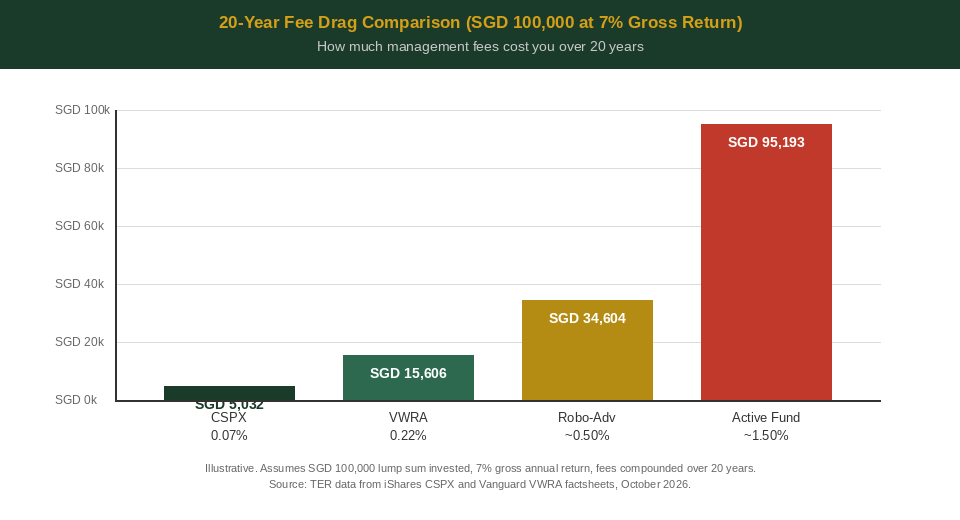
| Investment Type | Annual Fee (TER) | 20-Year Portfolio Value | Cost Drag vs No Fees |
|---|---|---|---|
| No fees (benchmark) | 0% | SGD 386,968 | — |
| CSPX (S&P 500 ETF) | 0.07% | SGD 381,937 | SGD 5,032 |
| VWRA (Global All-World ETF) | 0.22% | SGD 371,363 | SGD 15,606 |
| Robo-Advisor (all-in) | ~0.50% | SGD 352,365 | SGD 34,604 |
| Active Unit Trust / Fund | ~1.50% | SGD 291,776 | SGD 95,193 |
Illustrative calculation. Assumes SGD 100,000 lump sum invested, 7% gross annual return, fees compounded over 20 years. Does not include brokerage commissions, withholding tax, or taxes. Source: fee data from iShares CSPX and Vanguard VWRA factsheets (October 2026).
Choosing CSPX over a typical 1.5% active fund doesn’t just save you the fees — it keeps those SGD 90,161 working in your portfolio, compounding over decades. Use our Singapore retirement calculator to model your own scenarios.
Our Recommendation for Singapore Investors
Based on the data, here is what we recommend at The Kopi Notes:
Start With ETFs If You Are:
- A beginner investor (less than 3 years experience)
- Someone who cannot commit 10+ hours per week to company research
- Primarily saving for retirement (20+ year horizon)
- Starting with a portfolio under SGD 200,000 (ETF fees are negligible at this scale)
- Prioritising simplicity and automation (RSP plans via Syfe referral code and sign-up bonus or FSMOne referral code)
Consider Individual Stocks As a Satellite If You Are:
- An experienced investor (5+ years) with a clear investment thesis
- Genuinely passionate about company analysis and the research process
- Building income-oriented portfolio with Singapore dividend stocks (DBS, OCBC, REITs)
- Using CPF OA funds via CPFIS where LSE ETFs are not eligible
The Hybrid Approach (Most Practical for Singapore Investors)
Many experienced Singapore investors use a core-satellite strategy:
- Core (70–80%): CSPX or VWRA via IBKR — market-rate returns at lowest cost
- Satellite (20–30%): Singapore blue chips (DBS, OCBC, REITs) for local income and CPF-eligibility
- SRS allocation: Route SRS contributions through Endowus for tax-efficient ETF investing
The core ETF foundation handles global equity exposure efficiently. The satellite stocks provide dividend income, Singapore market participation, and the intellectual engagement of following specific companies — without betting your entire financial future on stock picks being right.
Whatever approach you choose, consistency matters more than optimisation. Starting with SGD 100/month in a low-cost ETF at age 25 beats starting with SGD 1,000/month in the “perfect” stock portfolio at 35.
Frequently Asked Questions
Is it better to buy ETFs or individual stocks in Singapore?
For most Singapore investors, ETFs are the better starting point. A low-cost index ETF like CSPX (TER: 0.07%) gives you instant diversification across 500+ companies, lower costs, and — based on SPIVA data — better long-term performance than the majority of actively managed funds. Individual stocks can outperform, but require significant research time, carry higher concentration risk, and most retail investors underperform a simple index ETF over 10 years. A core ETF portfolio with a small stock satellite is a practical middle ground for those who enjoy company research.
What is withholding tax and how does it affect ETF vs stock investors in Singapore?
Withholding tax (WHT) is a tax deducted at source on dividends paid to foreign investors. Singapore investors holding US stocks directly face 30% WHT on US dividends. However, Ireland-domiciled ETFs like CSPX and VWRA benefit from the US-Ireland tax treaty, reducing WHT to 15% — saving you half the dividend tax drag. Over decades and on a larger portfolio, this 15% difference compounds materially. Additionally, accumulating ETFs (like CSPX) reinvest dividends gross within the fund before the 15% is applied, which is more efficient than receiving dividends net of WHT.
Do I need to pay capital gains tax on stocks or ETFs in Singapore?
No. Singapore has no capital gains tax for individual investors. Profits from selling ETFs or individual stocks — whether listed in Singapore, the UK (LSE), or the US — are completely tax-free in Singapore. This applies to both short-term and long-term gains. Note that dividends are subject to withholding tax (see above), and there are specific rules if you are deemed to be trading as a business. For the vast majority of buy-and-hold retail investors, capital gains are 100% tax-free.
Can I use CPF or SRS money to buy ETFs or individual stocks?
SRS funds can be invested in ETFs through platforms like Endowus (which offers CSPX, VWRA, and other ETF-based portfolios) and in individual SGX-listed stocks through brokers that support SRS. LSE-listed ETFs like CSPX cannot be bought directly with SRS funds from a standard brokerage — they must be accessed via Endowus or similar platforms. CPF OA funds (via CPFIS) can be used for approved Singapore-listed stocks and the STI ETF, but not for LSE ETFs. Always check with your broker for the current list of CPFIS-approved instruments.
What is the minimum amount needed to invest in CSPX vs individual stocks?
CSPX trades in board lots of 1 share on the LSE. As of 2026, each CSPX share costs approximately GBP 500–600 (~SGD 840–1,000). Through regular savings plans (RSPs) via platforms like Syfe or FSMOne, you can invest in ETF portfolios from as little as SGD 50/month without needing to buy a full share. Individual Singapore stocks typically require a minimum of 100 shares (one board lot) — costs vary from ~SGD 100 for some counters to SGD 2,000+ for blue chips. US stocks can be bought in fractional shares via some brokers with no minimum.
What does SPIVA data tell us about stock picking vs ETF investing?
The S&P SPIVA scorecard is the most comprehensive global study of active vs passive fund performance. The Asia ex-Japan Year-End 2025 edition found that in 10 of 13 fund categories, a majority of professionally managed active funds underperformed their benchmark indices over 5 years. In Thailand, 83% of large-cap active funds underperformed; in Malaysia, 68.3%; and in Korea’s US equity fund category, 77% trailed the S&P 500. These are professional managers — retail stock pickers typically face even steeper odds. The takeaway: an index ETF is likely to outperform the majority of stock portfolios over a 5–10 year period.
Ready to Start Investing in Singapore?
Compare platforms, claim referral bonuses, and start building your portfolio today.
This article was researched with the help of AI. While we strive to keep all information accurate and up to date, there may be errors. If you notice any discrepancies, please contact us.