ASEAN ETF Singapore: How to Invest Across Malaysia, Thailand, Indonesia & Vietnam (2026 Guide)
There’s no single UCITS ETF for ASEAN — here’s how Singapore investors actually build regional exposure in 2026.
There is no clean, single UCITS ETF that tracks all of ASEAN. Singapore investors instead use the US-listed Global X FTSE Southeast Asia ETF (ASEA), which bundles Singapore, Malaysia, Thailand, Indonesia and the Philippines, or build a DIY basket from single-country funds like EWM, THD, EIDO, EPHE and VNM. Both routes are US-domiciled, meaning 30% dividend withholding tax and US estate tax exposure above USD 60,000 — unlike LSE-listed Ireland UCITS ETFs.
Not financial advice. All figures are for educational reference only. Data verified as at 25 October 2026 unless otherwise noted.
What Is ASEAN ETF Investing?
ASEAN ETF investing means buying a fund (or a basket of funds) that gives exposure to the ten-member Association of Southeast Asian Nations bloc — in practice, for a retail Singapore investor, that means Malaysia, Thailand, Indonesia, the Philippines and Vietnam, since Singapore itself is already well covered by SGX-listed STI ETFs. Unlike the S&P 500 or MSCI World, there is no large, liquid, Ireland-domiciled UCITS ETF that tracks a broad ASEAN index on the London Stock Exchange the way CSPX or VWRA does for US and global equities. The closest broad-basket option is the Global X FTSE Southeast Asia ETF (ticker: ASEA), listed on NYSE Arca in the US and tracking the FTSE/ASEAN 40 Index — a 40-stock index spanning Singapore, Malaysia, Indonesia, Thailand and the Philippines. ASEA’s single largest holding is typically DBS Group, at around 16% of the fund, according to Global X’s ASEA fund page and Robinhood’s April 2026 holdings data, which tells you something important: even the “regional” ETF is really a Singapore-bank-and-blue-chip fund with some neighbouring exposure layered on, not a pure play on Southeast Asian growth sectors.
For investors who want more targeted or larger exposure to a specific ASEAN growth market — Vietnam’s manufacturing and consumption boom, or Indonesia’s commodity and domestic-consumption story — the alternative is to buy single-country ETFs directly: iShares MSCI Malaysia (EWM), iShares MSCI Thailand (THD), iShares MSCI Indonesia (EIDO), iShares MSCI Philippines (EPHE), and VanEck Vietnam (VNM). None of these are SGX-listed; all trade on US exchanges (NYSE Arca or Cboe BZX).
Why ASEAN Is Back on Investors’ Radar in 2026
Three macro threads have pushed ASEAN back into investor conversations in 2026. First, the “China plus one” supply-chain shift continues to route manufacturing investment into Vietnam, Malaysia and Indonesia as companies diversify production away from a single-country concentration in China. Second, with the US Federal Reserve cutting rates through 2026, capital has historically rotated back into higher-growth, rate-sensitive emerging and frontier Asian markets as the US dollar softens and carry trades unwind. Third, intra-ASEAN economic integration — including digital payment links such as MAS’s PayNow-linked schemes expanding regionally — has strengthened the narrative that Southeast Asia’s combined economic bloc, with a population above 650 million, is investable as a theme in its own way, even without a single clean index product to express it.
For a Singapore investor specifically, there’s also a home-bias argument: ASEAN neighbours like Malaysia and Indonesia are directly affected by Singapore-linked trade, investment and labour flows, so this is a region many SG investors already have an intuitive feel for before researching a single stock or fund.
Best ASEAN-Exposure ETFs for Singapore Investors
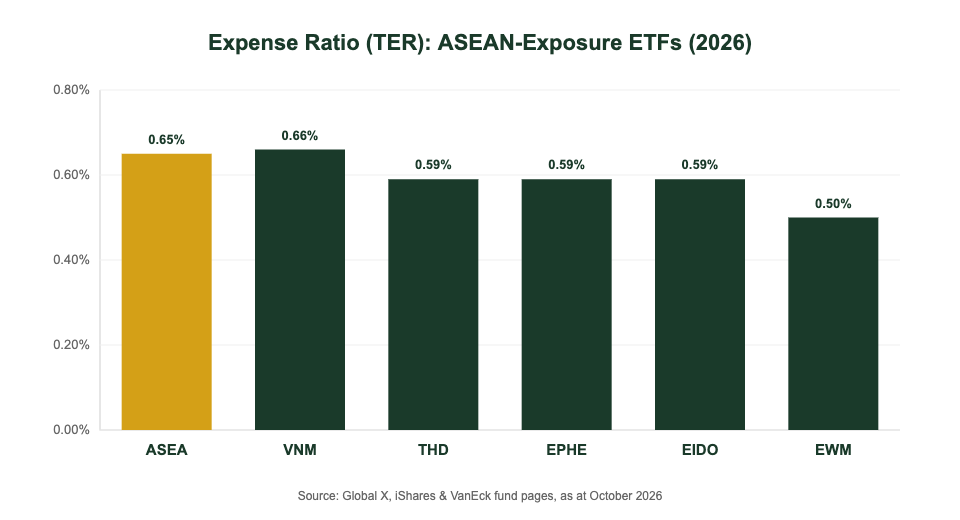
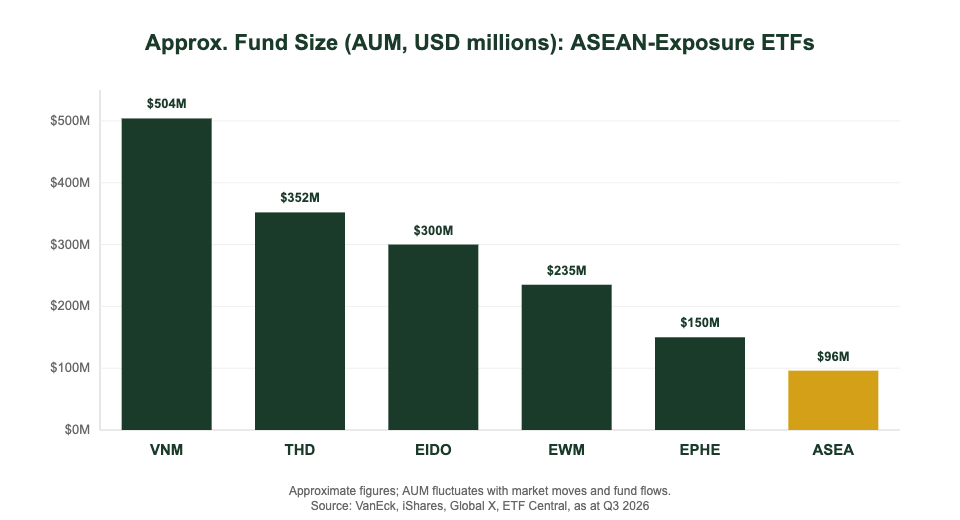
Here is how the main options compare on cost, size and what each actually holds. All figures are approximate and sourced from issuer fund pages and third-party data aggregators as at Q3 2026 — ETF AUM moves daily with markets and flows, so treat these as a snapshot rather than a live number.
| ETF | Exchange | TER | Approx. AUM | Focus |
|---|---|---|---|---|
| ASEA (Global X FTSE Southeast Asia) | NYSE Arca | 0.65% | ~USD 96M | Broad basket: SG, MY, ID, TH, PH |
| VNM (VanEck Vietnam) | Cboe BZX | 0.66% | ~USD 504M | Vietnam single-country |
| THD (iShares MSCI Thailand) | NYSE Arca | 0.59% | ~USD 352M | Thailand single-country |
| EIDO (iShares MSCI Indonesia) | NYSE Arca | 0.59% | ~USD 270-300M | Indonesia single-country |
| EWM (iShares MSCI Malaysia) | NYSE Arca | 0.50% | ~USD 235M | Malaysia single-country |
| EPHE (iShares MSCI Philippines) | NYSE Arca | 0.59% | ~USD 150-190M | Philippines single-country |
Source: Global X, VanEck and iShares fund pages; Pensions & Investments and ETF Central AUM data, as at Q3 2026.
Tax: Why There’s No “Clean” ASEAN UCITS ETF
Singapore investors who use CSPX or VWRA are used to a specific tax structure: Ireland-domiciled UCITS ETFs, listed on the London Stock Exchange, which benefit from the Ireland-US tax treaty’s 15% withholding tax rate on US-sourced dividends and carry no US estate tax exposure. None of the ASEAN options above work this way. ASEA, EWM, THD, EIDO, EPHE and VNM are all US-domiciled funds, listed on US exchanges. That has two consequences for a Singapore resident. First, dividend withholding tax on these funds is 30% rather than 15%, because the treaty benefit that applies to Ireland-domiciled funds doesn’t apply here — although in practice this matters less for ASEAN ETFs, since most of the underlying companies are themselves based in Malaysia, Thailand, Indonesia or the Philippines rather than the US, so US withholding tax applies only to the US-domiciled fund wrapper’s own distributions, not to foreign-sourced dividends flowing through it. Second, and more materially, these are US situs assets for US estate tax purposes — a non-resident alien holding more than USD 60,000 in combined US situs assets (which includes ETFs listed on US exchanges) can be exposed to US estate tax on death, with rates that escalate steeply and no spousal exemption for non-US-domiciled individuals, according to IRS guidance on estate tax for nonresidents.
For a Singapore investor building a SGD 50,000 position in VNM, EIDO or ASEA, the estate tax exposure alone is a reason to size these positions deliberately and consider them a smaller, satellite allocation rather than a core holding — the way many SG investors already treat emerging and frontier market tilts relative to a CSPX or VWRA core.
How to Buy ASEAN ETFs in Singapore
Because every option above is listed on a US exchange, the mechanics are the same regardless of which specific ticker you choose. Fund your brokerage account in SGD or USD, search for the ticker (ASEA, EWM, THD, EIDO, EPHE or VNM), confirm you’re selecting the NYSE Arca or Cboe BZX listing, and place your order in USD during US market hours.
Interactive Brokers (IBKR) remains the most cost-effective choice for larger, buy-and-hold ASEAN ETF positions, given its low per-trade commissions and tight FX conversion spreads on larger amounts. For investors who want a simpler mobile-first experience, the Syfe referral code and sign-up bonus gives access to Syfe Brokerage’s commission-free US market trades, which is well suited to building a smaller, dollar-cost-averaged ASEAN satellite position without per-trade fee drag. MooMoo Singapore also lists all six tickers and is a reasonable middle ground on fees and platform usability for Singapore-based investors who already hold a MooMoo account for other US-listed ETFs.
None of these ASEAN ETFs are SGX-listed, so they are not CPFIS-approved and cannot be bought with CPF Ordinary Account savings. They are, however, generally SRS-compatible through brokers that support SRS-funded trades on US exchanges — worth checking with your specific broker before assuming SRS funds can be deployed here. For a broader view of how ASEAN exposure fits into a CPF-and-SRS retirement strategy, see our CPF investment strategy guide.
Risks to Consider
ASEAN ETFs carry concentration risk at both the country and stock level — ASEA’s ~16% weighting to a single bank (DBS) means the “regional” fund can move largely on Singapore financial-sector news rather than broad ASEAN growth. Single-country funds like VNM, EIDO and EPHE are even more concentrated, often in financials, telecoms and a handful of large conglomerates, and some of these markets have historically had periods of low average daily trading volume at the fund level, which can widen bid-ask spreads versus a heavily-traded fund like VWRA or CSPX. Currency risk is layered on top: while the ETFs trade in USD, the underlying companies earn in MYR, THB, IDR, PHP and VND, so a Singapore investor is taking on three layers of currency exposure (local currency to USD to SGD) rather than the simpler USD-to-SGD exposure of a US or global equity ETF. Finally, these are thematic/regional satellite positions, not core holdings — most of the EEAT and risk-management literature on factor and regional tilts suggests sizing a basket like this as a modest percentage of a portfolio rather than a primary allocation, alongside a core such as the Singapore REIT ETF guide covers for income-focused investors, or the broader diversification discussed in our passive income Singapore article.
For investors who prefer a lower-maintenance, broadly diversified core before adding regional satellites like ASEAN exposure, our Singapore REIT ETF guide and the Singapore retirement calculator are useful starting points for sizing how much of a portfolio a thematic regional tilt like this should realistically occupy. If you’re assessing whether ASEAN exposure should sit inside an SRS account, our Singapore T-bills 2026 guide also covers how to think about the “safe core, growth satellite” split more generally.
Disclaimer: This article is for educational purposes only and does not constitute financial advice. ETF prices, expense ratios, AUM and tax rules change over time — always verify current figures on the issuer’s official fund page and consult a licensed financial adviser before making investment decisions. The Kopi Notes may earn a referral fee from some of the broker links above.
Frequently Asked Questions
Is there a single ASEAN ETF Singapore investors can buy?
The closest option is the Global X FTSE Southeast Asia ETF (ASEA), listed on NYSE Arca, which tracks the FTSE/ASEAN 40 Index and holds a basket of Singapore, Malaysia, Indonesia, Thailand and Philippine stocks. It is not SGX-listed, is relatively small (around USD 96 million in assets as at mid-2026), and is heavily weighted toward Singapore financials such as DBS. There is no Ireland-domiciled UCITS equivalent on the London Stock Exchange.
Which ASEAN country ETF has the lowest fees?
iShares MSCI Malaysia (EWM) has the lowest expense ratio among the main options at approximately 0.50% per year, compared with 0.59% for THD, EIDO and EPHE, and around 0.65-0.66% for ASEA and VNM. Fees are a secondary consideration here, though — fund liquidity, bid-ask spreads and country-specific risk usually matter more for sizing a position than a 0.1-0.15 percentage point TER difference.
Can I buy ASEAN ETFs with my CPF or SRS funds?
No CPF Ordinary Account funds — ASEA, EWM, THD, EIDO, EPHE and VNM are US-listed and not CPFIS-approved. SRS funds can generally be used if your broker supports SRS-funded trades on US exchanges, but this varies by broker and should be confirmed before you plan around it.
Is ASEAN ETF investing safe for a Singapore retiree's portfolio?
ASEAN ETFs are generally better suited as a smaller, satellite allocation rather than a core retirement holding, given their country concentration, currency layering (local currency to USD to SGD) and, for VNM, EIDO and EPHE specifically, thinner trading liquidity than a broad global fund like VWRA. Most retirees would be better served by sizing any ASEAN tilt as a modest percentage of a diversified core portfolio.
What is the US estate tax risk on ASEAN ETFs for Singapore investors?
Because ASEA, EWM, THD, EIDO, EPHE and VNM are all listed on US exchanges, they count as US situs assets. A non-resident alien (including a Singapore citizen or PR) holding more than USD 60,000 in combined US situs assets at death can be exposed to US estate tax, which has no spousal exemption for non-US-domiciled individuals and rates that rise steeply above that threshold, per IRS guidance for nonresidents. This is a key reason to size ASEAN ETF positions deliberately rather than concentrating a large portfolio in US-listed regional funds.
Should I buy the ASEA basket or build my own with single-country ETFs?
ASEA is simpler — one ticker, one trade — but its heavy weighting to Singapore financials means it doesn’t give you much that a Singapore-based investor doesn’t already have. Building your own basket from EWM, THD, EIDO, EPHE and VNM costs more in brokerage commissions and requires more rebalancing effort, but lets you overweight the specific growth markets (like Vietnam or Indonesia) you actually have a view on, rather than accepting ASEA’s fixed country weights.
Ready to Add ASEAN Exposure to Your Portfolio?
Open a brokerage account and size your ASEAN ETF allocation as part of a diversified plan.
This article was researched with the help of AI. While we strive to keep all information accurate and up to date, there may be errors. If you notice any discrepancies, please contact us.