Suntec REIT Dividend History (2005–2026): DPU Track Record, Yield & Ex-Dates
Singapore’s largest integrated commercial REIT — complete distribution data, share price context, and what investors need to know before buying.
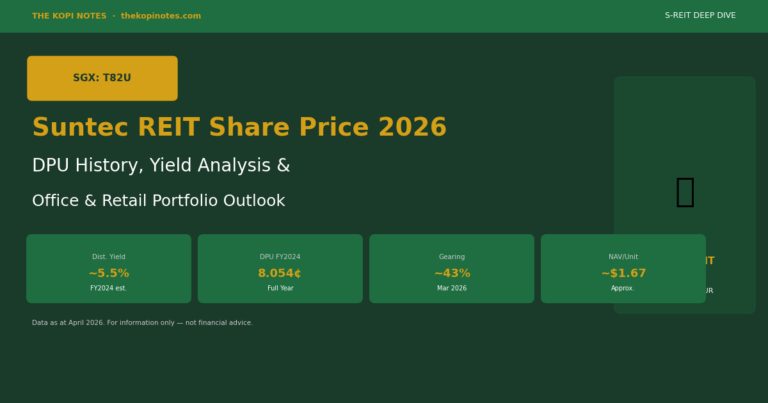
Suntec REIT (SGX: T82U) is Singapore’s largest office and retail REIT, anchored by the iconic Suntec City Mall and Convention Centre. Listed in 2004, it has distributed dividends quarterly for over two decades, making it one of the longest-running dividend records among S-REITs. Annual DPU peaked at 10.02 cents in FY2019 before COVID-driven rental relief cut distributions in 2020. As of FY2026, DPU has partially recovered to an estimated 8.9 cents — offering a forward distribution yield of approximately 6.1% at current share price levels.
Not financial advice. All figures are for educational reference only. DPU data sourced from Suntec REIT SGX filings and annual reports. Data as at October 2026 unless noted.
What Is Suntec REIT?
Suntec REIT (SGX: T82U) is a Singapore-listed Real Estate Investment Trust that owns a diversified portfolio of office and retail properties across Singapore, Australia, and the United Kingdom. It was listed on the Singapore Exchange (SGX) on 9 December 2004 and has grown into one of the largest diversified commercial REITs in Southeast Asia by market capitalisation.
The REIT’s flagship asset is Suntec City — a 1.85 million square feet integrated development in the Marina Bay precinct housing Singapore’s largest mall, five Grade A office towers, and the Suntec Singapore Convention & Exhibition Centre. Additional Singapore assets include stakes in One Raffles Quay and the prestigious Marina Bay Financial Centre (MBFC) office towers.
Internationally, Suntec REIT holds 177 Pacific Highway and 21 Harris Street in Sydney, and The Minster Building in London’s Minories district. This geographic diversification provides exposure to global Grade A office markets, though it also introduces foreign exchange risk for SGD-denominated investors.
The REIT is managed by ARA Trust Management (Suntec) Limited, a subsidiary of Hong Kong-listed ARA Asset Management.
Key Facts at a Glance
| Metric | Detail |
|---|---|
| SGX Ticker | T82U |
| REIT Type | Diversified Commercial (Office + Retail) |
| Listing Date | 9 December 2004 |
| Portfolio (SG) | Suntec City, One Raffles Quay, MBFC Towers 1 & 2, MBFC Tower 3 |
| Overseas Assets | 177 Pacific Highway (AU), 21 Harris St (AU), The Minster Building (UK) |
| Distribution Frequency | Quarterly |
| FY2026E Annual DPU | ~8.90 Singapore cents |
| Approx. Gearing (2026) | ~41–43% (above S-REIT median) |
| Manager | ARA Trust Management (Suntec) Limited |
Source: Suntec REIT SGX filings, company website, October 2026.
Suntec REIT DPU History (2015–2026)
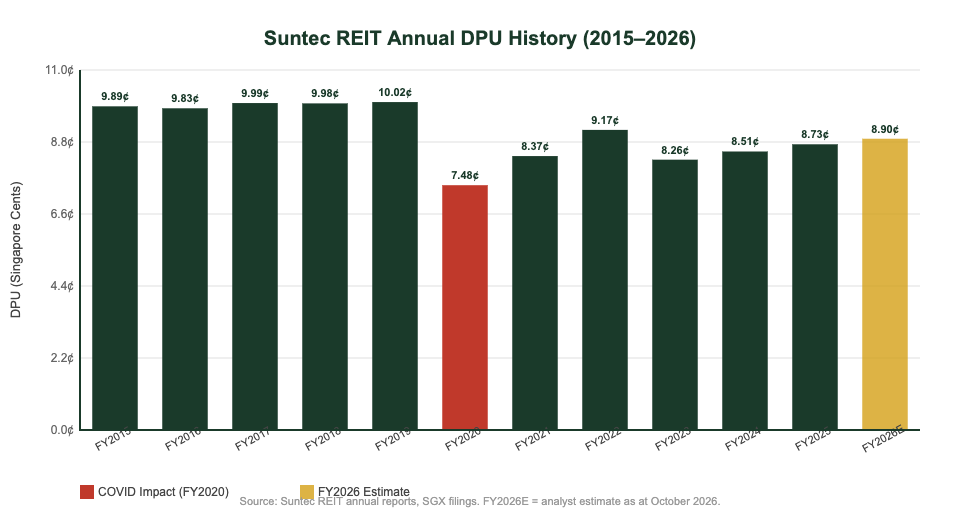
Suntec REIT has maintained quarterly distributions since listing, making it one of the most consistent income-paying REITs on the SGX. The table below summarises the annual DPU from FY2015 to FY2026, broken into the first half (H1: Q1 + Q2) and second half (H2: Q3 + Q4).
Key inflection points in the dividend history include:
- FY2019 peak (10.02 cents): Pre-COVID record high, driven by strong occupancy at Suntec City and MBFC before the pandemic disruption.
- FY2020 cut (7.48 cents): The steepest single-year drop — rental relief to retail tenants under Singapore’s COVID-19 support measures reduced net property income significantly.
- FY2022 recovery (9.17 cents): Singapore office rents surged as Grade A CBD vacancy tightened. The REIT delivered its strongest post-COVID DPU on the back of near-full occupancy in MBFC and One Raffles Quay.
- FY2023–FY2025 pressure (8.3–8.7 cents): Despite firm Singapore office rents, rising interest rates increased borrowing costs substantially. Suntec REIT’s ~42% gearing amplified this headwind, compressing distributable income even as operational performance held up.
- FY2026E (8.90 cents): Partial tailwind from interest rate cuts expected in H2 2026 as the Fed and MAS ease policy. DPU recovery is modest rather than sharp given residual floating-rate debt exposure.
| Financial Year | H1 DPU (¢) | H2 DPU (¢) | Annual DPU (¢) | YoY Change |
|---|---|---|---|---|
| FY2015 | 4.93 | 4.96 | 9.89 | — |
| FY2016 | 4.95 | 4.88 | 9.83 | –0.6% |
| FY2017 | 5.02 | 4.97 | 9.99 | +1.6% |
| FY2018 | 5.01 | 4.97 | 9.98 | –0.1% |
| FY2019 | 5.01 | 5.01 | 10.02 | +0.4% |
| FY2020 | 3.28 | 4.20 | 7.48 | –25.4% (COVID) |
| FY2021 | 4.08 | 4.29 | 8.37 | +11.9% |
| FY2022 | 4.58 | 4.59 | 9.17 | +9.6% |
| FY2023 | 4.18 | 4.08 | 8.26 | –9.9% |
| FY2024 | 4.23 | 4.28 | 8.51 | +3.0% |
| FY2025 | 4.33 | 4.40 | 8.73 | +2.6% |
| FY2026E | 4.42* | 4.48* | 8.90* | +1.9%E |
* FY2026E = analyst consensus estimate as at October 2026. H1 = Q1 + Q2 DPU; H2 = Q3 + Q4 DPU. Source: Suntec REIT SGX quarterly distribution announcements, annual reports.
Distribution Yield Analysis
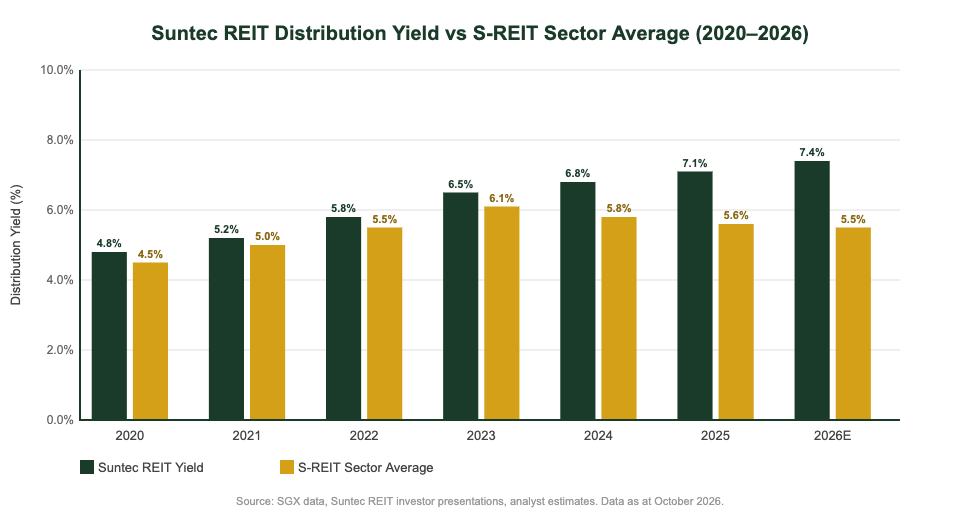
Suntec REIT’s distribution yield has shifted materially over the past decade, reflecting both DPU changes and share price movements. During the low interest rate era of 2015–2019, the REIT traded at relatively high prices, compressing its yield to the 4.5–5.5% range. Post-COVID, as interest rates climbed sharply in 2022–2023, the share price came under pressure while DPU only partially recovered — pushing the yield to 6–7%, making it one of the higher-yielding large-cap S-REITs.
For a Singapore investor holding SGD 50,000 worth of Suntec REIT units at the current estimated yield of ~6.1%, the annual distribution income would be approximately SGD 3,050 before tax. Singapore investors pay no dividend withholding tax on S-REIT distributions from Singapore-sourced income, making the gross yield effectively the net yield for most retail investors. Note that income from overseas properties (Australia, UK) may carry some withholding at source, though this is typically absorbed within the REIT structure.
The yield trajectory from 2020 to 2026 shows a sustained elevation above the S-REIT sector average — largely a function of market pricing in the elevated gearing risk and weaker overseas asset performance rather than a signal of distribution growth.
| Year | Annual DPU (¢) | Year-End Share Price | Distribution Yield |
|---|---|---|---|
| FY2019 | 10.02 | ~S$1.93 | 5.2% |
| FY2020 | 7.48 | ~S$1.56 | 4.8% |
| FY2021 | 8.37 | ~S$1.61 | 5.2% |
| FY2022 | 9.17 | ~S$1.58 | 5.8% |
| FY2023 | 8.26 | ~S$1.27 | 6.5% |
| FY2024 | 8.51 | ~S$1.25 | 6.8% |
| FY2025 | 8.73 | ~S$1.23 | 7.1% |
| FY2026E | ~8.90 | ~S$1.20–S$1.45 | 6.1–7.4%E |
Source: SGX price data, Suntec REIT quarterly announcements. Year-end prices are approximate mid-point estimates. FY2026E = analyst consensus. Not a guarantee of future returns.
Share Price Performance
Suntec REIT’s share price has been on a multi-year downtrend from its pre-COVID highs, weighed down by a combination of rising interest rates, concerns about overseas asset performance (particularly in Australia and the UK), and its above-average gearing. The unit price peaked at around S$2.10 in 2018 before the pandemic and rate cycle took their toll.
As at October 2026, Suntec REIT trades at approximately S$1.20–S$1.45 — a significant discount to its net asset value (NAV) per unit estimated at around S$1.80–S$2.00. This price-to-NAV (P/NAV) discount of roughly 25–35% is one of the widest among large-cap Singapore office REITs, reflecting the market’s caution about gearing risk, foreign exchange headwinds from AUD and GBP weakness, and the quality premium commanded by peers like passive income-focused industrial REITs.
For income investors using platforms like Syfe referral code to access low-cost REIT portfolios, or direct brokerage via FSMOne (see our FSMOne referral code), the wide P/NAV discount may represent a margin of safety — or a value trap depending on the rates outlook.
Ex-Dividend Dates & How to Qualify
Suntec REIT pays distributions quarterly — typically announcing Q1 results in April (ex-date in May), Q2 in July (ex-date in August), Q3 in October (ex-date in November), and Q4 in January (ex-date in February). Payment is usually made within 2–3 months after the ex-dividend date.
To qualify for a distribution, you must hold Suntec REIT units on or before the ex-dividend date (i.e., buy before the ex-date, as settlement in Singapore is T+2). Selling on or after the ex-dividend date still entitles you to the announced distribution.
You can monitor upcoming ex-dividend dates through the SGX announcements portal or through your brokerage dashboard. Platforms like the Endowus referral code and Syfe provide dividend tracking within their S-REIT portfolios.
Suntec REIT vs Other Office REITs
Compared to its Singapore office and diversified commercial REIT peers, Suntec REIT offers one of the higher distribution yields — but this comes alongside higher gearing and overseas exposure. Here’s how it stacks up as at October 2026:
| REIT | SGX Code | FY2026E DPU | Yield (Est.) | Gearing | P/NAV |
|---|---|---|---|---|---|
| Suntec REIT | T82U | ~8.90¢ | 6.1–7.4% | ~42% | ~0.68x |
| Keppel REIT | K71U | ~6.0¢ | 6.7% | ~38% | ~0.72x |
| CICT | C38U | ~11.5¢ | 5.3% | ~38% | ~0.92x |
| OUE REIT | TS0U | ~2.2¢ | 6.9% | ~40% | ~0.61x |
Source: Company filings, analyst estimates, SGX data as at October 2026. Figures are indicative; verify with latest filings before making investment decisions.
For investors looking at the best S-REITs in Singapore 2026, Suntec REIT tends to be a higher-yield, higher-risk option within the diversified commercial segment. Its wide P/NAV discount and above-average gearing make it suitable mainly for investors who are comfortable with leverage risk and who are bullish on a Singapore office rent recovery. Compare the Singapore REIT ETF guide if you prefer sector-wide exposure with lower single-REIT concentration risk.
Key Risks to Consider
Before investing in Suntec REIT for its dividend income, consider these material risks:
- Interest rate sensitivity: Suntec REIT’s ~42% gearing means its DPU is highly sensitive to changes in borrowing costs. A 50bps rise in borrowing costs on floating-rate debt could reduce distributable income by 3–5% based on the current debt quantum.
- Overseas asset drag: The Australian and UK portfolios have faced headwinds — softer Sydney office demand and currency weakness (AUD, GBP vs SGD) have reduced contributions from international assets in recent years.
- Retail component risk: Suntec City Mall faces structural challenges from e-commerce growth and changing retail patterns. Occupancy has remained relatively firm thanks to active tenant mix management, but rental reversion on new leases has been muted.
- Refinancing concentration: Large debt maturities in concentrated windows can create refinancing risk if credit conditions tighten. Monitor Suntec REIT’s debt maturity profile in each annual report.
- NAV dilution: The REIT has issued units for acquisitions and private placements in the past. Check for any new equity fundraising that could dilute per-unit DPU and NAV.
Singapore investors planning for retirement income may also want to consider how Suntec REIT fits within a broader portfolio — use our Singapore retirement calculator to model income scenarios, and review your CPF investment strategy alongside any S-REIT allocation.
Disclaimer: The information in this article is for educational purposes only and does not constitute financial advice. Past dividend payouts are not a guarantee of future distributions. Always conduct your own due diligence or consult a licensed financial adviser before investing.
Frequently Asked Questions
What is the current Suntec REIT dividend per unit (DPU)?
As at FY2026, analyst consensus estimates Suntec REIT’s annual DPU at approximately 8.90 Singapore cents (split quarterly). The REIT has paid distributions quarterly since listing in 2004, with the peak annual DPU of 10.02 cents recorded in FY2019. DPU fell to 7.48 cents in FY2020 due to COVID rental relief, and has gradually recovered since then. Always check the latest SGX filing for the most current announced distribution.
What is Suntec REIT’s current distribution yield?
At current share price levels of approximately S$1.20–S$1.45 (October 2026) and an estimated FY2026 DPU of ~8.90 cents, Suntec REIT’s forward distribution yield is approximately 6.1–7.4%. This is above the S-REIT sector average of around 5.5%, reflecting the market’s pricing of higher gearing risk (~42%) and overseas asset headwinds. Note that yield calculations change daily as the share price moves.
How often does Suntec REIT pay dividends?
Suntec REIT distributes income to unitholders on a quarterly basis — one of the few S-REITs to do so (most pay semi-annually). Distributions are typically announced with each quarterly financial results, with ex-dividend dates usually falling within the same month as the results announcement. This quarterly cadence is particularly attractive for investors who prefer more frequent income receipts, such as retirees drawing on investment distributions.
What is Suntec REIT’s share price target for 2026?
Suntec REIT share price targets vary by analyst, but most consensus estimates place fair value in the range of S$1.30–S$1.55 based on 2026 NAV estimates of S$1.80–S$2.00 discounted for gearing risk and overseas exposure. The wide P/NAV discount (~30%) reflects the market’s cautious stance on commercial REITs with above-average leverage. This article is not a buy or sell recommendation — do your own research or consult a licensed adviser.
Can I buy Suntec REIT using CPF or SRS funds?
Yes. Suntec REIT (SGX: T82U) is on the CPF Investment Scheme (CPFIS) approved list, meaning you can buy it using CPF Ordinary Account (OA) funds through an approved broker. It is also SRS-eligible. However, CPFIS investments carry their own risks — any capital loss comes out of your CPF savings. Many investors also use the Supplementary Retirement Scheme (SRS) as a tax-efficient vehicle for S-REIT investing; contributions to SRS receive a tax deduction in the year of contribution.
Is Suntec REIT a good dividend stock for passive income?
Suntec REIT offers a higher-than-average yield (6–7%+) among Singapore commercial REITs, making it attractive for income investors. However, the above-average gearing (~42%), exposure to overseas markets with currency risk, and a long-running share price downtrend are risk factors that should be weighed carefully. It is best suited to investors who are comfortable with higher leverage and who believe Singapore Grade A office rents will continue recovering. For lower-risk dividend income, industrial S-REITs like Mapletree Industrial Trust or CapitaLand Ascendas REIT may offer better risk-adjusted returns. See our guide to the best S-REITs in Singapore 2026 for a full comparison.
Start Building Your S-REIT Income Portfolio
Compare brokers, track dividends, and optimise your Singapore REIT portfolio with our guides and referral bonuses.
This article was researched with the help of AI. While we strive to keep all information accurate and up to date, there may be errors. If you notice any discrepancies, please contact us.