Endowment Plan vs Index Fund Singapore 2026: Which Grows Your Money Faster?
Comparing guaranteed-return insurance plans with low-cost global index ETFs — the numbers may surprise you.
📋 Table of Contents
Quick Answer: Endowment Plan vs Index Fund
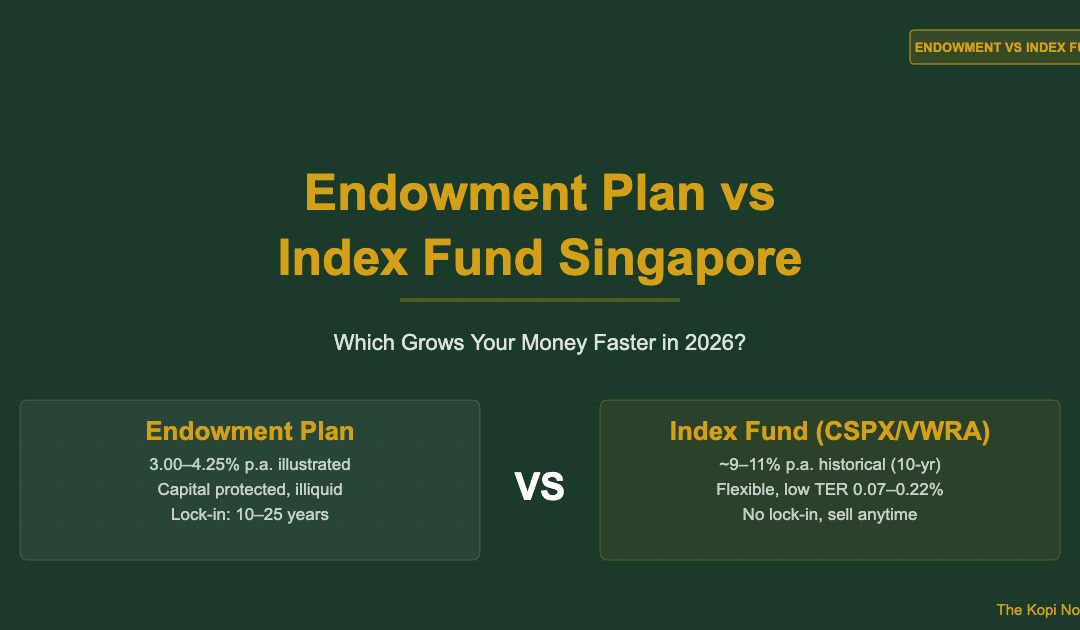
Choosing between an endowment plan and an index fund in Singapore is really a trade-off between certainty and growth. Endowment plans offer capital protection and illustrated returns of 3.00–4.25% p.a. (LIA Singapore guidelines), while index funds like CSPX and VWRA have historically returned 12–15% p.a. over 10 years. If wealth accumulation is your primary goal and you don’t need a capital guarantee, index funds have consistently outperformed endowment plans over the long run.
Not financial advice. All figures are for educational reference only. LIA illustration rates verified against LIA Singapore official page. CSPX 10-year return sourced from BlackRock factsheet as at 30 June 2026. Data verified as at 23 October 2026.
This doesn’t mean endowment plans are without merit — they serve a specific purpose for risk-averse investors who want the peace of mind of a guaranteed floor. But the numbers tell a clear story when you compare both products side by side.
In this guide, we break down how each product works, compare returns using Singapore-specific data, and show you exactly what SGD 50,000 could grow to under each scenario — so you can make an informed decision.
What Is an Endowment Plan?
An endowment plan is a life insurance product that combines a savings or investment component with a death benefit. You pay premiums (single or regular) over a fixed term — typically 3 to 25 years — and at maturity you receive a lump sum payout.
In Singapore, most endowment plans from insurers like AIA, Great Eastern, Prudential, Manulife, and NTUC Income are participating (par) plans. Par plans invest your premiums into the insurer’s participating fund, and your returns come from two components:
- Guaranteed bonuses — a smaller, fixed amount committed at policy inception
- Non-guaranteed bonuses — reversionary and terminal bonuses that depend on the fund’s performance and insurer discretion
The Life Insurance Association (LIA) Singapore sets caps on how insurers may illustrate returns in their product illustrations. As of 1 July 2021 — and confirmed unchanged as at 2026 — the caps are:
| Illustration Rate | Cap (SGD Policies) | What It Means |
|---|---|---|
| Upper Illustration Rate | 4.25% p.a. | Optimistic (non-guaranteed) scenario |
| Lower Illustration Rate | 3.00% p.a. | Conservative (non-guaranteed) scenario |
| Spread | At least 1.25% gap | LIA mandated minimum spread |
Source: LIA Singapore — Illustrated Investment Rate of Return for Par Policies (effective 1 Jul 2021, reviewed annually, unchanged as at 2026)
Important: These are illustration rates used in product benefit illustrations — they are NOT a promise of returns. Actual returns can be lower or higher depending on the insurer’s par fund performance.
Key characteristics of endowment plans:
- Capital is generally protected (you get back at least premiums if held to maturity)
- Illiquid — surrender charges apply if you exit early
- Death benefit built in (typically 101–105% of premiums)
- Not linked to stock market directly (par fund manages a mix of bonds, equities, and property)
What Is an Index Fund (ETF) in Singapore?
An index fund is a passively managed fund that tracks a market index — like the S&P 500 or FTSE All-World — at very low cost. In Singapore, retail investors typically access index funds through Exchange-Traded Funds (ETFs) bought on stock exchanges like the London Stock Exchange (LSE) or SGX.
The three most popular index fund ETFs among Singapore investors in 2026 are:
| ETF | Index Tracked | TER | 10-Yr Return (Annualised) | Domicile |
|---|---|---|---|---|
| CSPX | S&P 500 (US large-cap) | 0.07% | 15.15% | Ireland (UCITS) |
| VWRA | FTSE All-World (global) | 0.22% | ~12.75%* | Ireland (UCITS) |
| ES3 (Nikko AM STI ETF) | Straits Times Index (Singapore) | 0.30% | ~6.5%* | Singapore |
Source: BlackRock CSPX factsheet (as at 30 Jun 2026); *VWRA 10-yr approximate based on VWCE proxy; STI ETF approximate historical average. Past performance not indicative of future returns.
Both CSPX and VWRA are Irish-domiciled UCITS ETFs, which means Singapore investors benefit from a reduced dividend withholding tax of 15% (vs 30% for US-domiciled ETFs) and no US estate tax exposure. You can buy these through brokers like IBKR, Saxo, or via robo-advisors like Syfe referral code and Endowus referral code.
Key characteristics of index fund ETFs:
- No lock-in — buy and sell anytime during market hours
- No capital guarantee — value fluctuates with the market
- Very low cost (TER as low as 0.07%)
- No life insurance or death benefit component
- Transparent — you always know what you own and what it’s worth
Key Differences: Endowment Plan vs Index Fund Singapore
Here’s a side-by-side breakdown of how these two investment vehicles differ across every dimension that matters to a Singapore investor:
| Feature | Endowment Plan | Index Fund ETF |
|---|---|---|
| Capital Guarantee | ✅ Yes (if held to maturity) | ❌ No |
| Illustrated / Historical Returns | 3.00–4.25% p.a. | ~12–15% p.a. (10-yr historical) |
| Lock-in Period | 3–25 years | None |
| Annual Cost | Often 1–2% (par fund internal costs) | 0.07–0.30% TER |
| Life Insurance | ✅ Yes | ❌ No |
| Transparency | Low (par fund = black box) | High (daily NAV, holdings public) |
| Market Risk | Low (smoothed returns) | High (full market exposure) |
| CPF-compatible | Some products (CPFIS-approved) | Select ETFs via CPFIS-OA |
| Suitable for | Conservative investors, forced savers | Growth-focused, long-horizon investors |
Source: LIA Singapore; BlackRock; The Kopi Notes analysis. Data as at October 2026.
The returns comparison is stark. Below is a visual breakdown of annualised returns across both product types, using the LIA illustration rate caps for endowments and verified 10-year historical data for index funds:
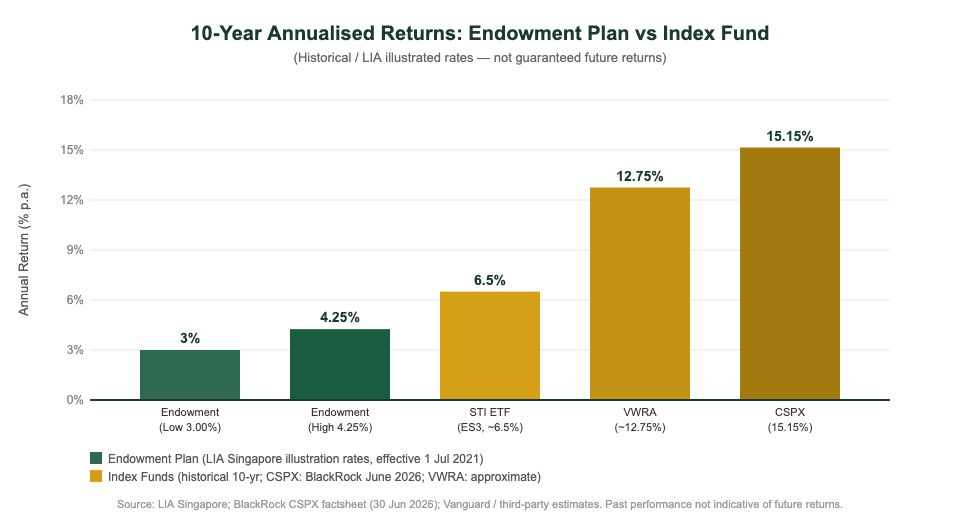
Returns comparison: LIA illustration rate caps (3.00% low, 4.25% high) vs historical 10-year average for CSPX (15.15%, BlackRock Jun 2026) and VWRA (~12.75%, approximate). Past performance not indicative of future returns.
SGD 50,000 Invested: What Happens Over 10 and 20 Years?
Numbers on a chart are one thing — but what does the difference actually look like in your bank account? Let’s run a scenario using a SGD 50,000 lump-sum investment (or single-premium endowment) across all five products:
| Product | Rate / Return | After 10 Years | After 20 Years |
|---|---|---|---|
| Endowment Plan (Low, 3.00%) | 3.00% p.a. | S$67,196 | S$90,306 |
| Endowment Plan (High, 4.25%) | 4.25% p.a. | S$75,519 | S$113,928 |
| STI ETF (ES3, ~6.5% historical) | 6.5% p.a. | S$93,576 | S$174,893 |
| VWRA (~12.75% approx.) | 12.75% p.a. | S$165,819 | S$550,161 |
| CSPX (15.15% — 10-yr, Jun 2026) | 15.15% p.a. | S$202,854 | S$823,178 |
Calculations by The Kopi Notes using compound interest formula. Endowment at LIA illustration rates (not guaranteed). Index fund figures use historical 10-year annualised returns — past performance is not indicative of future returns. CSPX source: BlackRock factsheet, 30 Jun 2026. VWRA approximate. STI ETF approximate. Data as at October 2026.
The gap is staggering. After 20 years, CSPX-invested capital would be worth ~7× more than the same sum in a low-rate endowment plan. Even the conservative VWRA (global diversification) would deliver nearly 5× more than the endowment plan’s upper illustrated rate.
This is why most independent financial educators in Singapore argue that for pure wealth accumulation, index funds dominate. You can calculate your own retirement projections using our Singapore retirement calculator.
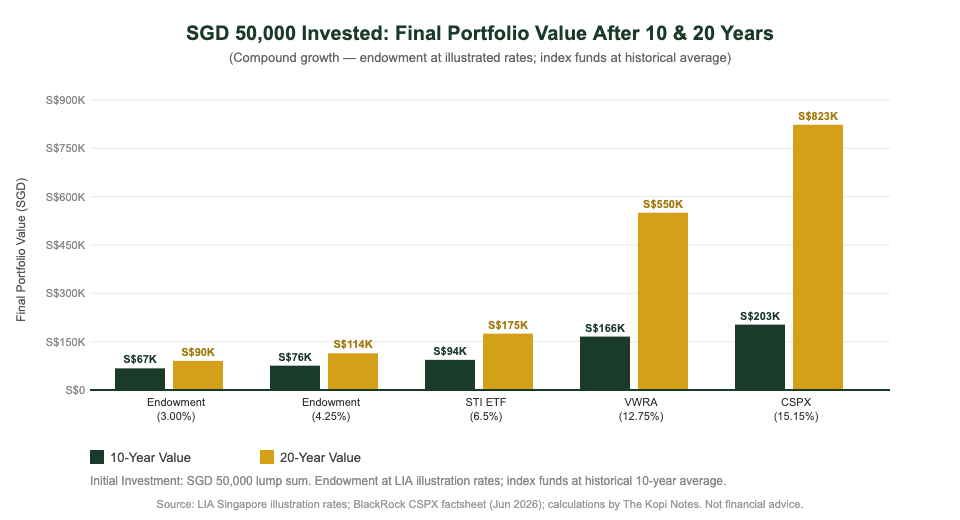
Final portfolio value of SGD 50,000 lump sum across different products at 10 and 20 years. All figures based on constant annual rates — actual returns will vary. Source: The Kopi Notes calculations.
When an Endowment Plan Makes Sense in Singapore
Despite the lower return ceiling, endowment plans aren’t without merit. There are specific scenarios where choosing an endowment makes good sense:
1. You want capital protection above all else
If losing even 20–30% of your principal temporarily would cause you financial hardship or extreme anxiety, the guaranteed floor of an endowment plan provides peace of mind that no index fund can replicate. Bear markets (like 2008 or 2020) can see equity funds drop 30–50% — a level of volatility some investors simply cannot tolerate.
2. You need forced savings discipline
The lock-in mechanism works both ways. Surrender charges make it painful to withdraw early, which is actually useful for investors who lack the discipline to stay invested during market downturns. If you know you’d panic-sell a CSPX holding during a crash, an endowment’s illiquidity becomes a feature.
3. You want built-in life insurance
Endowment plans bundle a death benefit (typically 101–105% of total premiums). If you need life coverage and a savings vehicle in one product, the combined cost may be more efficient than buying separate term life + investment products.
4. Short-term savings goals (3–5 year endowments)
For specific goals with a defined horizon — say, a down payment on a flat in 3 years — short-term single-premium endowments offer a higher guaranteed yield than Singapore Savings Bonds in some market environments. Compare with Singapore Savings Bonds before committing.
5. CPF investment with CPFIS
Certain CPFIS-approved endowment products allow you to use CPF OA funds with competitive capital-guaranteed returns. However, note that the CPF OA’s risk-free 2.5% p.a. is a formidable benchmark — many CPFIS products barely beat it after charges.
When Should You Choose an Index Fund Over an Endowment Plan?
For most Singapore investors with a 10+ year horizon, index funds are the more rational choice for wealth building. Choose an index fund when:
1. Your investment horizon is 10 years or more
The longer your time horizon, the more market volatility averages out. Over any rolling 10-year period in history, globally diversified funds like VWRA have rarely delivered negative total returns. Time in the market beats endowment plan guarantees over the long run.
2. You want maximum wealth accumulation for retirement
If your primary goal is to build a retirement nest egg — especially if you’re still 20–30 years away — the compounding difference shown in the table above is life-changing. S$50,000 growing to S$823k (CSPX historical) vs S$114k (endowment high) over 20 years is not a marginal difference.
3. You value flexibility and liquidity
Index funds have no lock-in. You can sell any portion on any trading day, access your money for emergencies, or rebalance without penalty. This flexibility is particularly valuable if your life circumstances might change — job loss, major medical expense, or an investment opportunity.
4. You’re already separately covered for life insurance
If you have an existing term life policy (which is the most cost-efficient way to get life coverage), there is no reason to pay the blended cost of an endowment plan. Keep protection and investment separate for maximum efficiency.
You can invest in CSPX and VWRA through brokers like IBKR, Saxo, FSMOne (FSMOne referral code), or through robo-advisors such as Syfe (Syfe referral code) and Endowus (Endowus referral code). Robo-advisors are particularly useful for beginners — they handle rebalancing automatically.
The Verdict: Endowment Plan vs Index Fund for Singapore Investors
The choice comes down to what you’re optimising for:
| Your Priority | Best Choice |
|---|---|
| Maximum long-term wealth (10+ years) | ✅ Index Fund (CSPX / VWRA) |
| Capital guarantee + no loss of sleep | ✅ Endowment Plan |
| Forced savings + life coverage combo | ✅ Endowment Plan |
| Flexibility to access funds anytime | ✅ Index Fund |
| Short-term goal (3–5 years) | ✅ Short-term endowment (or SSB / T-bills) |
Source: The Kopi Notes analysis based on LIA Singapore rates and verified index fund data. Not financial advice.
For most Singaporeans building wealth for retirement, index funds dominate on returns. But endowment plans serve a legitimate role for those who genuinely cannot tolerate equity volatility or need built-in protection.
The smartest approach many financial educators recommend is a core-satellite structure: build the core (70–80%) in low-cost index funds like CSPX or VWRA, and use a smaller allocation (20–30%) for capital-guaranteed products like endowments or Singapore Savings Bonds if stability matters to you.
If you’re focused on retirement income from your investment portfolio, also explore our guide on best S-REITs in Singapore 2026 — S-REITs offer dividend yields of 5–7% that complement an index fund growth strategy.
Not sure how much you need to retire? Run the numbers with our Singapore retirement calculator — it’s free and takes under 2 minutes.
Frequently Asked Questions
Is an endowment plan better than an index fund in Singapore?
What is the LIA illustration rate for endowment plans in 2026?
What is the difference between an endowment plan and a unit trust?
Can I use CPF to buy an index fund or endowment plan?
Is there a Singapore estate tax advantage for CSPX and VWRA?
What happens if I surrender an endowment plan early?
Get Free Insurance Advice
Speak with a licensed insurance advisor. No obligation, no cost.
By submitting this form, you agree to our Privacy Policy.
This article was researched with the help of AI. While we strive to keep all information accurate and up to date, there may be errors. If you notice any discrepancies, please contact us.