S-REIT ANALYSIS · OCTOBER 2026
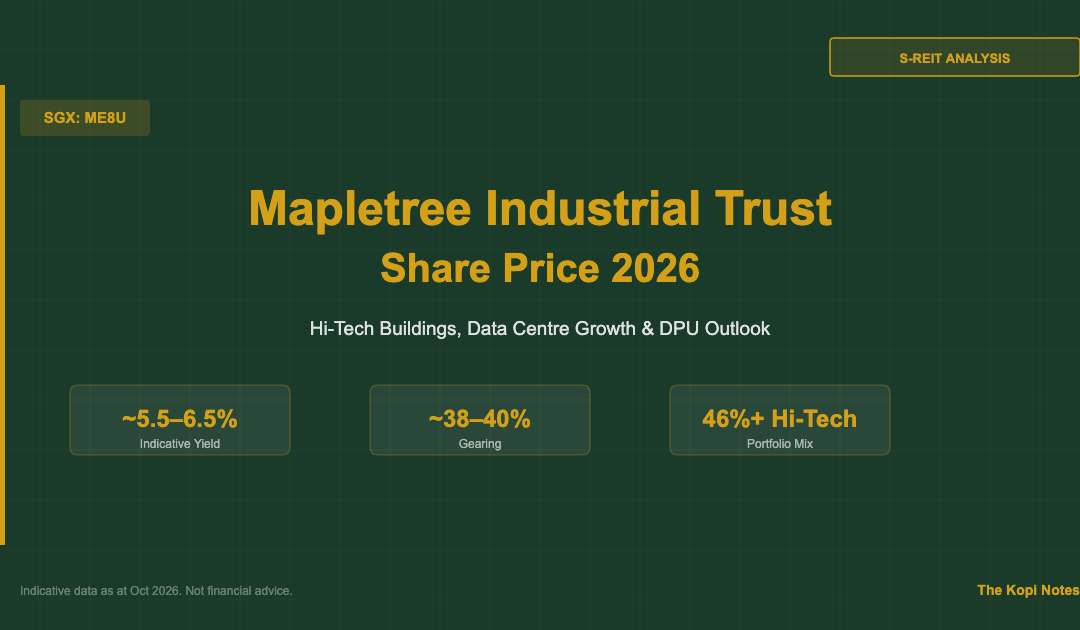
Mapletree Industrial Trust Share Price 2026: Hi-Tech Portfolio, Data Centre Growth & DPU Outlook
By Sean Young · Updated October 2026 · 10 min read
📋 Table of Contents
- What Is Mapletree Industrial Trust (ME8U)?
- MIT REIT Portfolio Breakdown 2026
- Hi-Tech Buildings & Data Centre Segment
- MIT DPU History & Distribution Yield
- MIT Share Price & Valuation 2026
- Key Risk Factors for MIT REIT Investors
- How to Invest in MIT REIT in Singapore
- Investment Verdict: Buy, Hold or Sell?
- Frequently Asked Questions
Mapletree Industrial Trust (SGX: ME8U) is one of Singapore’s largest and most diversified industrial REITs, with a portfolio valued at approximately S$6–7 billion spanning over 100 properties across Singapore, the United States, Japan, Australia, and South Korea. Managed by Temasek-backed Mapletree Investments, MIT REIT has transformed from a traditional flatted-factory landlord into a high-growth data centre and hi-tech buildings operator — with approximately 46% of its portfolio now in data centre and hi-tech assets as at 2026, making it a compelling hybrid play on Singapore’s industrial and technology infrastructure boom.
Not financial advice. All figures are indicative and for educational reference only. Data as at October 2026 unless noted. Verify current data with SGX announcements and the MIT REIT manager’s official disclosures before making any investment decision.
What Is Mapletree Industrial Trust (ME8U)?
Mapletree Industrial Trust (MIT REIT) was listed on the Singapore Exchange (SGX) in October 2010, making it one of Singapore’s more established industrial REITs. Its manager, Mapletree Investments Pte Ltd, is a wholly owned subsidiary of Temasek Holdings — Singapore’s state investment company — providing strong sponsor support, a robust acquisition pipeline, and financial backing that smaller, independent REIT managers cannot match.
At IPO, MIT REIT was a straightforward industrial landlord: flatted factories, stack-up buildings, and light industrial units across Singapore’s industrial estates. Over the past decade, however, the trust has executed a deliberate portfolio upgrade strategy — selling lower-yielding flatted factories and reinvesting into higher-growth hi-tech buildings and US data centres. This transformation has fundamentally changed MIT REIT’s risk/return profile, attracting institutional investors who previously overlooked Singapore industrial REITs.
For a broader comparison of all major Singapore REITs by yield and quality, see our guide to the best S-REITs in Singapore 2026.
MIT REIT Quick Facts (October 2026)
| Detail | Value (Indicative, Oct 2026) |
|---|---|
| SGX Stock Code | ME8U |
| REIT Manager | Mapletree Industrial Trust Management Ltd |
| Sponsor | Mapletree Investments Pte Ltd (Temasek-backed) |
| Listed Since | October 2010 (SGX) |
| Approx. Market Cap | ~S$6–7 billion |
| No. of Properties | 100+ |
| Portfolio Countries | Singapore, USA, Japan, Australia, South Korea |
| Aggregate Leverage (Gearing) | ~38–40% |
| Indicative Distribution Yield | ~5.5–6.5% (at Oct 2026 prices) |
Source: Mapletree Industrial Trust SGX Filings, October 2026. All figures indicative and approximate.
MIT REIT Portfolio Breakdown 2026
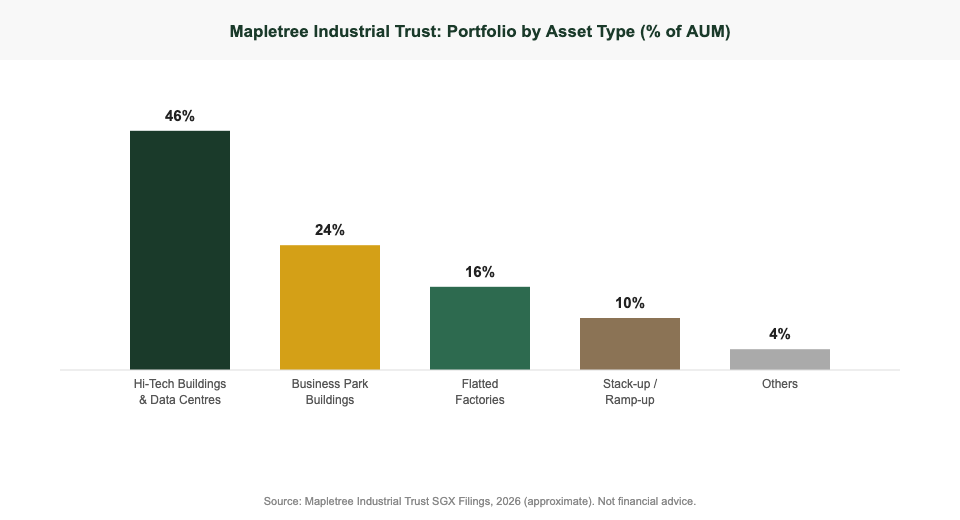
One of MIT REIT’s most compelling investment attributes in 2026 is its ongoing portfolio transformation. What was once a predominantly flatted-factory REIT now has nearly half its assets in high-value data centre and hi-tech building properties — commanding premium rents, longer lease terms, and higher occupancy rates than traditional light industrial assets.
The chart below illustrates the approximate portfolio composition by asset type as at 2026:
| Asset Type | % of AUM (est. 2026) | Key Characteristics |
|---|---|---|
| Hi-Tech Buildings & Data Centres | ~46% | Long leases, high occupancy (>95%), tech tenants, premium rents |
| Business Park Buildings | ~24% | Grade A office-like environments, R&D and knowledge economy tenants |
| Flatted Factories | ~16% | Diverse SME tenants, shorter leases, steady occupancy |
| Stack-up / Ramp-up Buildings | ~10% | Multi-level industrial units, mid-range tenant profile |
| Others | ~4% | Light industrial, pipeline assets |
Source: Mapletree Industrial Trust SGX Filings / Annual Report 2026. Approximate. Verify latest figures at MIT REIT’s official website.
Hi-Tech Buildings & Data Centre Segment: MIT REIT’s Growth Engine
The Hi-Tech Buildings and Data Centre segment is the primary driver of MIT REIT’s DPU growth outlook for 2026 and beyond. This segment encompasses two distinct but complementary property types that benefit from Singapore’s and the global technology infrastructure boom.
Singapore Hi-Tech Buildings
MIT REIT’s Singapore hi-tech buildings include properties designed for precision manufacturing, semiconductor testing, pharmaceutical production, and cleanroom operations. These assets command 30–50% rent premiums over standard flatted factories, and their specialised fit-outs create high switching costs for tenants — translating into lower tenant churn and more predictable income streams. Key properties include assets at Kallang, Toa Payoh, and Woodlands, housing tenants from the aerospace, biomedical, and electronics sectors.
US Data Centre Portfolio
MIT REIT holds interests in a significant portfolio of data centres across the United States, spanning 13 states. These data centres are leased to hyperscalers and enterprise cloud providers on long-term triple-net leases (typically 7–15 years), providing highly predictable USD-denominated income. In 2026, demand from AI infrastructure build-outs has driven exceptionally strong leasing momentum across US data centre markets, with rental reversions (rent increases upon lease renewal) running well above historical averages.
Key growth drivers for this segment in 2026–2027:
- AI infrastructure demand surge: Microsoft, Amazon Web Services, and Google continue to commit billions to data centre capacity expansion, providing structural tailwinds for US data centre landlords.
- Power constraints as a moat: Data centres with existing grid connections and power supply agreements are increasingly scarce, giving MIT REIT’s US portfolio a competitive advantage that new entrants cannot easily replicate.
- Singapore government support for hi-tech manufacturing: Singapore’s ambition to grow its semiconductor and precision engineering sector — anchored by the S$25 billion Chips+ programme and EDB incentives — supports long-term demand for MIT REIT’s Singapore hi-tech assets.
MIT REIT’s data centre strategy has drawn natural comparisons with Keppel DC REIT, Singapore’s pure-play data centre REIT. However, MIT REIT offers investors a more diversified income base — the data centre upside is blended with stable Singapore industrial income, providing a smoother DPU profile. For investors seeking pure data centre exposure at a higher valuation, Keppel DC REIT remains the benchmark. MIT REIT suits investors who want data centre growth with a cushion of traditional industrial income.
MIT REIT DPU History & Distribution Yield 2026
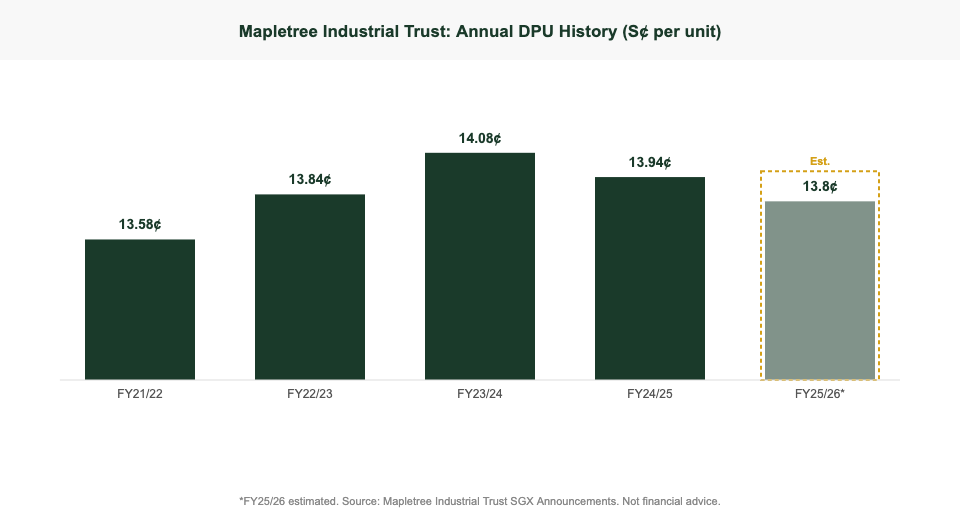
Mapletree Industrial Trust has maintained broadly stable distributions per unit (DPU) over the past five financial years, a track record that underscores the defensive quality of its industrial tenant base and long weighted average lease expiry (WALE). Below is MIT REIT’s full DPU history from FY2021/22 to FY2025/26 (estimated):
| Financial Year | Annual DPU (S¢) | YoY Change | Key Driver |
|---|---|---|---|
| FY2021/22 | 13.58¢ | +2.3% | Post-COVID recovery, hi-tech leasing |
| FY2022/23 | 13.84¢ | +1.9% | US data centre contribution, positive reversions |
| FY2023/24 | 14.08¢ | +1.7% | AI demand boost, full-year US DC contribution |
| FY2024/25 | 13.94¢ | –1.0% | Higher refinancing costs offset by reversions |
| FY2025/26 (est.) | ~13.80¢ | ~–1.0% | Gradual rate normalisation, leasing tailwinds |
Note: FY2025/26 is estimated. Source: Mapletree Industrial Trust SGX Announcements / Results Presentations. Not financial advice — verify figures at SGX.
The modest DPU dip in FY2024/25 and estimated FY2025/26 reflects higher all-in borrowing costs as fixed-rate debt was refinanced at post-2022 rate levels. However, MIT REIT’s management has guided for DPU stabilisation as: (1) interest rate headwinds ease with central bank rate cuts; (2) rental reversions across hi-tech buildings and data centres remain positive; and (3) new leasing activity fills vacated flatted factory space. At an indicative price of ~S$2.30, MIT REIT’s trailing yield of ~6.0% remains competitive against Singapore T-bills and Singapore Savings Bonds while offering long-term capital appreciation potential.
For investors building passive income in Singapore through dividends, MIT REIT’s quarterly distribution schedule (semi-annual for some unitholders, check your brokerage) and stable ~14 cents annual DPU make it a natural core holding in a S-REIT portfolio.
MIT REIT Share Price & Valuation 2026
MIT REIT’s share price has historically commanded a modest premium to its reported net asset value (NAV) per unit, reflecting the quality of its sponsor, long WALE, and growing data centre exposure. As at October 2026, the indicative valuation metrics for ME8U are as follows:
| Valuation Metric | Indicative Value (Oct 2026) | Comment |
|---|---|---|
| Indicative Share Price Range | ~S$2.20–2.45 | Check live price on SGX or your brokerage |
| Net Asset Value (NAV) per Unit | ~S$1.85–2.05 | As per last reported NAV; fluctuates with property revaluations |
| Price-to-NAV (P/NAV) | ~1.1–1.3x | Premium reflects quality and sponsor strength |
| Distribution Yield (trailing) | ~5.5–6.5% | Indicative; verify with latest DPU & current price |
| Aggregate Leverage | ~38–40% | Well below MAS 50% regulatory cap |
| Interest Coverage Ratio (est.) | ~4–5x | Comfortable coverage; sensitivity to rate changes |
Source: Mapletree Industrial Trust SGX Filings, October 2026 (indicative). Always verify with the latest MIT REIT quarterly/half-yearly results before investing.
A P/NAV above 1.0x may seem expensive relative to some retail or office REITs trading at discounts, but it reflects the market pricing MIT REIT’s superior asset quality, data centre optionality, and Temasek sponsor premium. For context, Keppel DC REIT — Singapore’s pure-play data centre REIT — has historically traded at P/NAV of 1.5–2.0x, making MIT REIT the more modestly priced option for investors seeking data centre exposure within an industrial REIT wrapper. Use our Singapore retirement calculator to model how a 6% yield compounds over your investment horizon.
Key Risk Factors for MIT REIT Investors
No investment is without risk. Investors considering MIT REIT (ME8U) should carefully evaluate these key risk factors before committing capital:
- Interest rate sensitivity: MIT REIT carries ~38–40% gearing. Every 50 basis point rise in average all-in borrowing costs reduces DPU by an estimated 0.3–0.5 cents per unit annually. Monitor the US Federal Reserve rate decisions and Singapore SORA closely, as US data centre debt is typically USD-denominated.
- USD/SGD currency risk: Approximately 30% of MIT REIT’s portfolio AUM is in the United States. While MIT REIT hedges a portion of its USD income, a strengthening Singapore dollar can reduce the SGD value of US-sourced distributions when translated back. This risk is asymmetric — a weak SGD benefits distributions.
- Tenant concentration in data centres: Large hyperscaler tenants (cloud providers) provide stable, long-term income but create concentration risk. If a major US data centre tenant declines to renew or scales back, it could materially impact DPU in that financial year.
- Singapore flatted factory headwinds: JTC Corporation has been repositioning Singapore’s industrial land base, and new supply in certain industrial zones may put pressure on flatted factory occupancy and rents. This affects MIT REIT’s ~16% flatted factory exposure.
- Capital raising risk: To fund accretive acquisitions, MIT REIT may undertake equity fund-raising exercises (rights issues or private placements), which temporarily dilute DPU per unit before new acquisitions contribute to income. MIT REIT’s track record of accretive acquisitions has historically supported DPU recovery post-dilution.
- Regulatory and environmental risks: Tightening energy efficiency standards for data centres in the US and Singapore could require capex investment to maintain tenant appeal and regulatory compliance.
How to Invest in MIT REIT (ME8U) in Singapore
MIT REIT units (SGX: ME8U) can be purchased through any SGX-approved brokerage with a CDP (Central Depository) account. Here are the most cost-effective platforms for Singapore retail investors in 2026:
| Platform | Commission Rate | Min Commission | Best For |
|---|---|---|---|
| moomoo Singapore | 0.03% (promo) | S$0.99 | Active traders, low-cost buying |
| FSMOne | 0.08% | S$10 | Fund & ETF investors, all-in-one platform |
| Syfe Trade | Flat fee from S$1.49 | S$1.49 | Regular investment plans, fractional shares |
| IBKR | USD 1.00 flat | USD 1.00 | Cost-conscious investors buying large lots |
Fee data indicative as at 2026. Verify current fee schedules directly with each broker.
For investors who prefer a managed S-REIT portfolio rather than picking individual stocks, consider Syfe’s income portfolio (use referral code SRPRFFFCD for exclusive fee waivers — the first 6 months management fee is waived for new clients) or FSMOne’s Regular Savings Plan (referral code P0544985). Both platforms include Mapletree Industrial Trust in their Singapore REIT allocations. For a detailed breakdown of moomoo’s features and fees for SGX trading, read our moomoo Singapore review.
If you are investing through your Supplementary Retirement Scheme (SRS) account, MIT REIT is an eligible SRS investment — making it a tax-efficient way to generate retirement income. Model your SRS-funded REIT portfolio’s projected income using our Singapore retirement calculator.
Investment Verdict: Is MIT REIT a Buy in 2026?
Mapletree Industrial Trust (ME8U) remains one of the highest-quality industrial REITs in Singapore, offering investors a rare combination of: (1) stable, ~5.5–6.5% indicative yield from a diversified industrial tenant base; (2) structural growth from its data centre and hi-tech building transformation; and (3) strong Temasek sponsor support providing acquisition pipeline visibility that independent REITs cannot match.
The DPU headwind from higher financing costs (2024–2025) appears to be stabilising in 2026 as interest rates begin to normalise, and MIT REIT’s positive rental reversions across hi-tech and data centre segments provide a growth offset. At ~1.1–1.3x P/NAV, MIT REIT trades at a meaningful discount to pure-play data centre REITs while offering similar technology infrastructure exposure through its US data centre portfolio and Singapore hi-tech buildings.
Who MIT REIT suits: Income-focused Singapore investors who want data centre growth upside without paying a pure-play data centre REIT’s premium valuation. Long-term holders who believe the structural shift toward data-driven industrial assets will continue over the next 5–10 years. SRS investors seeking tax-efficient REIT income.
Who should look elsewhere: Investors seeking maximum yield (consider higher-yielding office or retail REITs at a discount to NAV) or pure data centre exposure (consider Keppel DC REIT for undiluted tech-REIT exposure). Compare all major options in our best S-REITs Singapore 2026 guide and see how MIT REIT fits into a comprehensive passive income strategy for Singapore investors.
This article is for informational and educational purposes only. It does not constitute financial advice. Please conduct your own due diligence and consult a licensed financial adviser before making investment decisions. All figures are indicative as at October 2026.
Frequently Asked Questions: Mapletree Industrial Trust (ME8U) 2026
What is Mapletree Industrial Trust (MIT REIT) and how do I invest in it?
Mapletree Industrial Trust (SGX: ME8U) is a Singapore-listed REIT managed by Mapletree Investments, a Temasek subsidiary. It owns a portfolio of industrial and technology properties across Singapore, the US, Japan, Australia, and South Korea. You can invest in MIT REIT by opening a brokerage account (moomoo, FSMOne, IBKR, or Syfe Trade) and buying ME8U shares on the SGX, or through managed platforms like Syfe Income or FSMOne portfolios.
What is MIT REIT's current distribution yield and DPU?
MIT REIT’s annual DPU (distribution per unit) has ranged between approximately 13.58 and 14.08 cents over FY2021/22 to FY2023/24, with a slight dip to approximately 13.94 cents in FY2024/25 and an estimated ~13.80 cents in FY2025/26 due to higher financing costs. At an indicative share price of ~S$2.30, the trailing yield is approximately 6.0%. Always verify the latest DPU from MIT REIT’s SGX results announcements before investing.
How does MIT REIT's data centre exposure compare to Keppel DC REIT?
MIT REIT has approximately 46% of its AUM in hi-tech buildings and data centres, while Keppel DC REIT (KDC REIT) is a pure-play data centre REIT with 100% of its portfolio in data centres. KDC REIT typically trades at a higher P/NAV (historically 1.5–2.0x) and offers higher growth potential, while MIT REIT provides a blended income profile at a lower valuation premium (~1.1–1.3x P/NAV). Investors who want data centre exposure without paying a pure-play premium may prefer MIT REIT.
What is MIT REIT's gearing level and is it safe?
MIT REIT’s aggregate leverage (gearing) is approximately 38–40% as at 2026, comfortably below the MAS regulatory cap of 50% for Singapore REITs. The interest coverage ratio is estimated at approximately 4–5x, indicating strong ability to service debt obligations. While gearing is not alarming, every 50 basis point increase in average borrowing costs reduces DPU by an estimated 0.3–0.5 cents, so monitoring interest rate trends is important for MIT REIT investors.
Can I invest in MIT REIT through my SRS account?
Yes, Mapletree Industrial Trust (ME8U) is eligible for investment through the Supplementary Retirement Scheme (SRS) in Singapore. You can buy ME8U units using your SRS funds through most major brokerages including DBS Vickers, Phillip Securities (POEMS), FSMOne, and moomoo. Investing through SRS provides an upfront income tax deduction on contributions and defers tax on investment gains until withdrawal, making it a tax-efficient way to build REIT income for retirement.
What are the main risks of investing in MIT REIT?
The key risks for MIT REIT (ME8U) investors include: (1) interest rate sensitivity — higher borrowing costs reduce DPU; (2) USD/SGD currency risk from the ~30% US portfolio exposure; (3) data centre tenant concentration risk if major US hyperscaler tenants do not renew; (4) Singapore flatted factory demand softness; and (5) potential equity dilution from fund-raising for acquisitions. MIT REIT’s strong Temasek sponsor, diversified asset base, and long WALE mitigate these risks relative to smaller peers.
This article was researched with the help of AI. While we strive to keep all information accurate and up to date, there may be errors. If you notice any discrepancies, please contact us.