Frasers Centrepoint Trust Share Price 2027: Buy, Sell or Hold?
A deep-dive investor guide to FCT’s DPU outlook, valuation, suburban portfolio resilience, and 2027 share price target — updated October 2026.
Frasers Centrepoint Trust (SGX: J69U) is Singapore’s largest suburban retail REIT, owning nine necessity-driven malls including Causeway Point, Northpoint City North Wing, and Waterway Point. Trading near its net asset value at roughly SGD 2.10–2.20 and offering a forward yield of ~5.8%, FCT remains one of the most defensive S-REITs for income investors heading into 2027. The key question: does the subdued DPU growth justify holding, or is a catalyst needed to re-rate the stock higher?
Not financial advice. All figures are for educational reference only. Data as at October 2026 unless noted.
Table of Contents
Contents — Click to expand
What Is Frasers Centrepoint Trust?
Frasers Centrepoint Trust (FCT) is a Singapore-focused retail REIT listed on the SGX Mainboard under the ticker J69U. Sponsored by Frasers Property Limited, FCT owns and manages a portfolio of nine suburban retail malls with a combined net lettable area (NLA) of approximately 2.23 million sq ft as at September 2026. Unlike Orchard Road mall REITs that rely on tourist spending, FCT’s malls are neighbourhood and suburban assets anchored by supermarkets, F&B, healthcare, and daily-necessity tenants — providing structurally resilient footfall regardless of the macro environment.
FCT’s portfolio spans key HDB heartland catchments: Causeway Point (Woodlands), Northpoint City North Wing (Yishun), Tampines 1, Waterway Point (Punggol), Changi City Point, Tiong Bahru Plaza, White Sands (Pasir Ris), Hougang Mall, and YewTee Point. The trust completed its consolidation of the FrasersProperty Retail portfolio in FY2023, leaving it with a concentrated, high-quality suburban retail cluster with very limited vacancy risk. For investors looking at the best S-REITs in Singapore 2026, FCT’s defensive profile makes it a perennial inclusion.
Key Metrics at a Glance (Oct 2026)
| Metric | Value (as at Oct 2026) |
|---|---|
| Ticker (SGX) | J69U |
| Share Price (approx.) | SGD ~2.16 |
| NAV per Unit | SGD ~2.18 |
| P/NAV | ~0.99x |
| FY2025 DPU | 11.847 cents |
| FY2026E DPU | ~12.0–12.2 cents (est.) |
| Forward Dividend Yield | ~5.6–5.8% |
| Aggregate Leverage (Gearing) | ~38% |
| Portfolio Occupancy | ~98.9% |
| WALE (by NLA) | ~4.4 years |
| Market Cap | ~SGD 3.3 billion |
Source: Frasers Centrepoint Trust SGX filings, company announcements, October 2026.
DPU Performance & FY2026 Outlook
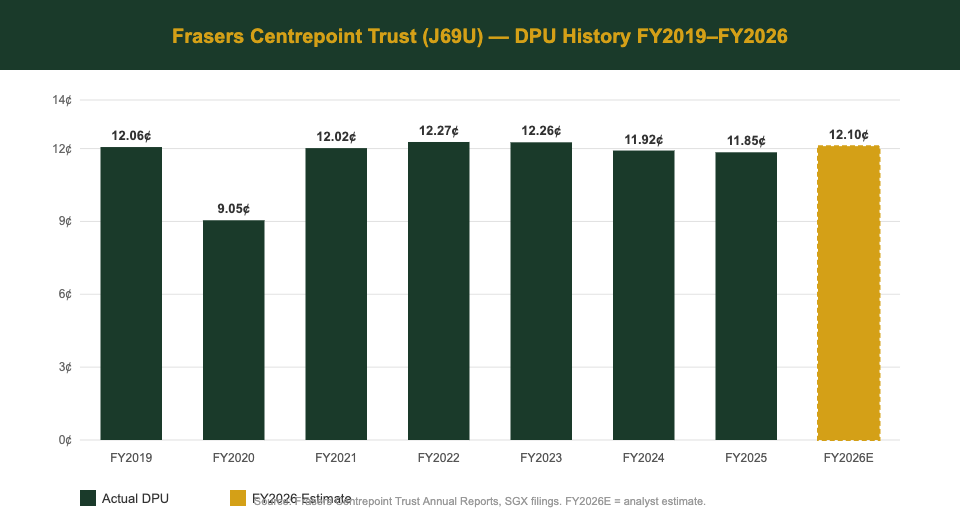
FCT’s DPU track record reflects the dual challenge of post-COVID normalisation and a higher-for-longer interest rate environment. After hitting 12.063 cents in FY2019, the trust saw a sharp cut in FY2020 (9.048 cents) due to tenant relief during the pandemic. DPU recovered strongly through FY2021–FY2023, peaking at approximately 12.27 cents in FY2022 before gradually softening to 11.847 cents in FY2025 as higher financing costs compressed distributable income.
The headwind is structural in the near term: FCT carries meaningful floating-rate debt exposure, meaning that even with the Federal Reserve’s ongoing rate cuts, the full benefit to DPU will lag by 6–12 months as hedges roll off. Management has guided for incremental NPI growth from positive rental reversions across the portfolio — mid-single digit average reversions in FY2025 were encouraging — but this is partially offset by higher borrowing costs on refinanced tranches. For the full FCT dividend history from 2012 to 2026, including the DPU per half-year breakdown, see our dedicated data page.
Looking ahead to FY2026 (year ending September 2026), consensus estimates point to a modest DPU recovery toward 12.0–12.2 cents, supported by: (1) positive rental reversions from lease renewals, (2) partial interest rate relief as SORA eases, and (3) the ramp-up of Tampines 1’s asset enhancement initiative (AEI) completion. This translates to a forward yield of approximately 5.6–5.8% at the current share price — competitive relative to Singapore fixed deposits and T-bills, though the spread over risk-free rates has compressed compared to 2022–2023.
Portfolio Quality & Suburban Resilience
FCT’s competitive advantage over Orchard Road and CBD-focused retail REITs lies in its structural demand base. Suburban malls anchored by NTUC FairPrice, Cold Storage, Giant, and Sheng Siong serve necessity-driven daily shopping — grocery, pharmacy, F&B, childcare, and healthcare. This insulates FCT from the cyclical swings that affect discretionary retail, and it showed up clearly during COVID-19: FCT’s tenant sales recovered faster and its occupancy held above 98% even during circuit breaker periods.
As of October 2026, FCT’s portfolio occupancy stands at approximately 98.9%, comfortably above the 95–96% level seen at most regional mall REITs. Rental reversions have been consistently positive — ranging from +3% to +6% across lease renewals in FY2024 and FY2025 — reflecting the pricing power that comes from limited suburban mall supply in Singapore’s HDB townships. The upcoming asset enhancement at Northpoint City North Wing is expected to unlock additional NLA and reposition the food & beverage mix, with completion targeted for FY2027.
The sponsor pipeline remains a potential upside catalyst. Frasers Property Limited still holds several retail assets — including Anchorpoint and Central Plaza — that could eventually be injected into FCT at the right price. The trust’s ROFR (right of first refusal) on these assets gives management optionality to grow the portfolio without resorting to expensive external acquisitions. Investors seeking passive income Singapore through REITs will find FCT’s high occupancy and necessity-anchor profile particularly compelling for portfolio stability.
Valuation: Is FCT Fairly Priced in 2027?
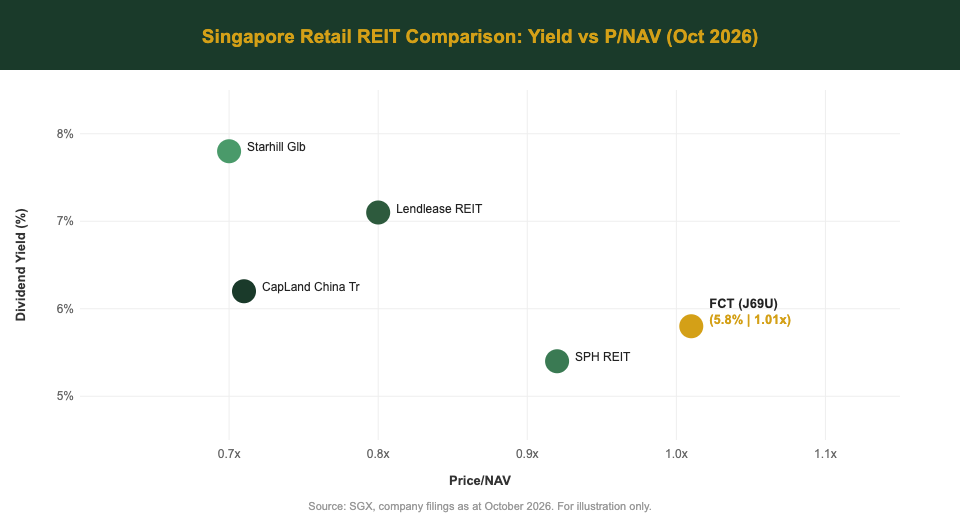
FCT currently trades at approximately 0.99x P/NAV (price-to-net asset value) — essentially at par. This is a premium to distressed retail peers like Lendlease Global Commercial REIT (~0.80x) and CapitaLand China Trust (~0.71x), but it reflects the higher quality of FCT’s Singapore suburban mandate and its lower risk profile. The peer comparison below illustrates where FCT sits in the Singapore retail REIT landscape as at October 2026.
| REIT | Yield | P/NAV | Gearing | Focus |
|---|---|---|---|---|
| FCT (J69U) | ~5.8% | ~0.99x | ~38% | SG suburban malls |
| SPH REIT (SK6U) | ~5.4% | ~0.92x | ~31% | SG & AU malls |
| Lendlease REIT (JYEU) | ~7.1% | ~0.80x | ~40% | SG & AU mixed-use |
| Starhill Glb REIT (P40U) | ~7.8% | ~0.70x | ~36% | Orchard Rd + overseas |
| CapLand China Tr (AU8U) | ~6.2% | ~0.71x | ~40% | China malls |
Source: SGX company filings, analyst estimates, October 2026. Yields are forward estimates and may differ from actual distributions.
On a pure yield basis, FCT screens at the lower end of the Singapore retail REIT peer group. But yield alone is a misleading metric — FCT’s premium P/NAV is justified by its Singapore-only suburban focus, near-full occupancy, and lower risk of capital value impairment vs peers with overseas or Orchard exposure. For a retirement or income portfolio where capital preservation matters alongside income, FCT’s defensive positioning makes sense. Investors can also explore using a Singapore retirement calculator to model how FCT’s yield stacks up against other income assets in a long-term portfolio.
2027 Share Price Target: Bull vs Bear Case
FCT’s share price is largely a function of DPU expectations, interest rates, and sentiment toward Singapore retail. At the current level of ~SGD 2.16, the market is pricing the trust at approximately 17.7x trailing DPU — in line with its historical average. For 2027, two scenarios are plausible:
Bull Case (SGD 2.35–2.45 target): A meaningful Fed rate cut cycle flows through to SORA, reducing FCT’s floating rate debt costs by 40–60bps. Combined with continued +4% rental reversions and the NorthPoint AEI kicker, DPU recovers to 12.5–12.8 cents. Applying a 5.2–5.4% yield multiple (consistent with pre-2022 historical averages when rates were low), the stock could re-rate toward SGD 2.35–2.45. This requires SORA to fall below 2.5% and Singapore consumer confidence to remain firm.
Bear Case (SGD 1.90–2.00 target): If SORA stays elevated above 3.0% through 2026, refinancing costs crimp distributable income. DPU growth stalls at 11.5–12.0 cents. Retail footfall faces headwinds if a Singapore recession materialises (GDP growth <1%). The yield premium demanded by investors rises, pushing FCT toward a 5.8–6.2% yield multiple — implying a price range of SGD 1.90–2.08. In this scenario, unitholders collect the income but see limited capital appreciation.
Base Case (SGD 2.15–2.30 range): The most likely scenario sees FCT trading in a tight band, consolidating the income stream while rate uncertainty persists. DPU recovers modestly to ~12.1 cents on partial interest cost relief and rental reversion tailwinds. The stock offers a 5.6–5.8% yield — attractive relative to current fixed deposit rates — without a catalyst for a meaningful re-rating higher. This is fundamentally a hold: collect the income and wait for the rate cycle to provide the next upside leg.
FCT 2027 Investor Verdict: Buy, Sell or Hold?
Our verdict: HOLD, with BUY on meaningful pullbacks below SGD 2.00.
Frasers Centrepoint Trust is not a REIT you buy for explosive share price growth — it is a defensive income vehicle anchored in Singapore’s most structurally resilient retail sub-sector. The suburban necessity mall model is as close to a “moat” as Singapore retail gets: high occupancy, positive rental reversions, low churn, and a sponsor pipeline for future growth. At current prices, the ~5.8% forward yield is fairly priced for the quality on offer, meaning there is limited margin of safety for a new buyer paying near NAV.
For existing unitholders, there is no reason to sell into current weakness — FCT’s income profile remains intact and the rate cut tailwind will eventually flow through to DPU. New investors looking to initiate a position should wait for a correction toward SGD 2.00–2.05 (implying a yield of ~6.0%), which would provide a better entry point with meaningful upside to the bull case scenario. Investors building a broader S-REIT income portfolio should consider pairing FCT with higher-yielding industrial or data centre names for diversification — a strategy explored in detail in our Syfe referral code and investment starting guide.
For CPF/SRS investors: FCT (J69U) is eligible for SRS investing through most brokers including IBKR, Saxo, and Endowus (Fund Smart platform). It is also CPF Investment Scheme (CPFIS) eligible under OA and SA funds — making it one of the few REITs that can be held directly within CPF for retirement income planning. Use the referral code 2V343 for Endowus or SRPRFFFCD for Syfe to get started with sign-up bonuses.
Frequently Asked Questions
What is Frasers Centrepoint Trust and why do investors buy it?
Frasers Centrepoint Trust (SGX: J69U) is a Singapore suburban retail REIT sponsored by Frasers Property Limited. It owns nine malls including Causeway Point and Northpoint City North Wing, anchored by supermarkets and daily-necessity tenants. Investors buy FCT for its stable, high-occupancy income stream (~5.6–5.8% forward yield), near-NAV valuation, and defensive suburban retail exposure that holds up well through economic cycles.
What is FCT's DPU for FY2026 and is the dividend sustainable?
FCT’s FY2025 DPU was 11.847 cents. For FY2026 (ending September 2026), analyst consensus estimates a modest recovery to approximately 12.0–12.2 cents as interest cost headwinds ease and rental reversions stay positive. The DPU is well-supported by near-100% portfolio occupancy and a Singapore-only mandate — there is no offshore currency or GDP risk in the distribution. The main risk to sustainability is a prolonged high-SORA environment that keeps financing costs elevated.
Is Frasers Centrepoint Trust a buy in 2027 at current prices?
At approximately SGD 2.16 and ~5.8% forward yield, FCT is trading at fair value — not obviously cheap or expensive. The base case is a HOLD for existing unitholders: collect the income and wait for the rate cycle to boost DPU. New investors seeking a better margin of safety should consider waiting for a pullback toward SGD 2.00–2.05 (implying ~6.0% yield) before building a full position. A meaningful rate cut in Singapore rates would be the catalyst for a re-rating toward the SGD 2.35–2.45 bull case target.
Can I buy FCT using my CPF or SRS funds?
Yes. FCT (J69U) is eligible for both the CPF Investment Scheme (CPFIS) under Ordinary Account and Special Account funds, and for SRS (Supplementary Retirement Scheme) investing. You can purchase it through CPF-approved brokers such as DBS Vickers, UOB Kay Hian, OCBC Securities, and IBKR. Endowus also offers CPF-eligible access to REITs via its Fund Smart platform. This makes FCT one of the more accessible S-REITs for retirement-focused investors in Singapore.
What is FCT's share price target for 2027?
Based on a DPU recovery to 12.0–12.5 cents and a normalised yield multiple of 5.2–5.6%, the FCT share price target for 2027 falls in the range of SGD 2.20–2.40. The bull case (rate cuts + AEI kickers) points to SGD 2.35–2.45; the bear case (rates stay high, consumer slowdown) sees FCT range-bound at SGD 1.90–2.10. The base case is a consolidation in the SGD 2.15–2.30 band as markets wait for clearer rate direction.
How does FCT compare to other Singapore retail REITs?
FCT stands out from peers by offering Singapore-only suburban mall exposure at near-NAV pricing (~0.99x P/NAV) with high occupancy (~98.9%). Relative to Starhill Global REIT (~7.8% yield, 0.70x P/NAV) or Lendlease REIT (~7.1% yield, 0.80x P/NAV), FCT appears pricier on yield — but the premium reflects its structural advantages: no overseas currency risk, defensive daily-necessity tenants, and consistent positive rental reversions. For quality-focused investors, FCT’s premium over peers is largely justified.
Start Building Your S-REIT Income Portfolio
Use our referral links to open an account and earn sign-up bonuses. Endowus code: 2V343 | Syfe code: SRPRFFFCD | FSMOne code: P0544985
This article was researched with the help of AI. While we strive to keep all information accurate and up to date, there may be errors. If you notice any discrepancies, please contact us.