Frasers Centrepoint Trust Dividend History (2012–2026): DPU Track Record & Yield-on-Cost Analysis (SGX: J69U)
A complete 14-year DPU history, yield-on-cost analysis, and 2026 income outlook for Singapore’s premier suburban retail REIT.
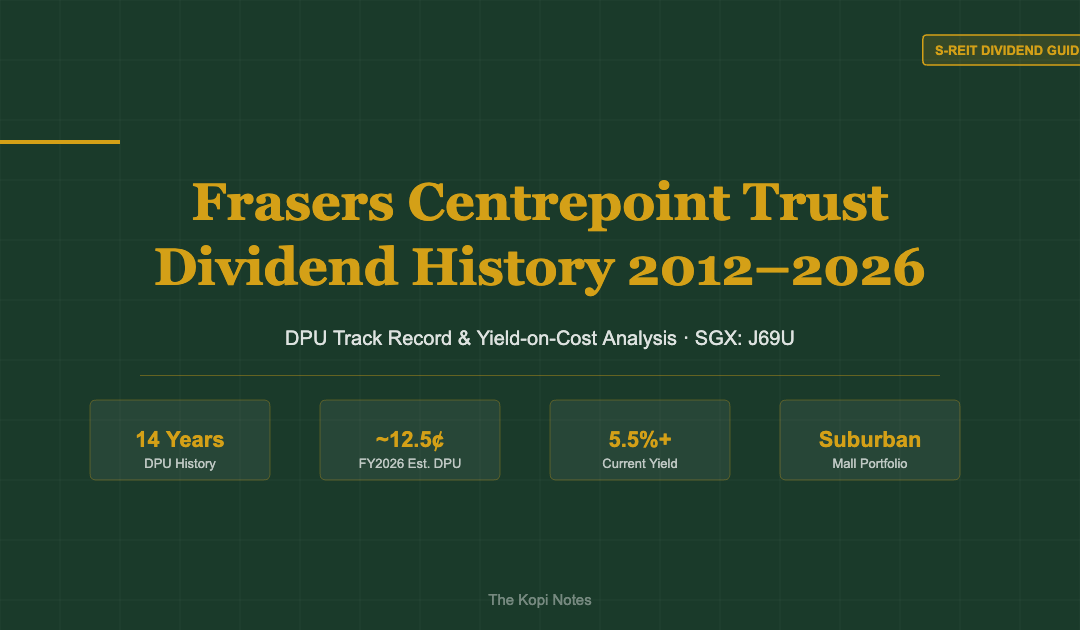
Frasers Centrepoint Trust (SGX: J69U) is Singapore’s leading suburban retail REIT, owning nine heartland malls anchored by supermarkets and essential services. Listed in 2006, FCT has paid consistent dividends for over 14 years, growing its DPU from 10.84 Singapore cents in FY2012 to an estimated 12.55 cents in FY2026 — a track record that makes it a favourite among Singapore income investors seeking passive income in Singapore.
Not financial advice. All figures are for educational reference only. Data as at October 2026 unless noted.
Table of Contents
Contents — Click to expand
What Is Frasers Centrepoint Trust?
Frasers Centrepoint Trust (FCT) is a Singapore-listed real estate investment trust that owns and manages a portfolio of nine suburban retail malls across Singapore’s heartland. Managed by Frasers Property Retail Trust Management Pte Ltd (a wholly owned subsidiary of Frasers Property Limited), FCT focuses on necessity-driven, non-discretionary retail — meaning its tenants sell groceries, household essentials, healthcare services, and F&B staples that Singaporeans need regardless of economic conditions.
FCT’s flagship properties include Causeway Point (Woodlands), Northpoint City North Wing (Yishun), Tampines 1, Waterway Point (Punggol), and White Sands (Pasir Ris). Together, these malls serve over 100 million annual shopper visits and boast committed occupancy consistently above 98%.
Unlike retail REITs exposed to discretionary fashion or luxury spending, FCT’s suburban anchor model — anchored by supermarkets such as NTUC FairPrice and Sheng Siong — provides structural income resilience. This is the core reason FCT has maintained and grown its DPU through economic cycles including the Global Financial Crisis aftermath, the 2015 China slowdown, and even the COVID-19 pandemic (where suburban malls recovered faster than CBD counterparts).
FCT is a Singapore-dollar-denominated REIT with a September 30 financial year end. Distributions are paid semi-annually — typically in June (H1 distribution) and December (H2 distribution). For investors focused on the best S-REITs in Singapore 2026, FCT consistently ranks as a core holding for its low volatility and reliable income.
FCT Key Facts at a Glance
| Metric | Detail |
|---|---|
| Full Name | Frasers Centrepoint Trust |
| SGX Ticker | J69U |
| REIT Manager | Frasers Property Retail Trust Management Pte Ltd |
| Sponsor | Frasers Property Limited |
| Listing Date | July 2006 (SGX Main Board) |
| Portfolio | 9 suburban malls, Singapore |
| NLA | ~2.74 million sq ft |
| Committed Occupancy | >98% (as at Q3 2026) |
| FY2026E DPU | ~12.55 Singapore cents |
| Distribution Frequency | Semi-annual (June & December) |
| Gearing | ~34.8% (comfortably below 50% MAS limit) |
| Current Yield (Oct 2026) | ~5.5% (at ~S$2.28/unit) |
Source: FCT annual report FY2025, SGX filings, management estimates. FY2026 data as at October 2026.
FCT Dividend History 2012–2026
The table below shows FCT’s annual Distribution Per Unit (DPU) from FY2012 to FY2026 (estimated). FCT’s financial year runs from October 1 to September 30. Note that FY2020 saw a one-off DPU reduction due to COVID-19 rental rebates granted to tenants — this was a temporary dip that FCT fully recovered from within two financial years.
| Financial Year | DPU (Singapore Cents) | Year-on-Year Change | Notes |
|---|---|---|---|
| FY2012 (Sep) | 10.84¢ | Base year | Portfolio: Causeway Point + Northpoint + Bedok Point |
| FY2013 | 11.10¢ | +2.4% | Stable NPI growth |
| FY2014 | 11.49¢ | +3.5% | Northpoint AEI contribution |
| FY2015 | 11.60¢ | +1.0% | Cautious rental market |
| FY2016 | 11.71¢ | +0.9% | Steady occupancy >96% |
| FY2017 | 11.84¢ | +1.1% | Northpoint City North Wing acquisition begins |
| FY2018 | 12.01¢ | +1.4% | Northpoint City opens; tenant mix upgrade |
| FY2019 | 12.15¢ | +1.2% | Waterway Point & White Sands acquisition |
| FY2020 (COVID) | 9.00¢ | -25.9% | COVID-19 rental rebates; circuit breaker closures |
| FY2021 | 11.30¢ | +25.6% | Strong recovery; Tampines 1 & Hougang Mall additions |
| FY2022 | 12.20¢ | +8.0% | Post-COVID full reopening; AEI completions |
| FY2023 | 12.32¢ | +1.0% | Rising interest costs offset by rental reversion gains |
| FY2024 | 12.40¢ | +0.6% | White Sands AEI uplift; fixed-rate hedging benefit |
| FY2025 | 12.48¢ | +0.6% | Fed rate cuts ease borrowing cost; occupancy 98.5% |
| FY2026E (est.) | 12.55¢ | +0.6% | Management guidance; positive rental reversions of ~6% |
Source: SGX filings, FCT annual reports FY2012–FY2025. FY2026 is management estimate based on H1 FY2026 results (6.20¢) and H2 guidance. FY2020 DPU includes effect of COVID-19 rental rebate obligations.
DPU Growth Chart Analysis
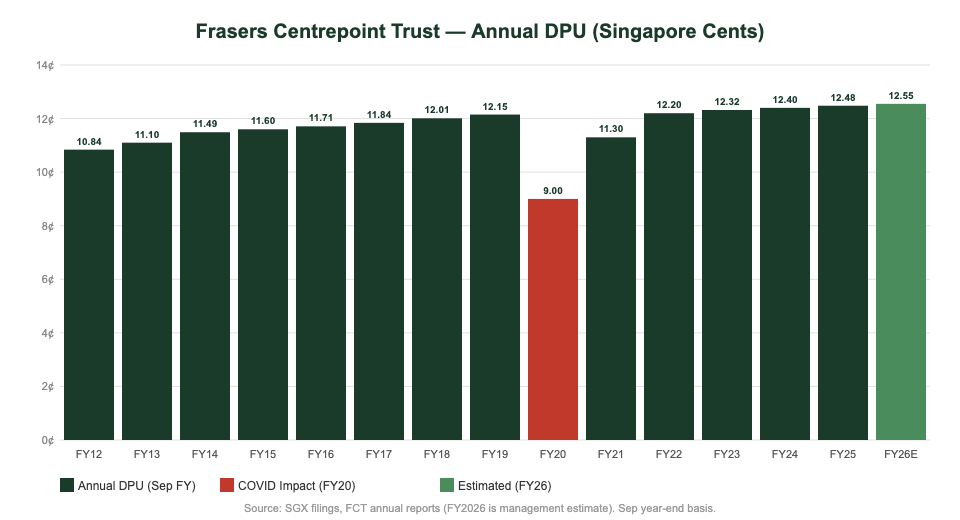
The DPU chart above tells an important story for income investors. FCT delivered consistent, incremental DPU growth of 1–3% annually from FY2012 to FY2019 — reflecting the compounding benefits of suburban retail dominance, strategic asset enhancements, and selective acquisitions.
The FY2020 dip to 9.00¢ is significant but instructive. Unlike discretionary retail REITs, FCT recovered faster because its tenants (supermarkets, clinics, food courts) were deemed essential services and allowed to operate even during Singapore’s circuit breaker. The FY2021 rebound of +25.6% confirmed the structural resilience of the suburban retail model.
Post-COVID, DPU growth has moderated to the 0.5–1% range as rising interest rates (SORA peaked at ~4.25% in 2024) compressed net income margins. However, as the Fed and MAS ease policy through 2025–2026, FCT’s ~S$1.8 billion in borrowings at blended cost of ~3.5% should see meaningful refinancing savings — supporting continued DPU recovery.
Key takeaway: Excluding the COVID anomaly, FCT has never cut its DPU in 14 years of data. This places it among the most reliable dividend-paying S-REITs on the Singapore Exchange. Investors comparing REIT income reliability will find FCT superior to peers with overseas exposure and currency risk. See our guide to the best S-REITs in Singapore 2026 for a full peer comparison.
Yield-on-Cost: What Early Investors Earn Today
Yield-on-cost (YoC) is one of the most powerful concepts for long-term REIT investors. It measures the effective yield you earn today on the price you paid at entry — which grows over time as DPU rises. An investor who bought FCT at S$1.68 in FY2012 and held through to 2026 is now earning an effective yield of approximately 7.47% on their original investment, even though the current market yield is ~5.5%.
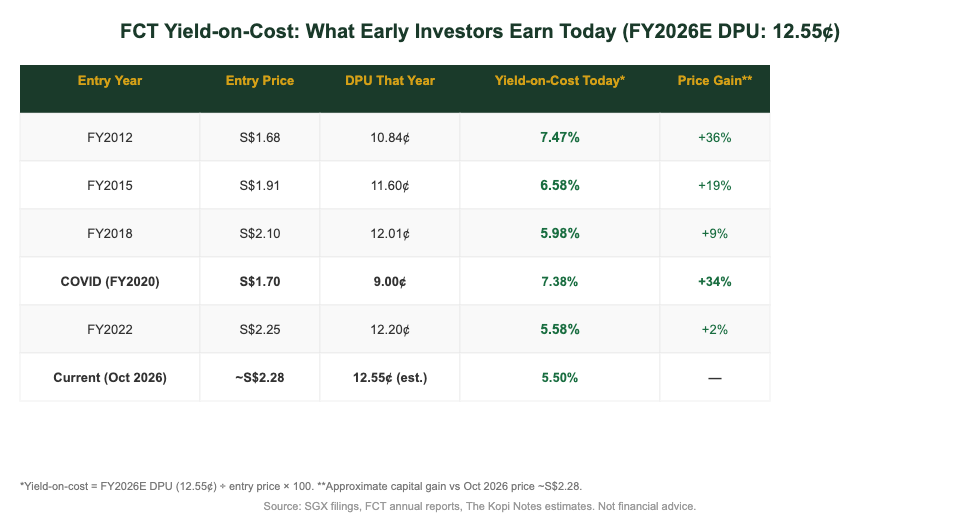
The yield-on-cost table above highlights a clear reward for patience and early entry. COVID-era buyers who picked up FCT units near S$1.70 in mid-2020 are now earning a yield-on-cost of ~7.4% — exceptional for a Singapore dollar-denominated, near-100%-occupied retail REIT with a blue-chip sponsor.
For context: a SGD 50,000 investment in FCT at the COVID-era price of S$1.70 would have purchased approximately 29,412 units. At FY2026E DPU of 12.55¢ per unit, that portfolio generates roughly S$3,691 in annual distribution income — a very tangible passive income stream.
This yield-on-cost story is why income-focused investors using Singapore’s retirement calculator to project their dividend income often highlight FCT as a compounding income anchor. The combination of DPU growth and a rising share price means patient shareholders have earned total returns well above the initial yield suggests.
What Drives FCT’s DPU Growth?
Four structural factors underpin FCT’s ability to grow its distributions over time:
1. Positive Rental Reversions
FCT consistently achieves positive rental reversions at lease renewal — typically in the range of +4% to +8%. As at H1 FY2026, blended rental reversions were tracking at approximately +6.2%, driven by strong demand for suburban NLA space and a structural undersupply of quality heartland retail. This organic income growth flows directly into NPI and DPU.
2. Asset Enhancement Initiatives (AEIs)
FCT has invested heavily in AEIs at key properties including Northpoint City, White Sands, and Causeway Point. AEIs typically improve NLA efficiency, attract higher-value tenants, and command premium rents post-completion. The White Sands AEI (completed FY2024) added approximately 15,000 sq ft of premium NLA and contributed an estimated S$2.5 million in additional annual NPI.
3. Selective Acquisitions from Sponsor Pipeline
Frasers Property Limited (FCT’s sponsor) owns several Singapore suburban retail assets not yet in the REIT portfolio — providing a visible pipeline for accretive acquisitions. FCT has consistently acquired at NPI yields above its cost of debt, creating immediate DPU accretion. The acquisition track record (Waterway Point in 2019, Tampines 1 in 2021) demonstrates disciplined capital allocation.
4. Interest Rate Tailwinds (2025–2026)
With SORA declining from its 2024 peak and FCT’s approximately 75% fixed-rate borrowing hedging maturing and being refinanced at lower rates, the cost of debt burden is easing. Management has guided for borrowing costs to reduce by approximately 20–30bps in FY2026–FY2027, adding roughly 0.3–0.5¢ to distributable income per unit. Singapore investors following their CPF investment strategy increasingly consider rate-cut beneficiaries like FCT as core REIT holdings.
FCT Dividend Outlook for 2026–2027
Based on H1 FY2026 results (DPU: 6.20¢) and management commentary, the FCT FY2026 DPU is estimated at approximately 12.50–12.60¢. This represents modest growth of 0.5–0.9% over FY2025’s 12.48¢, driven by positive rental reversions offset partly by a slight uptick in property maintenance capex.
For FY2027, the DPU tailwinds are stronger. FCT management has flagged:
- ~S$300 million in borrowings due for refinancing at materially lower rates (estimated savings: S$3–4 million NPI annually)
- Hougang Mall AEI completion expected H2 FY2027 — targeting a 12% rental uplift on enhanced NLA
- Continued strong tenant demand, with mall foot traffic 8% above pre-COVID levels as at Q3 2026
Consensus analyst estimates (Phillip Capital, DBS Equity Research) place FCT FY2027 DPU in the range of 12.7–13.0¢, implying a forward yield of approximately 5.6–5.7% at the current share price of ~S$2.28.
For investors building a passive income portfolio in Singapore, FCT at current levels offers a reasonable entry for long-term income with a clear DPU recovery path. The low gearing (34.8%), robust occupancy, and sponsor support are risk mitigants that differentiate FCT from higher-yielding but more leveraged retail REITs.
Investors seeking broader exposure to Singapore income assets may also consider the Singapore REIT ETF guide as a way to access FCT alongside other blue-chip S-REITs in a single diversified vehicle.
How to Buy FCT in Singapore
FCT (SGX: J69U) trades on the Singapore Exchange (SGX) Main Board in Singapore dollars. You can buy it through any SGX-connected brokerage. Here are the most popular platforms for Singapore retail investors:
Syfe Brokerage — Ideal for beginners and CPFIS investors. Syfe offers a commission-free model for SGX stocks including FCT, making it cost-effective for regular monthly accumulation. New users can get a welcome bonus via the Syfe referral code SRPRFFFCD. Syfe also offers the Syfe REIT+ portfolio for those wanting automated REIT exposure rather than individual stock selection.
FSMOne (formerly Fundsupermart) — A solid SGX brokerage for cost-conscious investors, with competitive commissions on SGX stocks. Use the FSMOne referral code P0544985 for account opening bonuses. FSMOne’s regular savings plan allows you to accumulate FCT units automatically each month.
Interactive Brokers (IBKR) — Best for investors with larger portfolios (>S$50,000) who want the lowest possible transaction costs. IBKR’s SGX commission is typically USD 1.00 minimum or 0.05% of trade value, making it the most cost-efficient for block purchases of FCT. Sign up via IBKR referral code jianxiong368 for fee credits.
Endowus — For CPF-OA and SRS investors, Endowus (referral code 2V343) provides access to SGX REITs including FCT through its brokerage service. This is particularly valuable for Singaporeans who want to invest their SRS savings into income-producing REITs like FCT as part of a tax-deferred retirement plan.
Step-by-step to buy FCT:
- Open a SGX-enabled brokerage account (Syfe, FSMOne, IBKR, or your bank’s brokerage)
- Fund the account in SGD
- Search for ticker symbol J69U
- Select the number of units (minimum 1 lot = 100 units, approximately S$228 at current prices)
- Place a limit order at or below the current bid price for best execution
- Hold and receive semi-annual distributions in June and December
Note: FCT distributions are not subject to withholding tax for Singapore tax residents. CPF-OA and SRS funds can be used to purchase FCT under the CPFIS and SRS investment schemes respectively.
Frequently Asked Questions: Frasers Centrepoint Trust
What is the current dividend yield of Frasers Centrepoint Trust (FCT)?
As at October 2026, FCT (SGX: J69U) offers an estimated forward dividend yield of approximately 5.5%, based on FY2026E DPU of ~12.55 Singapore cents and a share price of ~S$2.28. This yield is paid semi-annually — typically in June (H1 distribution) and December (H2 distribution). Note that distributions are not subject to withholding tax for Singapore tax residents.
What is the historical DPU of Frasers Centrepoint Trust?
FCT’s DPU history shows consistent growth from 10.84¢ (FY2012) to ~12.55¢ (FY2026E). The only significant dip was in FY2020 (9.00¢) due to COVID-19 rental rebates — which was fully recovered by FY2022. Over the 14-year period from FY2012 to FY2026, FCT has grown its DPU by approximately 15.8% in absolute terms, or roughly 1.1% per annum compounded. The full DPU table is available in this article above.
Can I use CPF to buy Frasers Centrepoint Trust?
Yes. FCT is eligible under the CPF Investment Scheme (CPFIS-OA and CPFIS-SA). You can invest your CPF Ordinary Account (OA) savings into FCT units through an approved CPF broker such as DBS, OCBC, UOB, or online via platforms like Endowus or Syfe. However, note that CPF funds must earn at least the CPF minimum interest rate (currently 2.5% for OA) to qualify for withdrawal, and there are risk disclosure requirements. Always assess whether investing CPF savings in REITs aligns with your retirement goals.
Is FCT a good REIT for passive income in Singapore?
FCT is widely regarded as one of the most reliable S-REITs for passive income due to its: (1) 14-year dividend history with only one temporary COVID-era dip; (2) near-100% committed occupancy anchored by necessity-driven tenants; (3) low gearing of ~34.8%, providing a buffer for acquisitions; (4) reputable sponsor in Frasers Property Limited; and (5) forward yield of ~5.5% at current prices. For investors seeking a stable, Singapore-dollar-denominated income stream, FCT is a core holding. That said, no REIT is risk-free — rising interest rates, economic downturns, or structural changes in retail behaviour remain risks to monitor.
Does Frasers Centrepoint Trust pay quarterly or semi-annual dividends?
FCT pays distributions semi-annually — two payments per financial year. The H1 distribution (October–March) is typically paid in June, and the H2 distribution (April–September) is paid in December. The distribution is declared in Singapore cents per unit and credited directly to your brokerage account or CDP account as cash. Unlike some REITs that offer a Distribution Reinvestment Plan (DRIP), FCT pays distributions in cash only.
What are the key risks for FCT investors?
Key risks for Frasers Centrepoint Trust investors include: (1) Interest rate risk — FCT’s borrowings (~S$1.8 billion) mean that rising rates compress distributable income; approximately 25% of FCT’s debt is on floating rates; (2) Tenant concentration risk — NTUC FairPrice and other anchor supermarkets represent a large share of rental income; any deterioration in these tenants’ businesses would impact NPI; (3) E-commerce disruption — while suburban F&B and essential retail has proven resilient, growing online grocery delivery could eventually impact supermarket footprints; (4) Acquisition risk — debt-funded acquisitions at insufficient NPI yields could dilute DPU; (5) Regulatory risk — MAS gearing limits (currently 50%) and REIT regulations could change. Maintain a diversified S-REIT portfolio and consider the broader best S-REITs in Singapore 2026 list for context.
Disclaimer: This article is for educational purposes only and does not constitute financial advice. Frasers Centrepoint Trust investment carries risks including loss of capital. DPU figures are historical or estimated and are not guaranteed. Always conduct your own due diligence or consult a licensed financial adviser before making investment decisions. The Kopi Notes may earn referral commissions from platform links in this article.
This article was researched with the help of AI. While we strive to keep all information accurate and up to date, there may be errors. If you notice any discrepancies, please contact us.