TribeCar + Endowus + GXS + Syfe + Trust Bank: Ranking Exit Friction (2026)
Opening these five accounts takes minutes. Closing them — and getting every dollar back — is a very different story.
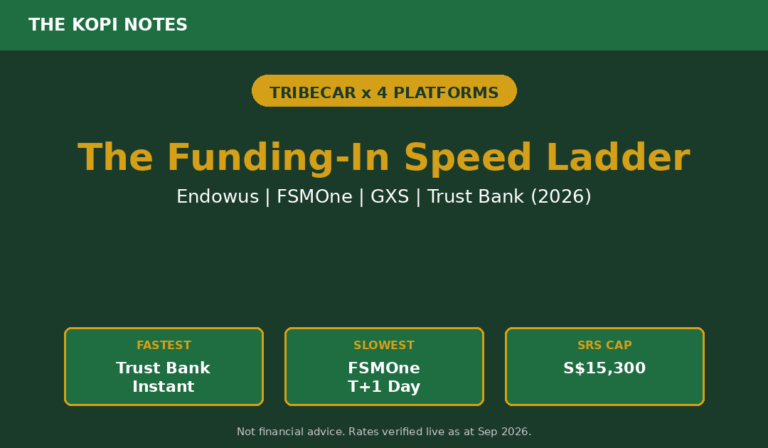
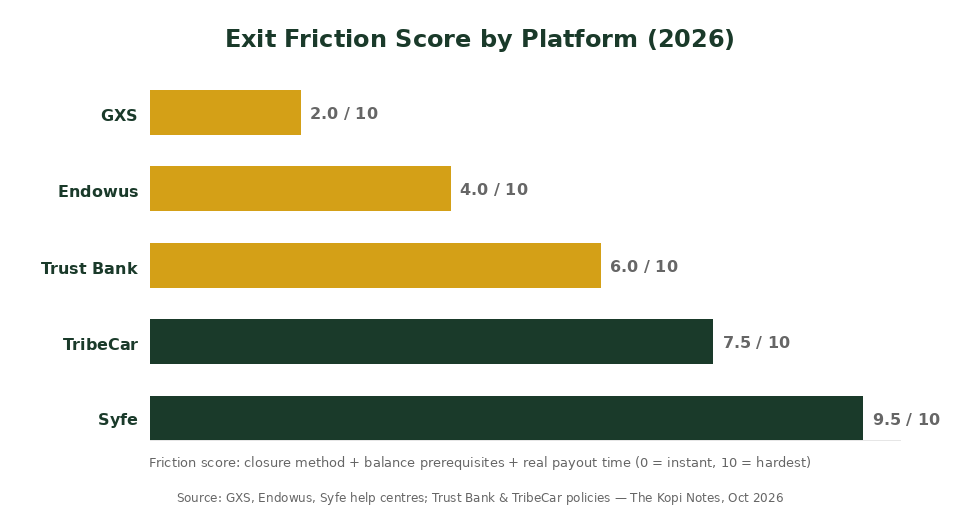
Among TribeCar, Endowus, GXS, Syfe and Trust Bank, GXS is the easiest to exit — an in-app request closes it in roughly a day once your balance is zero. Syfe is the hardest: even after you redeem every holding and cancel recurring deposits, a formal cooling-off period of about 180 days applies before the account is actually closed. Endowus sits in the middle with a predictable 4-15 business day redemption-and-withdrawal chain, while Trust Bank and TribeCar each carry a different kind of friction — undocumented closure timelines for Trust Bank, and a deposit that’s refundable but a top-up wallet balance that explicitly isn’t for TribeCar. Ranking all five by closure method, balance prerequisites and real payout time shows which platform to think twice about before you fund it heavily.
Not financial advice. Account closure processes, fees and processing times change as platforms update their policies — details below were verified in October 2026, so always check the current closure terms on each platform’s own help centre before you start.
Table of Contents
Contents — Click to expand
- The exit friction score, side by side
- GXS (YONG477) — close in-app, under a day
- Endowus (2V343) — redeem, withdraw, then close
- Trust Bank (HTWYQP95) — the undocumented exit
- TribeCar (zZDeg) — deposit back, top-up credit gone
- Syfe (SRPRFFFCD) — a 180-day cooling-off period
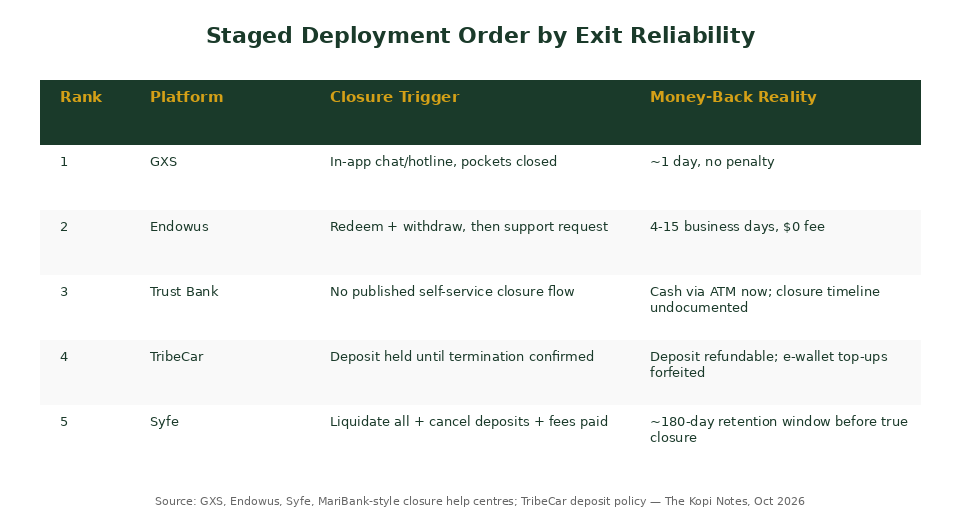
- Staged deployment order by exit reliability
- What this means before you fund any of them
- FAQ
The Exit Friction Score, Side by Side
Most comparison articles rank these platforms on how fast you can join. This one ranks the opposite: how hard it is to leave. “Exit friction” combines three things — the closure method itself (app, form, call), what has to be true about your balance before you’re even allowed to close, and how long the final payout actually takes once you’ve asked. Lower score means an easier, faster exit. Here’s the honest breakdown as at October 2026:
| Platform | Closure Method | Balance Prerequisite | Exit Friction Score |
|---|---|---|---|
| GXS | In-app chat or hotline request | Close all Saving/Boost Pockets, transfer out balance | 2.0 / 10 |
| Endowus | Support request once balance is $0.00 | Redeem all holdings, withdraw remaining cash | 4.0 / 10 |
| Trust Bank | No published self-service flow — in-app chat/hotline only | Not publicly documented | 6.0 / 10 |
| TribeCar | Account termination request to close deposit | Loaded e-wallet credit forfeited, deposit held until termination | 7.5 / 10 |
| Syfe | Redeem everything, cancel deposits, pay fees — then wait | ~180-day retention period before closure finalises | 9.5 / 10 |
Source: GXS Help Centre, Endowus Help Centre, Syfe account closure notice, MariBank-style closure precedent, Trust Bank and TribeCar policies — verified by The Kopi Notes, October 2026.
GXS (Code YONG477) — Close In-App, Under a Day
GXS is the easiest of the five to leave. Before closing, GXS’s help centre is explicit that you must close any Saving Pocket or Boost Pocket you’ve created first — closure is only possible at a zero balance — then transfer the remaining funds out via PayNow or FAST, since GXS is digital-only and doesn’t offer cash withdrawal services directly. Once that’s done, raise the closure request through GXS Chat in the app (GXS’s own recommended route) or the hotline at 1800 866 6685. There’s no stated penalty for closing, GXS confirms the closure by email, and your PayNow linkage is removed automatically — but note you cannot reinstate or reapply for the same GXS Savings Account once it’s closed. See our full GXS Bank review for how the Boost Pocket and Saving Pocket rates work while you’re still using it. Code YONG477 applies if you haven’t opened the account yet.
Endowus (Code 2V343) — Redeem, Withdraw, Then Close
Endowus’s process is a clean three-step chain rather than a single bottleneck. First, redeem every holding via Invest > Redeem > Transfer — Endowus charges no transaction fees or penalties for this, and cash redemptions confirmed before 12:30pm on a business day are typically executed the same day, settling in about 3-5 working days. CPF and SRS redemptions run on a separate 8:30am cut-off and take roughly 5-7 business days to reach your CPF or SRS Agent Bank. Second, withdraw whatever cash is left — 1-2 business days to a local bank account, 5-10 days to an overseas one. Only once your investments and Uninvested Cash Balance both read $0.00 can you submit a support request to close the account itself. Nothing about the closure request is hard; the friction is simply waiting out the redemption settlement, which is bounded and predictable rather than open-ended. See our full Endowus robo-advisor review for how the fee tiers and fund list work while the account is still open. Code 2V343 applies on sign-up.
Trust Bank (Code HTWYQP95) — The Undocumented Exit
Trust Bank’s friction is a different kind entirely: it’s not a long waiting period, it’s a lack of a published process. Unlike GXS, Endowus or Syfe, Trust Bank has no public help-centre article walking through self-service account closure or a stated turnaround time for returning a closed account’s balance — closure has to be requested through in-app live chat or the hotline, and the actual processing time is simply not documented anywhere we could verify. The one thing that is clear is that your cash stays genuinely accessible while the account is open: Trust customers can withdraw using their Trust card at any Standard Chartered Bank ATM across the island, plus one Trust-branded ATM at FairPrice Xtra in VivoCity, so parking money there doesn’t lock it up day-to-day. The friction only shows up if you ever want to close the account entirely — you’re relying on a support conversation with no published SLA, rather than a documented self-service flow. See our Trust Bank Singapore guide for how the Freedom Card and savings rates work day-to-day. Code HTWYQP95 applies if you’re signing up fresh.
TribeCar (Code zZDeg) — Deposit Back, Top-Up Credit Gone
TribeCar’s exit friction isn’t about speed — it’s about what you get back. The refundable security deposit (S$100 for citizens and PRs, S$200 for new drivers, S$500 for Employment Pass holders, up to S$1,000 for some foreign licence holders) is held against your account and only released once account termination is confirmed — there’s no self-service “close now” button inside the app the way there is for GXS or Endowus. The part that catches people out is the e-wallet: any credit you’ve topped up into your TribeCar wallet is explicitly non-refundable even after you terminate your account, so prepaid balance you haven’t spent on bookings simply doesn’t come back. That makes TribeCar the one platform on this list where closing the account can mean a genuine, permanent loss — not just a slow refund. Keep your TribeCar top-ups close to what you’ll actually spend if there’s any chance you’ll close the account later.
Syfe (Code SRPRFFFCD) — A 180-Day Cooling-Off Period
Syfe is the hardest exit of the five by a wide margin, and the friction is structural, not a one-off delay. Before you can even request closure, Syfe’s help centre requires that all portfolio positions be fully redeemed, any brokerage holdings liquidated with pending orders cancelled, recurring deposits cancelled, and any outstanding fees paid. Once you submit the closure request, Syfe’s own account closure notice describes a cooling-off window of roughly 180 days (about six months) from the date you confirm your instructions — the account isn’t actually closed until that period lapses, intended to cover any late-arriving fees, dividends, interest or corporate actions. Syfe is explicit that funds arriving after the account closes may be forfeited, or an administrative fee charged to process a refund. In other words: the moment you ask to close is just the start of a half-year tail, not the end of the process. See our Syfe SRS account guide for how the portfolios and fee tiers work while the account is still open. Code SRPRFFFCD applies on sign-up.
Staged Deployment Order by Exit Reliability
If you’re deciding where to park money you might need back quickly versus money you’re happy to lock away, exit reliability is the missing input most comparisons skip. Lined up this way, GXS and Endowus are the two accounts that behave predictably on the way out, Trust Bank’s gap is informational rather than time-based, TribeCar’s risk is a forfeited top-up rather than a slow refund, and Syfe is the one platform where “closing” genuinely means committing for roughly half a year.
What This Means Before You Fund Any of Them
Exit friction doesn’t mean “don’t use the platform” — it means fund it with that friction in mind:
Keep GXS for money you might need back on short notice. A clean closure request returns your balance within roughly a day, so it’s the right home for a buffer you might unwind, not just a bonus-chasing account you forget about.
Treat Endowus’s 4-15 day window as normal, not a red flag. It’s simply how long redemption settlement takes — CPF/SRS legitimately takes longer than cash — and there’s no fee or penalty attached to any of it.
Don’t assume Trust Bank will be fast just because the digital banks above it are. Without a published closure SLA, budget extra time and a support conversation if you ever decide to leave, even though your cash stays reachable via ATM the whole time you’re still active.
Only load TribeCar’s wallet with what you’ll actually spend. The deposit itself is recoverable, but top-up credit is gone for good once you terminate — don’t treat it like a savings balance.
Size any Syfe position with the 180-day tail already priced in. If there’s a real chance you’ll need the full balance back within six months of deciding to leave, that’s a reason to keep less of it in Syfe, not a reason to avoid Syfe altogether for its stronger rates while you’re actually using it.
None of this is a reason to avoid any of the five — it’s simply the other half of the picture that a joining-speed or bonus-size comparison alone doesn’t show you.
Claim the Five Codes
FAQ
Which of the five is genuinely the easiest to close?
Is Syfe's 180-day cooling-off period a fee, or just a wait?
Why is Trust Bank's score based on missing information rather than a long wait?
Does TribeCar's non-refundable e-wallet credit expire, or is it lost immediately on termination?
Does closing one of these accounts affect my referral bonus from the others?
Should exit friction stop me from opening any of these accounts?
The Bottom Line
GXS is the account you can treat like a true emergency buffer — closed and refunded within a day. Endowus is a predictable multi-day unwind, not a red flag. Trust Bank’s risk is a lack of information, not a lack of speed. TribeCar’s risk is a forfeited top-up, not a slow refund. And Syfe deserves real patience — budget for roughly six months, not six days, if you ever decide to close it fully.
See our CPF retirement sum guide for where money freed from a closed account can go next, or read our onboarding friction ranking for how fast these same platforms are to join, before you worry about how hard they are to leave.
This article was researched with the help of AI. While we strive to keep all information accurate and up to date, there may be errors. If you notice any discrepancies, please contact us.