How to Invest in Singapore: Year-End SRS & Tax Optimisation Guide (2026)
Cut your tax bill by up to $3,672 before 31 December — here’s exactly what to do with your SRS account.
The Supplementary Retirement Scheme (SRS) is the single most powerful year-end tax move for most Singapore investors: top up $15,300 by 31 December, and every dollar reduces your chargeable income dollar-for-dollar. At a 22% marginal rate, that’s $3,366 back in your pocket — before investing a single dollar. Combined with a CPF RSTU top-up, eligible Singapore residents can reduce their tax bill by up to $5,126 before year end.
Not financial advice. All figures are for educational reference only. Data verified as at 15 October 2026.
Why $3,672 in Tax Savings Goes Unclaimed Every Year
Every year, the Singapore Inland Revenue Authority of Singapore (IRAS) quietly refunds millions of dollars to SRS account holders — and leaves an equal amount unclaimed on the table because residents either don’t have an SRS account, or remember to top it up in November and December when it’s almost too late to invest the money.
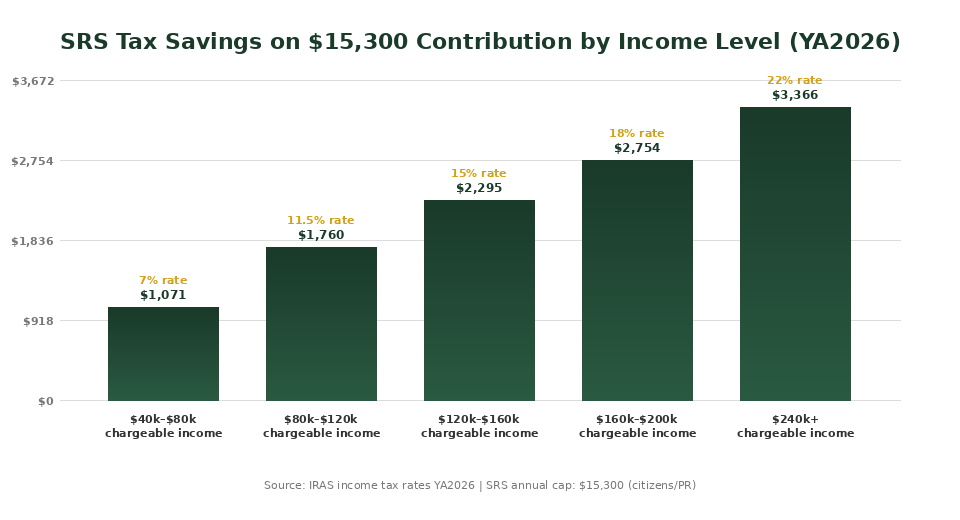
The numbers matter more than most people realise. A Singapore citizen or permanent resident earning above $160,000 in chargeable income can reduce their tax bill by $2,754 per year simply by topping up their SRS account to the $15,300 annual cap. At $240,000 and above, that rises to $3,366. At the absolute maximum marginal rate of 24% (income above $1 million), the saving is exactly $3,672.
Foreigners working in Singapore get an even larger window: their SRS cap is $35,700 per year, translating to maximum savings of $8,568 at the top marginal rate.
What most people miss is the compounding effect. The money you save on tax doesn’t just sit there — if you invest it, even into a simple S&P 500 ETF or a Singapore Savings Bond, you are effectively putting the government’s money to work for your retirement. That’s the power of the SRS tax deferral structure.
The other missed opportunity: the CPF Retirement Sum Top-Up Scheme (RSTU). Topping up your own Special Account or Retirement Account by $8,000 gives you $8,000 in personal income tax relief. Topping up a family member’s CPF SA/RA by another $8,000 gives you a further $8,000 in relief — $16,000 combined. At a 15% marginal rate, that’s $2,400 saved on top of SRS savings.
How SRS and CPF Top-Ups Actually Cut Your Tax Bill
Both SRS contributions and CPF RSTU top-ups are deducted from your assessable income before IRAS calculates your chargeable income. The tax saving is your marginal rate multiplied by the contribution amount — it’s dollar-for-dollar relief, not a percentage rebate.
SRS Tax Relief Mechanics
Here is how the SRS calculation works for a Singapore citizen or PR:
- Open an SRS account at DBS/POSB, OCBC, or UOB (this takes 10 minutes online).
- Transfer up to $15,300 into your SRS account any time before 31 December of the current year.
- The $15,300 is deducted from your assessable income when you file your tax return (the contribution is self-reported on the IR8A or individual filing form).
- IRAS reduces your chargeable income by $15,300, and your tax bill falls by $15,300 × (your marginal rate).
You don’t pay tax on SRS withdrawals immediately. At your statutory retirement age (currently 64 years old — changed from 63 effective 1 July 2026), you can withdraw SRS funds and only 50% of the amount withdrawn is taxable. If you’re retired with low income, you may pay little to no tax on withdrawals.
The effective tax benefit: you save at your current (higher) working marginal rate today and potentially pay at a much lower (or zero) rate in retirement. That’s the core arbitrage.
| Chargeable Income (Before SRS) | Marginal Rate | Tax Saved on $15,300 SRS |
|---|---|---|
| $40,001 – $80,000 | 7% | $1,071 |
| $80,001 – $120,000 | 11.5% | $1,760 |
| $120,001 – $160,000 | 15% | $2,295 |
| $160,001 – $200,000 | 18% | $2,754 |
| $200,001 – $240,000 | 19% | $2,907 |
| $320,001 – $500,000 | 22% | $3,366 |
| Above $1,000,000 | 24% | $3,672 |
Source: IRAS Personal Income Tax Rates, YA2026. SRS annual contribution cap: $15,300 (citizens/PR), $35,700 (foreigners).
CPF RSTU: The Other Year-End Move
The Retirement Sum Topping-Up Scheme (RSTU) lets you top up your own or a family member’s CPF Special Account (SA) or Retirement Account (RA). The amounts are:
- Top up your own SA/RA: Up to $8,000 in personal income tax relief.
- Top up a family member’s SA/RA (spouse, siblings, parents, grandparents): Up to an additional $8,000 in relief.
- Combined maximum: $16,000 in tax relief.
Important 2025 change: MediSave top-ups for family members no longer qualify for tax relief from YA2025 onwards. Only SA and RA top-ups count. Your own MediSave top-up (up to the Basic Healthcare Sum of $79,000 in 2026) still qualifies for the $8,000 cap under MediSave contributions — but family member MediSave top-ups were removed from the scheme. Review your year-end plan if you relied on this route previously.
A useful combination: a married couple with two working spouses can each top up $8,000 to their own SA/RA and $8,000 to their spouse’s SA/RA, for $32,000 in total relief across the household.
Singapore’s Year-End Tax Relief Landscape
Singapore’s personal income tax system is progressive, with chargeable income rates ranging from 0% to 24%. The key number to know: there is an overall personal income tax relief cap of $80,000 per year of assessment. Once your total reliefs exceed $80,000, you receive no additional benefit from stacking more reliefs. But most working Singaporeans are well below this cap.
Common reliefs that most employees already claim include CPF employee contributions (auto-deducted and reported by employers), earned income relief ($1,000–$3,000 depending on age), and course fee relief. After these, most residents still have substantial room for voluntary top-ups like SRS and RSTU. Check your previous year’s NOA (Notice of Assessment) to see where you currently stand.
| Relief Type | Max Amount | Action Required | Deadline |
|---|---|---|---|
| SRS Contribution | $15,300 (citizen/PR), $35,700 (foreigner) | Open account + top up | 31 Dec |
| CPF RSTU (own SA/RA) | $8,000 | Top up via CPF portal | 31 Dec |
| CPF RSTU (family SA/RA) | Additional $8,000 | Top up family member CPF | 31 Dec |
| CPF MediSave (own account) | Up to BHS ($79,000 in 2026) | Top up own MediSave | 31 Dec |
| Course Fees Relief | $5,500 | Pay qualifying course fees | 31 Dec |
| NSman (Active) | $5,000 | Auto-applied | Auto |
Source: IRAS Tax Reliefs, YA2026. Overall cap: $80,000 total reliefs per year.
One strategic consideration: if your combined SRS + CPF RSTU top-ups would push your total reliefs above the $80,000 cap, prioritise the SRS contribution first. SRS money goes into your account and can be invested for growth; CPF RSTU puts money into the CPF system where it earns the guaranteed 4–5% SA/RA rate but cannot be withdrawn freely before 55. For most high earners, the combination of SRS ($15,300) plus RSTU ($8,000 own) plus employee CPF contributions ($37,740 for those at the CPF salary ceiling of $7,400/month) sits below the $80,000 cap, so both can be claimed in full.
For a deeper dive on CPF strategy, see our guide on CPF investment strategy Singapore, which covers the full spectrum of CPF voluntary contribution options.
Where to Invest Your SRS in 2026
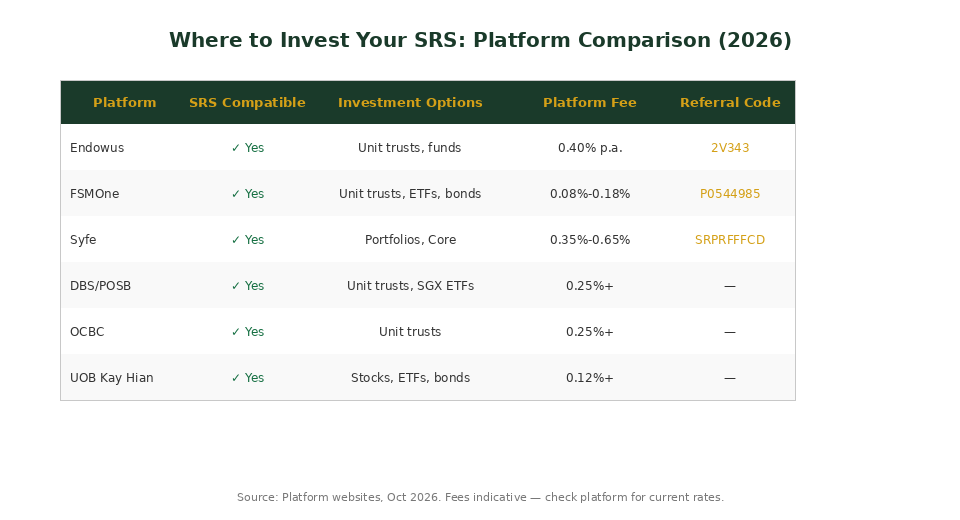
Opening an SRS account is the first step — but leaving the money as cash in your SRS account earns only 0.05% per year (the default SRS cash rate at most banks). The real power of SRS comes from investing those funds. You can invest SRS money in stocks, ETFs, unit trusts, Singapore Savings Bonds, T-bills, and fixed deposits — as long as the platform is SRS-approved.
Here is how the main SRS investing platforms compare in 2026:
| Platform | Annual Fee | Minimum | Key Strength | Referral Code |
|---|---|---|---|---|
| Endowus | 0.40% p.a. (multi-fund), 0.15% (cash mgmt) | $1,000 | 100% trailer fee rebates; fund-of-funds access; SRS + CPF | 2V343 |
| FSMOne | 0.08% – 0.18% p.a. | $100 | Low fees; direct ETF & bond access; RSP available | P0544985 |
| Syfe | 0.35% – 0.65% p.a. | $1 | Beginner-friendly; auto-rebalancing; REIT+ portfolio | SRPRFFFCD |
| DBS/POSB | 0.25% + fund fees | Varies | SRS account issuer; no separate transfer; SGX ETFs | — |
| OCBC | 0.25% + fund fees | Varies | SRS account issuer; OneInvest platform | — |
| UOB Kay Hian | 0.12% + transaction | Varies | Stocks, bonds, SSBs and T-bills via SRS | — |
Source: Platform websites, October 2026. Fees are indicative — check platform for current rates before investing.
Our take: Endowus remains the most cost-effective choice for SRS investors who want managed multi-asset portfolios, because their 100% trailer fee rebate means you receive all fund management rebates back in your account — something the banks do not do. Use our Endowus referral code (2V343) to get a fee waiver on your first $10,000 managed for six months. If you prefer to pick your own funds with lower platform fees, FSMOne (referral: P0544985) charges just 0.08–0.18% and gives you direct access to unit trusts and fixed-income instruments. For hands-off portfolio management, use your Syfe referral code (SRPRFFFCD).
One important note: ETFs listed on foreign exchanges (like London Stock Exchange ETFs such as CSPX or VWRA) cannot be purchased using SRS funds. SRS can invest in SGX-listed securities, Singapore unit trusts, SSBs, T-bills, and fixed deposits. If your SRS allocation is primarily passive index exposure, Endowus’s fund portfolios give you broad equity coverage at reasonable cost, or you can buy the Nikko AM STI ETF or Lion-Phillip S-REIT ETF on SGX using your SRS via UOB Kay Hian.
Your October-to-December Action Checklist
With Q4 underway, the clock is ticking. Here is a practical step-by-step plan to maximise your year-end tax position. All deadlines are 31 December 2026 unless otherwise noted.
Step 1: Check Your Current Tax Position (10 minutes)
Log into myTax Portal and check your YA2026 estimated chargeable income. This tells you your marginal rate and how much room you have under the $80,000 relief cap. If you filed for extension, use your YA2025 NOA as a proxy.
Step 2: Open an SRS Account If You Don’t Have One
You can open an SRS account at DBS/POSB, OCBC, or UOB — the three approved SRS operators in Singapore. This takes 10–15 minutes online via their respective banking apps. You do not need to fund the account immediately; what matters is that it is open before 31 December so contributions in December count toward YA2026. Use the Singapore retirement calculator to model how your SRS contributions affect your retirement projection.
Step 3: Top Up to $15,300 (or $35,700 if Foreigner)
Transfer the maximum annual SRS contribution to your SRS account via internet banking. The funds need to be credited to the SRS account by 31 December. Most banks process same-day. If you can’t afford the full amount, even a partial top-up gives you partial relief — every dollar counts.
Step 4: Invest the Funds — Don’t Leave Them as Cash
Transfer your SRS funds from the bank SRS account to your preferred investment platform (Endowus, FSMOne, or Syfe all accept SRS top-ups). Cash sitting in the default SRS account earns only 0.05% per year. Investing in a diversified portfolio historically beats this by orders of magnitude over a 20-year retirement horizon. If you’re unsure, the Endowus Core suite or an SSB ladder are both sensible options.
Step 5: CPF RSTU Top-Up
Log into my CPF and make a voluntary RSTU contribution to your SA or RA (depending on age). If you have a spouse, parents, or in-laws with CPF accounts, the additional $8,000 family top-up doubles your relief. Ensure you have not already hit the Full Retirement Sum ($213,000 for the 1961 cohort) — top-ups above FRS do not earn the extra 1% interest and may not give the maximum tax benefit.
Step 6: Log Your Contributions for Tax Filing
SRS contributions are auto-reported to IRAS by the SRS operator. CPF RSTU top-ups are also auto-filed by CPF Board. You should still keep the transaction records — your SRS account statement and CPF transaction history are the proof if IRAS queries your claim. If you use a tax filing agent, forward them these statements by March 2027.
Not financial advice. Tax savings are illustrative based on IRAS YA2026 rates. Individual circumstances vary. Consult a tax professional for personalised advice.
Frequently Asked Questions
How much tax can I save with the SRS in 2026?
Singapore citizens and PRs can contribute up to $15,300 per year to their SRS account. The tax saving equals $15,300 multiplied by your marginal income tax rate. At a 22% marginal rate (chargeable income $320,001–$500,000), that’s $3,366. At 15% (chargeable income $120,001–$160,000), it’s $2,295. Foreigners can contribute up to $35,700 and save up to $8,568 at the top rate.
Can I still open an SRS account and contribute before December 31?
Yes — you can open an SRS account at DBS/POSB, OCBC, or UOB online in about 15 minutes, then immediately transfer funds. As long as the contribution is credited to your SRS account by 31 December, it counts toward your YA2026 tax relief. Same-day processing is standard for internet banking transfers between your savings account and your SRS account at the same bank.
What can I invest my SRS money in?
SRS funds can be invested in Singapore Exchange (SGX)-listed stocks and ETFs, unit trusts approved for SRS investment, Singapore Savings Bonds (SSBs), Singapore Government Securities (T-bills), fixed deposits, and annuities. Notably, ETFs listed on foreign exchanges such as CSPX or VWRA on the London Stock Exchange are not SRS-eligible. For broad market exposure, consider Endowus or FSMOne’s unit trust portfolios, or SGX-listed ETFs such as the Nikko AM STI ETF.
When can I withdraw my SRS money without penalty?
You can withdraw SRS funds at or after the statutory retirement age (currently 64 years old as at 1 July 2026). At retirement age, only 50% of each withdrawal is taxable — meaning if your other income in retirement is low, you may pay very little or no tax on SRS withdrawals. Withdrawals before retirement age incur a 5% penalty on the amount withdrawn, and 100% of the amount is subject to income tax (not the 50% concession). You must complete all SRS withdrawals by age 72, or a deemed withdrawal is triggered.
What is the CPF RSTU and how does it differ from SRS?
The CPF Retirement Sum Topping-Up Scheme (RSTU) lets you make voluntary cash contributions to your CPF Special Account (SA) or Retirement Account (RA), earning the CPF guaranteed rate of 4% p.a. (SA) or 4–6% p.a. (RA, with first $30k at the higher rate). RSTU top-ups earn a fixed CPF rate and are locked into the CPF system, while SRS contributions can be invested in market-linked instruments. The tax relief rules are different: SRS gives relief equal to the full contribution amount (up to the annual cap), while RSTU gives relief up to $8,000 for your own account and another $8,000 for family members.
Is there an overall cap on how much tax relief I can claim?
Yes — Singapore’s total personal income tax relief is capped at $80,000 per year of assessment. This cap covers all reliefs combined: employee CPF contributions, earned income relief, SRS, RSTU, course fees, NSman, parenthood reliefs, and others. Most working residents earning below $200,000 will be below the cap after SRS and RSTU. Check your previous year’s Notice of Assessment on myTax Portal to see your total reliefs claimed and available headroom.
Does SRS make sense if I am close to retirement?
SRS is most powerful when you have many years for the invested funds to compound. However, even at age 55–60, if you are at a high marginal rate now and expect to be in a lower bracket in retirement, the arithmetic still works in your favour: you save at 22% today and withdraw at effectively 0–11% later (because only 50% of withdrawals are taxable). The minimum useful window is around 5–10 years before retirement age; any shorter and the investment return advantage narrows. Use the Singapore retirement calculator to run the numbers for your specific age and income.
Can foreigners working in Singapore use SRS?
Yes — foreigners holding an Employment Pass, S Pass, or other Singapore work pass are eligible to open an SRS account and contribute up to $35,700 per year, versus $15,300 for citizens and PRs. The higher cap reflects the assumption that foreigners may not benefit from CPF contributions. The same withdrawal rules apply: full retirement age (64) for penalty-free withdrawal with 50% tax concession, and full 5% penalty plus 100% taxability for early withdrawal. Foreign SRS accounts also allow penalty-free withdrawal when leaving Singapore permanently (subject to a 10-year holding period in some scenarios).
Start Your Year-End Tax Optimisation Today
Open an SRS account, invest via a platform with low fees, and claim your tax relief before 31 December 2026.
This article was researched with the help of AI. While we strive to keep all information accurate and up to date, there may be errors. If you notice any discrepancies, please contact us.