ISP Downgrade 2025: The Complete Decision Checklist
What to verify before switching to a lower Integrated Shield Plan tier — using the latest 2025 MOH data.
In 2025, 128,200 Singaporeans downgraded or discontinued their Integrated Shield Plan — and 181,800 cancelled their IP rider, both record highs according to MOH data. Rising premiums are pushing many households to reconsider their coverage tier. But downgrading without a structured plan risks leaving you with large hospital bills at the worst possible time. This checklist walks you through the five decisions you must make before downgrading.
Not financial advice. All figures are for educational reference only. Data verified as at 15 October 2026 unless noted.
Table of Contents
Contents — Click to expand
The 2025 ISP Downgrade Data: What MOH Found
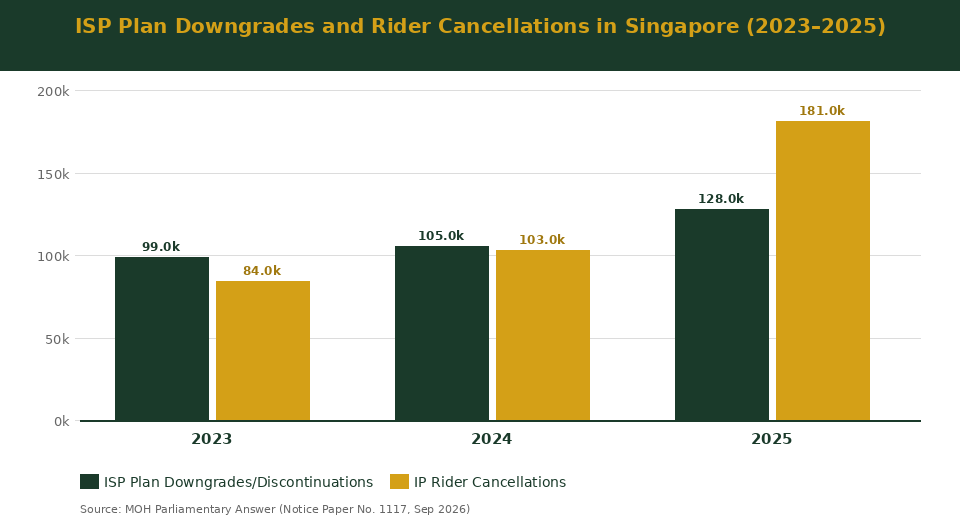
In a parliamentary answer published 9 September 2026 and updated 15 October 2026, the Ministry of Health revealed that Integrated Shield Plan (ISP) downgrades and discontinuations have risen sharply over three consecutive years. The trend is even more pronounced for IP riders.
| Year | ISP Plan Downgrades / Discontinuations | IP Rider Cancellations | YoY Change (Riders) |
|---|---|---|---|
| 2023 | 99,000 | 84,800 | — |
| 2024 | 105,900 | 103,400 | +21.9% |
| 2025 | 128,200 | 181,800 | +75.8% |
Source: MOH Parliamentary Answer, Notice Paper No. 1117, September 2026
The rider cancellation figure is particularly striking: a 75.8% jump in a single year, from 103,400 to 181,800. MOH does not formally track the reasons policyholders downgrade or cancel, noting only that “affordability concerns” and decisions to “right-size coverage” are both plausible drivers. The ISP base premiums rising in 2026 are a key factor pushing many households toward this decision.
What the data does not tell you is whether these 128,200 downgrades were wise financial decisions — or regrettable ones made without a full understanding of the consequences. That is precisely what this checklist is designed to help you work out.
What You Give Up When You Downgrade
Downgrading your ISP means moving to a lower ward class tier. In Singapore’s healthcare system, the four tiers from highest to lowest are: Private Hospital, Class A (public hospital private ward), Class B1 (public hospital), and MediShield Life Only (Class B2/C wards). Each step down changes not just your monthly or annual premium, but your actual hospital experience — and your maximum out-of-pocket exposure.
1. Ward Type and Amenities
Private hospital coverage gives you access to fully private hospitals like Mount Elizabeth, Gleneagles, and Raffles Hospital. Class A coverage places you in a single-bedded private ward within a restructured public hospital such as SGH or NUH. Class B1 puts you in a 2–4-bedded ward in a public hospital. Downgrading from private to Class A typically means giving up your choice of private hospital, while remaining in a public hospital’s premium ward. Downgrading from Class A to B1 reduces privacy further but keeps you in a public hospital setting with subsidised rates partially applying.
2. Choice of Doctor
Private hospital coverage generally allows you to see any specialist, including those outside the insurer’s panel. Class A plans may require you to use the insurer’s panel of doctors for rider claims to apply. Class B1 plans are more restrictive. Riders from 1 April 2026 onward require a minimum 10% co-payment from you — see the new ISP rider co-payment rules for the full breakdown.
3. Deductibles and Co-Insurance
Each ISP plan comes with a deductible — the amount you pay out-of-pocket before the insurer pays. Deductibles typically range from S$1,500 to S$3,500 depending on your ward class, your age, and whether you have a rider. Importantly, from 1 April 2026, the minimum IP deductible can no longer be covered by IP riders — you must pay it out-of-pocket. If you are currently relying on a rider to eliminate your deductible, downgrading your plan does not remove this new out-of-pocket obligation. It is built into the system regardless of your plan tier.
ISP Premium Ranges: All Ward Classes Compared
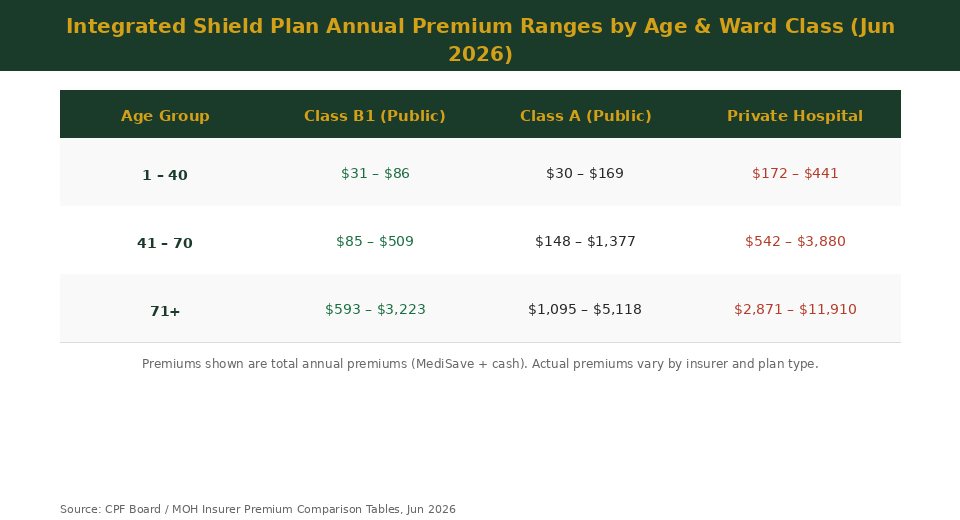
The premium differences between ward classes can be substantial — but the gap widens dramatically at older ages. A 35-year-old switching from private hospital to Class B1 coverage saves roughly S$100–$350 per year. A 55-year-old making the same switch could save S$1,000–$3,000+ per year. The savings calculation is very different at different life stages, which is why your age and health trajectory matter enormously in this decision.
| Age Group | Class B1 (Public) | Class A (Public) | Private Hospital |
|---|---|---|---|
| 1 – 40 | S$31 – S$86 | S$30 – S$169 | S$172 – S$441 |
| 41 – 70 | S$85 – S$509 | S$148 – S$1,377 | S$542 – S$3,880 |
| 71+ | S$593 – S$3,223 | S$1,095 – S$5,118 | S$2,871 – S$11,910 |
Source: CPF Board / MOH Insurer Premium Comparison Tables, June 2026. Total annual premiums (MediSave + cash component). Actual premiums vary by insurer.
Note that for most people under 70, MediSave covers the ISP base premium in full. The MediSave Annual Withdrawal Limit for ISP premiums is S$300 (age 40 and below), S$600 (age 41–70), and S$900 (age 71 and above). When your premium exceeds this limit, the balance must be paid in cash. This cash component is where many households feel the pressure — particularly for older policyholders on private hospital plans.
The 5-Point Checklist Before You Downgrade
Downgrading is often done reactively — someone gets the renewal notice, sees the premium increase, and cancels in frustration. The five-point check below takes 30 minutes but can save you from a much larger bill later.
✓ 1. Know Your Recent Health History and Risk Trajectory
Review the last 5 years of your health records. Have you used hospitalisation coverage? Do you have any pre-existing conditions that are now under managed care? Is there a family history of conditions that typically require private or specialist care — cancer, heart disease, neurological disorders? If your health risk profile is high, the premium savings from downgrading may be dwarfed by a single large hospital bill. If you are young and healthy with no significant history, the risk-reward calculation tilts differently. This should be your first filter.
✓ 2. Calculate the Actual SGD Savings — Not Just the Premium
The real savings from downgrading are not just the premium reduction. You must also factor in: (a) the higher deductible you will face on a lower-tier plan if you are hospitalised; (b) potential co-insurance obligations; and (c) any additional out-of-pocket costs for non-panel specialists. For a 45-year-old switching from Class A to Class B1, the annual premium saving might be S$300–$700, but a single hospitalisation under B1 coverage could expose you to S$1,500–$3,500 in deductible costs that your Class A rider would have mitigated. Use the Singapore retirement planning calculator to factor healthcare costs into your long-term financial model.
✓ 3. Check Your Current Doctor Relationships
If you have a specialist you see regularly — for a chronic condition, ongoing monitoring, or simply a trusted relationship — find out whether they are on the panel of your target lower-tier plan. Many restructured hospital specialists are panel doctors for Class A and B1 plans, but private hospital specialists typically are not. Switching away from a known doctor mid-treatment can affect the quality and continuity of your care, and in some cases creates complications with pre-existing condition declarations.
✓ 4. Understand the Deductible Increase
From 1 April 2026, no IP rider can cover the minimum ISP deductible — you pay it out-of-pocket regardless. But higher-tier plans often have lower absolute deductibles, and their riders absorb a larger proportion of co-insurance. When you downgrade to a lower tier, your deductible may increase and your rider (if you keep it) covers less. Run the maths: if you are admitted once every four years on average, what does the deductible increase cost you per year? Compare that to the annual premium saving. The break-even point is often closer than people expect, especially after age 50. The MediSave being drained faster by rising ISP premiums article covers how to model this accurately.
✓ 5. Stress-Test the Decision Against a Worst-Case Scenario
Ask yourself: if I am diagnosed with a serious illness next year that requires surgery and three weeks of hospitalisation, what is my total out-of-pocket cost under the new plan versus the current plan? Under a private hospital plan with a rider, this could be S$3,500–$10,000 after the minimum deductible. Under a B1 plan without a rider, the same scenario in a public hospital could cost less in absolute terms — but your access to specialists and treatment options may be constrained. The worst-case scenario test is the single most important sanity check before downgrading.
Should You Cancel Your ISP Rider Too?
Many of the 181,800 Singaporeans who cancelled their ISP rider in 2025 did so because rider premiums have risen sharply — particularly for older policyholders who saw increases of 20–40% in a single renewal cycle. But the rider cancellation decision is separate from the plan downgrade decision, and they should be evaluated independently.
Keeping the Base Plan, Dropping the Rider
This is often the financially smarter move. Dropping your rider saves the rider premium (which can be S$500–$2,500+ per year for older age groups) while keeping your access to the relevant ward class and hospital network. Your out-of-pocket exposure increases — you pay the deductible and co-insurance yourself — but you retain the underlying coverage for catastrophic hospitalisation costs. This works well if you have sufficient liquid savings to cover S$3,000–$8,000 in out-of-pocket hospitalisation costs without financial strain.
The Legacy Rider Question
If you currently hold an older “full rider” that covers co-payment completely (these were sold before 2021), note the ISP legacy rider transition deadline of April 2028. From that date, all legacy riders must transition to the new co-payment structure (minimum 10% out-of-pocket). If you are considering cancelling a legacy rider before April 2028, understand that you cannot reinstate it on the old terms — you will only be offered the new co-payment rider on future policies. Factor this into your decision timeline carefully.
New ISP Rider Rules from April 2026
For riders sold from 1 April 2026 onward, a minimum 10% co-payment applies to all claims, and the minimum plan deductible is no longer coverable by any rider. These changes reduce the financial value of holding a rider compared to pre-2026 policies, making the case for rider cancellation more compelling for some policyholders — especially those who are healthy and infrequent hospital users.
Smarter Alternatives to a Full Downgrade
Before committing to a full plan downgrade, consider these intermediate strategies that can reduce your premium burden while preserving more of your coverage.
Strategy 1: Keep the ISP Tier, Drop the Rider
As described above — eliminate the rider premium while keeping your Class A or private hospital access. You absorb more risk personally, but your hospital network options remain open. Works best if you have S$5,000–$15,000 in accessible savings as a healthcare buffer.
Strategy 2: Downgrade One Level, Not Two
If you are currently on private hospital coverage, switching to Class A (not B1) is a smaller downgrade. You move from private hospitals to the private wards of restructured hospitals — still a significant reduction in premium but without losing access to public hospital specialists, which are often of equally high quality. The premium saving is meaningful (S$300–$2,000+ per year depending on age) and the coverage gap is more manageable.
Strategy 3: Shop Within Your Current Tier
ISP premiums for the same ward class vary by insurer. If your current insurer has raised premiums significantly at renewal, compare the other four insurers at the same ward class tier. You may be able to switch to a lower-premium product without any reduction in coverage level. MOH publishes a comparison of Standard IPs (Class B1 coverage) updated as at June 2026 — check the official comparison tool before assuming your current insurer’s price is market rate.
Strategy 4: Use a Cash Reserve Strategy
Some financially disciplined households downgrade deliberately and redirect the premium savings into a ring-fenced healthcare fund (a high-interest savings account or short-duration T-bill). If the savings are S$1,200 per year for a 45-year-old, after five years you have S$6,000+ available to self-insure the deductible and co-payment exposure. This approach works if you have the financial discipline to maintain the fund and not dip into it for non-healthcare purposes.
Frequently Asked Questions
What is the difference between downgrading and discontinuing an integrated shield plan?
Downgrading means switching from a higher ward-class tier (e.g. private hospital) to a lower one (e.g. Class A or B1) while keeping an active ISP policy. Discontinuing means cancelling the ISP entirely, leaving you with only MediShield Life’s basic coverage for Class B2/C wards. Downgrading keeps you within the ISP framework and retains your accumulated no-claims history with that insurer; discontinuing removes the ISP layer entirely and re-exposes you to full co-payment under MediShield Life alone.
If I downgrade my integrated shield plan now, can I upgrade back to private hospital coverage later?
Yes, you can apply to upgrade your ISP tier in the future. However, if your health condition has changed since you downgraded — for example, you have been diagnosed with a new chronic condition — the insurer may impose exclusions or loading on the upgraded plan, or decline the upgrade entirely. Underwriting applies at the time of the upgrade application. This is one of the key risks of downgrading that is frequently underestimated: once you have a health event, your ability to upgrade on the same terms is no longer guaranteed.
What happens to my pre-existing conditions when I downgrade my ISP?
Downgrading within the same insurer typically does not trigger a new underwriting review for pre-existing conditions already covered under your existing policy. Your existing coverage for declared and accepted conditions is preserved within the new lower-tier plan. However, if you switch insurers as part of a downgrade — for example, moving from AIA’s private hospital plan to Singlife’s Class B1 plan — you are applying for a new policy and full underwriting applies. All pre-existing conditions must be re-declared and could be excluded or loaded.
Is it better to cancel my ISP rider or my base ISP plan to save money?
For most policyholders, cancelling the rider while keeping the base ISP plan is the more prudent strategy. The base plan provides the catastrophic coverage that matters most — access to your ward class and hospitalisation coverage up to the plan’s limits. The rider adds convenience (lower out-of-pocket at time of claim) but at a significant ongoing premium cost. Cancelling the base plan is rarely recommended unless you have no hospitalisation history, are very young, and have substantial liquid savings to self-fund hospitalisation. The base plan premium is much smaller than the rider premium for most age groups below 60.
What is the minimum out-of-pocket cost I should expect after downgrading to Class B1?
Under a Class B1 ISP with a rider (as at April 2026 rules), you must pay at minimum: (a) the plan deductible, which cannot be covered by any rider, typically S$1,500–S$3,000 depending on your plan; and (b) 10% of the remaining eligible costs as co-payment, since new riders from April 2026 cannot offer 0% co-payment. For a typical restructured hospital Class B1 admission costing S$8,000 total, your minimum out-of-pocket might be S$1,500 deductible + 10% of the balance = approximately S$2,150. Without a rider, your co-payment obligations increase further.
Does the MOH track why Singaporeans are downgrading their ISPs?
No. According to the parliamentary answer published by MOH in September 2026, the Ministry does not formally track the reasons policyholders downgrade or discontinue their ISPs. MOH acknowledges that affordability concerns and deliberate decisions to right-size coverage are both plausible reasons for the trend, but cannot assign proportions. The 75.8% surge in rider cancellations in 2025 — from 103,400 to 181,800 — is widely attributed to premium increases and the April 2026 co-payment rule changes removing the value proposition of full riders, but this is not officially confirmed by MOH data.
Plan Your Healthcare Finances Carefully
Use our free retirement calculator to model healthcare costs across different ISP tiers and life stages.
Get Free Insurance Advice
Speak with a licensed insurance advisor. No obligation, no cost.
By submitting this form, you agree to our Privacy Policy.
This article was researched with the help of AI. While we strive to keep all information accurate and up to date, there may be errors. If you notice any discrepancies, please contact us.