SSB Singapore Login: How to Check Holdings & Apply Online (2026)
A step-by-step guide for DBS, OCBC, and UOB — check your balance, apply for new issues, and redeem early.
To login and manage your Singapore Savings Bonds (SSB) account, use your DBS, OCBC, or UOB internet banking or mobile app — there is no separate SSB login portal. Your SSB holdings are held under your CDP account and can be viewed, applied for, or redeemed through your bank’s existing online platform. This guide covers every step for all three banks, including current October 2026 SSB interest rates.
Not financial advice. All figures are for educational reference only. Data as at October 2026 unless noted.
Table of Contents
What is SSB Singapore Login?
Singapore Savings Bonds (SSBs) are government-backed bonds issued monthly by the Monetary Authority of Singapore (MAS). They offer a flexible, risk-free way for retail investors to earn stepped-up interest rates over a 10-year period, with the option to redeem early at any time with just one month’s notice.
Unlike unit trusts or stocks, SSBs do not require a separate investment account or portal. Instead, your SSB holdings are linked to your CDP (Central Depository) account and managed entirely through your existing internet banking account with DBS, OCBC, or UOB. This means logging in to your SSB is simply logging in to your bank — there’s no additional username or password to remember.
Applications for each monthly SSB issue open on the 1st business day of each month and close on the 26th (or the last business day before the 26th). Interest is paid semi-annually — in February and August each year — directly to your bank account. Our comprehensive Singapore Savings Bonds guide covers the full mechanics if you’re new to SSBs.
3 Ways to Login & Check Your SSB Holdings
There are three participating banks for SSB transactions in Singapore: DBS/POSB, OCBC, and UOB. All three allow you to apply, check holdings, and redeem through their internet banking platforms. Here is the step-by-step login process for each bank.
DBS/POSB Internet Banking (iBanking)
- Go to www.dbs.com.sg or open the DBS/POSB digibank mobile app.
- Log in with your User ID and PIN (or biometric on mobile).
- Navigate to Invest → Fixed Income & Bonds → Singapore Government Securities.
- Select Singapore Savings Bonds to view your current holdings, transaction history, and interest earned.
DBS also allows SSB applications through ATM: select “More Services → Fixed Income & Bonds → SSB Apply/Redeem”.
OCBC Internet Banking
- Log in to OCBC Online Banking or the OCBC app.
- Go to Invest → Bonds → Singapore Savings Bonds.
- View your SSB balance, upcoming interest payments, and issue details.
- To apply for a new issue, select “Apply” during the application window (1st–26th of each month).
OCBC also supports SSB transactions at its ATMs under the “Investment Services” menu.
UOB Internet Banking
- Log in to UOB Personal Internet Banking or the TMRW by UOB app.
- Select Invest → Fixed Deposits & Bonds → Singapore Savings Bonds.
- View your holdings and apply or redeem as needed.
Note: UOB only allows redemption requests via UOB Personal Internet Banking (not TMRW app). ATM transactions are also supported at UOB ATMs.
| Bank | Internet Banking Path | Mobile App | ATM Support |
|---|---|---|---|
| DBS/POSB | Invest → Fixed Income & Bonds → SGS | digibank app | Yes |
| OCBC | Invest → Bonds → Singapore Savings Bonds | OCBC app | Yes |
| UOB | Invest → Fixed Deposits & Bonds → SSB | TMRW (view only) | Yes |
Source: DBS, OCBC, UOB official website instructions, October 2026
How to Apply for a New SSB Issue Online
Each month, MAS releases a new SSB issue with its own set of interest rates. Applications open from the 1st business day of the month to the 26th (or last business day before 26th). Here’s how to apply online:
- Check the latest SSB rates on the MAS SSB website before applying.
- Log in to your DBS, OCBC, or UOB internet banking (as described above).
- Navigate to the SSB section and select “Apply” for the current month’s issue.
- Enter the amount you wish to apply (minimum S$500, in multiples of S$500).
- Confirm the transaction — funds are deducted from your bank account on the last business day of the month.
- SSBs are allotted by ballot if demand exceeds supply. Results are announced in the first week of the following month.
Important: The maximum SSB holding per individual is S$200,000 across all issued SSBs combined. Applications that would breach this limit are automatically rejected. If you are also investing in Singapore T-bills 2026, note that SSB and T-bill applications are separate processes — T-bills are procured via a non-competitive auction.
How to Redeem Your SSB Early
One of the most attractive features of SSBs is the ability to redeem them early at any time, without penalty. You receive the full principal plus any accrued interest — making SSBs a superior alternative to fixed deposits for flexible savings.
- Log in to your bank’s internet banking and navigate to the SSB section.
- Select the SSB issue you wish to redeem.
- Choose full or partial redemption (minimum S$500 for partial).
- Submit your request by the redemption deadline: typically the 26th of each month.
- Funds are credited to your bank account on the 2nd business day of the following month.
If you are planning your retirement income and wish to compare SSBs with other low-risk investment options, our Singapore retirement calculator can help you model different savings scenarios.
SSB October 2026 Interest Rates
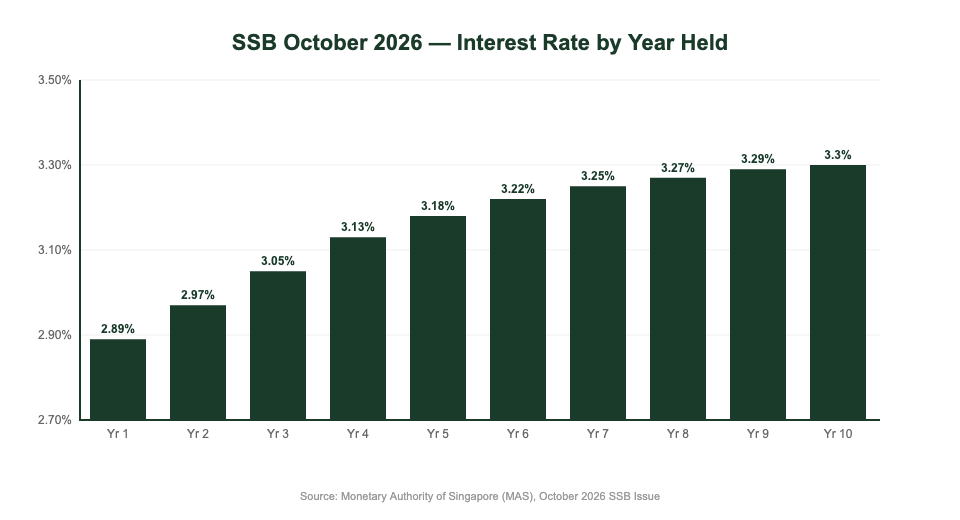
Each SSB issue has its own interest rate schedule, which steps up over 10 years. Below are the indicative rates for the October 2026 SSB issue (OCT26 GX26100G). Always verify on the MAS website before applying.
| Year Held | Interest Rate (% p.a.) | Average Return if Held to This Year |
|---|---|---|
| 1 | 2.89% | 2.89% |
| 2 | 2.97% | 2.93% |
| 3 | 3.05% | 2.97% |
| 4 | 3.13% | 3.01% |
| 5 | 3.18% | 3.04% |
| 6 | 3.22% | 3.07% |
| 7 | 3.25% | 3.10% |
| 8 | 3.27% | 3.12% |
| 9 | 3.29% | 3.15% |
| 10 | 3.30% | 3.17% (10-year average) |
Source: Indicative rates based on MAS SGS reference rates, October 2026. Always verify on MAS website before applying.
For a S$10,000 investment held for the full 10 years, you would earn approximately S$3,170 in total interest — with payments made semi-annually every February and August. For more on how SSB fits into a broader fixed-income strategy, refer to our CPF investment strategy Singapore guide.
SSB vs T-Bills vs Fixed Deposits
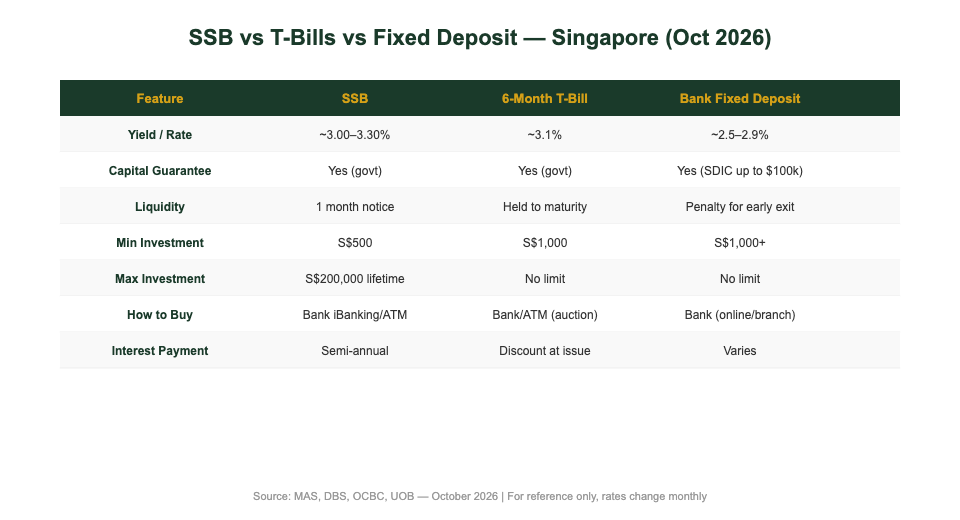
SSBs occupy a unique niche in Singapore’s risk-free savings landscape. Compared with Singapore T-bills and bank fixed deposits, SSBs offer the best combination of capital safety, liquidity, and a long-duration yield lock-in.
Key differences for Singapore investors:
- SSB vs T-Bills: T-bills currently offer a slightly higher yield for the 6-month tenor (~3.10% as at October 2026), but you cannot redeem a T-bill early — you must hold it to maturity. SSBs let you redeem with one month’s notice. T-bills are also purchased via an auction (non-competitive bid), which adds a layer of complexity.
- SSB vs Fixed Deposits: Bank fixed deposits from DBS, OCBC, and UOB typically offer 2.5–2.9% for a 12-month tenor as at October 2026. Early withdrawal often forfeits accrued interest entirely. SSBs pay competitive rates with full early-exit flexibility.
- SSB vs CPF SA Top-Up: CPF SA earns a guaranteed 4% p.a. — well above SSBs — but the funds are illiquid until retirement. SSBs are the better choice if you want accessible savings that still earn more than a savings account.
Tips for Maximising Your SSB Returns
With a S$200,000 lifetime cap per individual, strategic planning helps you get the most from Singapore Savings Bonds. Here are the key principles to follow:
- Apply every month during high-rate periods. SSB rates move with Singapore government bond yields. When rates are high, it pays to lock in as much as possible — especially for long-duration holdings where the 10-year average yield is most attractive.
- Use SSBs as your emergency fund base. With one month’s notice, SSBs are almost as liquid as a savings account — but earn 2.89–3.30% vs a typical savings rate of 0.05–0.25% at most banks. Keep 3–6 months of expenses in SSBs instead of letting it sit idle.
- Ladder your SSB holdings. Apply for a new SSB issue each month with a fixed amount. This ensures your interest payments are spread throughout the year and you always have some bonds approaching redemption if you need liquidity.
- Consider pairing SSBs with Endowus or FSMOne for the growth portion of your portfolio. SSBs handle your risk-free, capital-guaranteed bucket; your growth investments in diversified funds or REITs can handle long-term wealth building.
Always verify the latest SSB application dates, rates, and allotment results on the MAS SSB official page. Rates and policies may change. This article is for informational purposes only and does not constitute financial advice.
Frequently Asked Questions
How do I login to my SSB account in Singapore?
There is no separate SSB login portal. To access your SSB account, log in to your DBS/POSB, OCBC, or UOB internet banking and navigate to the bonds or fixed income section. Your SSB holdings are linked to your CDP account and visible directly through your bank. On DBS, go to Invest → Fixed Income & Bonds → Singapore Government Securities. On OCBC, go to Invest → Bonds → Singapore Savings Bonds. On UOB, go to Invest → Fixed Deposits & Bonds → SSB.
How do I check my SSB balance in Singapore?
Log in to your participating bank’s internet banking (DBS, OCBC, or UOB) and navigate to the SSB section. You can see your total holdings, the issue codes for each SSB you hold, when you applied, and how much interest you have earned. You can also check your holdings via the CDP Online portal at cdp.sgx.com, where your SSBs are listed as securities under your CDP account.
Can I apply for SSB using the DBS digibank app or OCBC mobile app?
Yes. Both DBS digibank and the OCBC mobile app support SSB applications and redemptions. For DBS, open the app and go to the Invest section; for OCBC, use the Invest → Bonds pathway. Note that for UOB, full SSB management (including redemption) is only available via the UOB Personal Internet Banking website — the TMRW app supports viewing holdings only.
What is the SSB application deadline each month?
SSB applications open on the 1st business day of each month and close on the 26th (or the last business day before the 26th if it falls on a weekend or public holiday). Redemption requests follow the same monthly deadline. If you miss the deadline, you must wait for the next month’s application window. Funds for successful applications are deducted on the last business day of the month.
Is my SSB investment safe?
Yes. SSBs are issued by the Singapore government and backed by the full credit of the Singapore Government — rated AAA by major credit rating agencies. Your principal is fully guaranteed regardless of market conditions. Unlike bank deposits, SSBs are not covered by the Singapore Deposit Insurance Corporation (SDIC) because they carry sovereign (not bank) risk, which is considered a higher level of security. There is effectively zero default risk for SSBs held by Singapore residents.
Can I use CPF or SRS funds to buy SSB?
No. SSBs cannot be purchased using CPF funds (OA, SA, or MA) or SRS (Supplementary Retirement Scheme) funds. SSBs are funded directly from your bank’s savings or current account. If you want to invest CPF funds in fixed income, the CPF Board offers CPF SA which earns a risk-free 4% p.a. For SRS funds, platforms like Endowus and FSMOne offer bond funds and fixed income alternatives that accept SRS contributions.
Build Your Risk-Free Foundation With SSBs
SSBs are an excellent low-risk anchor for any portfolio. Pair them with growth investments for a balanced Singapore strategy.
This article was researched with the help of AI. While we strive to keep all information accurate and up to date, there may be errors. If you notice any discrepancies, please contact us.