Singapore T-Bill Interest Rate 2026: Why Rates Have Fallen & What To Do Now
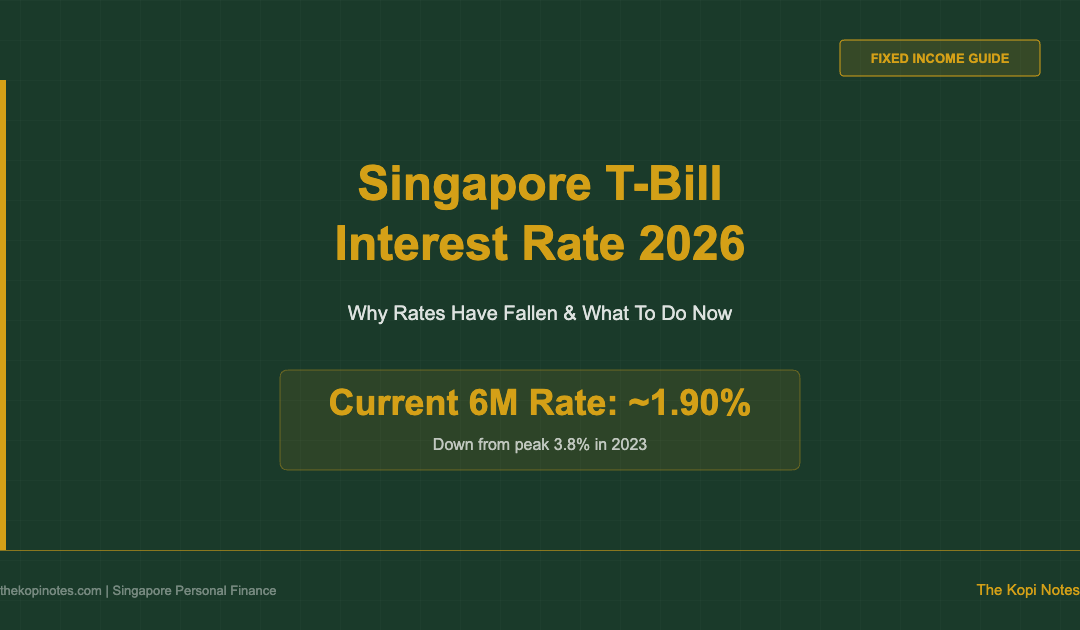
The Singapore T-bill interest rate has dropped sharply in 2026. The 6-month Treasury bill cut-off yield now stands at approximately 1.90% per annum — down from a peak of 3.80% in mid-2023. With T-bill rates now sitting below CPF OA (2.50%), Singapore Savings Bonds (2.18%), and many fixed deposits, investors are questioning whether T-bills still make sense as a cash management tool in the current rate environment.
Not financial advice. All figures are for educational reference only. Data as at October 2026 unless noted.
Table of Contents
- Current T-Bill Interest Rates (October 2026)
- Why Are Singapore T-Bill Rates Falling?
- Historical T-Bill Rate Trend 2022–2026
- T-Bill vs SSB vs Fixed Deposit vs CPF: Full Comparison
- Should You Still Buy T-Bills in 2026?
- How to Buy Singapore T-Bills
- Better Alternatives at Current Rates
- Frequently Asked Questions
Current T-Bill Interest Rates (October 2026)
The Monetary Authority of Singapore (MAS) auctions Treasury bills on a regular schedule. Based on the most recent auction results, here are the current cut-off yields:
| T-Bill Tenor | Cut-off Yield (p.a.) | Auction Frequency | Min Investment |
|---|---|---|---|
| 6-Month | ~1.90% | Bi-weekly | S$1,000 |
| 1-Year | ~1.85% | Monthly | S$1,000 |
Source: MAS T-bill auction results, October 2026. Cut-off yields are indicative; actual yields vary by auction.
Context matters: at the 2023 peak, a 6-month T-bill yielded 3.80% — more than double today’s rate. A Singapore investor parking S$50,000 in a 6-month T-bill would have earned approximately S$950 in interest at the 2023 peak. At the current 1.90% rate, that same investment earns approximately S$475 — a 50% reduction in return.
Why Are Singapore T-Bill Rates Falling in 2026?
Singapore T-bill rates don’t move in isolation — they are closely linked to US Federal Reserve policy and global interest rate conditions. Here’s what has driven the dramatic decline:
1. US Federal Reserve Rate Cuts
The US Fed began cutting interest rates in late 2024, and continued doing so through 2025 and 2026 as inflation returned to target. Since Singapore’s short-term interest rates track US dollar funding costs closely (due to our open capital account), the MAS-managed SGD rates followed suit. Each Fed rate cut of 25 basis points typically translates to a 15–25 basis point decline in Singapore T-bill yields within one to two auction cycles.
2. Easing MAS Monetary Policy Stance
The Monetary Authority of Singapore (MAS) manages monetary policy through the SGD exchange rate rather than interest rates directly. As the MAS eased its policy stance in response to slowing growth and lower inflation in 2025–2026, domestic interest rates naturally softened, compressing T-bill yields further.
3. Global Liquidity Conditions
With central banks globally cutting rates and liquidity returning to financial markets, demand for safe-haven short-term instruments has normalized from the 2022–2023 peak when inflation fears drove investors en masse into T-bills and SSBs. Reduced panic demand, combined with lower base rates, has pushed yields down.
Historical T-Bill Rate Trend: From 0.5% to 3.8% and Back
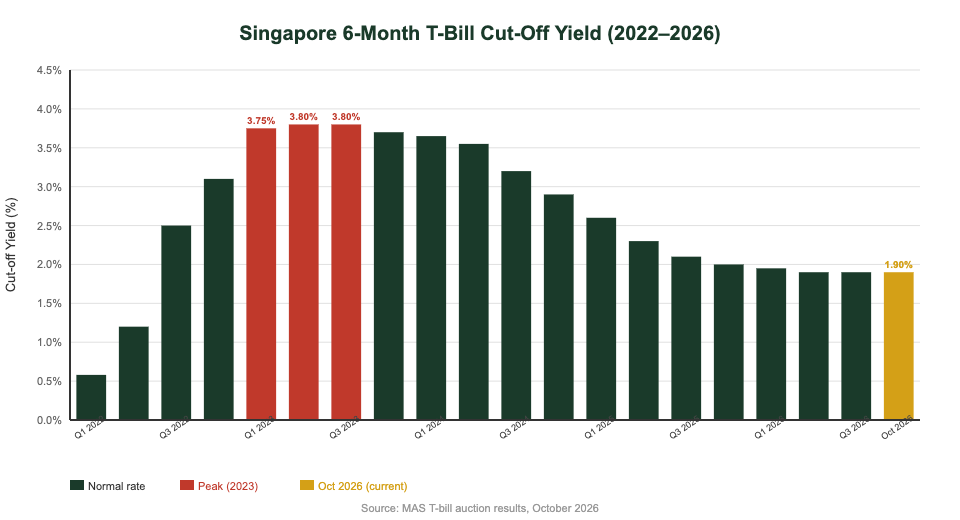
The chart below tracks the Singapore 6-month T-bill cut-off yield from early 2022 through October 2026. It tells the story of the fastest rate-hike cycle in decades, followed by an equally rapid normalization.
Source: MAS T-bill auction results. Chart shows quarterly approximate cut-off yields.
Key milestones in the rate cycle:
- Q1 2022 (0.58%): Near-zero era. T-bills were unattractive vs. bank deposits.
- Q1–Q3 2023 (3.75–3.80%): Peak. Singapore investors flooded into T-bills, with auctions heavily oversubscribed. Queues at ATMs for application became a social phenomenon.
- Q4 2024 (2.90%): First meaningful decline as US Fed began cutting rates.
- Q2 2025 (2.30%): Rate falls below many 12-month fixed deposits, triggering the first wave of investor reassessment.
- October 2026 (1.90%): Now at roughly half the 2023 peak. Below CPF OA, SSB, and many promotional fixed deposit rates.
For Singapore investors who locked into 12-month T-bills at 3.70% in late 2023, those positions have now matured — and reinvesting at 1.90% represents a significant income drop.
T-Bill vs SSB vs Fixed Deposit vs CPF: October 2026 Comparison
Source: MAS, CPF Board, Selected Banks — October 2026. Not financial advice.
| Instrument | Rate (p.a.) | Tenor | Liquidity | Capital Safety |
|---|---|---|---|---|
| 6-Month T-Bill | 1.90% | 6 months | Can sell on SGX | ✅ Gov. guaranteed |
| 12-Month T-Bill | 1.85% | 12 months | Can sell on SGX | ✅ Gov. guaranteed |
| SSB (Oct 2026) | 2.18% | Up to 10 years | Redeem any month | ✅ Gov. guaranteed |
| CPF OA | 2.50% | Ongoing | CPF rules apply | ✅ Gov. backed |
| Best 12M Fixed Deposit | ~2.40% | 12 months | Penalty if broken | ✅ SDIC insured |
| CPF SA / RA | 4.00% | Ongoing | CPF rules apply | ✅ Gov. backed |
Source: MAS, CPF Board, Selected Banks — October 2026. SSB rate is the 10-year average yield. Fixed deposit rate is indicative of best available promotional rates.
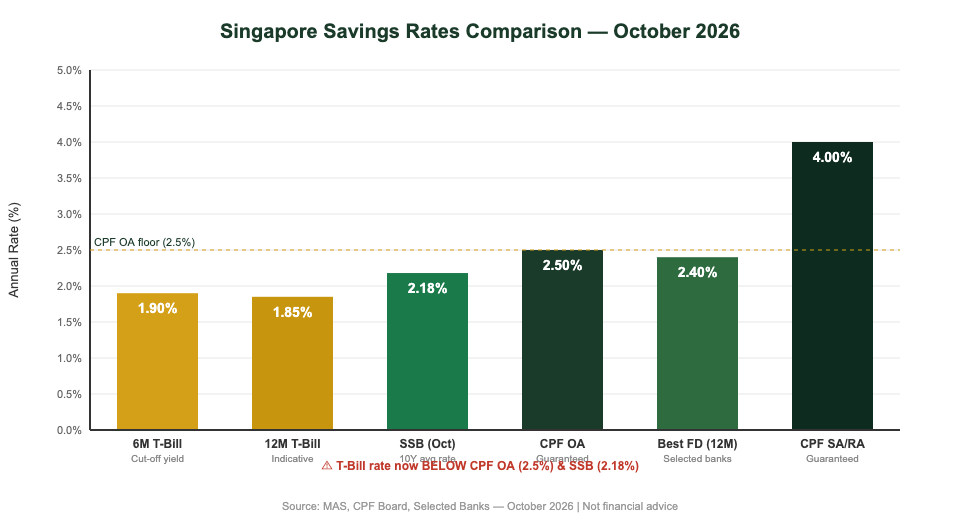
The data tells a clear story: as of October 2026, T-bills rank last among all major government-backed savings options in Singapore. CPF OA beats T-bills by 60 basis points, SSB beats T-bills by 28 basis points, and the best fixed deposits beat T-bills by 50 basis points.
That said, T-bills still offer one advantage: you can access your capital at the 6-month mark, whereas SSBs take one month to redeem and CPF funds have withdrawal restrictions. For funds you may need within exactly 6 months, T-bills still have a place.
Should You Still Buy T-Bills in 2026?
This depends entirely on your situation. Here is a practical framework:
✅ T-Bills Still Make Sense If:
- You need your money back in exactly 6 months and cannot tolerate the 1-month SSB redemption delay
- You have already maximised your CPF voluntary top-up limits for the year
- You have already fully deployed your SSB allocation (S$200,000 per person limit)
- You are parking cash from a recent property sale or major asset liquidation while you decide your next investment
- You are using your SRS account — T-bills are SRS-eligible and provide a tax-efficient short-term holding option for funds awaiting deployment
❌ T-Bills May Not Be the Best Choice If:
- You are seeking maximum yield from government-guaranteed instruments — SSB now offers a better rate
- You have CPF OA funds sitting idle that could earn 2.50% guaranteed (you could consider leaving them in CPF OA rather than withdrawing to buy T-bills)
- Your investment horizon is 12+ months — fixed deposits, SSBs, or CPF voluntary contributions will likely beat T-bills over this horizon
- You are looking to grow wealth over the long term — at 1.90%, T-bills barely keep pace with Singapore’s core inflation
For those holding T-bills purely for yield, the calculus has changed significantly since 2023. You should actively review your portfolio and consider whether Singapore Savings Bonds or a well-structured CPF investment strategy would serve your goals better at current rates.
How to Buy Singapore T-Bills in 2026
If you have decided T-bills still fit your needs, here is how to participate in the next auction:
Method 1: ATM / Internet Banking (Most Popular)
- Log in to your DBS/POSB, OCBC, or UOB internet banking or visit an ATM
- Navigate to “Government Securities” or “T-bills”
- Select the upcoming auction (6-month or 12-month)
- Enter your bid amount (minimum S$1,000, in multiples of S$1,000)
- For retail investors, submit a non-competitive bid — you accept whatever cut-off yield is set at auction
- Ensure you have sufficient funds in your linked bank account by the auction close
Method 2: Using Your CPF OA Funds
You can use CPF OA funds to subscribe to T-bills via the CPF Investment Scheme (CPFIS). However, given that CPF OA already earns 2.50% guaranteed, and T-bills currently yield only 1.90%, using CPF OA funds to buy T-bills is not recommended at current rate levels — you would be giving up 60 basis points of guaranteed return.
Method 3: Using Your SRS Account
SRS funds can be used to buy T-bills, and this remains a reasonable strategy for those wanting to defer tax on SRS contributions while waiting to decide on longer-term SRS investments. Learn more about Singapore T-bills 2026 guide for the full bidding walkthrough.
For a detailed step-by-step bidding guide, refer to our T-bill bidding strategy guide.
Better Alternatives at Current Rates
With T-bill yields now below multiple alternatives, here are the options worth considering:
1. Singapore Savings Bonds (SSB)
The October 2026 SSB issue offers a 10-year average return of 2.18% per annum — 28 basis points above the current T-bill rate. Key advantages over T-bills: no bid complexity, instant application via internet banking, and the ability to redeem with just one month’s notice (you keep all interest earned). The main constraint is the S$200,000 per person limit across all SSB holdings. See our Singapore Savings Bonds guide for the full picture on how to apply and when to redeem.
2. CPF Voluntary Top-Up (VC-SA)
For working Singaporeans who have not yet hit the Enhanced Retirement Sum, voluntary contributions to your CPF Special Account earn 4.00% per annum — more than double the current T-bill rate. Contributions are also tax-deductible up to S$8,000 per year. The trade-off is that funds are locked until age 55 for withdrawal and retirement. Learn how to optimise your CPF investment strategy here.
3. 12-Month Fixed Deposits
Several Singapore banks currently offer promotional 12-month fixed deposit rates of 2.20–2.40% per annum for new funds. These require a longer commitment and a penalty for early withdrawal, but they beat T-bills on yield. Check the latest rates directly with DBS, OCBC, UOB, and digital banks before applying.
4. Dividend-Paying S-REITs or ETFs via Robo-Advisors
If you can tolerate short-term market volatility and are investing for 3+ years, well-diversified dividend S-REITs are currently yielding 5–7% per annum — significantly above all fixed-income options. Platforms like Endowus (referral code 2V343) and Syfe (referral code SRPRFFFCD) make it easy to access diversified REIT portfolios. See our guide to the best S-REITs in Singapore 2026 and use a Singapore retirement calculator to stress-test your projections.
5. ETF Investing for Long-Term Growth
For funds with a 10+ year horizon, low-cost index ETFs — such as CSPX or VWRA on the London Stock Exchange — have historically returned 8–10% per annum over full market cycles. Learn more about passive income in Singapore using ETFs. Platforms like FSMOne (referral code P0544985) offer regular savings plans with low entry costs for ETF investing.
Frequently Asked Questions: Singapore T-Bill Interest Rates
What is the current Singapore T-bill interest rate in October 2026?
Why have Singapore T-bill interest rates fallen so sharply in 2026?
Is the Singapore T-bill interest rate taxable?
Can I buy Singapore T-bills using my CPF OA funds?
Should I switch from T-bills to Singapore Savings Bonds (SSB) now?
What will happen to T-bill rates in the rest of 2026 and 2027?
How often are Singapore T-bill auctions held?
Conclusion: T-Bills at 1.90% — Still Worth It?
Singapore T-bill interest rates have fallen dramatically from the 3.80% peak in 2023 to approximately 1.90% in October 2026. For most Singapore investors, T-bills no longer offer the best risk-free return — they are now outcompeted by SSBs (2.18%), CPF OA (2.50%), and selected fixed deposits (up to 2.40%).
T-bills still serve a specific purpose: they are ideal for parking cash you need back in exactly 6 months, for SRS investors awaiting a deployment decision, or as part of a diversified liquidity strategy. But if you are rolling over T-bill proceeds purely for yield, the current rate environment strongly favours SSBs or CPF top-ups as better alternatives.
For long-term wealth building — beyond the safe harbour of fixed income — consider diversified exposure to Singapore REITs or index ETFs via platforms like Endowus (code 2V343), Syfe (code SRPRFFFCD), or FSMOne (code P0544985).
This article is for educational purposes only and does not constitute financial advice. Past rates do not guarantee future yields. Please consult a licensed financial adviser before making investment decisions.
This article was researched with the help of AI. While we strive to keep all information accurate and up to date, there may be errors. If you notice any discrepancies, please contact us.