Sabana REIT Review 2026: Alpha Integrated REIT, DPU Recovery & Should You Buy?
Singapore’s small-cap industrial REIT that rebranded — plus the full breakdown of DPU, gearing, and whether it belongs in your portfolio.
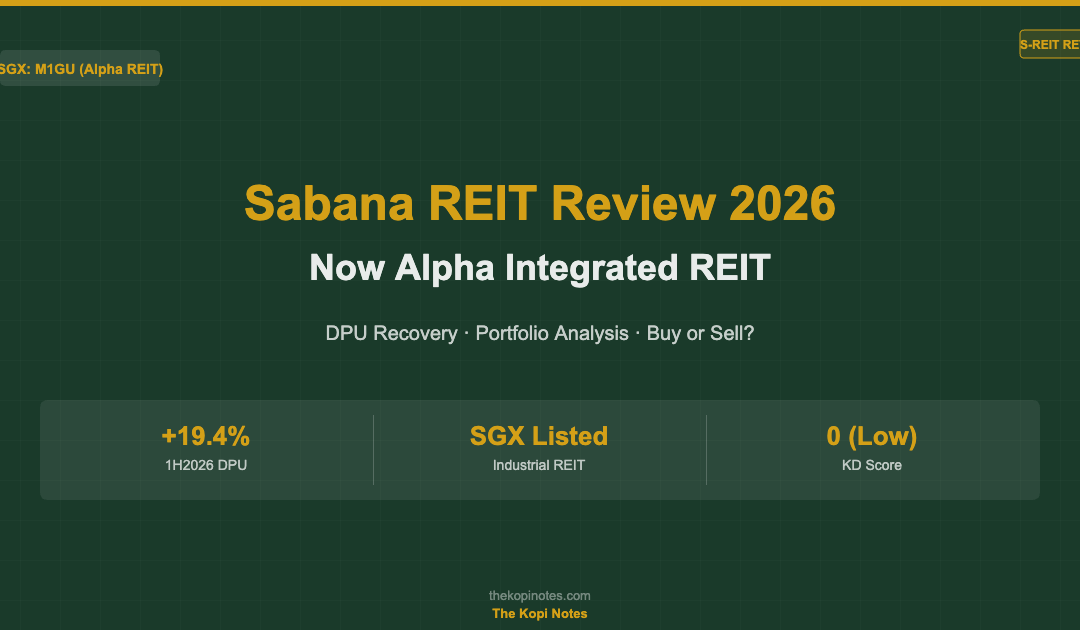
Sabana REIT (SGX: M1GU) is a Singapore-listed industrial REIT that rebranded to Alpha Integrated REIT in 2026 after a strategic overhaul. It owns a portfolio of industrial properties across Singapore — warehouses, high-tech industrial buildings, and logistics facilities. In 1H2026, DPU climbed 19.4% year-on-year, making it one of the fastest-recovering small-cap S-REITs. At an 8%+ forward yield, it attracts income investors, but the relatively high gearing and smaller portfolio size demand careful analysis before committing capital.
Not financial advice. All figures are for educational reference only. Data as at October 2026 unless otherwise stated.
Table of Contents
Contents — Click to expand
- What Is Sabana REIT (Alpha Integrated REIT)?
- Key Facts at a Glance
- Portfolio & Properties Analysis
- DPU History & 1H2026 Recovery
- Gearing, Debt & Balance Sheet
- Share Price Performance & Valuation
- Sabana REIT vs Industrial REIT Peers
- Risks to Consider
- Should You Buy Sabana REIT in 2026?
- Frequently Asked Questions
What Is Sabana REIT (Alpha Integrated REIT)?
Sabana Shari’ah Compliant Industrial REIT — commonly known as Sabana REIT — was established in 2010 as Singapore’s first Shari’ah-compliant REIT. It is listed on the Singapore Exchange under the ticker M1GU and focuses on industrial properties in Singapore’s heartland industrial estates and high-tech clusters.
In 2026, the REIT completed a significant rebrand, transitioning from the “Sabana” identity to Alpha Integrated REIT. This rebranding reflected the manager’s strategic pivot: expanding beyond the original Shari’ah-compliant mandate to attract a broader investor base and positioning the trust for a more diversified industrial portfolio. Despite the name change, the SGX ticker M1GU and the underlying Singapore industrial property portfolio remain the core of the trust.
The REIT is managed by ESG-focused property manager Alpha Real Trust Management Pte. Ltd. (formerly Sabana Real Estate Investment Management). The portfolio spans multiple industrial sub-sectors: general industrial, high-tech industrial, warehouse & logistics, and business park space — giving it diversified exposure to Singapore’s manufacturing and logistics ecosystem.
For investors already familiar with Singapore’s industrial REIT landscape, Sabana / Alpha Integrated sits in the small-cap tier, competing with peers like other leading S-REITs for investor capital.
Key Facts at a Glance
| Metric | Detail |
|---|---|
| Full Name | Alpha Integrated REIT (formerly Sabana REIT) |
| SGX Ticker | M1GU |
| REIT Type | Industrial (Singapore) |
| 1H2026 DPU | ~2.10 cents (+19.4% YoY) |
| Annualised Yield (est.) | ~8.2% (based on Oct 2026 share price) |
| Portfolio Occupancy | ~88.5% (as at 1H2026) |
| Gearing Ratio | ~35.2% (MAS limit: 50%) |
| Distribution Frequency | Semi-annual |
| Manager | Alpha Real Trust Management Pte. Ltd. |
| Listing Year | 2010 |
Source: SGX company filings, REIT investor relations, October 2026. All data for educational reference only.
Portfolio & Properties Analysis
Alpha Integrated REIT’s portfolio (as at 1H2026) spans approximately 18–22 properties concentrated in Singapore’s established industrial corridors: Jurong, Tuas, Ubi, Paya Lebar, and Chai Chee. The properties fall across four main sub-categories:
- High-Tech Industrial: Buildings designed for light manufacturing, R&D, and assembly operations — command premium rents relative to standard industrial space.
- Warehouse / Logistics: Single-storey and multi-storey ramp-up facilities serving e-commerce fulfilment, logistics, and distribution companies.
- General Industrial: Standard factory spaces leased to SMEs across manufacturing and service trades.
- Business Park: Professional services and tech-adjacent tenants in campus-style settings.
Portfolio occupancy sat at approximately 88.5% in 1H2026 — below the sector’s best-in-class occupancy (AIMS APAC REIT reports ~97%) but recovering meaningfully from lows of ~84% in FY2024. The manager has been actively repositioning vacant space and updating older buildings to attract better-quality tenants at higher asking rents.
The weighted average lease expiry (WALE) stands at approximately 2.8 years (by NLA), which is relatively short and means significant lease renewal activity in 2027–2028. Investors should watch for lease renewal rates as a key signal of portfolio quality improvement.
For Singapore investors building a passive income portfolio, the industrial sector’s exposure to Singapore’s logistics and manufacturing tailwinds is a structural positive — but Sabana’s smaller scale and portfolio quality constraints are worth noting against larger peers.
DPU History & 1H2026 Recovery
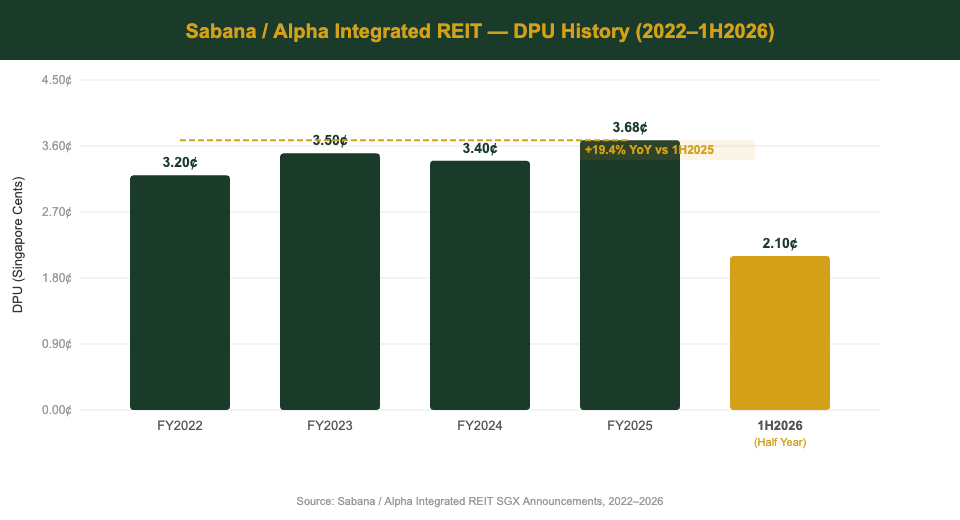
The DPU (Distribution Per Unit) trajectory for Sabana REIT has been uneven over the years, reflecting the trust’s management transition, strategic repositioning, and the broader impact of Singapore’s industrial property cycle. Here’s the historical picture:
| Period | DPU (cents) | YoY Change | Notes |
|---|---|---|---|
| FY2022 | 3.20¢ | — | Base year; portfolio repositioning underway |
| FY2023 | 3.50¢ | +9.4% | Occupancy recovery and AEI completions |
| FY2024 | 3.40¢ | −2.9% | Higher interest costs on floating rate debt |
| FY2025 | 3.68¢ | +8.2% | Debt refinancing at lower rates + AEI uplift |
| 1H2026 | 2.10¢ | +19.4% (vs 1H2025) | Occupancy improvement + rate cut tailwind |
Source: SGX announcements, Alpha Integrated REIT/Sabana REIT investor presentations, 2022–2026. Past DPU is not indicative of future distributions.
The 19.4% YoY increase in 1H2026 DPU is the standout data point. Two primary drivers explain this: (1) Refinancing of floating-rate debt at lower interest rates following 2025’s rate cuts, which materially reduced finance costs, and (2) Higher occupancy rates and positive rental reversions from portfolio repositioning. The manager’s decision to exit weaker assets and focus on higher-quality tenants is beginning to bear fruit.
Annualised, the 1H2026 DPU run-rate implies approximately 4.20¢ for FY2026 — which at October 2026 unit price levels translates to a forward yield of roughly 8.0–8.5%. This sits in the top quartile of Singapore industrial REITs by yield. If you’re using a retirement planning calculator to model passive income, a yield of this magnitude from a Singapore-listed REIT is attractive — though the risks discussed below must be weighed carefully.
Gearing, Debt & Balance Sheet
Gearing is one of the most important metrics for any REIT investor. The MAS caps Singapore REIT gearing at 50% (or 55% with credit rating). Sabana / Alpha Integrated REIT’s gearing sits at approximately 35.2% as at 1H2026, which falls in the mid-range for S-REITs — meaningfully higher than ultra-low-geared peers like AIMS APAC REIT (~26.8%) but well within regulatory limits.
Key balance sheet metrics worth tracking:
| Metric | Value (1H2026) | Commentary |
|---|---|---|
| Aggregate Leverage (Gearing) | ~35.2% | Mid-range; headroom of ~14.8pp to MAS 50% limit |
| Interest Coverage Ratio (ICR) | ~3.2x | Comfortable; above the 1.5x MAS trigger threshold |
| % Fixed-Rate Debt | ~72% | Good hedge against future rate uncertainty |
| Weighted Avg Debt Maturity | ~2.4 years | Moderate — watch for 2027–2028 refinancing events |
| Net Asset Value (NAV) per unit | ~SGD 0.42–0.46 | Units may be trading near or at discount to NAV |
Source: SGX filings, Alpha Integrated REIT 1H2026 results presentation. Figures approximate.
The relatively short debt maturity profile (2.4 years) means the REIT will need to refinance meaningful portions of its debt stack in 2027–2028. In a stable or falling interest rate environment, this creates opportunity (locking in lower rates). In a rising rate scenario, it poses cost risk. Given current market expectations for rates in Singapore, the near-term refinancing outlook is considered manageable.
For investors tracking Singapore T-bills 2026 or fixed deposit rates, it’s worth noting that an 8%+ REIT yield represents a meaningful premium to current risk-free rates — compensating investors for property risk, management execution risk, and liquidity risk.
Share Price Performance & Valuation
Sabana REIT units have historically traded at a discount to NAV, reflecting the market’s scepticism about portfolio quality, occupancy, and management execution. The rebrand to Alpha Integrated REIT has been accompanied by modest re-rating, with units recovering from multi-year lows seen in 2024.
In 2026, the unit price has generally traded in the SGD 0.40–0.52 range. At current levels (~SGD 0.51), the unit trades at approximately NAV parity or a slight premium — a significant shift from the persistent discounts of prior years. This suggests the market is beginning to price in the operational improvements and DPU recovery narrative.
Key share price signals to monitor:
- Price-to-NAV ratio: If the discount widens again (below 0.90x), it may represent a buying opportunity. If it extends to a premium (>1.10x), valuation becomes stretched relative to the REIT’s portfolio quality.
- Distribution yield compression: As the unit price rises, the forward yield compresses. At SGD 0.60, the yield drops to ~7.0%; at SGD 0.48, it would be ~8.75%.
- Trading liquidity: As a small-cap REIT, average daily volume is modest. Investors with larger position sizes may experience meaningful price impact on entry or exit.
Singapore investors looking to build a diversified income portfolio should compare this against the best S-REITs for 2026 — where larger-cap options with better occupancy may offer more predictable distributions.
Sabana REIT vs Industrial REIT Peers
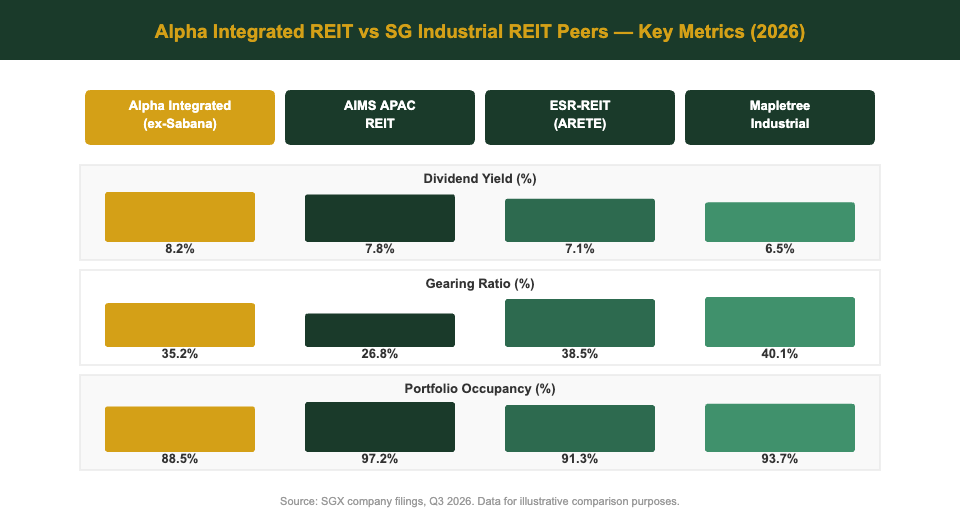
How does Alpha Integrated REIT (Sabana) stack up against Singapore’s other industrial REITs? The comparison below covers key metrics across the main peer group as at Q3 2026:
| REIT | Ticker | Yield (est.) | Gearing | Occupancy | Best For |
|---|---|---|---|---|---|
| Alpha Integrated (Sabana) | M1GU | ~8.2% | 35.2% | 88.5% | High yield / recovery play |
| AIMS APAC REIT | O5RU | ~7.8% | 26.8% | 97.2% | Low gearing + high occupancy |
| ESR-REIT / ARETE | J91U | ~7.1% | 38.5% | 91.3% | Large-cap SG industrial exposure |
| Mapletree Industrial Trust | ME8U | ~6.5% | 40.1% | 93.7% | Data centre growth + SG blue-chip |
Source: SGX filings, company investor presentations, Q3 2026. Yield estimates based on prevailing market prices; not a projection or guarantee of future distributions.
The verdict from the peer comparison: Sabana / Alpha Integrated REIT offers the highest yield in the group but the lowest occupancy. AIMS APAC REIT wins on portfolio quality and gearing — but the yield premium you forgo versus Sabana is approximately 40–50 basis points. For income-focused investors comfortable with the quality trade-off, Sabana’s yield story remains compelling. For quality-first investors, AIMS APAC REIT or Mapletree Industrial Trust may be the better choice.
If you’re looking to invest through platforms like Syfe (referral code: SRPRFFFCD), FSMOne (referral code: P0544985) or Endowus (referral code: 2V343), most of these platforms carry SGX-listed REITs in their portfolios or allow direct purchase of individual S-REIT units.
Risks to Consider
Every investment carries risks, and Sabana REIT / Alpha Integrated REIT is no exception. Singapore investors should weigh the following before adding M1GU to their portfolio:
- Portfolio Quality & Occupancy Risk: At ~88.5% occupancy (1H2026), the REIT has meaningful vacancy. If occupancy slips further — particularly in an economic slowdown — DPU will come under pressure. The below-average occupancy relative to peers is the single biggest risk flag.
- Short WALE (2.8 Years): With a weighted average lease expiry of 2.8 years, a significant chunk of leases expire in 2028–2029. If market rents weaken or tenants exit, there is downside risk to income. If market rents rise (as has been the trend in Singapore industrial), this is a tailwind.
- Debt Refinancing in 2027–2028: The REIT needs to refinance meaningful debt in the next 2–3 years. In a benign rate environment, this is manageable. A sudden rate spike (unlikely but possible) would dent DPU.
- Manager Track Record & Rebrand Execution: The rebranding from Sabana to Alpha Integrated REIT carries execution risk. Can the new branding and strategy attract better-quality tenants and institutional interest? The 1H2026 results suggest early progress, but the track record needs more time to be proven.
- Liquidity Risk: As a small-cap REIT, daily trading volumes can be low. Large institutional exits can compress the unit price significantly, and individual investors may struggle to exit large positions without impacting the market.
- No CPF Investability: Sabana REIT units are not on the CPF Investment Scheme (CPFIS) approved list. This reduces the investor base and limits access for CPF top-up strategies. See our CPF investment strategy guide for alternatives.
Should You Buy Sabana REIT in 2026?
Sabana REIT (Alpha Integrated REIT) is suitable for income investors with a higher risk tolerance who are specifically seeking small-cap industrial REIT exposure and are comfortable with the occupancy and management execution risks outlined above.
Consider Alpha Integrated REIT (M1GU) if:
- You are seeking a forward yield of 8%+ from a Singapore-listed industrial REIT
- You believe the DPU recovery trend (proven in 1H2026) will continue into 2H2026 and FY2027
- You are comfortable with a small-cap, less liquid S-REIT as part of a diversified income portfolio
- You see the rebranding as a genuine operational catalyst, not just a marketing exercise
Consider alternatives (AIMS APAC, ESR-REIT, Mapletree Industrial) if:
- Portfolio quality and near-100% occupancy is your primary criterion
- You prefer better-established management track records and institutional-quality portfolios
- You want higher liquidity and tighter bid-ask spreads for easier position sizing
- You are building a passive income stream and need stable, predictable distributions
As always, this is not financial advice. Conduct your own due diligence, review the latest SGX announcements, and consider consulting a licensed financial adviser before making investment decisions.
Frequently Asked Questions
What is Sabana REIT and why did it rebrand to Alpha Integrated REIT?
Sabana REIT (SGX: M1GU) was originally established in 2010 as Singapore’s first Shari’ah-compliant industrial REIT. In 2026, it rebranded to Alpha Integrated REIT under its new management team. The rebrand dropped the Shari’ah-compliant positioning to allow a broader mandate for asset acquisition and tenant attraction, while the SGX ticker M1GU and the underlying Singapore industrial portfolio remain unchanged. The move signals a strategic pivot toward mainstream industrial REIT positioning.
What is Sabana REIT's current dividend yield in 2026?
Based on the 1H2026 DPU of approximately 2.10 cents per unit (representing a 19.4% year-on-year increase), and annualising to approximately 4.20 cents for FY2026, the forward dividend yield sits at approximately 8.0–8.5% depending on the prevailing unit price in October 2026. This is among the highest yields in the Singapore industrial REIT sector. Note that DPU is not guaranteed and can vary based on occupancy, interest costs, and property income.
Is Sabana REIT safe to invest in?
All REITs carry investment risk, and Sabana / Alpha Integrated REIT has specific risks worth noting: below-average portfolio occupancy (~88.5% vs sector leaders at 95–97%), a short weighted average lease expiry of 2.8 years, and a management rebrand still proving its execution track record. On the positive side, gearing of ~35.2% is within a comfortable range and well below the 50% MAS regulatory limit. Whether it is “safe” depends on your risk tolerance and investment horizon — for higher-risk-tolerance income investors, the yield compensates; for conservative investors, larger-cap industrial REITs may be more appropriate.
Can I buy Sabana REIT (M1GU) using CPF funds?
No — Sabana REIT units are not listed on the CPF Investment Scheme (CPFIS) approved list as at October 2026. This means you cannot use your CPF Ordinary Account or Special Account funds to invest in M1GU. You can, however, purchase the units using cash through a brokerage account. For CPF-investable S-REIT options, refer to the official CPF Board website for the current approved list, or read our CPF investment strategy guide for alternatives.
How does Sabana REIT compare to AIMS APAC REIT?
Sabana REIT offers a higher yield (~8.2% vs ~7.8% for AIMS APAC REIT) but significantly lower portfolio quality by two key measures: occupancy (88.5% vs ~97%) and gearing (35.2% vs 26.8%). AIMS APAC REIT has a stronger operational track record, better occupancy, and a more conservative balance sheet. Investors who prioritise income stability and portfolio quality should lean toward AIMS APAC REIT; those seeking maximum current yield and comfortable with small-cap risk may prefer Sabana / Alpha Integrated REIT.
Where can I buy Sabana REIT (M1GU) in Singapore?
Sabana REIT / Alpha Integrated REIT (SGX: M1GU) can be purchased through any SGX-connected brokerage account. Popular options for Singapore retail investors include: Interactive Brokers (low commission costs for larger portfolios), FSMOne (referral code P0544985), Syfe Brokerage (referral code SRPRFFFCD), and local bank brokerages (DBS Vickers, OCBC Securities, UOB Kay Hian). Note that the unit price can be volatile and liquidity is lower than large-cap REITs — consider placing limit orders rather than market orders.
Ready to Build Your S-REIT Portfolio?
Start investing in Singapore REITs through these platforms and unlock sign-up bonuses with our referral codes.
This article was researched with the help of AI. While we strive to keep all information accurate and up to date, there may be errors. If you notice any discrepancies, please contact us.