Term Life Insurance for Parents in Singapore (2026)
How much coverage does your family really need — and which policy fits your budget?
Term life insurance for parents in Singapore pays a tax-free lump sum to your family if you die or are diagnosed with a terminal illness during the policy term. Most parents with young children need SGD 500,000–SGD 1.5 million in coverage — roughly 10–15 times annual household income — to replace lost income, clear the home loan, and fund children’s education through university. Premiums start from SGD 26 per month for a healthy non-smoker aged 30.
Not financial advice. All figures are for educational reference only. Premiums are indicative and subject to underwriting. Data verified as at October 2026.
Why Parents Need Term Life Insurance
The moment you have a child, your financial responsibilities multiply. Unlike a single professional whose income supports only themselves, a parent’s income typically funds the household mortgage, childcare costs, school fees, groceries, utilities, and long-term savings for children’s tertiary education — often the equivalent of SGD 100,000–SGD 200,000 per child at a local university, or more if studying abroad.
The government’s Dependants’ Protection Scheme (DPS) — Singapore’s compulsory group term life coverage deducted from CPF — provides a maximum payout of just SGD 70,000. As highlighted in our article on DPS vs term life insurance, this sum is rarely sufficient for a family with a mortgage and young children. A private term life policy bridges the gap between the DPS payout and what your family genuinely needs to maintain their standard of living.
Consider a parent aged 32 earning SGD 7,000 per month. If they die today, their family loses approximately SGD 840,000 in future income over the next 20 years (before inflation). Their DPS pays SGD 70,000. Without private term life cover, that family faces an SGD 770,000 shortfall — potentially forcing them to sell the flat, withdraw CPF prematurely, or rely on relatives.
Term life insurance is designed for exactly this scenario: affordable premiums during the high-need years (typically age 25–55) when children are dependent and the mortgage balance is highest.
How Much Coverage Do You Need?
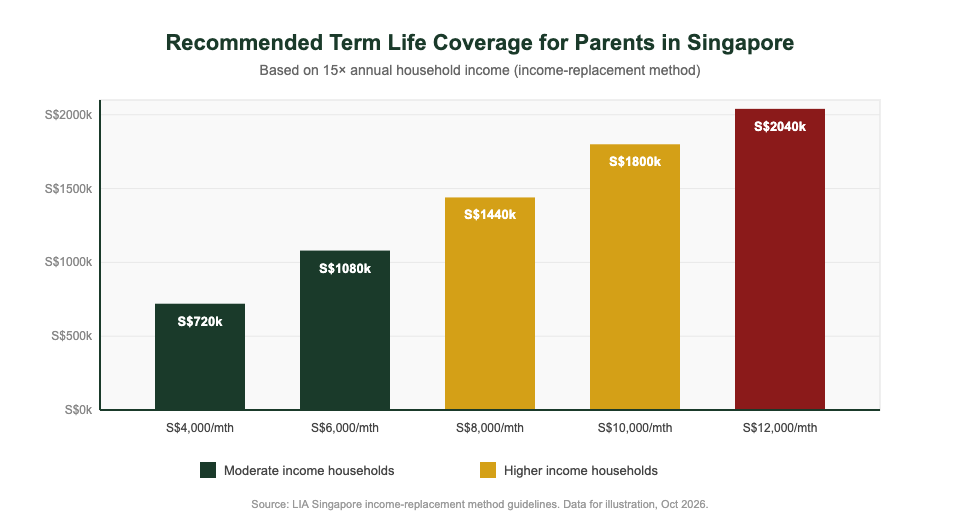
The Life Insurance Association Singapore (LIA Singapore) recommends using the income-replacement method: multiply your annual household income by 9–15 years, depending on how many dependent years remain. For parents of young children, 12–15 times annual income is the appropriate benchmark — it covers the years until your youngest child reaches financial independence.
The DIME method provides an alternative cross-check tailored to parents:
| Factor | What to Include | Example (SGD) |
|---|---|---|
| D — Debt | Outstanding home loan + car loan + credit card | SGD 450,000 |
| I — Income | Annual salary × years until youngest child is 25 | SGD 84,000 × 22 = SGD 1,848,000 |
| M — Mortgage | Already included in Debt above (HDB/private) | Included |
| E — Education | University cost per child × number of children | SGD 160,000 × 2 = SGD 320,000 |
DIME total in this example: SGD 450,000 + SGD 1,848,000 + SGD 320,000 = SGD 2,618,000 gross coverage need. Deduct existing assets (CPF savings, existing insurance, investments) to arrive at your net coverage gap. Source: LIA Singapore protection gap study framework, 2026.
In practice, most dual-income households in Singapore find that each working parent should carry SGD 500,000–SGD 1,000,000 in term life coverage, with a combined household protection of SGD 1,000,000–SGD 2,000,000. Use our Singapore retirement calculator to model how your income and savings would cover the family in the event of death of either parent.
How Long Should the Term Be?
Choosing the right term length is as important as choosing the right coverage amount. The term should last at least until your youngest child reaches financial independence — commonly assumed at age 25 in Singapore, by when most have completed national service and university — and ideally until your mortgage is fully paid off.
| Parent’s Age | Youngest Child’s Age | Recommended Term | Policy Ends At |
|---|---|---|---|
| 28 | Newborn | 30 years | Age 58 |
| 32 | 1 year old | 25 years | Age 57 |
| 35 | 2 years old | 23 years | Age 58 |
| 38 | Newborn | 27 years | Age 65 |
Source: LIA Singapore financial planning guidelines. Term extended to cover both youngest-child dependency period and typical mortgage tenure (25–30 years).
If you have two or more children with a significant age gap, use the youngest child’s expected independence age as your anchor. A common mistake is choosing a 20-year term that ends when the older child finishes university — leaving the younger child unprotected for several more years. Many policies now offer terms up to age 65, 70, or even 85 (whole-of-life), though the latter is significantly more expensive and usually more appropriate for estate planning than family protection.
Parents planning for CPF investment strategy should note that term life premiums can be paid from CPF MediSave (up to an annual limit set by the CPF Board) for policies that include a CI rider, reducing out-of-pocket cost.
Key Riders Every Parent Should Consider
A base term life policy only pays out on death or terminal illness. For parents, several add-on riders significantly enhance protection:
| Rider | What It Covers | Why Parents Need It |
|---|---|---|
| Total & Permanent Disability (TPD) | Lump sum if unable to work permanently | Income loss from disability can be just as devastating as death |
| Critical Illness (CI) Rider | Lump sum on diagnosis of 37–57 critical illnesses | Covers treatment, recovery, and lost income during illness |
| Payor Benefit Rider | Waives child’s premium if parent dies/is disabled | Keeps child’s policy active without premium payments |
| Disability Income Rider | Monthly income replacement if unable to work | Supplements DI Insurance; covers short/long-term inability to work |
Source: MAS MoneySense guide to life insurance riders, 2026.
The CI rider deserves particular attention for parents. Singapore’s top three critical illness diagnoses — cancer, heart attack, and stroke — account for over 60% of all CI claims according to LIA Singapore’s 2025 annual statistics. A CI rider pays out upon diagnosis, giving you a lump sum to cover medical costs and household expenses while you focus on recovery, without needing to trigger the death benefit. For a deep dive on this, see our guide on term life insurance for women, which covers CI considerations for primary caregivers in detail.
Best Term Life Policies for Parents in Singapore (2026)
The Singapore term life market is well-developed, with premiums highly competitive following MAS’s push for direct-purchase term life (DIRECT products) and the proliferation of digital-first insurers like FWD and Singlife. The table below compares indicative monthly premiums for a SGD 500,000 death benefit, 20-year term, non-smoker (premiums differ by health history and are subject to underwriting):
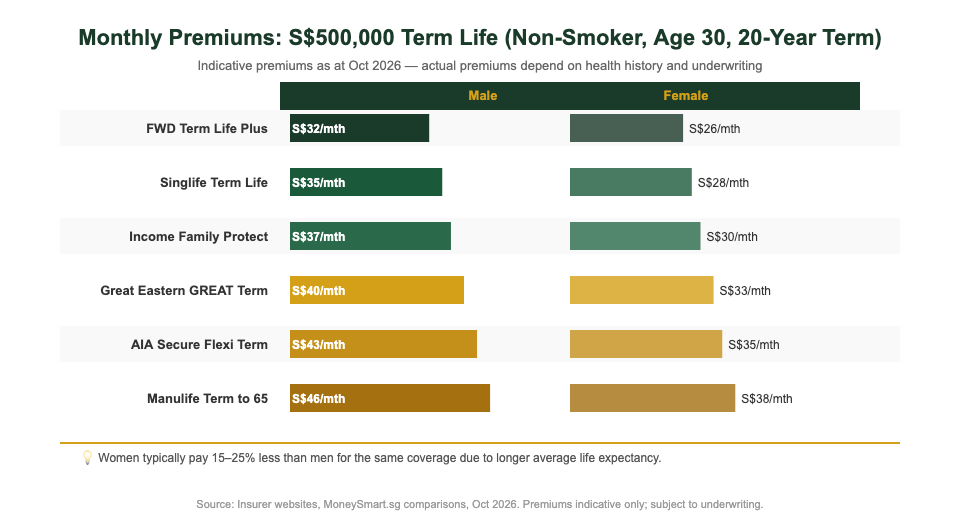
Key observations from the premium comparison:
- Women pay significantly less — typically 15–25% lower premiums than men for identical coverage, reflecting longer average life expectancy. Our article on term life insurance for women in Singapore explores this in detail.
- Digital-first insurers (FWD, Singlife) are typically cheapest — lower distribution overheads pass savings to policyholders.
- Premiums are level for the entire term on most policies — the SGD 32/month you pay at age 30 stays SGD 32/month at age 49, making budgeting straightforward.
For comparison purposes, using FSMOne referral code to access their DIY insurance comparison platform lets you compare direct quotations from multiple insurers side-by-side — useful for parents who want to customise riders and see the actual premium impact before applying.
How to Apply: Step-by-Step
Applying for term life insurance in Singapore is straightforward and typically completed online in 15–30 minutes for standard cases. Here is how:
1. Calculate your coverage need — Use the DIME method above or the income-replacement formula (annual income × 12–15 years minus existing assets). Decide on the sum assured and term length before comparing quotes.
2. Compare policies — Use an aggregator such as MoneySmart.sg, Comparefirst.sg (the MAS-mandated direct-purchase platform), or FSMOne’s insurance comparison tool. Comparefirst lists DIRECT products from all MAS-licensed insurers with no advisor mark-up.
3. Complete the health declaration — Most policies require a health questionnaire covering pre-existing conditions, smoking status, BMI, and family medical history. Be accurate: non-disclosure is grounds for claim rejection. Applicants with complex health histories may be asked to undergo a medical examination.
4. Nominate a beneficiary via CPF (if applicable) — For policies with CPF-linked premiums, complete the CPF nomination to ensure proceeds go directly to your spouse and children without going through your estate (which would be subject to the Intestate Succession Act or your Will). For policies paid entirely by cash, name beneficiaries directly with the insurer.
5. Review and accept the policy — Upon approval, the insurer issues a policy document. Read the exclusions section carefully. Most standard term life policies exclude pre-existing conditions, self-inflicted injury, and acts of war. The free-look period (10–14 days in Singapore) allows you to cancel for a full refund if you change your mind.
If you are considering pairing term life with investments, Endowus allows CPF OA and SRS funds to be invested in diversified portfolios while your term life insurance keeps the family protected independently — a cleaner structure than investment-linked policies (ILPs) which bundle protection and investment in one product.
Important Reminders for Parents
Before wrapping up, a few practical points specific to parents in Singapore:
- Review your coverage after every major life event: new child, salary increase, new mortgage, or a spouse returning to full-time work.
- The protection gap tends to be largest for stay-at-home parents whose economic contribution (childcare, household management) is not captured by income replacement formulas. Consider insuring the non-working parent for at least SGD 300,000–SGD 500,000 to cover the cost of replacement services.
- Term life is not the same as mortgage insurance (MRTA/MLTA). Mortgage insurance reduces in line with your loan balance and pays the bank directly. Term life pays your family, who can use the money however they choose — including paying off the mortgage.
- Premiums paid for term life insurance in Singapore are not tax-deductible (unlike CPF top-ups or SRS contributions). However, CI riders attached to policies that qualify for MediSave payment can have MediSave premiums offset against your Medisave account up to the MediSave Integrated Shield Plan limit (check CPF Board for current year limits).
Frequently Asked Questions
How much term life insurance do parents in Singapore need?
Most parents in Singapore need coverage of 10–15 times their annual household income. For a household earning SGD 7,000 per month (SGD 84,000 per year), this translates to SGD 840,000–SGD 1,260,000 in coverage. The exact amount depends on your outstanding mortgage, number of children, ages of dependants, and existing savings and CPF balances. Deduct your existing DPS coverage (up to SGD 70,000), CPF savings, and other insurance from the gross figure to arrive at your net coverage gap.
Is the government's DPS enough for parents?
The Dependants’ Protection Scheme (DPS) provides a maximum payout of SGD 70,000 — far below what most families with a mortgage and young children require. DPS is a baseline safety net, not comprehensive family protection. Parents should treat DPS as a supplement to private term life coverage, not a replacement. Most financial planners recommend supplementing DPS with at least SGD 500,000–SGD 1,000,000 in private term life coverage per working parent.
Can I use CPF to pay for term life insurance premiums?
Yes, but only for specific policy types. The CPF Board allows MediSave withdrawals to pay premiums for term life policies that include a critical illness (CI) rider, up to an annual MediSave withdrawal limit (which varies by age group — check cpf.gov.sg for the current year’s limits). The base term life premiums without a CI rider must be paid in cash. Using MediSave for eligible premiums reduces your out-of-pocket cost significantly.
Should both parents in Singapore get term life insurance?
Yes — both working parents should have their own term life policies, as the family’s financial plan depends on both incomes in most dual-income households. Even stay-at-home parents should be insured: the replacement cost of childcare, household management, and caregiving services in Singapore can easily exceed SGD 3,000–SGD 5,000 per month. Losing a stay-at-home parent without insurance means the surviving working parent must either reduce income (to care for children) or bear significant additional costs.
What happens to my term life policy if I survive the full term?
If you outlive the policy term, no payout is made and the policy simply lapses. This is by design — term life is pure protection, not a savings vehicle. The premiums you paid bought coverage for that period, just as car insurance premiums don’t pay out if you don’t have an accident. This is why term life is significantly cheaper than whole life or investment-linked policies. By the end of the term, your children should be financially independent and your mortgage paid off, reducing your protection need substantially.
Can I increase my coverage after having another child?
Yes — most insurers in Singapore allow you to purchase additional coverage (a new policy or a top-up rider) when you have a new child, subject to underwriting at the time of the new application. Some policies include a guaranteed insurability option (GIO) that lets you increase coverage at specified life events (marriage, birth of child) without additional medical underwriting, provided you do so within the stipulated window. Check if your policy includes this option when comparing term life policies — it is particularly valuable for young parents who plan to have more children.
What is the difference between term life and whole life insurance for parents?
Term life provides pure death coverage for a fixed period (e.g. 20–30 years) at a low, fixed premium. Whole life insurance covers you for life and builds a cash value (surrender value) over time, but premiums are 5–15 times higher than term life for the same sum assured. For most parents in Singapore focused on family protection during the high-need years (when children are young and the mortgage is large), term life delivers far more coverage per dollar. Whole life is better suited for estate planning or if you need lifelong coverage with a savings component.
Protect Your Family Today
Compare term life policies and get the coverage your family deserves. Use our referral links for sign-up bonuses on robo-advisory platforms that complement your insurance plan.
Get Free Insurance Advice
Speak with a licensed insurance advisor. No obligation, no cost.
By submitting this form, you agree to our Privacy Policy.
This article was researched with the help of AI. While we strive to keep all information accurate and up to date, there may be errors. If you notice any discrepancies, please contact us.