Singapore Retirement Age 2026: What Happens to Your CPF at 55, 63, 65 & 70
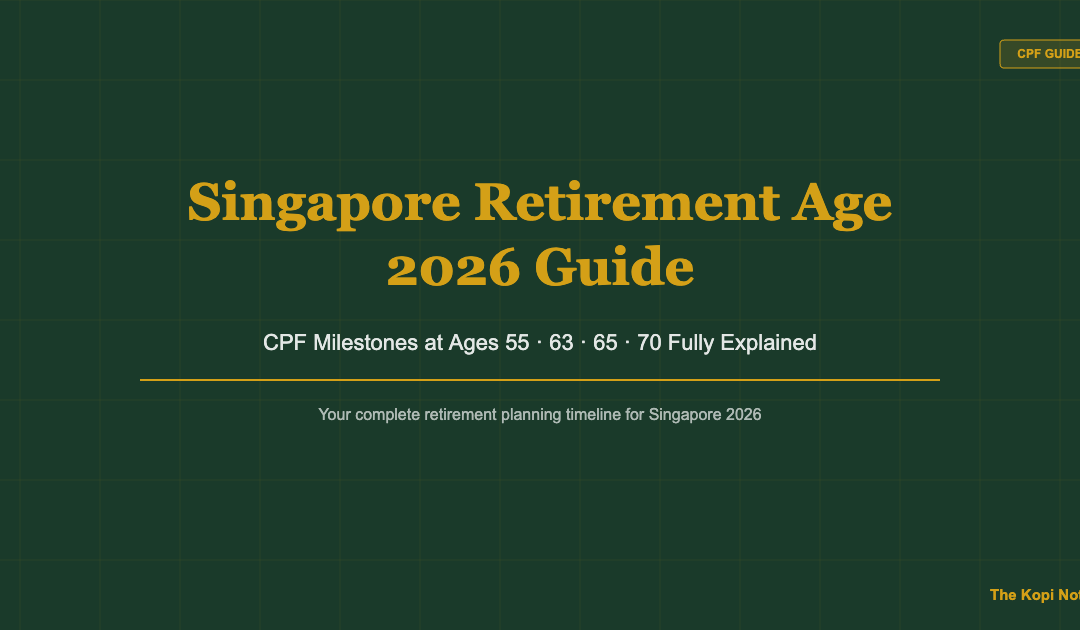
Singapore’s official retirement age is 63, but your CPF retirement journey spans four critical milestones: at 55 your Special Account closes and Retirement Account forms; at 63 you gain full employment protection; at 65 your CPF LIFE payouts begin; and at 70, deferring payouts can boost your monthly income by up to 56%. Here’s exactly what happens at each age — and how to plan for it.
Not financial advice. All figures are for educational reference only. Data as at October 2026 unless noted.
Table of Contents
- What Is the Official Retirement Age in Singapore 2026?
- Age 55: CPF Special Account Closes, Retirement Account Opens
- Age 63: Employment Rights at Official Retirement Age
- Age 65: When CPF LIFE Payouts Begin
- Age 68: Re-Employment Age — What Employers Must Offer
- Age 70: Deferring CPF LIFE for Higher Monthly Payouts
- CPF Milestones at a Glance 2026
- CPF LIFE Plan Comparison: Basic, Standard & Escalating
- How to Plan Your Retirement Timeline
- Frequently Asked Questions
What Is the Official Retirement Age in Singapore 2026?
As of 2026, Singapore’s official retirement age is 63 years old, raised from 62 under the government’s phased retirement age increases. The re-employment age — the age up to which employers are obligated to offer continued work — stands at 68 years old.
These are not the only ages that matter for retirement planning in Singapore. Your CPF account structure changes meaningfully at 55, 63, 65, 68, and 70 — and understanding each milestone is essential to maximising your retirement income.
The government’s roadmap calls for the retirement age to reach 65 by 2030 and re-employment age to reach 70 by 2030, in line with Singapore’s Ministry of Manpower (MOM) advisory. Planning now with the future schedule in mind gives you more flexibility.
Age 55: CPF Special Account Closes, Retirement Account Opens
Turning 55 is the first major CPF event in your retirement journey. The CPF Board makes three significant changes at this age:
- Retirement Account (RA) is created — Savings from your Ordinary Account (OA) and Special Account (SA) are transferred into the new RA, up to the Full Retirement Sum (FRS). For 2026, the FRS is approximately $213,000.
- Special Account (SA) is closed — Once the RA is formed, your SA is closed. Any remaining SA savings above the FRS transfer to the OA.
- Withdrawal eligibility begins — You can withdraw CPF savings above the Basic Retirement Sum (BRS) — approximately $106,500 in 2026 — as a lump sum, or leave the money in CPF to grow at 4% per annum in your RA.
A Singapore investor aged 55 with $250,000 in CPF (combined OA + SA) would have $213,000 swept into the RA (FRS), leaving approximately $37,000 available for withdrawal or kept in the OA earning 2.5% per annum.
The key decision at 55: should you withdraw the excess or keep it earning interest? The RA earns a guaranteed 4% per annum — significantly higher than most fixed deposits. Most financial planners recommend leaving the maximum in CPF unless you have an immediate need for the cash.
Age 63: Employment Rights at Official Retirement Age
Singapore’s Retirement and Re-employment Act (RRA) provides key protections at 63. Employers cannot dismiss you solely on grounds of age before you reach 63, and once you hit 63, your employer is legally required to offer re-employment up to age 68, provided you meet three criteria:
- You are a Singapore citizen or permanent resident
- You have served the company for at least 3 years prior to 63
- You are assessed to be medically fit to continue working
Re-employment does not have to be in the same role or at the same salary. Employers may adjust your terms (including pay) to reflect the new role. However, if re-employment is not feasible, the employer must pay an Employment Assistance Payment (EAP) — typically 3.5 months of salary, capped at $14,750.
Importantly, your CPF contribution rates change at 55 and continue stepping down by age group. At 60-65, employer CPF contribution is 9% and employee is 7.5%. From 65 onwards, rates drop further. The government has committed to gradually raising these rates to support older workers’ retirement savings as part of the Silver Support Scheme roadmap.
For retirement planning purposes, age 63 is the point at which many Singaporeans begin shifting from active income dependency to a hybrid of employment income and CPF/investment income — particularly those who have built a passive income Singapore stream through S-REITs or dividend ETFs.
Age 65: When CPF LIFE Payouts Begin
CPF LIFE (Lifelong Income for the Elderly) is Singapore’s national longevity insurance scheme. It begins monthly payouts at age 65 by default, providing guaranteed income for life regardless of how long you live.
Three CPF LIFE plans are available, and your choice must be made before payouts begin:
- Standard Plan — Higher monthly payouts, lower bequest. Most popular. Suitable if you want to maximise monthly income.
- Basic Plan — Lower monthly payouts but leaves a larger estate (your unused CPF savings). Suitable if legacy/bequest is a priority.
- Escalating Plan — Starts at lower payouts but increases by 2% per year. Protects against inflation. Payouts eventually exceed Standard Plan after approximately 18 years.
At the Full Retirement Sum (FRS) of ~$213,000 in 2026, the approximate CPF LIFE Standard Plan payouts starting at age 65 are around $1,460/month. To top up your CPF RA to the Enhanced Retirement Sum (ERS) — which is 4x BRS or ~$426,000 — monthly payouts increase to approximately $2,900/month.
You can supplement CPF LIFE payouts with dividends from S-REITs. Our guide to the best S-REITs in Singapore 2026 covers yield-focused options paying 5–7% annually.
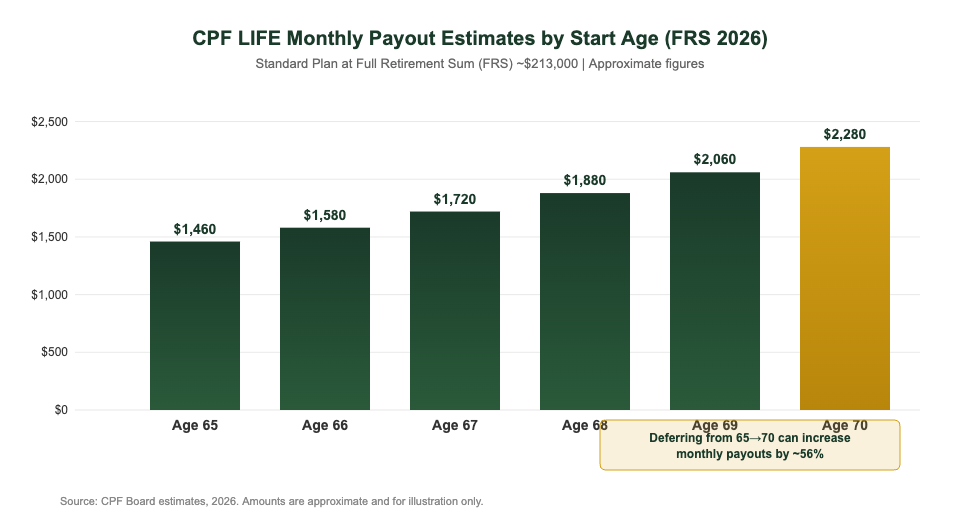
Source: CPF Board estimates, 2026. Approximate figures for illustration at FRS (~$213,000). Actual payouts vary.
Age 68: Re-Employment Age — What Employers Must Offer
Under the Retirement and Re-employment Act, employers in Singapore must offer re-employment to eligible employees up to age 68 (rising to 70 by 2030). This is the age beyond which your employer has no legal obligation to keep you — though many choose to continue flexible work arrangements.
If you are re-employed between 63 and 68, the role may be different from your previous position. Your employer can:
- Adjust your salary to match the new role’s market rate (this is legal)
- Change your job scope, hours, or employment terms
- Convert you from a permanent employee to a term-contract employee
If no suitable role exists, they must pay the Employment Assistance Payment (EAP). From 2026, the EAP minimum is 3.5 months of last drawn salary, capped at $14,750 for those with 2+ years of service in the re-employment period.
Age 68 is also a meaningful investment planning milestone. Many Singaporeans use this period to gradually shift from growth-oriented investments toward capital-preservation strategies — for example, moving from Singapore T-bills 2026 and fixed deposits toward a balanced portfolio that continues generating passive income without high capital risk.
Age 70: Deferring CPF LIFE for Higher Monthly Payouts
CPF LIFE payouts don’t have to start at 65. You can defer your CPF LIFE start date up to age 70 — and this can meaningfully increase your monthly income for life.
Every year you defer your CPF LIFE payout start (from 65 to 70), your monthly payout increases by approximately 6–7% per year. This is because your RA savings continue compounding at 4% per annum and the actuarial calculations improve. The result: deferring from 65 to 70 can increase your monthly CPF LIFE payout by approximately 50–56%.
For a Singapore retiree with $213,000 in the RA (FRS 2026):
- Start at 65: ~$1,460/month (Standard Plan)
- Defer to 70: ~$2,280/month (Standard Plan)
- Difference: ~$820/month more for life
The break-even age for deferring from 65 to 70 is approximately 80–82 years. If you live beyond this age — which is the median life expectancy for Singaporeans — deferral is mathematically better. Singapore’s life expectancy as at 2026 is approximately 83 years (Department of Statistics).
The strategy of deferring CPF LIFE while drawing down from SRS account investments, dividends, or T-bill/SSB income is sometimes called the “CPF LIFE bridge” strategy. Your Singapore retirement calculator can help model whether deferral makes sense for your specific numbers. You can also supplement retirement income by opening an SRS account — compare options via the Endowus referral code (code: 2V343) or the Syfe referral code and sign-up bonus (code: SRPRFFFCD).
CPF Milestones at a Glance 2026
| Age | Key Event | What You Should Do |
|---|---|---|
| 55 | SA closes → RA formed up to FRS (~$213,000). Lump-sum withdrawal eligible. | Review whether to top up RA to ERS or withdraw excess OA savings. |
| 60 | Silver Housing Bonus eligibility (if downsizing HDB). | Evaluate HDB right-sizing options to unlock housing equity for retirement. |
| 63 | Official retirement age. Employer cannot force retirement before this. | Know your re-employment rights and negotiate continued employment or EAP. |
| 65 | Default CPF LIFE payout start. Choose Basic, Standard or Escalating plan. | Decide whether to start payouts at 65 or defer. Model the break-even. |
| 68 | Re-employment age. Employer legal obligation ends (rising to 70 by 2030). | Plan for income transition — CPF LIFE + passive income portfolio. |
| 70 | Maximum CPF LIFE deferral age. Highest monthly payout achievable. | Start CPF LIFE latest by 70. Payouts ~56% higher vs starting at 65. |
Source: CPF Board, Ministry of Manpower (MOM) 2026. FRS and ERS amounts are indicative for 2026.
CPF LIFE Plan Comparison: Basic, Standard & Escalating (2026)
At 65 (or when you defer), you must select one of three CPF LIFE plans. Here’s how they compare at the Full Retirement Sum (~$213,000) in 2026:
| Plan | Monthly Payout (FRS at 65) | Payout Pattern | Estate / Bequest | Best For |
|---|---|---|---|---|
| Standard | ~$1,460/month | Fixed for life | Lower (unused premium refunded) | Maximising monthly income |
| Basic | ~$1,210/month | Fixed for life (lower) | Higher bequest to beneficiaries | Those with estate planning goals |
| Escalating | ~$1,120/month, +2%/yr | Rises 2% annually | Lower | Inflation-conscious retirees |
Source: CPF Board 2026. Payouts are approximate for FRS ~$213,000 at age 65 Standard Plan. Actual amounts depend on cohort and plan selection timing.
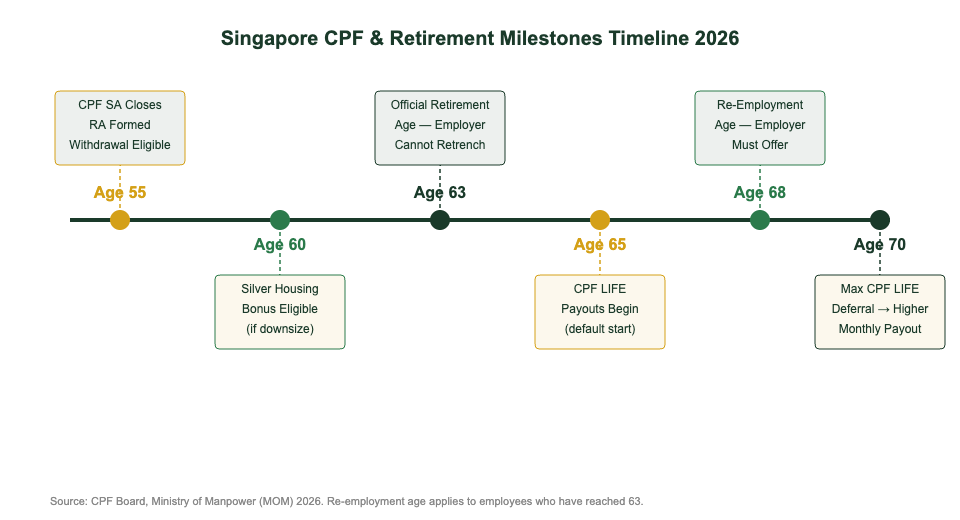
Source: CPF Board, Ministry of Manpower 2026.
How to Plan Your Retirement Timeline in Singapore
With four key CPF age milestones between 55 and 70, retirement planning in Singapore requires a staged approach — not a single decision at the point of leaving work.
In your 40s and early 50s: Focus on maximising CPF SA contributions (before SA closes at 55) and building a diversified passive income portfolio. Making CPF investment strategy decisions before the SA closes gives you the best compounding window. Consider whether S-REITs — accessible via FSMOne referral code (P0544985) or Syfe — fit your risk profile.
At 55: Review your CPF balances and decide whether to top up your RA to the ERS (~$426,000 in 2026) for higher CPF LIFE payouts later, or withdraw excess savings for investment. You cannot reverse this decision easily.
Between 55 and 65: Build the income bridge. If you plan to defer CPF LIFE to 70, you’ll need 5 years of income between 65 and 70 that doesn’t depend on CPF LIFE. Dividend portfolios, T-bills, SSBs, and SRS withdrawals can fill this gap. See our Singapore T-bills 2026 guide for risk-free options.
At 65: Make your CPF LIFE plan choice. This is irrevocable. Use our Singapore retirement calculator to model the break-even age for Standard vs Escalating, and the deferral benefit of waiting until 70.
From 65 to 70 (if deferring): Draw down on SRS, T-bills, dividend income, and any rental income. Keep CPF LIFE deferred to let it compound at 4% in the RA.
Frequently Asked Questions: Singapore Retirement Age 2026
What is the official retirement age in Singapore in 2026?
The official retirement age in Singapore in 2026 is 63 years old, raised from the previous 62 under the phased increases legislated by MOM. Employers cannot force employees to retire before 63. The re-employment age — the age up to which employers must offer continued work — is 68 in 2026, rising to 70 by 2030 under the government’s roadmap.
What happens to my CPF at age 55 in Singapore?
At age 55, your CPF Special Account (SA) is closed and a new Retirement Account (RA) is created. Savings from your OA and SA are swept into the RA up to the Full Retirement Sum (FRS), which is approximately $213,000 in 2026. Any savings above the FRS or the Basic Retirement Sum (BRS, ~$106,500) can be withdrawn as a lump sum. Your RA then earns 4% per annum until CPF LIFE payouts begin.
When do CPF LIFE payouts start in Singapore?
CPF LIFE payouts begin at age 65 by default. However, you can defer your start date to any age up to 70. Each year of deferral increases your monthly payout by approximately 6–7%, because your Retirement Account savings continue to earn 4% interest and actuarial adjustments improve. Deferring from 65 to 70 can increase monthly payouts by approximately 50–56%.
Can my employer force me to retire in Singapore?
No. Under the Retirement and Re-employment Act, your employer cannot dismiss you solely on grounds of age before you reach 63. After 63, they are required to offer re-employment up to age 68 (rising to 70 by 2030), subject to you being a Singapore citizen or PR, having served the employer for at least 3 years, and being medically fit. If re-employment is not feasible, they must pay the Employment Assistance Payment (EAP) of 3.5 months’ salary (capped at $14,750).
Which CPF LIFE plan is best: Basic, Standard or Escalating?
For most retirees who want to maximise monthly income, the Standard Plan is most popular — it pays the highest fixed monthly amount for life. If leaving a larger bequest to your children matters more than monthly payout, the Basic Plan retains more money in your RA for your estate. The Escalating Plan starts lower but increases 2% per year — it overtakes the Standard Plan’s cumulative payout at around year 18, making it best for those who want inflation protection and expect to live well past 83.
What is the re-employment age in Singapore and how does it differ from retirement age?
The retirement age (63 in 2026) is the earliest age at which an employer can start the process of retiring an employee — before this age, employers cannot force retirement. The re-employment age (68 in 2026) is the age up to which an employer must offer continued employment after the retirement age. Between 63 and 68, employers must make reasonable re-employment offers. Beyond 68, there is no legal obligation, though many companies offer flexible or contract work voluntarily. Both ages are increasing — to 65 and 70 respectively by 2030.
Should I defer my CPF LIFE payout to age 70?
Deferring CPF LIFE from 65 to 70 increases your monthly payout by approximately 50–56% for life. The break-even age is around 80–82 — if you live beyond this (Singapore’s average life expectancy is ~83), deferral benefits you financially. However, deferral requires alternative income between 65 and 70 (from SRS investments, T-bills, dividends, or part-time work). Use our Singapore retirement calculator to model your personal numbers before deciding.
Ready to Build Your Retirement Portfolio?
Understanding your CPF retirement milestones is only one part of the picture. Singaporeans who retire comfortably typically supplement CPF LIFE with dividends from S-REITs, ETFs, and SRS-invested funds. Here are the tools and platforms TKN readers use most:
- Syfe — Robo-advisor with REIT and Income portfolios. Use Syfe referral code and sign-up bonus (SRPRFFFCD) for a welcome bonus.
- Endowus — CPF and SRS investing platform. Use Endowus referral code (2V343) for fee rebates.
- FSMOne — Low-cost broker for S-REITs and ETFs. Use FSMOne referral code (P0544985) on sign-up.
Disclaimer: The Kopi Notes may earn a referral fee when you use these codes, at no extra cost to you. This is not financial advice. Please seek independent financial advice before making investment decisions.
This article was researched with the help of AI. While we strive to keep all information accurate and up to date, there may be errors. If you notice any discrepancies, please contact us.