MediSave for Overseas Treatment: Malaysia, JB & What’s Changing (2026)
Using your MediSave at approved Malaysian hospitals — withdrawal limits, approved hospitals, and what the RTS Link means for healthcare costs.
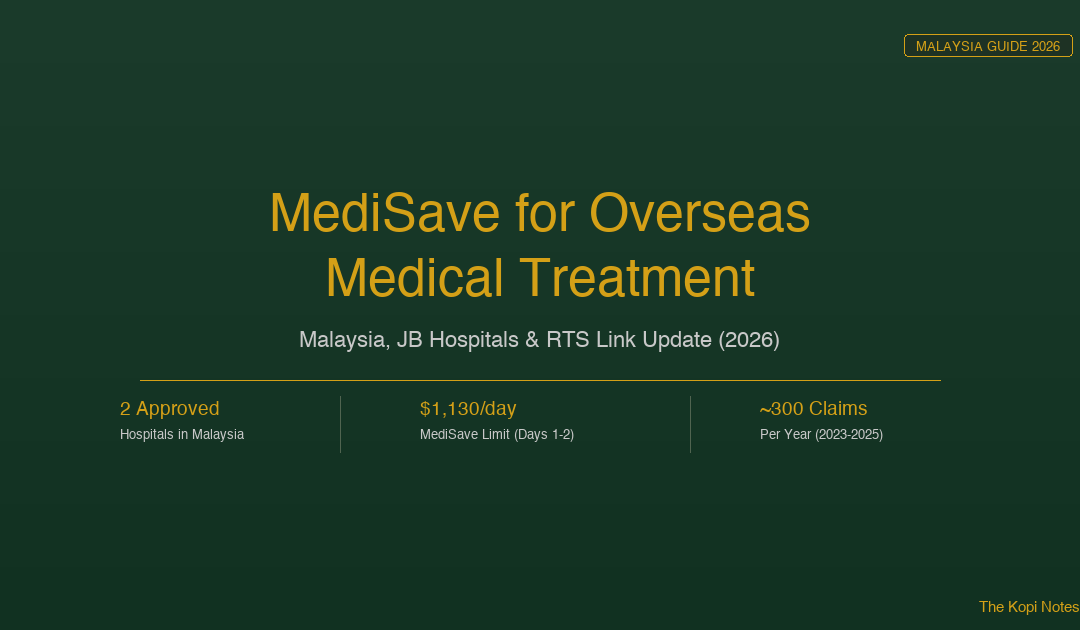
Singapore residents can use MediSave to pay hospital bills at two approved Malaysian hospitals — Regency Specialist Hospital in Johor Bahru and Mahkota Medical Centre in Melaka — via a referral arranged through HMI Medical Centre. The same withdrawal limits as domestic treatment apply: up to S$1,130 per day for the first two days of inpatient care. MediShield Life does not cover overseas treatment. You must arrange a referral before treatment; retroactive claims are not accepted. As at September 2026, approximately 300 claims are made per year, and MOH is reviewing the scheme ahead of the RTS Link opening in early 2027.
Not financial advice. All figures are for educational reference only. Data as at September 2026 unless noted.
Table of Contents
Contents — Click to expand
Why Overseas MediSave Matters
For many Singapore residents — particularly those with family ties to Johor Bahru — cross-border healthcare is not a novelty but a practical reality. Malaysian hospitals, especially those in JB, have long been a destination for certain procedures where wait times are shorter or costs significantly lower. The question most people ask is simple: can I tap my MediSave savings to pay for it?
The short answer is yes, but with important caveats. The CPF Board introduced the Overseas MediSave scheme to help Singaporeans and Permanent Residents access quality care at specific accredited Malaysian hospitals while still drawing on their accumulated MediSave balances. This matters because MediSave is often one of the largest healthcare reserves a working Singaporean holds — for a 40-year-old, the balance could easily exceed S$50,000 — and keeping it locked out of overseas bills means paying those bills in full from cash or savings.
Understanding the scheme is also timely. With the Johor Bahru-Singapore Rapid Transit System (RTS Link) expected to open in early 2027, cross-border travel will become significantly easier. MOH has confirmed it is reviewing the overseas MediSave scheme to ensure it keeps pace with the anticipated increase in cross-border healthcare demand. For Singaporeans planning elective procedures in JB, 2026 is the right time to understand how the scheme works — and what might change.
Your CPF investment strategy should account for all your CPF accounts, including MediSave — understanding its rules for healthcare spending is as important as knowing how to grow your retirement savings.
Approved Malaysian Hospitals
As at September 2026, only two Malaysian hospitals are approved under the CPF Board’s overseas MediSave scheme. Both are operated by Health Management International (HMI), a Singapore-listed healthcare group:
| Hospital | Location | Operator | Nearest SG Access |
|---|---|---|---|
| Regency Specialist Hospital | Johor Bahru (Skudai) | HMI Medical | Woodlands Checkpoint / CIQ |
| Mahkota Medical Centre | Melaka | HMI Medical | ~3.5h drive from Singapore |
Source: CPF Board, September 2026. No other Malaysian hospital is approved under this scheme.
No other Malaysian hospital — including other private hospitals in JB like Columbia Asia or KPJ — is approved. Patients who seek treatment at unapproved hospitals cannot use MediSave to pay those bills, regardless of the procedure. The CPF Board periodically reviews the list of approved hospitals, and any expansion would be announced on cpf.gov.sg.
MediSave Withdrawal Limits for Overseas Treatment
The same MediSave withdrawal limits that apply to domestic inpatient and surgical treatment in Singapore also apply to overseas treatment at approved Malaysian hospitals. This means the limits are governed by the type of care, not the location. Here is the full breakdown as at September 2026:
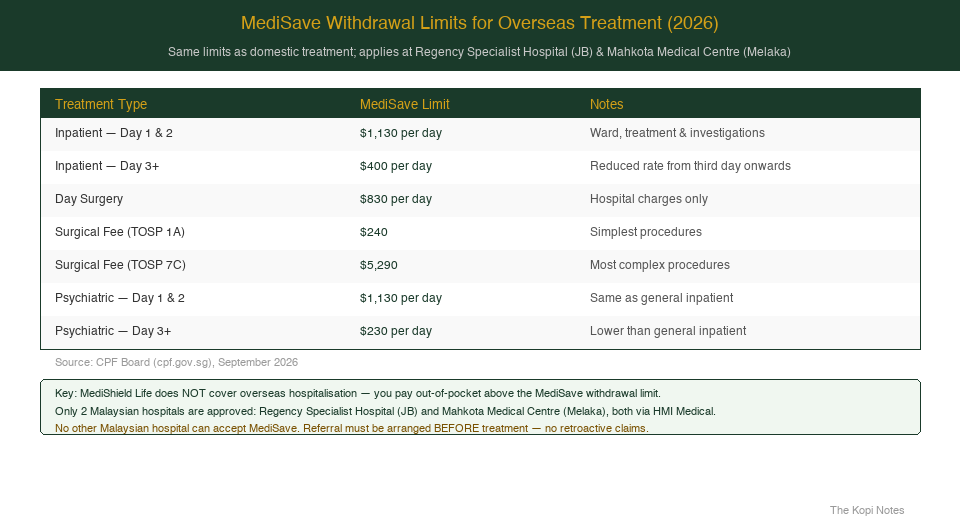
A worked example: a Singapore resident admitted to Regency Specialist Hospital in JB for a 4-day inpatient stay would be able to withdraw via MediSave: S$1,130 (day 1) + S$1,130 (day 2) + S$400 (day 3) + S$400 (day 4) = S$3,060 total. Any hospital charges above this amount — including costs for procedures outside the TOSP list — must be paid in cash or through a personal insurer’s overseas hospitalisation rider (if one is held).
Critically, MediShield Life does not extend to overseas treatment. This is one of the most commonly misunderstood points. Even if you have MediShield Life (or an Integrated Shield Plan with a private insurer), these policies cover hospitalisation in Singapore only. The only CPF-related coverage for overseas treatment is MediSave — and only at the two approved hospitals listed above. If you plan to travel to Malaysia for medical treatment regularly, a travel insurance policy with medical coverage, or an overseas medical insurance plan, would provide the gap coverage that MediSave alone cannot.
For context, the average MediSave claim at the two approved Malaysian hospitals in the 2023–2025 period was approximately S$3,200 to S$3,400 per patient. The most common procedures claimed were obstetrics and gynaecology (OB/GYN), reflecting the higher proportion of Johor-based Singapore permanent residents seeking maternity care closer to home.
Step-by-Step: How to Use MediSave in Malaysia
The overseas MediSave scheme is not a direct billing arrangement in the same way that Singapore public hospitals process MediSave claims automatically. Instead, it operates through a four-step referral and claim process managed by HMI Medical Centre’s Singapore office. The most important rule: the referral must be arranged before treatment begins. There are no retroactive claims.
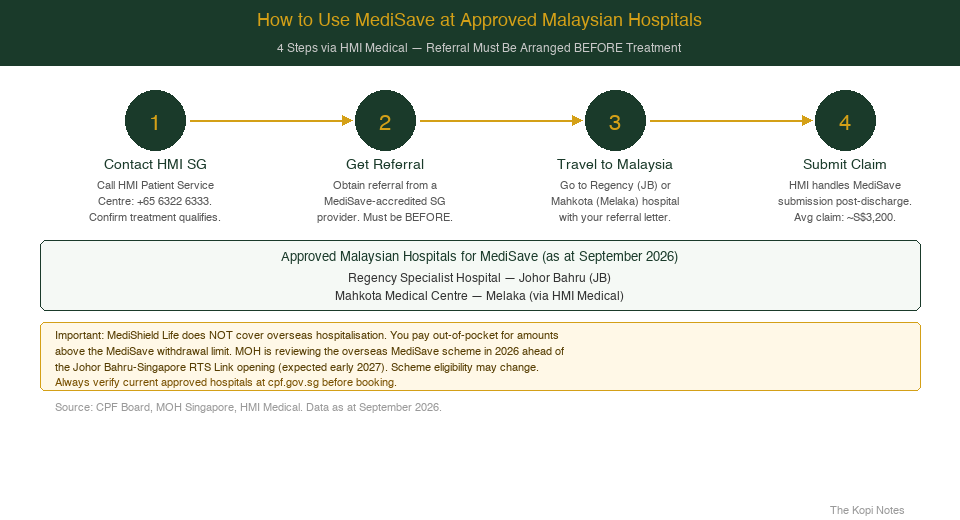
In practice, the four steps are:
Step 1 — Contact HMI Singapore: Call the HMI Patient Service Centre at +65 6322 6333 or visit their clinic at Gleneagles Medical Centre. Confirm that your planned procedure qualifies under the overseas MediSave scheme. Not all procedures are covered — elective cosmetic procedures, for instance, are excluded.
Step 2 — Obtain a Referral: You will need a referral letter from a MediSave-accredited Singapore healthcare provider. This can be your GP, a polyclinic, or a specialist you already see in Singapore. The referral must be issued before your travel to Malaysia.
Step 3 — Proceed to the Approved Hospital: With your referral letter, travel to either Regency Specialist Hospital (JB) or Mahkota Medical Centre (Melaka). Present the referral letter and your Singapore IC or passport at admission. The hospital will register your MediSave eligibility at this point.
Step 4 — Claim Submission Post-Discharge: HMI’s administrative team handles the MediSave withdrawal submission after you are discharged. You do not need to submit any forms yourself. The CPF Board processes the claim and directly deducts the applicable amount from your MediSave account. Any balance due is settled by you directly with the hospital.
Cost Comparison: Singapore vs Malaysia
One of the main reasons Singapore residents seek treatment in Malaysia is cost. While clinical quality at HMI hospitals is internationally accredited (Regency Specialist Hospital holds JCI accreditation), the price differential for certain procedures can be meaningful — particularly for elective procedures not covered by MediShield Life.
| Procedure Type | Typical Cost in SG (Private) | Typical Cost at Regency JB | MediSave Covers |
|---|---|---|---|
| Normal delivery (OB/GYN) | S$8,000–S$15,000 | RM 5,000–RM 8,000 (~S$1,500–S$2,400) | Up to S$2,260 (2 days) |
| Caesarean section | S$12,000–S$25,000 | RM 8,000–RM 14,000 (~S$2,400–S$4,200) | Up to S$3,060 (3-4 days) + surgical fee |
| General specialist consultation | S$180–S$350 | RM 80–RM 160 (~S$24–S$48) | Not covered (outpatient) |
Note: Malaysian Ringgit figures based on approximate MYR/SGD rate of 3.3:1 as at September 2026. Hospital costs are indicative; actual bills vary by procedure complexity, specialist, and ward class. Sources: HMI Medical, MOH Singapore, CPF Board.
The table illustrates an important point: for inpatient stays, especially OB/GYN procedures, the total Malaysian hospital bill may actually be lower than what MediSave would cover. In those cases, MediSave pays the entire bill and the patient faces no out-of-pocket hospital cost. This is why OB/GYN dominates MediSave claims at the approved Malaysian hospitals.
For outpatient specialist consultations — which account for the majority of Singaporeans crossing the border for medical visits — MediSave cannot be used. Only inpatient and approved day surgery procedures are eligible. This is a key limitation to plan around if your primary reason for visiting a Malaysian hospital is specialist consultations rather than an admitted procedure.
If you are exploring ways to build passive income streams to fund healthcare costs, our guide to passive income in Singapore covers dividend-generating assets worth considering alongside MediSave.
RTS Link & What’s Changing in 2026–2027
The Johor Bahru-Singapore Rapid Transit System Link — a cross-border rail connection between Bukit Chagar (JB) and Woodlands North (Singapore) — is expected to open in early 2027. The RTS Link will significantly reduce travel time between the two city centres from over an hour by car to approximately 5 minutes by train. This is expected to change the calculus for cross-border healthcare dramatically.
Regency Specialist Hospital is located in Skudai, approximately 20 minutes from the JB CIQ. With the RTS Link operational, a Singapore resident could, in principle, travel to JB for a same-day specialist procedure or even a day surgery and return home by evening — without the delay and expense of private car or bus transport at the Causeway or Second Link.
MOH confirmed in 2026 that it is reviewing the overseas MediSave scheme to assess whether the current two-hospital arrangement remains appropriate given the anticipated increase in cross-border patient flows. The review may result in: (a) expansion of approved hospitals, (b) revision of withdrawal limits, (c) introduction of additional procedural categories, or (d) no change. The outcome is not yet known as at the date of this article.
What this means practically: Singaporeans planning to use the overseas MediSave scheme for non-urgent elective procedures in 2027 or later may wish to wait until the review outcome is announced. Those with urgent treatment needs should proceed under the current scheme without waiting.
Use our Singapore retirement calculator to factor healthcare costs — including potential overseas treatment — into your long-term financial planning.
Key Things Singapore Patients Must Know
Before seeking treatment at an approved Malaysian hospital under the MediSave scheme, there are several points that frequently catch patients off-guard:
1. Referral first, always. If you travel to Regency Specialist Hospital and check in for a procedure without a prior referral from a Singapore provider arranged through HMI, you cannot use MediSave. The hospital will still treat you, but the bill must be settled fully in cash.
2. Only inpatient and day surgery bills are covered. Outpatient specialist visits, physiotherapy, dental, and GP consultations at the approved hospitals are not covered under the overseas MediSave withdrawal scheme. MediSave for outpatient use is a separate, limited scheme covering only certain conditions (e.g. chronic disease management) at approved Singapore clinics — not at overseas facilities.
3. No MediShield Life, no Integrated Shield Plan. Your Integrated Shield Plan (ISP) from AIA, Prudential, GE Life, Income, Raffles Shield, or other providers covers Singapore hospitalisation only. A claim for an overseas procedure, even at an approved hospital, will not be accepted by your ISP insurer. If you want coverage above MediSave’s limits for overseas procedures, you will need a separate international medical insurance or overseas hospitalisation rider.
4. Currency risk is yours to bear. Malaysian hospital bills are denominated in Ringgit. CPF withdrawals are made in Singapore dollars at the prevailing rate at the time of claim settlement. If the Ringgit strengthens significantly between your treatment date and claim settlement, the SGD equivalent of your bill could be higher than you planned for.
5. The MediSave minimum sum still applies. You cannot draw down your MediSave below the Basic Healthcare Sum (BHS) threshold in force at the time of withdrawal. As at 2026, the BHS is S$71,500. If your MediSave balance is at or near the BHS, you may only be able to use MediSave for a portion of the bill. Check your CPF statement before booking the procedure.
Frequently Asked Questions
Can I use MediSave for treatment in Malaysia?
Yes, but only at two specific approved hospitals: Regency Specialist Hospital in Johor Bahru and Mahkota Medical Centre in Melaka. Both are operated by HMI Medical Centre. You must arrange a referral through HMI’s Singapore Patient Service Centre (Tel: +65 6322 6333) before your treatment. No other Malaysian hospital accepts MediSave. Outpatient visits and consultations are not covered — only inpatient admissions and approved day surgeries qualify.
How much MediSave can I use at a Malaysian hospital?
The same limits as domestic Singapore treatment apply. For inpatient care: S$1,130 per day for days 1 and 2, then S$400 per day from day 3 onwards. Day surgery is capped at S$830 per day. Surgical fees depend on the procedure’s TOSP classification, ranging from S$240 (Class 1A, simplest) to S$5,290 (Class 7C, most complex). There is no MediShield Life coverage for overseas treatment, so any amount above MediSave’s limits is paid out-of-pocket.
Does my Integrated Shield Plan cover Malaysian hospitals?
No. All Integrated Shield Plans (from AIA, Prudential, GE Life, Income, Raffles Shield, etc.) cover hospitalisation in Singapore only. Your ISP will not pay claims for treatment at Malaysian hospitals, including the two approved hospitals under the CPF MediSave overseas scheme. If you want insurance coverage for overseas procedures, you need a separate travel insurance policy with medical benefits or a standalone international health insurance plan. This is one of the most important points to clarify before seeking cross-border treatment.
What happens to the MediSave overseas scheme when the RTS Link opens?
MOH has confirmed it is reviewing the overseas MediSave scheme in 2026 ahead of the JB-Singapore RTS Link opening, which is expected in early 2027. The review outcome is not yet known. Possible changes include expanding the list of approved hospitals, revising withdrawal limits, or introducing new procedural categories. The current scheme remains in force until any changes are announced. Singaporeans planning non-urgent elective procedures may wish to watch for the review outcome before booking.
Can I use MediSave for a JB specialist consultation?
No. MediSave for overseas treatment covers inpatient admissions and approved day surgeries only. Outpatient specialist consultations at Regency Specialist Hospital or Mahkota Medical Centre cannot be funded with MediSave, even at the approved hospitals. For outpatient visits, you pay in cash (Malaysian Ringgit) at the point of service. The cost is typically significantly lower than equivalent private specialist consultations in Singapore.
What if I get emergency treatment at a Malaysian hospital — can I claim MediSave?
MediSave claims for overseas treatment require a pre-arranged referral through HMI Medical Centre before admission. In a genuine emergency where pre-arrangement was not possible, the CPF Board reviews claims on a case-by-case basis. You would need to contact CPF Board directly after discharge and provide documentation of the emergency nature of the treatment. This pathway is not guaranteed and should not be relied upon for routine care. Travel insurance with emergency medical coverage is a more reliable safety net for unexpected situations overseas.
Plan Your Healthcare Costs with The Kopi Notes
Understanding your MediSave is just one part of healthcare financial planning. Use our tools and guides to build a complete picture of your CPF and investment strategy.
The Kopi Notes is an independent Singapore personal finance blog. We are not affiliated with CPF Board, MOH, or HMI Medical. This article is for informational purposes only and does not constitute financial, medical, or insurance advice. Always verify current limits and approved hospital lists at cpf.gov.sg before making decisions.
Get Free Insurance Advice
Speak with a licensed insurance advisor. No obligation, no cost.
By submitting this form, you agree to our Privacy Policy.
This article was researched with the help of AI. While we strive to keep all information accurate and up to date, there may be errors. If you notice any discrepancies, please contact us.