LIFE INSURANCE GUIDE • DATA VERIFIED 27 SEP 2026
Critical Illness Insurance Singapore 2026: The Parent’s Guide
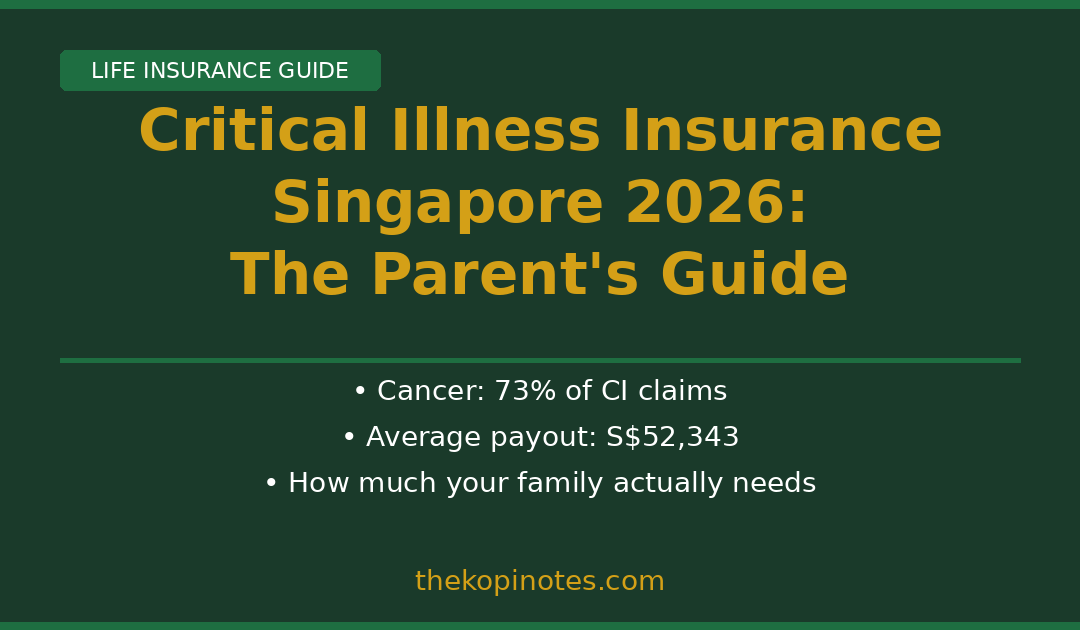
Cancer makes up 73% of CI claims in Singapore. The average payout is S$52,343. For a family with two young children, that number rarely covers 12 months of mortgage, school fees, and household expenses while one parent is recovering. This guide covers what parents actually need from CI insurance — and how to close the gap.
Disclaimer: This article is for general information only. It is not financial advice. Consult a licensed financial adviser before purchasing insurance.
Table of Contents
What CI Insurance Covers in Singapore
Critical illness insurance pays a tax-free lump sum on diagnosis. It does not replace hospital bills (that is MediShield Life and your Integrated Shield Plan) or lost wages over time (that is disability income insurance). CI pays once, in full, so you can choose how to spend it.
Singapore’s LIA CI Framework 2024 standardises coverage across 37 major conditions. Every insurer uses the same definitions. The top five conditions account for over 90% of all claims: cancer (73.17%), heart attack, stroke, kidney failure, and coronary artery bypass. Breast cancer and colorectal cancer alone make up a large share of that 73%.
Many newer plans also add early and intermediate stage coverage, which now accounts for over 60% of all CI payouts in Singapore. Catching cancer at Stage 1 or 2 rather than Stage 3 or 4 is increasingly common, and early-stage plans pay 25% to 100% of the sum assured at that point.
Why Parents Need More CI Coverage
Singles carry one income and one set of expenses. Parents carry two sets of stakes.
If you earn S$6,000 a month and have two young children, your household’s monthly fixed costs likely run S$5,000 to S$7,000 once you add the mortgage, childcare, groceries, utilities, and school fees. A CI diagnosis does not pause any of that for the 12 to 24 months of treatment and recovery.
The average CI payout in Singapore is S$52,343. That covers less than nine months of a median Singapore household’s expenses. For a parent earning S$72,000 a year, the LIA recommendation of five times annual income means CI coverage of S$360,000 — nearly seven times the current average payout level.
Parents also face costs that singles do not: childcare replacement if the ill parent was the primary carer, school fees that cannot be deferred, and the need to keep servicing the housing loan while one income drops or disappears entirely.
The Stay-at-Home Parent Problem
Stay-at-home parents are the most underinsured group in Singapore. They have no salary, so the traditional “five times income” formula produces zero.
The right way to insure a stay-at-home parent is to price the replacement cost of what they do. Full-time childcare in Singapore runs S$1,200 to S$2,500 a month per child. Add part-time domestic help and the annual cost of replacing a stay-at-home parent for two children can reach S$40,000 to S$60,000.
A stay-at-home parent with a serious CI diagnosis also creates a second problem. The working parent may need to reduce hours or leave work temporarily to manage caregiving. CI coverage for the non-earning parent should be at least S$200,000 to S$300,000 to fund this gap.
Most advisers skip this. The premium cost of insuring a stay-at-home parent is lower than for a working adult of the same age because insurers use declared income as a ceiling for many plans. Term CI coverage for a 35-year-old non-smoking woman typically costs S$300 to S$600 a year for S$300,000 of coverage.
How Much CI Coverage a Parent Needs
The LIA guideline is five times your annual income for CI. For a household with young children, add a mortgage buffer on top.
A working parent earning S$72,000 a year needs at least S$360,000 in CI coverage. If the household has a S$600,000 outstanding mortgage and the other parent cannot service it alone on a single income, add another S$200,000 to S$300,000. Total CI coverage for this parent: S$560,000 to S$660,000.
Most people are significantly underinsured. The average CI sum assured in Singapore is well below S$100,000. The gap between what people hold and what parents actually need is the core problem this guide addresses.
A simple parent’s CI coverage formula
| Component | Calculation | Example (S$6k/mo earner) |
|---|---|---|
| Income replacement | 5x annual income | S$360,000 |
| Mortgage buffer (if applicable) | 2–3 years of repayments | S$60,000–S$90,000 |
| Childcare replacement | S$2,000/mo per child x 2 years | S$48,000 (1 child) |
| Suggested minimum total | — | S$468,000–S$498,000 |
You do not need to hold all this in a single policy. Many parents stack a term CI plan (cheap, large sum assured) over a multipay CI rider (pays multiple times if diagnosed twice) and an early CI layer. The total premium across all three layers can still be S$1,500 to S$2,500 a year for a 35-year-old non-smoker.
Free Child CI Add-Ons: Which Plans Include Them
Several Singapore CI plans include automatic child coverage at no extra premium, provided the parent holds the policy. The benefit is typically capped at S$25,000 or 25% of the parent’s sum assured, whichever is lower, and covers children up to age 17.
Child CI add-ons usually cover 36 major critical illnesses plus 9 juvenile conditions specific to children, including Kawasaki disease and severe aplastic anaemia. These are conditions that adult CI policies do not cover because healthy adults do not get them.
The free child rider does not replace proper standalone child CI coverage. A S$25,000 payout on a child diagnosis covers initial treatment costs but not prolonged hospitalisation, overseas treatment, or parental income lost during caregiving. If a child’s CI is a priority for your family, consider a standalone child CI plan on top of the parent’s free rider.
Which major Singapore CI plans include free child coverage
| Insurer / Plan | Free child rider | Child coverage cap |
|---|---|---|
| AIA Power Critical Care | Yes (AIA Child Protect) | S$25,000 per child |
| Manulife ManuProtect CI | Varies by plan tier | 25% of parent sum assured |
| Prudential PRUActive Protect | Check current policy terms | Subject to underwriting |
| FWD Big 3 CI / FWD CI plans | No (direct plans only) | N/A |
Always verify current plan terms directly with the insurer before purchase. Terms change.
Best CI Plans for Parents 2026
Parents buying CI in 2026 generally choose between three approaches: pure term CI (cheapest, largest sum assured), multipay CI (pays out more than once if you survive a first CI and then get a second), and early CI rider stacked on a base plan. The right mix depends on your total coverage gap and budget.
| Plan Type | Best for | Indicative annual premium | Child CI rider |
|---|---|---|---|
| Term CI (e.g. FWD Big 3 CI) | Budget-conscious; large sum assured | ~S$198–S$400/yr for S$300k (35yo) | No |
| Multipay CI (e.g. Manulife ManuProtect) | Parents who want repeat payout protection | ~S$700–S$1,200/yr for S$300k (35yo) | Yes (some tiers) |
| Early CI + Term base (e.g. AIA Power Critical Care) | Parents prioritising early-stage detection | ~S$900–S$1,800/yr for S$300k (35yo) | Yes (free child rider) |
| Stay-at-home parent CI | Non-earning spouse; priced on replacement cost | ~S$300–S$600/yr for S$300k (35yo female) | Depends on plan |
Premium estimates are indicative only, sourced from comparison sites as at Sep 2026. Actual premiums depend on age, health status, smoker status, and plan terms. Get a formal quote before deciding.
Buying Strategy for Young Families
The most common mistake parents make with CI insurance is buying too little when premiums are cheapest — in their 20s — then finding it too expensive to top up after they have a mortgage and children.
CI premiums increase significantly with age. A 35-year-old non-smoker pays roughly twice what a 25-year-old pays for the same coverage. Locking in coverage early and converting or adding layers as income grows is almost always cheaper than buying everything late.
A practical buying sequence for young parents:
- First: buy a large term CI policy to cover the household income gap. S$300,000 to S$500,000 is a reasonable starting point.
- Second: add early CI coverage if your family history includes cancer or heart disease. Early-stage payouts matter most for the conditions most likely to hit.
- Third: review coverage when your mortgage peaks or when you have a second child. The gap is usually larger than you think at this point.
- Fourth: keep the stay-at-home parent’s CI separate and explicit in the plan — do not assume the working parent’s coverage protects both.
CPF cannot pay CI premiums directly, but the premium cost of term CI is low enough that it fits inside most household cash budgets. A combined household CI programme for two parents with young children typically runs S$2,000 to S$4,000 a year — less than many families spend on streaming services and gym memberships combined.
For a fee-based illustration from a financial adviser, MAS-licensed advisers can be found via MAS Register of Representatives. LIA Singapore also publishes comparison data on its site.
For tools to calculate your insurance gap and compare savings strategies, see the Insurance Gap Calculator and the Retirement Planning Calculator on this site.
Frequently Asked Questions
How much critical illness insurance does a parent in Singapore need?
Does critical illness insurance cover my children automatically?
Should a stay-at-home parent in Singapore have CI insurance?
What is the most common critical illness claim in Singapore?
What is the average CI payout in Singapore?
Is early critical illness insurance worth it for parents?
Can I use CPF to pay for CI insurance premiums in Singapore?
What is the difference between CI insurance and disability income insurance?
Which CI plan is best for Singapore parents in 2026?
Related Guides and Tools
- Critical Illness Coverage Singapore: How Much Do You Actually Need?
- Best Critical Illness Insurance Singapore 2026: Top Plans Compared
- CI Insurance Singapore: Why Claims Get Rejected and How to Avoid It
- Insurance Gap Calculator Singapore
- Term Life Insurance Premium Calculator Singapore
- Critical Illness Insurance Premium Calculator Singapore
Get Free Insurance Advice
Speak with a licensed insurance advisor. No obligation, no cost.
By submitting this form, you agree to our Privacy Policy.
This article was researched with the help of AI. While we strive to keep all information accurate and up to date, there may be errors. If you notice any discrepancies, please contact us.