Singapore Retirement Age 2026: How the Rate Hike Reshapes Your CPF LIFE Payouts & Retirement Timeline
Updated September 2026 • 11 min read
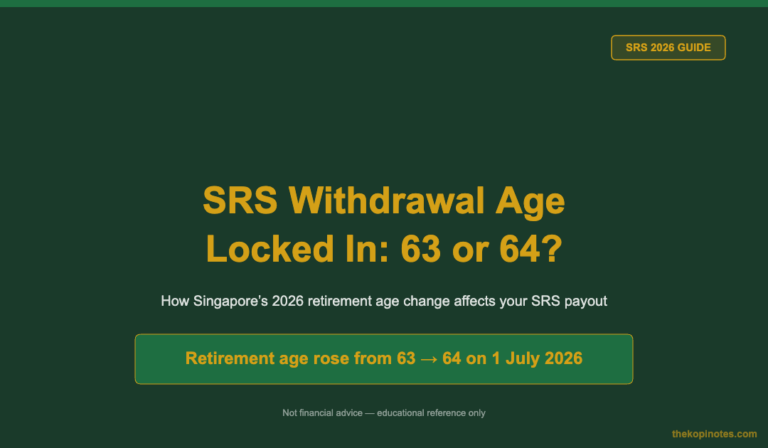
Singapore’s statutory retirement age is 63 in 2026, rising to 65 by 2030. The September 2026 FOMC rate hike changes the equation for retirees and pre-retirees: higher interest rates could lift CPF LIFE annuity payouts, improve fixed-income returns inside SRS, and change whether you should top up your Retirement Account (RA) now versus later.
Not financial advice. All figures are for educational reference only. CPF LIFE payout estimates are illustrative as at September 2026.
- Retirement age is 63 (statutory) and 68 (re-employment) — rising to 65 and 70 by 2030
- CPF withdrawals start at 55; CPF LIFE payouts begin at age 65 by default
- Post-rate-hike: higher bond yields could push CPF LIFE payouts up in the next annual review
- Deferring CPF LIFE to 70 gives ~7% more per year deferred — even more valuable in a high-rate environment
What Is Singapore’s Retirement Age?
Singapore’s statutory retirement age is currently 63 years old. This means employers cannot force an employee to retire before age 63, under the Retirement and Re-employment Act (RRA).
This age is increasing. Under the roadmap announced by the Ministry of Manpower (MOM), the retirement age will rise to 64 in 2028 and 65 by 2030.
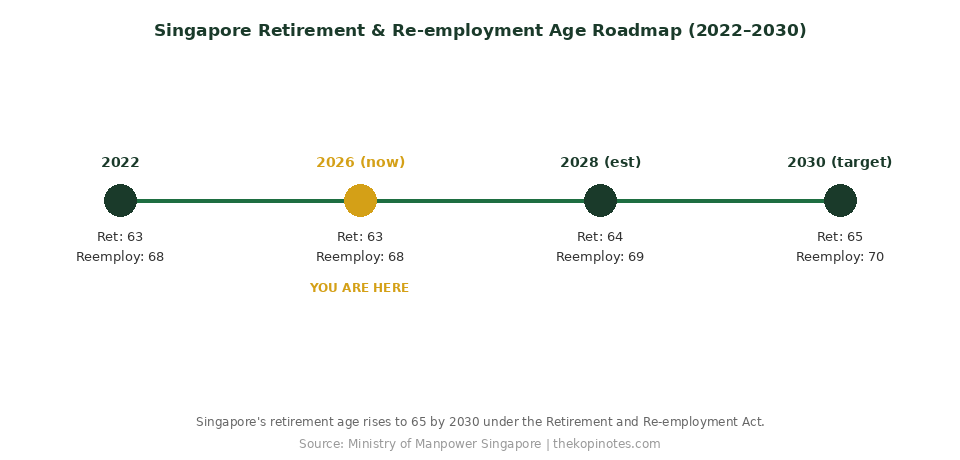
Singapore’s retirement and re-employment age roadmap. Source: Ministry of Manpower Singapore, 2026.
| Year | Retirement Age | Re-employment Age |
|---|---|---|
| 2022 (current baseline) | 63 | 68 |
| 2026 (now) | 63 | 68 |
| 2028 (estimated) | 64 | 69 |
| 2030 (target) | 65 | 70 |
Source: Ministry of Manpower Singapore. Exact transition years for 2028 milestones to be confirmed.
Re-employment Age and What It Means
The re-employment age is different from the retirement age. At 63, your employer can offer you a new contract on different terms — but they must offer you re-employment up to age 68 (rising to 70 by 2030), provided you are medically fit and your performance is satisfactory.
This matters for your retirement finances because every additional year of CPF contributions adds to your Ordinary Account (OA) and Special/Retirement Account balances. In a high-interest-rate environment, those extra years of CPF growth compound more meaningfully.
If re-employment is not possible, your employer must pay you an Employment Assistance Payment (EAP) — typically 3.5 months of salary, capped at S$14,750.
CPF Withdrawal Age vs Retirement Age
CPF operates on a separate timeline from Singapore’s statutory retirement age. Here is how it works:
- Age 55: CPF creates your Retirement Account (RA). Savings from OA and SA move into RA up to the Full Retirement Sum (FRS).
- Age 55: You can withdraw any OA/SA savings above the FRS (subject to CPF Minimum Sum rules).
- Age 65: CPF LIFE monthly payouts begin (default start age).
- Age 70: Maximum deferral age for CPF LIFE — every year you defer past 65 adds approximately 7% to your monthly payout.
Note: The SA was closed for under-55 members in early 2025, following the CPF changes announced in 2024. Retirement savings now flow directly into the RA at 55.
CPF LIFE Payouts in 2026
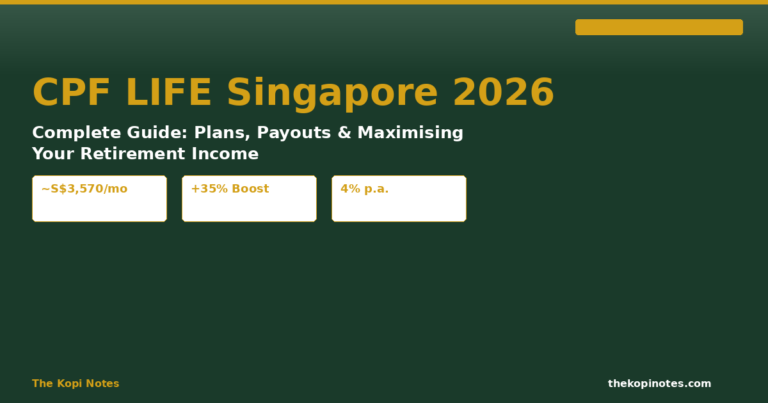
CPF LIFE (Lifelong Income For the Elderly) is a life annuity scheme that pays you monthly for life. The payout amount depends on the balance in your RA at age 65, which plan you choose, and whether you defer your start date.
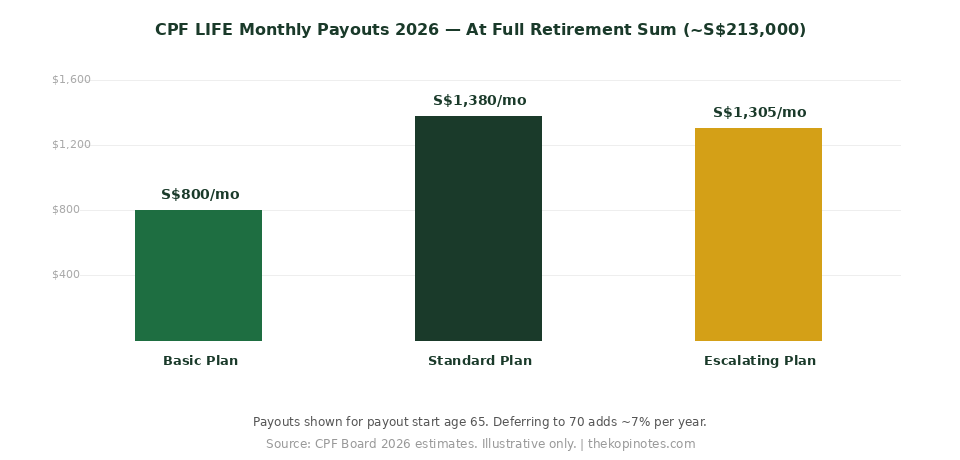
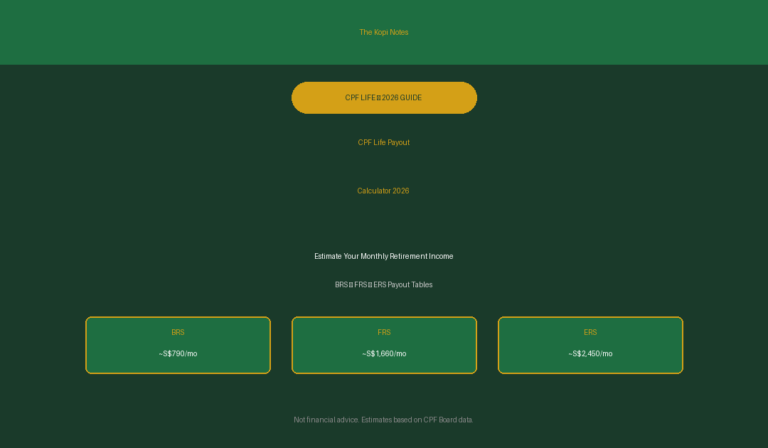
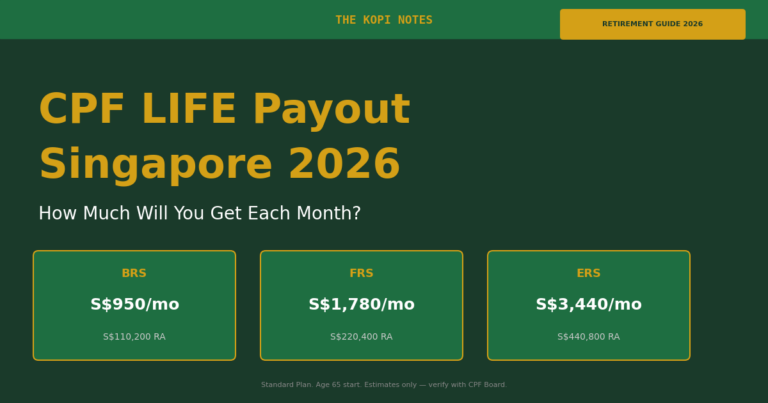
Estimated monthly payouts at FRS (S$213,000) starting at age 65. Source: CPF Board estimates, 2026.
| CPF Balance at 65 | BRS (~S$106,500) | FRS (~S$213,000) | ERS (~S$319,500) |
|---|---|---|---|
| Basic Plan (est.) | ~S$400/mo | ~S$800/mo | ~S$1,200/mo |
| Standard Plan (est.) | ~S$690/mo | ~S$1,380/mo | ~S$2,070/mo |
| Escalating Plan (est.) | ~S$650/mo | ~S$1,305/mo | ~S$1,960/mo |
Estimates only. Actual payouts vary. Check CPF Board website for your personalised projection. | thekopinotes.com
How the September 2026 Rate Hike Affects Your Retirement
The US Federal Reserve raised rates by 25 basis points in September 2026 — the first hike after a prolonged pause. Singapore’s monetary policy operates differently (MAS uses the Singapore dollar exchange rate, not interest rates), but the ripple effects matter for anyone planning retirement here.
1. CPF interest rates may rise in the next review
CPF OA interest is pegged to the average of major local bank rates but floored at 2.5%. The SA (now merged into RA at 55) earns 4%, floored. CPF reviews these rates quarterly. Higher global rates typically push Singapore interbank rates up, which can push CPF OA above the floor — though changes are gradual and often lag by several months.
2. CPF LIFE payouts are linked to bond yields
CPF Board invests the pooled LIFE funds in Singapore Government Securities (SGS) and other instruments. When SGS yields rise, the actuarial assumptions behind CPF LIFE improve — meaning future payout cohorts may see slightly higher payouts. This is a slow-moving effect, but it tilts the balance in favour of topping up your RA now (while you still get to accumulate at current accrual rates) versus waiting.
3. SRS fixed-income investments now yield more
If you hold T-bills, SGS, or bond ETFs inside your SRS, those are now paying higher rates. Singapore 6-month T-bill yields rose above 4% in September 2026. That makes the SRS cash-then-invest strategy more rewarding than it was when rates were near zero.
4. Equity valuations face short-term pressure
Higher rates compress valuation multiples for growth stocks. If your SRS is in equity-heavy positions, you may see short-term volatility. For those within 5 years of retirement, this is a prompt to review asset allocation and consider a gradual shift toward Singapore REITs or bonds.
Rate Hike Playbook for Pre-Retirees
- Top up your CPF RA now to lock in current accrual rates before any quarterly adjustment
- Consider investing idle SRS funds in T-bills or bond ETFs for 4%+ returns
- Defer CPF LIFE start to 70 if you can self-fund from ages 65–70 — each deferral year adds ~7%
- Review your SRS asset allocation if you are within 5 years of planned retirement
SRS Strategy in a Higher-Rate Environment
SRS (Supplementary Retirement Scheme) contributions give you a dollar-for-dollar tax deduction on up to S$15,300/year (for Singapore Citizens and PRs). In a rate-hike environment, the investment case for SRS gets stronger because:
- SRS-eligible fixed income (T-bills, SGS, bond ETFs) now yields more
- The tax break is immediate — deducted from Year of Assessment 2026 if you contribute before December 31
- With higher nominal rates, the real return from SRS investments improves even after accounting for inflation
You can invest SRS funds through Endowus (use referral code 2V343 for a management fee waiver) or Syfe (use code SRPRFFFCD for a bonus). Both platforms offer bond-heavy or income-oriented SRS portfolios suited to a higher-rate regime.
For those who prefer direct T-bill investing via SRS, DBS Vickers and OCBC Securities both support SRS-funded T-bill applications.
Singapore Retirement Timeline by Age
Here is a reference guide for key milestones in your Singapore retirement journey:
| Age | Key Milestone | Action to Consider |
|---|---|---|
| 50–54 | Pre-CPF lock-in window | Max SRS contributions; review CPF top-up to MA |
| 55 | CPF RA created; can withdraw above FRS | Decide BRS/FRS/ERS target; begin SRS drawdown planning |
| 60–62 | Approaching statutory retirement (63) | Negotiate re-employment contract; review asset allocation |
| 63 | Statutory retirement age (2026) | Employer may re-offer contract up to 68; EAP if not |
| 63+ | SRS withdrawal window opens | Spread SRS withdrawals over 10 years to minimise tax |
| 65 | CPF LIFE payouts begin (default) | Or defer to 70 for ~35% more in lifetime monthly income |
| 68 | Re-employment age ceiling (2026) | Last point for employer CPF contributions |
Source: CPF Board, MOM Singapore, 2026. Plan accordingly with a licensed financial adviser for personalised advice.
Use our Singapore Retirement Planning Calculator to model your CPF LIFE payouts at different start ages and balances.
Frequently Asked Questions
What is the retirement age in Singapore in 2026?
What is the re-employment age in Singapore?
When can I withdraw from CPF?
How does the 2026 rate hike affect CPF LIFE?
Should I top up my CPF RA now or wait?
What is the CPF Full Retirement Sum (FRS) in 2026?
Is SRS worth it after a rate hike?
This article was researched with the help of AI. While we strive to keep all information accurate and up to date, there may be errors. If you notice any discrepancies, please contact us.