SRS Account Singapore 2026: Best Ways to Invest Your SRS After the Fed Rate Hike
The Fed raised rates to 3.75–4.00% on 16 September 2026, and that changes the calculus for every SRS account holder in Singapore. Higher global rates mean higher yields on fixed income products inside your SRS — T-bills, Singapore Savings Bonds, and endowment plans are all repricing upward. This guide shows you exactly where to put your SRS dollars in Q4 2026, how to calculate your tax savings, and which platform to use.
TL;DR — SRS Q4 2026 Playbook
- Contribution cap 2026: S$15,300 (SC/PR) | S$35,700 (foreigners)
- Highest immediate yield: T-bills at ~3.9% p.a. (post-Fed hike) via FSMOne
- Best medium-term play: SSB Oct 2026 tranche at ~3.3% average 10-yr yield
- Highest tax saving: S$3,366 for income above S$320k (full S$15,300 top-up)
- Year-end deadline: Top up by 31 December 2026 to claim 2026 tax relief
- New Endowus referral code: 2V343 | FSMOne: P0544985
What Is the SRS Account?
The Supplementary Retirement Scheme (SRS) is a voluntary savings programme run by the Singapore government. You open an SRS account at DBS, OCBC, or UOB, contribute cash, and invest those funds in approved instruments. The key draw is the tax deduction: every dollar you contribute reduces your assessable income for that year.
Unlike CPF, SRS is entirely voluntary and gives you a wider investment universe — stocks, ETFs, unit trusts, T-bills, SSBs, and endowment plans all qualify. At retirement (currently age 62), you withdraw over 10 years, with only 50% of withdrawals taxed — a significant benefit versus withdrawing a lump sum in a high-earning year.
SRS funds must stay in the account until statutory retirement age, or you face a 5% penalty on the withdrawn amount plus full income tax on the withdrawal. That makes SRS a long-term commitment, so choosing the right investments within it matters.
SRS Contribution Limits 2026
The annual contribution caps for 2026 remain unchanged from the 2024 revision:
| Residency Status | Annual SRS Cap | Max Tax Relief |
|---|---|---|
| Singapore Citizen (SC) | S$15,300 | S$15,300 |
| Permanent Resident (PR) | S$15,300 | S$15,300 |
| Foreigner | S$35,700 | S$35,700 |
Source: IRAS, MAS SRS guidelines 2026.
The total personal income tax relief cap in Singapore is S$80,000 per year across all sources (CPF cash top-up, SRS, course fees, etc.). If you are already near this cap, additional SRS contributions still generate returns inside the account — they just may not reduce your tax further.
How Much Tax Do You Actually Save?
Your SRS tax saving equals your marginal tax rate multiplied by your contribution. Singapore’s top marginal rate is 24% (above S$1 million), but the most common bracket among SRS users is 15%–22% for incomes between S$120k and S$320k.
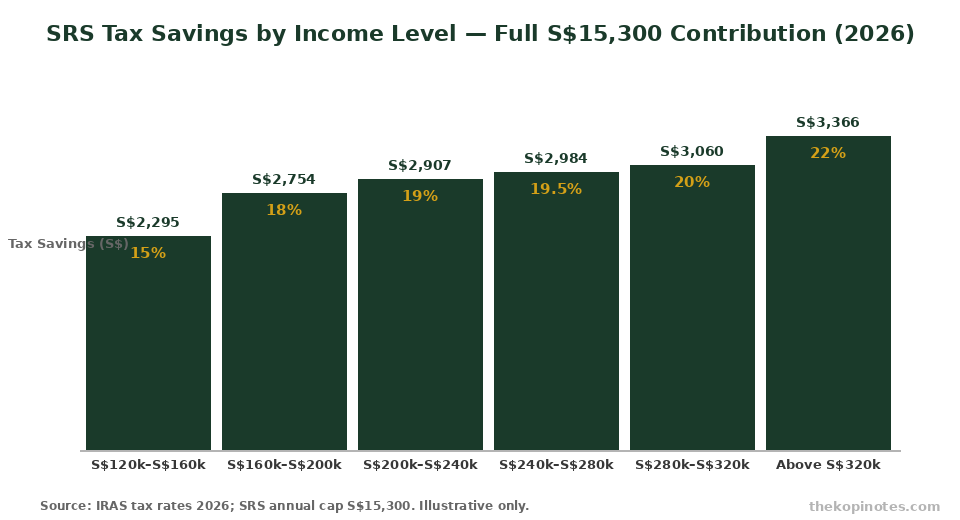
For a Singapore Citizen earning S$200,000 a year contributing the full S$15,300: the marginal rate on the top slice of income is 19%, so the tax saving is approximately S$2,907. That is equivalent to a guaranteed return of 19% on your first S$15,300 invested — before any investment returns inside the account.
Note: SRS contributions reduce assessable income, not chargeable income directly. Confirm your exact saving with an IRAS tax calculator or a licensed financial adviser, as deduction ordering (CPF, courses, dependant relief) affects the precise number.
Best SRS Investments Post-Rate-Hike Q4 2026
With the Fed funds rate at 3.75–4.00%, global fixed income yields have repriced upward. Here is how SRS-eligible instruments stack up in Q4 2026:
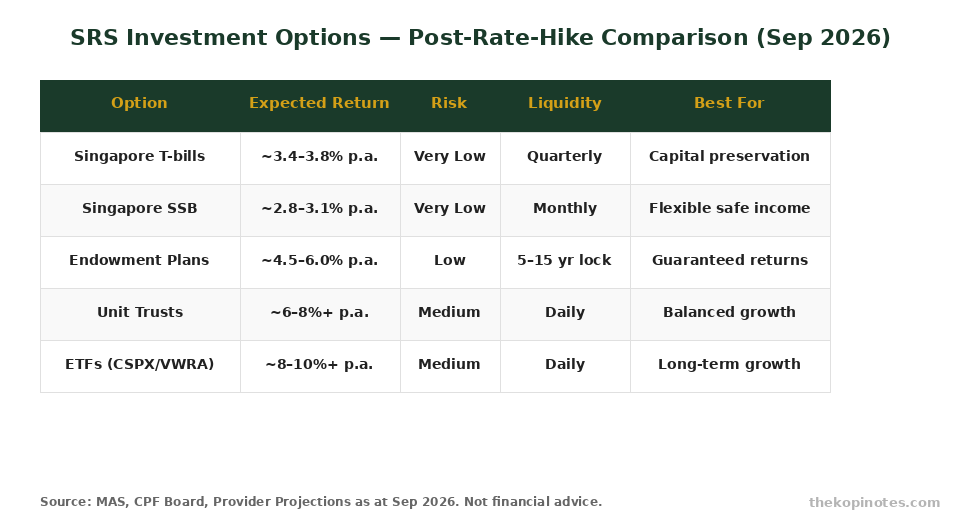
| Instrument | Indicative Yield (Q4 2026) | Tenure | Key Consideration |
|---|---|---|---|
| 6-Month T-Bill | ~3.9% p.a. | 6 months | Highest short-term yield; reinvest risk at maturity |
| 1-Year T-Bill | ~3.7% p.a. | 12 months | Locks in rate for 12 months |
| SSB Oct 2026 Tranche | ~3.3% avg 10-yr | Up to 10 years | Flexible redemption; capital guaranteed |
| Endowment Plan (short-term) | 3.3–3.8% p.a. | 2–5 years | New post-hike tranches repricing; guaranteed returns |
| Endowus Income Fund | ~4.5–5.5% p.a.* | Perpetual (open) | Higher yield, some credit/duration risk; not guaranteed |
| STI ETF (dividend yield) | ~4.5% dividend yield | Long-term equity | Capital upside + income; higher volatility |
*Fund distributions fluctuate; past distribution rates are not indicative of future rates. Source: MAS, MoneySense, fund factsheets as at Sep 2026.
Who Should Buy T-Bills in SRS?
T-bills are ideal for SRS investors within 3–5 years of retirement age 62 who want capital preservation at a meaningful yield. Post-hike, the 6-month T-bill at ~3.9% beats most savings accounts and is entirely risk-free (Singapore Government Securities). The main drawback is reinvestment risk — when the bill matures in six months, you must reinvest at whatever rate prevails then.
For SRS, you buy T-bills through your SRS bank operator (DBS/OCBC/UOB) or via brokers like FSMOne or MAS directly. Use the FSMOne referral code P0544985 for fee savings on your first few transactions. See our Singapore T-bill Guide for the full auction calendar and application process.
Who Should Use SSB?
Singapore Savings Bonds suit SRS holders who want flexibility. You can redeem SSB at any month-end without penalty, which is valuable if your circumstances change. The October 2026 tranche is expected at around 3.3% average 10-year yield — lower than T-bills but lockup-free. Apply through DBS/OCBC/UOB Internet Banking using your SRS funds.
Who Should Use Endowus?
Endowus excels for SRS holders with a 5–20 year runway. Its Income Portfolio targets 4.5–5.5% annualised distribution, spreading across investment-grade bonds, multi-asset funds, and dividend equities. For younger investors (below 55), the Core Equity 100% portfolio via Endowus captures long-term equity growth inside SRS with fees starting at 0.25% p.a. — significantly cheaper than bank unit trusts. Use referral code 2V343 to get started: Endowus Referral Code →
Endowus vs FSMOne: Which Platform for SRS?
Both platforms are MAS-licensed and SRS-approved. The right choice depends on what you are buying:
| Endowus | FSMOne | |
|---|---|---|
| Best for | Unit trusts, diversified portfolios | T-bills, bonds, ETFs, stocks |
| Advisory fee | 0.25–0.60% p.a. | 0% (self-directed) |
| T-bill access via SRS | No (use bank or FSMOne) | Yes — online application |
| Fund universe | Curated institutional funds | 1,000+ unit trusts + ETFs |
| Trailer fee rebate | 100% rebated | Partial rebate |
| Referral code | 2V343 | P0544985 |
Recommendation: Use FSMOne (FSMOne Referral Code →) for T-bills and bonds where you want zero advisory overhead. Use Endowus (Endowus Referral Code →) for managed portfolios like Income, Core Equity, or Factor. Many SRS holders use both: T-bills for the next 12 months of cash, Endowus for the 5–20 year horizon.
Year-End Top-Up Strategy
SRS contributions must be made by 31 December 2026 to count toward your 2026 tax assessment. Here is a simple decision tree for the rest of the year:
- Check your remaining cap. Log into your SRS bank’s internet banking to see how much you have contributed in 2026. The balance to reach S$15,300 (or S$35,700 for foreigners) is your top-up amount.
- Check the S$80,000 total relief cap. If you are already at S$80,000 from CPF cash top-up, NS relief, and course fees, additional SRS contributions still earn tax-free returns inside the account — you just will not get further income tax deductions.
- Contribute by mid-December. This gives your bank time to process the transfer before year-end. Do not wait until 30–31 December — processing delays are common.
- Invest immediately. SRS cash sitting uninvested earns near-zero interest. After transferring, log in to FSMOne or Endowus and deploy the cash into your chosen instrument within the same week.
For a more detailed analysis of how to build a retirement income stream using CPF and SRS together, see our CPF Investment Strategy Guide and our Retirement Planning Calculator.
Frequently Asked Questions
How much tax do I save by contributing to SRS in 2026?
Can I invest SRS funds in T-bills after the Fed rate hike?
What is the penalty for early SRS withdrawal?
Should I use Endowus or FSMOne for my SRS in Q4 2026?
Does the SRS contribution limit increase for 2026?
Can I use SRS money to buy Singapore Savings Bonds?
This article was researched with the help of AI. While we strive to keep all information accurate and up to date, there may be errors. If you notice any discrepancies, please contact us.