Best AI ETFs for Singapore Investors (2026 Guide)
Artificial intelligence ETFs, tax-efficient picks listed on the LSE, and how to buy them in Singapore.
AI ETFs for Singapore investors are best accessed through Ireland-domiciled, UCITS-compliant funds listed on the London Stock Exchange (LSE) — such as iShares IITU (S&P 500 IT sector) or Invesco EQQQ (Nasdaq 100). Buying LSE-listed ETFs instead of US-domiciled equivalents like QQQ cuts your dividend withholding tax from 30% to 15% and eliminates US estate tax exposure on holdings above USD 60,000. As at April 2026, several quality AI-tilted ETFs are available to Singapore retail investors via IBKR, Saxo, and MooMoo.
Not financial advice. All figures are for educational reference only. Data as at April 2026 unless noted.
What Is AI / Technology ETF Investing?
An AI or technology ETF is an exchange-traded fund that holds a basket of companies at the forefront of artificial intelligence, semiconductors, cloud computing, and related digital infrastructure. Rather than picking individual stocks like Nvidia, Microsoft, or TSMC, investors buy a single fund that spreads exposure across dozens or hundreds of such companies.
For Singapore investors, the key distinction is not just which ETF to buy — it is where that ETF is listed. The same underlying index (say, the Nasdaq 100 or S&P 500 Information Technology sector) can be accessed through a US-domiciled fund like QQQ or through an Ireland-domiciled UCITS ETF listed on the LSE such as Invesco EQQQ or iShares IITU. The structural difference has significant tax and legal implications for Singapore residents.
UCITS ETFs (Undertakings for Collective Investment in Transferable Securities) are regulated under EU/UK law, domiciled in Ireland, and benefit from the Ireland-USA double tax treaty. This treaty reduces US dividend withholding tax from 30% to 15% — a direct saving that compounds meaningfully over a long investment horizon. For those building a Singapore retirement calculator-backed portfolio, this difference matters.
Why AI ETFs Are Trending in 2026
The case for AI-tilted ETF investing has strengthened materially heading into 2026 for several reasons:
Earnings acceleration in mega-cap AI names: Microsoft, Alphabet, Meta, and Amazon all reported strong AI-related revenue growth through 2025, with AI-driven products — Copilot, Gemini, Meta AI, and AWS Bedrock — beginning to show meaningful monetisation. These names form the largest weights in S&P 500 and Nasdaq 100 ETFs.
Data centre infrastructure demand: AI model training and inference require enormous computing power. Capital expenditure on data centres by the US hyperscalers hit record levels in 2025, benefiting semiconductor names (Nvidia, TSMC, Broadcom) that are heavily represented in technology-sector ETFs. Singapore itself is a regional data centre hub, with MAS actively monitoring AI-related financial risk — see the MAS website for the latest guidance.
SGD depreciation hedge: Technology ETFs are USD-denominated. For Singapore investors holding SGD cash or CPF funds, a USD-denominated ETF provides natural currency diversification. Over the 10 years to 2025, the S&P 500 IT sector returned over 550% in USD terms, and even after SGD appreciation, the net SGD return remained strongly positive.
Interest rate tailwinds: As the US Federal Reserve shifted toward a more neutral rate stance in late 2025 and into 2026, growth/technology stocks re-rated upward. Lower discount rates benefit long-duration assets — exactly the profile of high-multiple AI companies.
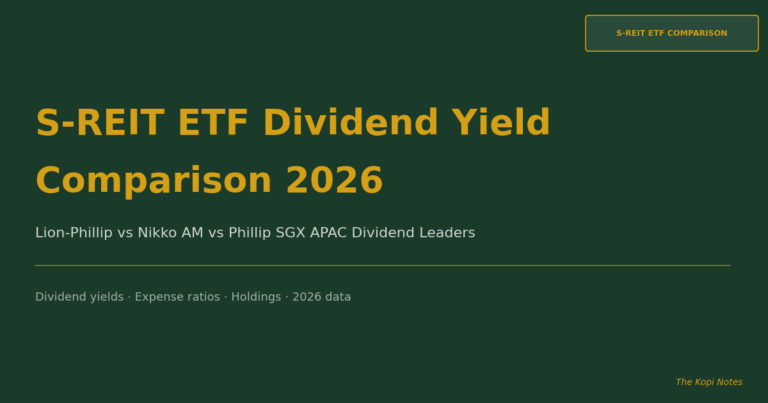
That said, concentration risk is real. The top 10 holdings in many AI ETFs can represent 40–60% of the total fund. Investors should size their AI/technology ETF allocation as part of a diversified portfolio — alongside broader market funds like CSPX or VWRA, and income-generating assets like the Singapore REIT ETF guide.
Best AI ETFs for Singapore Investors
The following ETFs are all available on the London Stock Exchange or Singapore Exchange and are accessible to Singapore retail investors. All are UCITS-compliant or SGX-listed. Data as at April 2026.
| ETF (Ticker) | Exchange | Index / Focus | TER | Structure | AUM |
|---|---|---|---|---|---|
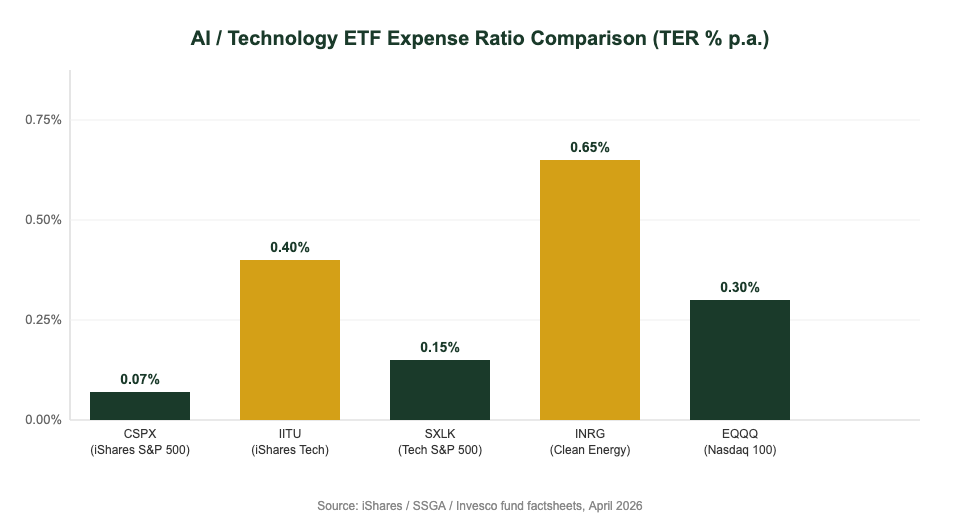
| iShares IITU | LSE | S&P 500 IT Sector | 0.15% | Accumulating | ~USD 3.5bn |
| Invesco EQQQ | LSE | Nasdaq 100 | 0.30% | Accumulating | ~USD 8bn |
| iShares CSPX | LSE | S&P 500 (30% AI/Tech) | 0.07% | Accumulating | ~USD 90bn |
| Invesco QDVE | LSE | S&P 500 Top 50 Tech | 0.20% | Accumulating | ~USD 1.5bn |
| iShares IQQQ | LSE | Nasdaq 100 (dist.) | 0.33% | Distributing | ~USD 5bn |
| Nikko AM-StraitsTrading Asia ex Japan Tech ETF | SGX | Asia ex-Japan Tech | 0.50% | Distributing | ~SGD 200m |
Source: iShares / Invesco / Nikko AM fund factsheets, April 2026. AUM rounded.
For most Singapore investors seeking AI/technology exposure with maximum tax efficiency, the recommended approach is: hold iShares CSPX as your core position (already ~30% technology at 0.07% TER), and optionally add Invesco EQQQ (Nasdaq 100) or iShares IITU (S&P 500 IT sector) as a satellite tilt. Avoid US-domiciled QQQ or QQQM directly — 30% WHT and US estate tax exposure make them less suitable for Singapore residents.
Looking for pure-play thematic exposure instead of a broad tech tilt? See our comparison of dedicated AI-powered robotics ETFs (RBOT, WTAI, AIAI and BOTZ), which hold concentrated baskets of AI and automation stocks rather than a diversified tech-sector index.
Tax Advantages of LSE-Listed AI ETFs for Singapore Investors
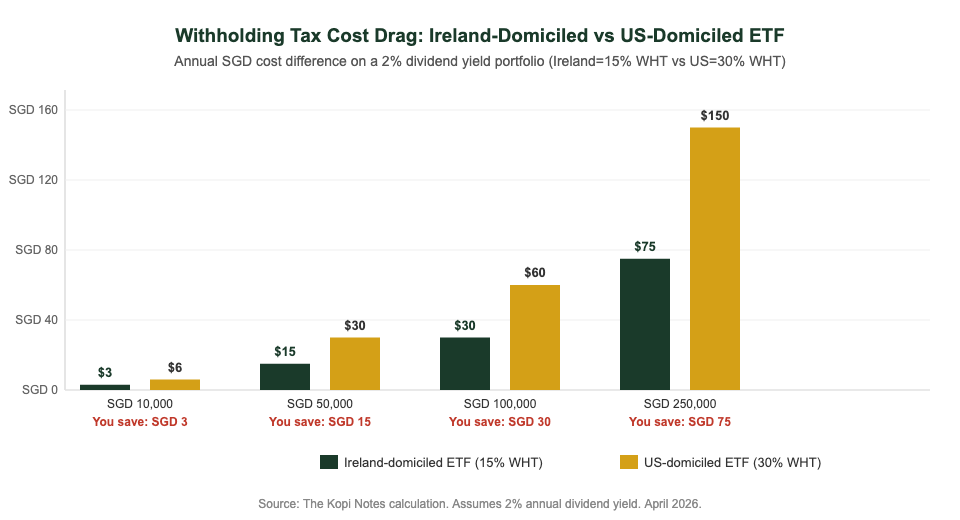
Singapore investors do not pay capital gains tax, and there is no dividend tax on distributions received from foreign funds. However, the ETF itself pays withholding tax on US-sourced dividends before those dividends are reinvested or distributed. Ireland-domiciled UCITS ETFs benefit from the Ireland-USA double tax treaty, capping US dividend withholding tax at 15%. A US-domiciled fund pays the full 30% rate. The table below shows the real SGD impact on a 2% annual dividend yield portfolio.
| Portfolio Size | Ireland ETF Cost (15% WHT) | US ETF Cost (30% WHT) | Annual SGD Saving |
|---|---|---|---|
| SGD 10,000 | SGD 3 | SGD 6 | SGD 3 |
| SGD 50,000 | SGD 15 | SGD 30 | SGD 15 |
| SGD 100,000 | SGD 30 | SGD 60 | SGD 30 |
| SGD 250,000 | SGD 75 | SGD 150 | SGD 75 |
Source: The Kopi Notes calculation. Assumes 2% annual dividend yield. April 2026.
Beyond withholding tax, there is a second major risk with US-domiciled ETFs: US estate tax. Non-US persons holding US-situs assets above USD 60,000 are subject to US federal estate tax on death, at rates up to 40%. Ireland-domiciled UCITS ETFs are not US-situs assets. For Singapore investors building long-term wealth, this is a material risk to avoid. Read more about passive income Singapore strategies.
How to Buy AI ETFs in Singapore (Step-by-Step)
Interactive Brokers (IBKR) — Best for cost-conscious investors. Commission is USD 1.70 per trade (fixed) or 0.05% of trade value, minimum USD 1.70 on LSE trades. No minimum deposit. Most cost-effective for portfolios above SGD 20,000.
Saxo Markets Singapore — Commission from 0.08% per trade, minimum SGD 8 for LSE trades. FX conversion fee applies. Singapore-licensed with local support.
MooMoo Singapore — Commission from SGD 1.99 per trade. Check the moomoo Singapore review for the latest fee schedule. Good for beginners.
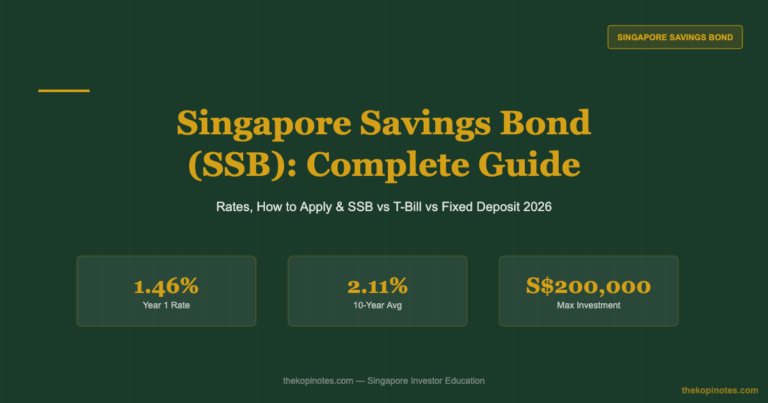
Syfe Brokerage — Syfe offers commission-free trading for US-listed ETFs and managed portfolio services. Use the Syfe referral code to get a cash bonus when you open a new account. Best for a managed, hands-off approach.
Step-by-step to buy EQQQ on IBKR: (1) Fund your IBKR account via FAST (SGD) or SWIFT (USD). (2) Search ticker EQQQ. (3) Select exchange LSE (London Stock Exchange). (4) Select currency USD. (5) Place a limit order at or near market price. (6) Confirm — settlement T+2.
Note: LSE-listed ETFs are not eligible for CPF investment. They may be SRS-compatible if your broker supports SRS accounts. See our CPF investment strategy Singapore guide for CPF-eligible alternatives.
Risks to Consider Before Buying AI ETFs
Concentration risk: The top 10 holdings in the Nasdaq 100 (Invesco EQQQ) represent approximately 50% of the fund. A significant drawdown in Nvidia, Apple, Microsoft, or Alphabet will disproportionately affect the fund. In 2022, the Nasdaq 100 fell over 32% peak-to-trough.
Valuation risk: AI-related stocks trade at elevated P/E multiples. As at Q1 2026, the Nasdaq 100 forward P/E was approximately 28–32x versus the S&P 500 at 21–23x. If AI monetisation disappoints, valuations could compress sharply.
Currency risk: These ETFs are USD-denominated. A strengthening SGD reduces returns when converted back.
Regulatory risk: AI regulation is evolving. The EU AI Act, potential US antitrust actions, and semiconductor export controls could impact fund holdings. See the MAS website for Singapore-specific guidance.
Sector cyclicality: Technology is cyclical. Pairing an AI ETF with income assets — S-REITs, Singapore Savings Bonds, or Singapore T-bills 2026 — provides portfolio balance.
Disclaimer: This article is for educational purposes only and does not constitute financial advice. Past performance is not indicative of future results. Always conduct your own research or consult a licensed financial adviser before investing.
Frequently Asked Questions
What is the best AI ETF for Singapore investors in 2026?
For most Singapore investors, the best AI ETF approach is a two-layer strategy: hold iShares CSPX as your core S&P 500 position (already ~30% technology/AI exposure at 0.07% TER), then add Invesco EQQQ (Nasdaq 100, 0.30% TER) or iShares IITU (S&P 500 IT sector, 0.15% TER) as a satellite tilt. All three are Ireland-domiciled UCITS ETFs listed on the LSE, giving you the 15% withholding tax rate and no US estate tax exposure. Avoid buying US-domiciled QQQ directly — 30% WHT and estate tax exposure make it less optimal for Singapore residents.
Can I buy AI ETFs like EQQQ or IITU using CPF or SRS funds?
LSE-listed ETFs such as EQQQ and IITU are not eligible for CPF investment — CPF-investable ETFs must be SGX-listed under the CPF Investment Scheme. However, they may be purchased using SRS funds if your broker supports SRS accounts — check directly with IBKR, Saxo, or MooMoo Singapore. For CPF-compatible technology exposure, consider SGX-listed ETFs such as the Nikko AM-StraitsTrading Asia ex Japan Technology ETF.
What is the difference between EQQQ and QQQ for Singapore investors?
Both EQQQ (Invesco, LSE) and QQQ (Invesco, Nasdaq) track the Nasdaq 100 index and hold the same underlying stocks. The key difference is domicile and tax treatment. EQQQ is Ireland-domiciled, paying only 15% US dividend withholding tax under the Ireland-USA tax treaty, versus 30% for QQQ. EQQQ is also not a US-situs asset, so Singapore investors are not exposed to US federal estate tax on holdings. EQQQ’s TER is 0.30% versus QQQ’s 0.20%, but the 15% WHT saving outweighs the TER difference for most investors.
Is CSPX considered an AI ETF?
Not specifically, but CSPX (iShares Core S&P 500 UCITS ETF) has significant AI and technology exposure by design. As at April 2026, the Information Technology sector comprises approximately 29–32% of the S&P 500 index weight, with Microsoft, Apple, Nvidia, Alphabet, and Meta among the top holdings. At just 0.07% TER, CSPX is often the most efficient way to gain broad AI exposure without taking on pure-tech concentration risk.
Which Singapore broker has the lowest fees for buying LSE ETFs?
For regular lump-sum investing, Interactive Brokers (IBKR) offers the lowest commissions for LSE-listed ETFs — USD 1.70 fixed or 0.05% of trade value. For portfolios above SGD 20,000 per trade, IBKR is highly cost-effective. MooMoo Singapore occasionally offers zero-commission promotions and is a good option for smaller trades. Saxo Markets charges from 0.08% with a SGD 8 minimum. For a hands-off approach, use the Syfe referral code for a sign-up bonus when opening a new Syfe account.
What are the main risks of AI ETF investing for Singapore investors?
AI and technology ETFs carry higher risk than broad diversified funds. Key risks include: concentration risk (top 10 holdings can be 40–55% of the fund), valuation risk (elevated P/E multiples), currency risk (USD denomination), regulatory risk (AI regulation and semiconductor export controls are evolving), and sector cyclicality (tech sold off 32% in 2022). Investors should have a time horizon of at least 5–10 years and balance their AI/tech allocation with defensive assets like S-REITs, T-bills, or Singapore Savings Bonds.
Ready to Start Investing in AI ETFs?
Open a brokerage account and buy your first ETF today. Use our referral links for exclusive sign-up bonuses.
This article was researched with the help of AI. While we strive to keep all information accurate and up to date, there may be errors. If you notice any discrepancies, please contact us.