TribeCar + Endowus + Trust Bank + FSMOne + IBKR: The Post-Hike Next-Dollar Decision Tree (2026)
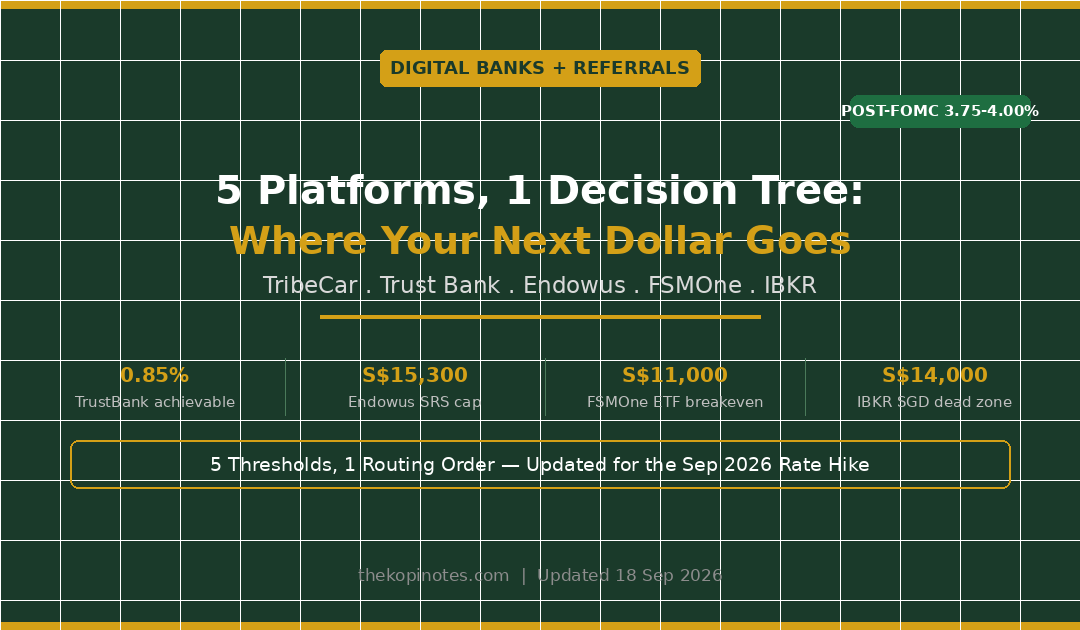
Skip car ownership with TribeCar and free up S$400–S$800 a month — but which of five platforms should get that money first? After the Fed’s 17 September 2026 hike to 3.75–4.00%, this guide combines Trust Bank, Endowus, FSMOne and IBKR into a single five-tier routing order, ranked not by advertised rate but by real thresholds: achievable interest, SRS relief caps, ETF fee breakevens, and currency dead zones.
Table of Contents
The Next-Dollar Mechanic: Why Order Matters
Most TribeCar-freed-cash guides pick one lens — certainty of return, or tax relief size, or fee efficiency — and rank platforms by that single dimension. That works until you actually have money to move every month and have to decide, dollar by dollar, where it goes next.
This guide answers a narrower, more practical question: “My next S$100 just freed up from skipping car ownership — which platform does it go to?” The answer changes depending on how much you’ve already routed, because each platform has a hard threshold — a cap, a fee breakeven, or a zero-interest dead zone — that changes the marginal value of the next dollar sent there.
The Fed’s 25bp hike to 3.75–4.00% on 17 September 2026 doesn’t change any of these thresholds — the SRS cap is still S$15,300, IBKR’s dead zones are still S$14,000 SGD / US$10,000 USD — but it does make the earlier tiers relatively more attractive, since achievable savings-account rates and SRS-linked cash yields tend to drift up first, while the value of parking uninvested cash falls further behind.
Tier 1: TribeCar Savings Into Trust Bank
Start by quantifying the TribeCar savings. A typical car owner in Singapore spends S$1,200–S$2,000 a month on loan instalments, insurance, parking, and petrol. Swapping to TribeCar’s pay-per-use model for occasional trips typically frees up S$400–S$800 a month — the pool this whole routing order works with. New users can apply referral code zZDeg for sign-up credit.
That freed cash should land first in Trust Bank’s Flex account — not for its 2.40% headline rate, which needs a S$20,000 TrustInvest portfolio or S$100,000 average daily balance to unlock, but for its achievable rate. Hitting just 3 of Trust Bank’s 8 “scoops” — salary GIRO credit, 5 card transactions of S$30+ each, and one PayNow transaction — gets you 0.85% p.a. (union member) or 0.75% p.a. (non-union) on your entire liquid balance, with zero lock-in. Use referral code HTWYQP95 for a welcome bonus.
This tier has no cap — it’s the buffer stage. Most savers stop adding here once they hold 3–6 months of expenses, then start routing new TribeCar savings to Tier 2.
Tier 2: Endowus SRS Relief Cap
Once your buffer is built, the next dollar should chase guaranteed tax relief rather than interest — no savings-account rate beats a marginal tax bracket saving. Route surplus TribeCar cash into an Endowus Supplementary Retirement Scheme (SRS) contribution, up to the S$15,300 annual cap (unchanged by the rate hike). Every dollar contributed reduces chargeable income at your marginal tax rate, which for most mid-career Singaporeans is worth more than any deposit rate available in Tier 1.
Endowus also runs Cash Smart tiers for any SRS balance not yet invested, and those yields are one of the products most likely to drift upward as SORA responds to the Fed hike over the coming weeks. Use referral code 2V343 for Endowus fee credits.
Stop adding here once you’ve hit the S$15,300 cap for the year — contributing beyond it earns no further relief, so overflow should move to Tier 3.
Tier 3: FSMOne SRS ETF Fee Breakeven
Once the SRS cap is filled via cash, invest that SRS balance through FSMOne, which charges 0% sales charge on unit trusts and a flat 0.08% ETF fee with an S$8.80 minimum per trade. The minimum fee means small trades pay a disproportionately high effective rate — the breakeven where the percentage fee overtakes the flat minimum sits at roughly S$11,000 per trade (S$8.80 ÷ 0.08% ≈ S$11,000).
Practically: let cash accumulate in Tier 1 (Trust Bank) or the SRS cash sleeve until a single ETF trade clears that S$11,000 threshold, then execute the trade through FSMOne rather than trading in smaller increments that eat disproportionately into returns via the minimum fee. Use referral code P0544985 to open an FSMOne account.
There is no hard cap here — FSMOne can absorb as much SRS-linked ETF investing as you want — but once your SRS allocation strategy is fully deployed for the year, new overflow should move to Tier 4.
Tier 4: IBKR Cash Dead Zone
This is the tier most savers get wrong. Interactive Brokers pays 0% interest on SGD cash below S$14,000 and 0% on USD cash below US$10,000 — a “dead zone” where parked cash earns nothing at all, unlike Trust Bank or Endowus Cash Smart. Use referral code jianxiong368 when opening an IBKR account.
The rule: never let TribeCar-freed cash sit idle inside IBKR below those thresholds. If you’re building toward a global equities allocation, accumulate the cash in Tier 1 first, then transfer to IBKR in a single batch that clears the S$14,000 or US$10,000 line — not gradually, which risks weeks or months of zero-yield idle cash inside the brokerage.
Tier 5: IBKR Global Equities Overflow
Once cash has cleared the dead-zone threshold, it converts into IBKR’s real purpose in this system: uncapped global equities exposure via low-cost ETFs like VWRA or CSPX. There is no relief cap, no fee-breakeven minimum, and no rate ceiling here — it is simply the final destination for surplus TribeCar cash once the first four tiers are satisfied for the period.
Because this tier carries full market risk (unlike the guaranteed or near-guaranteed earlier tiers), it should only receive money you won’t need at short notice — consistent with its position as the last stop in the routing order, not the first.
The Full 5-Tier Table
Here is the complete post-hike routing order for TribeCar-freed cash across all five platforms.
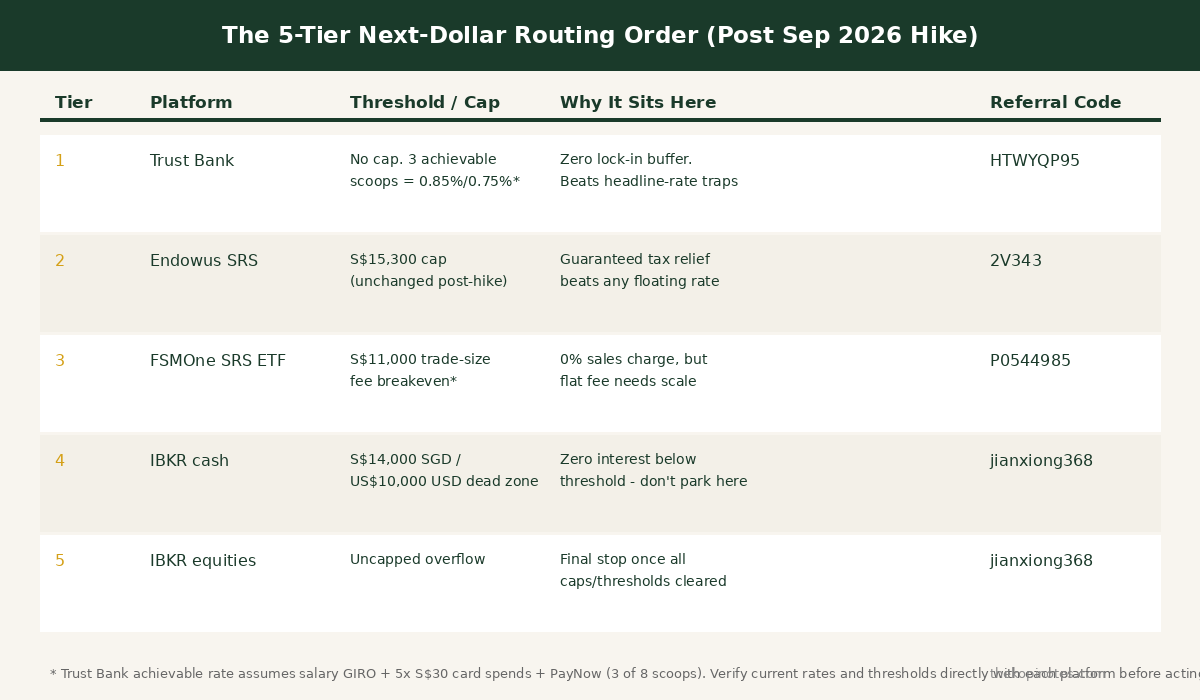
Figures verified across FSMOne, Trust Bank, Endowus and Interactive Brokers official rate pages this month. Rates, caps and thresholds change — always verify current figures directly with each platform before acting. Not financial advice.
Frequently Asked Questions
Why route by threshold order instead of just picking the highest rate?
Does the September 2026 Fed rate hike change any of these thresholds?
How much does TribeCar actually save compared to owning a car?
What happens once I've maxed out all 5 tiers for the year?
Is Trust Bank's 0.85% achievable rate guaranteed, or does it depend on spending behaviour?
Why does IBKR pay zero interest below S$14,000 SGD or US$10,000 USD?
Do I need all 5 platforms to benefit from this strategy, or can I use a subset?
Start Your 5-Tier Routing System
Sign up across all five platforms to put this post-hike decision tree to work.
- TribeCar referral code zZDeg — skip car ownership, free up the monthly savings pool
- Trust Bank referral code HTWYQP95 — Tier 1 buffer, achievable 0.85% p.a.
- Endowus referral code 2V343 — Tier 2 SRS relief cap
- FSMOne referral code P0544985 — Tier 3 SRS ETF investing, 0% sales charge
- IBKR referral jianxiong368 — Tier 4/5 cash-to-equities overflow
This article is for informational purposes only and does not constitute financial advice. All rates, caps and fee thresholds change frequently — verify current figures directly with each provider before making any decision. The Kopi Notes may receive referral compensation for some links above.
This article was researched with the help of AI. While we strive to keep all information accurate and up to date, there may be errors. If you notice any discrepancies, please contact us.