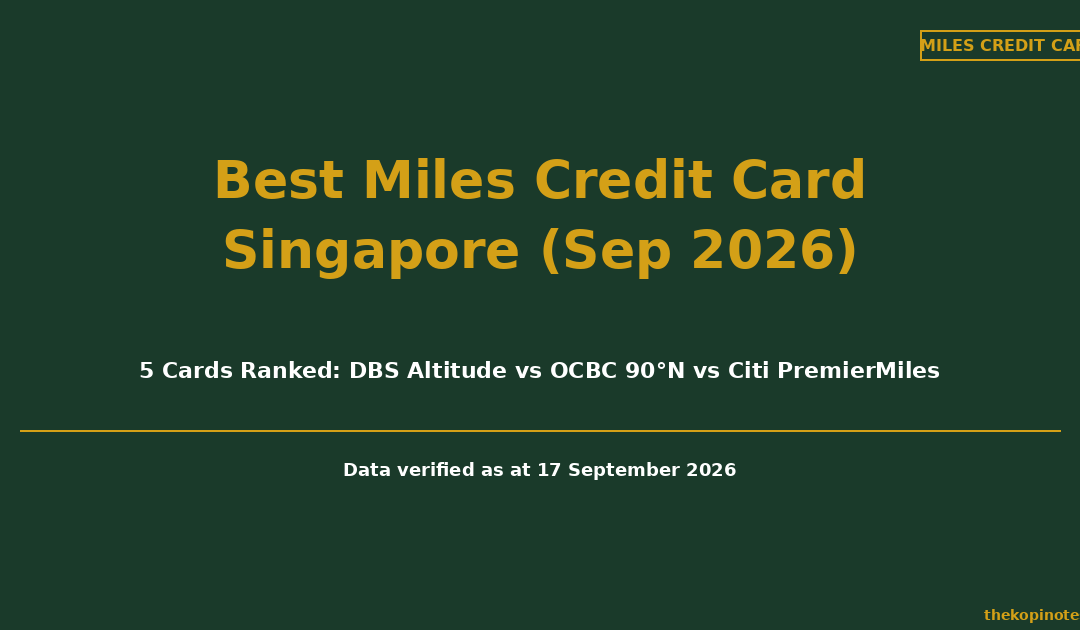
Best Miles Credit Card Singapore (September 2026): Top 4 Ranked
DBS Altitude vs OCBC 90°N vs Citi PremierMiles vs UOB PRVI Miles — compared on earn rates, fees & KrisFlyer perks
The best miles credit card in Singapore for most people is the OCBC 90°N Card — it earns 1.3 miles per dollar (mpd) locally and 2.1 mpd overseas, transfers to KrisFlyer for free, and requires a mere S$25,000 annual spend for a fee waiver. If you spend heavily overseas or value lounge access, the DBS Altitude or Citi PremierMiles also merit serious consideration.
Not financial advice. All figures are for educational reference only. Card terms subject to change — always verify with the issuing bank. Data verified as at 17 September 2026.
- Best overall: OCBC 90°N — free KrisFlyer transfer, solid earn rate, lowest waiver threshold
- Best for overseas spend: UOB PRVI Miles — 2.4 mpd overseas is the highest on this list
- Best for frequent flyers: Citi PremierMiles — 15,000 renewal miles covers the annual fee cost
- All four cards have no miles expiry, making them suitable for long-term mile accumulation
What Makes a Great Miles Card?
Before diving into rankings, here’s what you should actually care about when picking a miles card in Singapore:
Miles per dollar (mpd). The earn rate on local and overseas spend is the core metric. Higher mpd = more miles for the same spend. Most cards give a “base” rate for general spending, with bonuses for specific categories like travel bookings.
Transfer fees to KrisFlyer. You can’t fly on raw points — you convert them to airline miles (usually Singapore Airlines KrisFlyer). Some cards charge S$25–S$27 per conversion request. OCBC 90°N transfers for free, which matters if you convert frequently in small batches.
Annual fee and waiver. All four cards charge around S$196–S$262 per year. Whether you can get that waived — and at what spend threshold — varies significantly. DBS removed its automatic waiver from August 2026.
Miles expiry. None of these four cards expire your miles, which is a big deal. You can take years to accumulate enough for a business class redemption without rushing.
Lounge access. Three of the four cards offer 2 free airport lounge visits per year via Priority Pass or DragonPass — a useful perk if you travel a few times annually.
Top 4 Miles Cards: Quick Comparison (September 2026)
| Card | Local (mpd) | Overseas (mpd) | Annual Fee | KrisFlyer Fee |
|---|---|---|---|---|
| DBS Altitude Visa | 1.3 | 2.2 | S$196.20 | S$27.25 |
| OCBC 90°N | 1.3 | 2.1 | S$196.20 | FREE |
| Citi PremierMiles | 1.2 | 2.2 | S$196.20 | S$25.00 |
| UOB PRVI Miles | 1.4 | 2.4 | S$261.60 | Varies |
Source: Bank official websites, SingSaver — September 2026. UOB PRVI Miles Visa/Mastercard variants; DBS Altitude automatic fee waiver removed August 2026.
DBS Altitude Visa Signature
The DBS Altitude Visa Signature is a solid all-rounder. You earn 1.3 miles per dollar on local spend and 2.2 mpd overseas, which puts it at the top tier for overseas earners alongside Citi PremierMiles.
The biggest change in 2026: DBS removed the automatic annual fee waiver from August 2026. You now need to spend S$25,000 per year to get the S$196.20 fee waived, or you can pay it and receive 10,000 renewal miles (worth roughly S$100–S$150 at typical redemption values).
KrisFlyer conversion: DBS Points transfer to KrisFlyer at 2 points = 1 mile, with a flat S$27.25 fee per conversion request. If you’re converting in large one-off batches (e.g. 80,000 miles for a business class flight), this fee is negligible. If you convert small amounts frequently, it adds up.
Lounge access: 2 complimentary lounge visits per year, which is standard for this tier.
Best for: Spenders who hit S$25,000/year naturally (the waiver threshold) and want competitive overseas earn rates without paying the premium of the UOB PRVI Miles card.
OCBC 90°N Card
The OCBC 90°N Card is the easiest to recommend for most Singaporeans. The overseas earn rate of 2.1 mpd is slightly lower than DBS Altitude and Citi PremierMiles — but what sets it apart is the free KrisFlyer transfer at a 1:1 ratio. No conversion fees, ever.
Annual fee: S$196.20, with a waiver if you spend S$25,000 per year. That’s the same fee but a more achievable waiver threshold than Citi PremierMiles (which requires S$50,000).
Renewal bonus: Pay the annual fee and you receive 10,000 miles, which partially offsets the cost.
Lounge access: 2 complimentary visits per year via DragonPass.
Best for: Most people. The free KrisFlyer conversion, combined with a reasonable earn rate and waiver threshold, makes this the default recommendation for Singapore flyers who aren’t spending S$4,000+ per month overseas.
If you’re using GXS Bank or MariBank for savings, a miles card like OCBC 90°N pairs well — earn daily interest on your salary with your digital bank account, and put all discretionary spend on a miles card to accumulate travel rewards. Read our Maribank interest rate 2026 guide for the savings side of the equation.
Citi PremierMiles Visa
Citi PremierMiles is the longest-running miles card in Singapore’s market and still holds its ground in 2026. The local earn rate of 1.2 mpd is the lowest in this comparison, but the 2.2 mpd overseas rate matches DBS Altitude. The real differentiator is the 15,000 renewal miles when you pay the annual fee — the most generous renewal bonus in this group.
At a conservative valuation of 1.5 cents per mile, 15,000 miles = S$225 in value — more than covering the S$196.20 annual fee. This makes Citi PremierMiles genuinely worth paying for, unlike cards where the renewal bonus barely covers the fee.
Lounge access: 2 free visits per year via DragonPass — standard for this tier.
KrisFlyer conversion: S$25 per transfer, slightly cheaper than DBS Altitude’s S$27.25. Citi Miles never expire.
Fee waiver: S$50,000 annual spend — achievable only for high spenders.
Best for: Frequent flyers who plan to pay the annual fee anyway (the 15,000 renewal miles make it worthwhile) and spenders who focus on overseas transactions.
UOB PRVI Miles Card
UOB PRVI Miles offers the highest earn rate in this comparison: 1.4 mpd locally and a standout 2.4 mpd overseas. If you travel frequently and put your overseas spend on a card, the maths works strongly in PRVI Miles’ favour.
There’s a trade-off: the annual fee is S$261.60 — S$65 more than the other three cards. Only the American Express variant offers a spend-based waiver (S$50,000). The Visa and Mastercard variants have first-year waiver only; after that, you pay.
UOB PRVI Miles also earns bonus rates on specific booking platforms: 6 mpd on Expedia and Agoda, and 3 mpd in Malaysia, Indonesia, Thailand, and Vietnam. If you book travel frequently through these channels, the earning potential is significantly higher.
Best for: Heavy travellers and overseas spenders who can justify the higher annual fee through accumulated miles value. If you’re putting S$3,000+ per month on overseas spend, the extra 0.3 mpd vs OCBC 90°N adds up to hundreds of additional miles per year.
For Singapore investors managing their cash across multiple platforms, see our GXS Bank review and MariBank Singapore guide to set up an efficient savings stack alongside your miles card.
Miles Earn Rate Chart
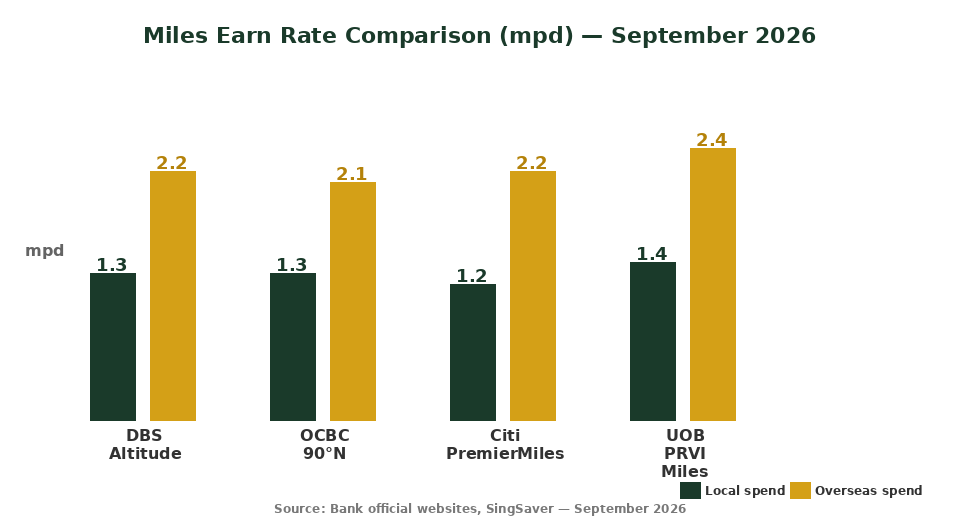
Source: Bank official websites, SingSaver — September 2026. Dark green bars = local spend; gold bars = overseas spend.
Annual Fee, Lounge Access & Benefits Comparison
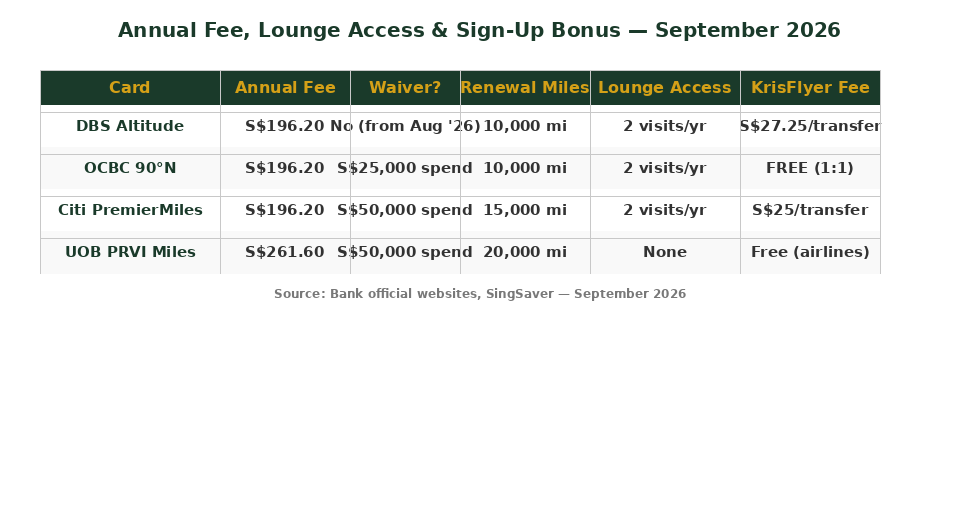
Source: Bank official websites, SingSaver — September 2026. Fees inclusive of 9% GST.
How to Choose the Right Miles Card for You
Here’s a simple decision framework based on your spending pattern:
| Your Situation | Recommended Card |
|---|---|
| Most people: moderate local + some overseas spend | OCBC 90°N (free KrisFlyer transfer) |
| Heavy overseas spender, travel >4x/year | UOB PRVI Miles (2.4 mpd overseas) |
| Want to pay annual fee for renewal miles payout | Citi PremierMiles (15,000 renewal miles) |
| DBS banking customer who spends S$25k/year | DBS Altitude (fee waiver at S$25k) |
Source: The Kopi Notes analysis, September 2026.
One practical tip: pair your miles card with a high-yield digital savings account. Credit your salary to Trust Bank or GXS Bank for the interest bonuses, then route all your daily spending through your miles card to accumulate points. The two strategies don’t conflict — they complement each other.
For investors building a broader financial stack, our best savings account Singapore guide covers the full picture of where to park your cash while your miles accumulate.
Our Verdict: OCBC 90°N for Most, UOB PRVI for Heavy Travellers
If you want one miles card that works well for the average Singaporean, choose the OCBC 90°N Card. Free KrisFlyer transfers, a solid 1.3/2.1 mpd earn rate, and a realistic S$25,000 waiver threshold make it the most frictionless option.
If you travel extensively — say, 5+ trips per year with meaningful overseas spend — the UOB PRVI Miles‘ 2.4 mpd overseas rate and 6 mpd on Expedia/Agoda justify the higher S$261.60 annual fee.
Frequent flyers who are going to pay the annual fee regardless should look at Citi PremierMiles — the 15,000 renewal miles more than cover the fee cost at standard mile valuations.
Frequently Asked Questions
What is the best miles credit card in Singapore in 2026?
How many miles per dollar does DBS Altitude earn?
Is the OCBC 90°N card worth it?
Does Citi PremierMiles miles ever expire?
Which miles card has the best overseas earn rate in Singapore?
What are miles credit cards good for in Singapore?
This article is for informational purposes only and does not constitute financial advice. Card terms, earn rates, and fees are subject to change — always verify with the issuing bank before applying. Data verified as at 17 September 2026.
This article was researched with the help of AI. While we strive to keep all information accurate and up to date, there may be errors. If you notice any discrepancies, please contact us.