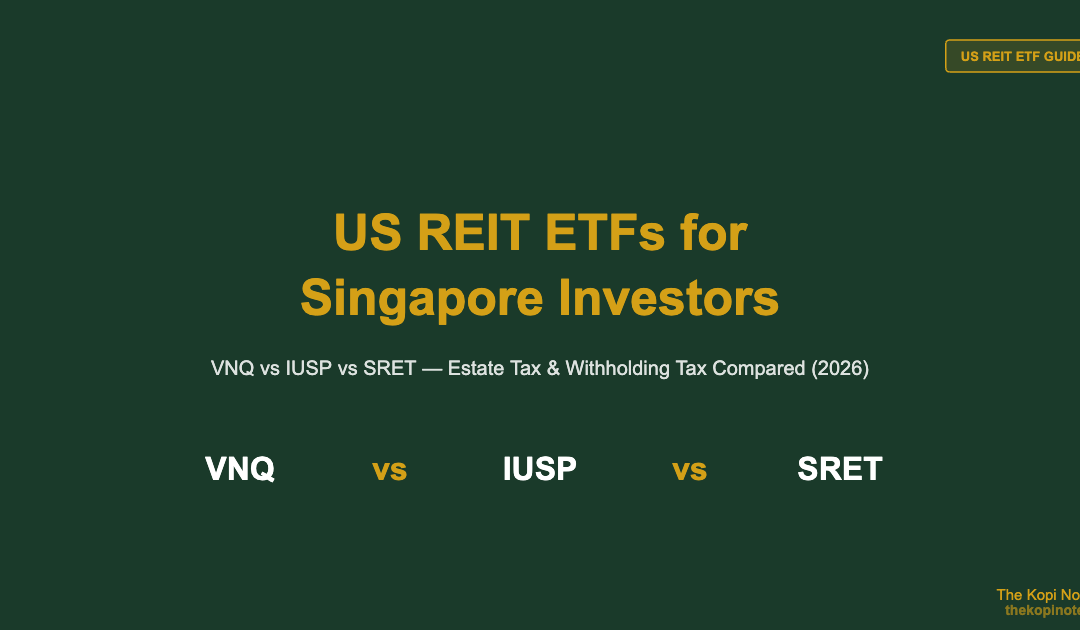
US REIT ETFs for Singapore Investors: VNQ vs IUSP vs SRET (2026 Guide)
A plain-English comparison of the three most accessible ways to add US real estate to your portfolio — and why the “cheapest” ETF on paper is not always the cheapest after tax.
VNQ and SRET are US-listed REIT ETFs with low headline fees, but as a Singapore investor you pay 30% withholding tax on their dividends and face US estate tax exposure above USD 60,000. IUSP, an Ireland-domiciled UCITS ETF on the London Stock Exchange, charges a higher 0.40% TER but cuts withholding tax to 15% and removes estate tax risk entirely.
Not financial advice. All figures are for educational reference only. Data verified as at 12 September 2026 unless otherwise noted.
- VNQ (0.13% TER) is the cheapest on paper, but its 30% dividend withholding tax and US estate tax exposure quietly eat into your returns.
- IUSP (0.40% TER, Ireland-domiciled, LSE-listed) trades a higher fee for a lower 15% withholding tax and zero US estate tax exposure — often the better net result for long-term holders.
- SRET is a high-yield (8.9% SEC yield) satellite play, not a core holding — it carries the same US tax exposure as VNQ plus higher concentration risk.
Table of Contents
Contents — Click to expand
What Are US REIT ETFs?
A US REIT ETF holds a basket of Real Estate Investment Trusts (REITs) — companies that own income-producing property like malls, hospitals, data centres and apartments, and are required to pay out most of their taxable income as dividends. Buying a REIT ETF gives you diversified US property exposure without picking individual landlords.
For Singapore investors, US real estate is a genuine diversifier away from S-REITs. You already know the S-REIT playbook from our Singapore REIT ETF guide — US REIT ETFs extend that same income idea into a much larger, more liquid market. But how you access that market matters more than most investors realise, because of two US tax rules that only affect non-US persons.
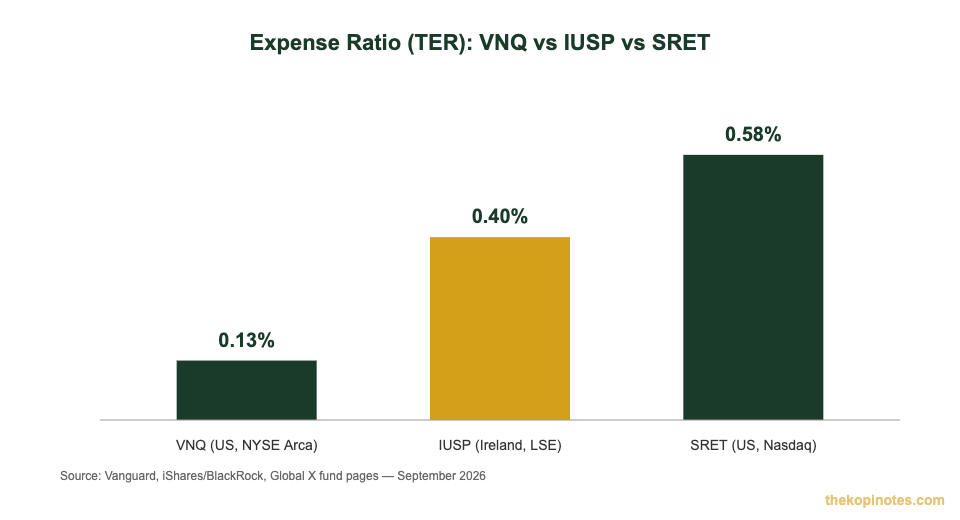
Three ETFs cover most of what a Singapore investor needs: Vanguard’s VNQ (broad, low-cost, US-listed), iShares’ IUSP (Ireland-domiciled, LSE-listed, income-tilted), and Global X’s SRET (high-yield, US-listed). Here’s how you they actually stack up once tax is factored in.
VNQ vs IUSP vs SRET: Key Facts at a Glance
| Feature | VNQ | IUSP | SRET |
|---|---|---|---|
| Full Name | Vanguard Real Estate ETF | iShares US Property Yield UCITS ETF | Global X SuperDividend REIT ETF |
| Exchange | NYSE Arca (US) | London Stock Exchange | Nasdaq (US) |
| Domicile | USA | Ireland | USA |
| TER (Expense Ratio) | 0.13% p.a. | 0.40% p.a. | 0.58% p.a. |
| AUM | USD 38.1 billion | USD 637 million | USD 223 million |
| Holdings | ~160 | 85 | 28 |
| Trailing Yield | ~3.5% | 3.09% (12-month trailing) | 8.89% (30-day SEC yield) |
| Distribution | Quarterly | Quarterly | Monthly |
| Structure | Broad US real estate index | High-yield US real estate tilt | 30 highest-yielding global REITs |
Source: Vanguard fund page, iShares/BlackRock fund page, Global X fund page — data as at 11-12 September 2026.
Why Domicile Matters: Withholding Tax and US Estate Tax
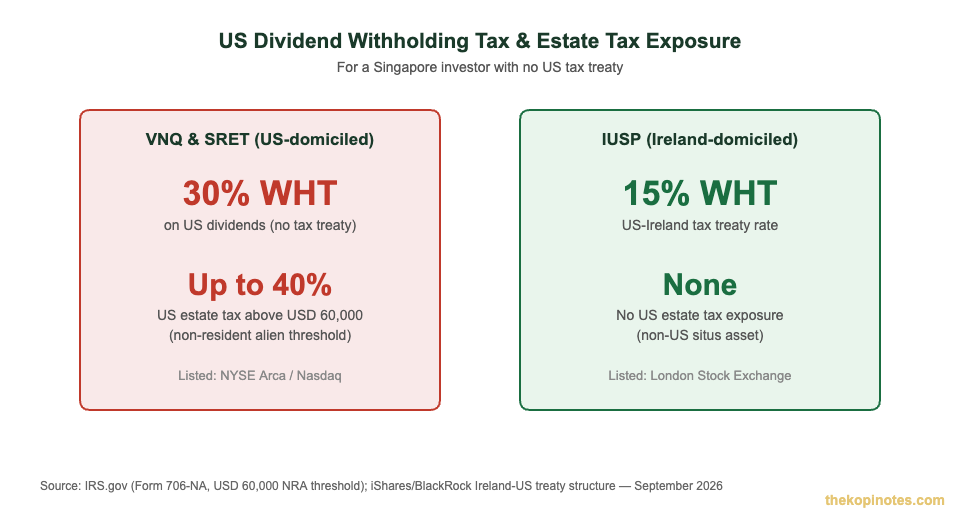
This is the part most comparison articles skip, and it is the whole reason IUSP exists. Singapore has no comprehensive tax treaty with the US covering individual investment income. That means dividends from US-domiciled ETFs like VNQ and SRET are taxed at the default non-treaty rate.
For example, if your VNQ holding pays out SGD 2,000 in dividends this year, USD 600 worth is withheld by the IRS before it ever reaches your brokerage account. You cannot claim this back — Singapore does not have a tax treaty that reduces it.
IUSP sidesteps this. It is domiciled in Ireland, which has a tax treaty with the US that caps withholding tax on US-source dividends flowing into the fund at 15%. Ireland then passes on distributions to you without a further layer of Irish tax, since Singapore also does not tax most foreign dividend income received by individuals. However, the fund manager still needs to run more complex custody arrangements to secure the reduced 15% rate — which shows up in a higher TER of 0.40% versus VNQ’s 0.13%.
The Second Problem: US Estate Tax
The more serious issue for larger portfolios is US estate tax. If you are not a US citizen or resident and you own US-situated assets — including US-listed ETFs like VNQ and SRET — above USD 60,000 in value at your death, your estate may owe US federal estate tax on the excess, at rates of up to 40%.
| ETF Type | Domicile | US Dividend WHT | US Estate Tax Risk |
|---|---|---|---|
| VNQ / SRET (NYSE/Nasdaq) | USA | 30% | Yes, above USD 60,000 |
| IUSP (LSE) | Ireland | 15% | None |
Source: IRS.gov, “Frequently asked questions on estate taxes for nonresidents not citizens of the United States” (page last reviewed 23 July 2026). A US citizen’s estate, by contrast, is sheltered up to USD 15 million — this USD 60,000 threshold applies only to non-resident non-citizens.
USD 60,000 is not indexed to inflation and has stayed fixed for decades. That means a Singapore investor who builds a meaningful VNQ position over 10-15 years can cross that threshold without realising it. This is the same estate tax trap covered in our US Estate Tax guide for Singapore investors — worth reading in full if you already hold any US-listed shares or ETFs.
Total Cost of Ownership: TER, Yield and the Tax Drag
Here’s a worked example. Say you invest SGD 50,000 and each ETF distributes its trailing yield in full over a year.
On VNQ, at roughly 3.5% yield, you would earn about SGD 1,750 in dividends before tax. At 30% withholding, you lose around SGD 525 to the IRS, leaving SGD 1,225 net — on top of a very low SGD 65 annual TER charge.
On IUSP, at 3.09% yield, you would earn about SGD 1,545 in dividends. At 15% withholding, you lose around SGD 232, leaving SGD 1,313 net — despite IUSP’s TER being roughly SGD 200 a year, more than triple VNQ’s.
In other words, the extra 0.27 percentage points of TER on IUSP is more than offset by halving your withholding tax rate. For a long-term holder reinvesting distributions, that gap compounds every year. It becomes even more decisive once the estate tax risk is added, since that is a one-time but potentially much larger cost that only US-domiciled ETFs carry.
SRET is a different animal. Its 8.89% SEC yield sounds attractive, but it carries the same 30% withholding tax and estate tax exposure as VNQ, plus a much higher 0.58% TER and concentration in just 28 small, high-yield REITs — several of which pay dividends partly as return of capital rather than pure income.
How to Buy VNQ, IUSP or SRET in Singapore
All three ETFs are accessible to Singapore-based investors, but through different exchanges.
For VNQ and SRET (US-listed): Open an account with a broker that offers US market access — Interactive Brokers, Saxo Markets, Tiger Brokers, or moomoo Singapore. Fund your account, search the ticker, and place your order during US market hours (9:30pm-4am SGT). You will need to submit a US tax form (W-8BEN) through your broker, which your broker typically handles during onboarding.
For IUSP (LSE-listed): Use a broker with UK/European market access, such as Interactive Brokers, Saxo, or FSMOne. Search “IUSP” and select the London Stock Exchange listing, quoted in GBP or USD depending on the share class. Place your order during UK market hours (3pm-11:30pm SGT, adjusting for daylight saving).
If you are new to LSE-listed ETFs generally, our guide to why Singapore investors buy ETFs on the LSE walks through the mechanics in more detail — the same principles that make CSPX and VWRA popular apply here.
Who Should Buy Which?
IUSP is ideal if you want US real estate exposure as a long-term core holding, you plan to build a position beyond a few tens of thousands of dollars over time, or you already hold other LSE-listed UCITS ETFs like CSPX or VWRA and want tax-structure consistency across your portfolio.
VNQ is worth considering if your total US-situated asset exposure (across all US stocks and ETFs) is comfortably below the USD 60,000 estate tax threshold and will likely stay there, and you value VNQ’s lower TER and deep liquidity for a smaller, tactical allocation.
SRET should be a small satellite position at most — its high yield comes with US tax exposure, higher fees, and concentration risk in a narrow slice of small-cap, high-yield REITs. It is not a substitute for a core real estate allocation.
None of these ETFs are CPF-OA investable, since CPFIS only covers a specific list of SGX-listed and locally-approved funds — see our CPF investment strategy guide for what is CPF-eligible. All three are SRS-compatible if bought through a broker that accepts SRS funds for the relevant exchange.
Risks to Consider
US REITs are sensitive to interest rate expectations — when rates rise, REIT valuations tend to fall, and vice versa. All three ETFs will move with US property market cycles and are concentrated in a single country, which is the trade-off for higher income versus a globally diversified equity ETF like VWRA. SRET carries additional single-stock concentration risk given its 28-holding portfolio, and part of its distribution may be classified as return of capital rather than pure income — check the fund’s 19a notices before assuming the full yield is sustainable.
Frequently Asked Questions
What is the best US REIT ETF for Singapore investors?
For most long-term investors, IUSP is the more tax-efficient choice despite its higher 0.40% TER, because its 15% withholding tax and zero US estate tax exposure typically outweigh VNQ’s lower fee once you factor in the full tax picture. VNQ can still make sense for smaller, tactical allocations that stay well under the USD 60,000 estate tax threshold.
Is VNQ subject to US estate tax for Singapore investors?
Yes. VNQ is a US-domiciled, US-listed ETF, which makes it a US-situs asset. If your total US-situated assets exceed USD 60,000 at the time of death and you are not a US citizen or resident, your estate may owe US federal estate tax at rates of up to 40% on the excess.
Why does IUSP have a higher expense ratio than VNQ?
IUSP’s Ireland domicile requires additional fund structuring to access the reduced 15% US dividend withholding tax rate under the US-Ireland tax treaty, rather than the 30% default rate. That extra structuring and custody complexity is reflected in a higher TER of 0.40% versus VNQ’s 0.13%.
Can I buy IUSP or VNQ using my CPF or SRS funds?
None of VNQ, IUSP, or SRET are on the CPFIS-approved investment list, so you cannot use CPF Ordinary Account funds to buy them. All three can typically be purchased with SRS funds through a broker that supports SRS trading on the relevant exchange (US markets for VNQ/SRET, LSE for IUSP) — check with your broker first.
Is SRET a good ETF for passive income?
SRET’s 8.89% SEC yield is high, but it comes from a concentrated basket of just 28 small, high-yield global REITs, some of which pay part of their distribution as return of capital rather than pure income. It also carries the same 30% US withholding tax and estate tax exposure as VNQ. Treat it as a small satellite income holding, not a core real estate allocation.
Which broker should I use to buy US REIT ETFs in Singapore?
For VNQ and SRET, Interactive Brokers, Saxo Markets, Tiger Brokers, and moomoo Singapore all offer US market access at competitive commission rates. For IUSP on the London Stock Exchange, Interactive Brokers, Saxo, and FSMOne are commonly used by Singapore investors who already buy LSE-listed ETFs like CSPX or VWRA.
Ready to Diversify Into US Real Estate?
Open a brokerage account with LSE or US market access and compare these ETFs against your existing S-REIT holdings.
This article was researched with the help of AI. While we strive to keep all information accurate and up to date, there may be errors. If you notice any discrepancies, please contact us.