ESG & Sustainable ETFs for Singapore Investors: SUSW vs V3AB vs XZW0 (2026 Guide)
What ESG ETFs actually cost, what they actually exclude, and whether the tradeoff is worth it for your portfolio.
ESG ETFs are Ireland-domiciled UCITS funds that screen out companies on environmental, social and governance grounds while still tracking a broad global index. For Singapore investors, the three main options on the London Stock Exchange are SUSW (iShares MSCI World SRI), V3AB (Vanguard ESG Global All Cap) and XZW0 (Xtrackers MSCI World ESG). They cost 0.06 to 0.17 percentage points more per year than VWRA, and 2025 saw global sustainable funds post their first-ever full year of net outflows.
Not financial advice. All figures are for educational reference only. Data verified as at September 2026 unless noted.
- ESG ETFs cost more than VWRA or CSPX — the premium ranges from 0.06% to 0.17% a year depending on the fund.
- 2025 was the first full year global sustainable funds saw net outflows, not inflows — the category has cooled, not grown.
- If you want ESG screening, SUSW and XZW0 are the cheaper, larger, more liquid options. If you just want low cost, stick with VWRA.
Table of Contents
Contents — Click to expand
- What Is an ESG ETF, Exactly?
- Why ESG ETFs Are Cooling Off in 2026
- The Three ESG ETFs Singapore Investors Can Actually Buy
- Cost Comparison: ESG vs VWRA and CSPX
- Tax Treatment for Singapore Investors
- How to Buy SUSW, V3AB or XZW0 in Singapore
- Who Should Actually Buy an ESG ETF?
- Frequently Asked Questions
What Is an ESG ETF, Exactly?
An ESG ETF tracks a modified version of a standard index. The modification is a screen. Companies that fail on environmental, social or governance criteria get excluded or down-weighted.
Environmental, Social and Governance (ESG) — this just means how a company treats the planet, its people and its own management. First mention, plain English, done. After this you’ll see it written as ESG for the rest of the article.
The three funds in this guide all track a “SRI” or “ESG” variant of the MSCI World or FTSE Global All Cap index. That means you still get thousands of global stocks. You just don’t get tobacco, weapons manufacturers, thermal coal miners, or companies with the worst-rated labour and governance practices.
This is different from a thematic fund like a clean energy ETF or a green bond fund. An ESG index fund like SUSW or V3AB still holds Microsoft, Apple and Nvidia. It simply excludes the worst offenders from an otherwise standard global portfolio.
Why ESG ETFs Are Cooling Off in 2026
Here’s the honest context most SG finance content skips. According to Morningstar, global sustainable funds recorded USD 84 billion in net outflows in 2025 — the first full year of net redemptions since Morningstar began tracking the category in 2018.
US investors alone pulled money out for a 13th straight quarter, with USD 4.6 billion in net redemptions in Q4 2025 (Morningstar Global Sustainable Fund Flows report). That’s a meaningful reversal from the 2019-2021 ESG boom years.
Performance hasn’t helped the story either. The iShares ESG Aware MSCI USA ETF trailed the S&P 500 over the five years through July 2026, though the gap narrowed to roughly level over the trailing 12 months. That’s a US large-cap ESG fund, not the global MSCI World SRI funds covered below — the index construction differs — but it illustrates the broader pattern: ESG screening hasn’t reliably added extra return, and in some periods it has cost investors a bit.
That’s the “why now” for this article. ESG investing in Singapore isn’t a hot trend anymore. It’s a mature, smaller category that some investors still value for non-financial reasons. This guide gives you the real numbers so you can decide for yourself, rather than assuming ESG is either a scam or a free lunch.
The Three ESG ETFs Singapore Investors Can Actually Buy
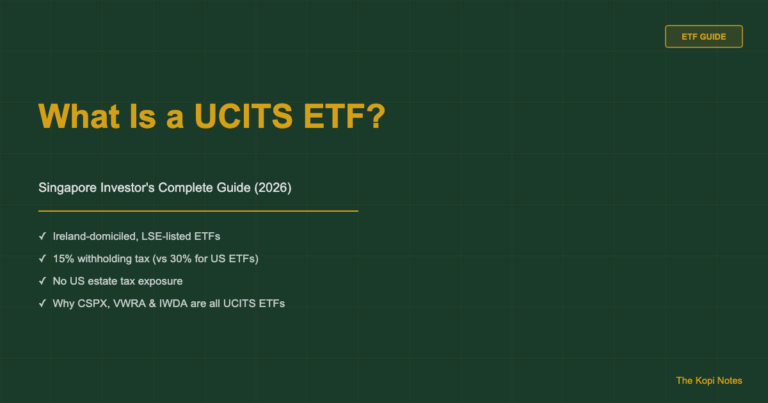
All three of these are Ireland-domiciled UCITS ETFs listed on the London Stock Exchange (LSE) — the same setup as VWRA and CSPX. You buy them through the same brokers, and they carry the same tax treatment.
iShares MSCI World SRI UCITS ETF (SUSW)
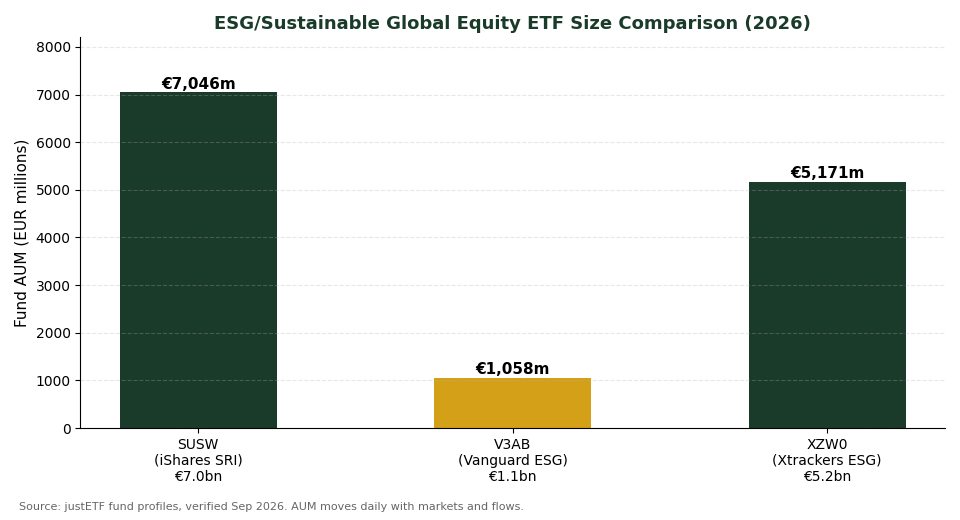
SUSW tracks the MSCI World SRI Select Reduced Fossil Fuels Index. It excludes tobacco, controversial weapons, thermal coal and companies with the weakest ESG ratings, then further trims fossil fuel exposure. TER is 0.20% per year. Fund size is roughly EUR 7.0 billion as at the iShares/justETF factsheet, making it the largest of the three. It’s accumulating, meaning dividends are reinvested automatically rather than paid out as cash.
Vanguard ESG Global All Cap UCITS ETF (V3AB)
V3AB tracks the FTSE Global All Cap Choice Index. Unlike the other two, it includes small-cap stocks, not just large and mid-cap names, giving broader diversification. TER is 0.24% per year — the most expensive of the three. Fund size is roughly EUR 1.1 billion, the smallest by a wide margin. Launched March 2021, it’s accumulating.
Xtrackers MSCI World ESG UCITS ETF (XZW0)
XZW0 tracks the MSCI World Low Carbon SRI Selection Index — a similar screening methodology to SUSW but run by DWS instead of BlackRock. TER is 0.20% per year, tied with SUSW for cheapest. Fund size is roughly EUR 5.2 billion. It’s accumulating and is the LSE-listed share class specifically (the Xetra-listed distributing share class, XZWD, is a different ticker and not the one to search for on LSE).
Cost Comparison: ESG vs VWRA and CSPX
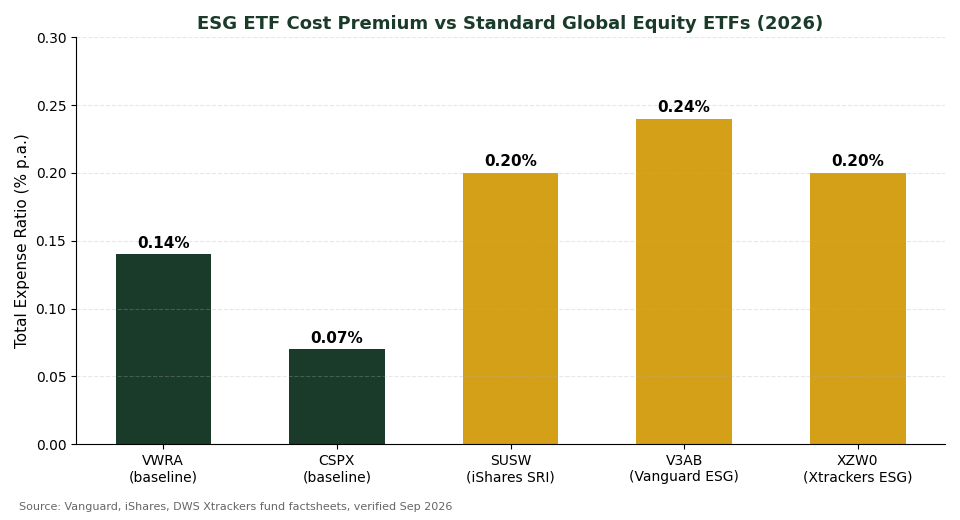
Here’s the number that matters most: how much extra you pay for the screening. VWRA’s TER was cut from 0.22% to 0.14% in July 2026 — many older Singapore guides still quote the stale 0.22% figure, so use 0.14% going forward. CSPX (S&P 500 only, not global) sits at 0.07%.
| ETF | Index | TER | Structure | AUM (approx.) | ESG Screen |
|---|---|---|---|---|---|
| VWRA | FTSE All-World | 0.14% | Accumulating | n/a (baseline) | None |
| CSPX | S&P 500 | 0.07% | Accumulating | n/a (baseline) | None |
| SUSW | MSCI World SRI (Reduced Fossil Fuels) | 0.20% | Accumulating | ~EUR 7.0bn | Yes |
| XZW0 | MSCI World Low Carbon SRI | 0.20% | Accumulating | ~EUR 5.2bn | Yes |
| V3AB | FTSE Global All Cap Choice | 0.24% | Accumulating | ~EUR 1.1bn | Yes |
Source: Vanguard, iShares and DWS Xtrackers fund factsheets; justETF fund profiles, verified September 2026.
Here’s a worked example. On a SGD 50,000 portfolio, VWRA costs you roughly SGD 70 a year in fees. The same amount in SUSW or XZW0 costs about SGD 100 a year — SGD 30 more. In V3AB it’s about SGD 120 a year — SGD 50 more than VWRA. That’s not a large sum in absolute terms, but it compounds over decades, and it’s a real, permanent cost you pay for the screening.
Tax Treatment for Singapore Investors
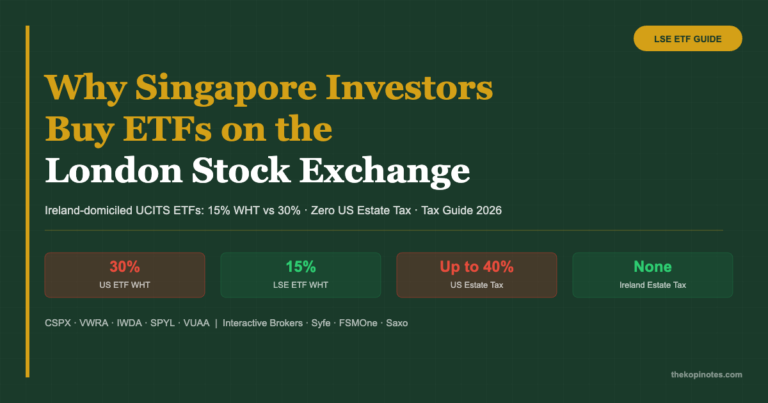
Because all three ESG ETFs are domiciled in Ireland — just like VWRA and CSPX — they qualify for the same reduced 15% US dividend withholding tax rate under the US-Ireland double tax treaty. This applies at the fund level, not based on which stocks the ESG screen keeps or drops.
That means an ESG ETF doesn’t cost you anything extra in withholding tax versus VWRA. The entire cost difference is the TER gap shown in the table above. There’s also no US estate tax exposure, since Ireland-domiciled funds sidestep the USD 60,000 threshold that applies to US-listed ETFs like VOO for non-resident aliens.
How to Buy SUSW, V3AB or XZW0 in Singapore
The process is identical to buying VWRA or CSPX, since all three trade on the LSE in the same way.
Fund your brokerage account, then search for the ticker — SUSW, V3AB or XZW0 — and select the London Stock Exchange listing specifically, since some of these funds have multiple share classes on different exchanges. Place your order in USD or GBP depending on the share class.
Syfe’s brokerage platform supports LSE-listed UCITS ETFs and is the simplest starting point if you’re new to overseas ETF investing. Interactive Brokers and Saxo Markets typically offer lower per-trade fees for larger, more frequent orders. FSMOne is another option worth comparing on fees before you commit to a platform.
Because these are relatively low-volume funds compared to VWRA or CSPX, use a limit order rather than a market order — the bid-ask spread can be a touch wider on quieter trading days.
Who Should Actually Buy an ESG ETF?
An ESG ETF like SUSW or XZW0 makes sense if you specifically want your portfolio to exclude tobacco, weapons and thermal coal, and you’re comfortable paying 0.06 to 0.10 percentage points more per year for that screening, on top of accepting a smaller, less liquid fund than VWRA.
Consider sticking with VWRA or CSPX instead if your main goal is the lowest possible cost, if you want the widest possible fund size and liquidity, or if you’re not particularly attached to the specific companies an ESG screen excludes. There’s no evidence in the data above that ESG screening reliably improves returns — in some recent periods it has lagged instead.
If you’re building a long-term retirement portfolio and want to model how a slightly higher TER affects your outcome over 20 to 30 years, run the numbers through our Singapore retirement calculator before deciding. For a deeper look at how accumulating funds like these compound your dividends automatically, see our accumulating vs distributing ETF guide.
If you’d rather stick with the lowest-cost global options, our VWRA guide and CSPX guide cover those in full detail, including step-by-step buying instructions.
Frequently Asked Questions
What is an ESG ETF and why do some Singapore investors buy it?
An ESG ETF tracks a modified global index that excludes companies with poor environmental, social or governance practices, such as tobacco, weapons and thermal coal producers. Singapore investors buy funds like SUSW, V3AB or XZW0 through LSE-listed UCITS ETFs when they want broad global exposure but prefer to exclude specific industries, accepting a slightly higher expense ratio in exchange.
Is an ESG ETF the same as VWRA with a green label?
Not exactly. VWRA tracks the standard FTSE All-World Index with no exclusions, at a TER of 0.14%. An ESG fund like SUSW or XZW0 tracks a screened version of the MSCI World index at 0.20%, holding fewer companies and typically a smaller, less liquid fund overall. The core holdings — big tech, major banks, healthcare giants — largely overlap, but the ESG version leaves out specific excluded sectors.
Can I buy SUSW, V3AB or XZW0 using my CPF or SRS funds?
These LSE-listed UCITS ETFs are not on the CPF Investment Scheme’s approved list, so you cannot buy them with CPF Ordinary Account funds. They can be bought with SRS funds if your brokerage supports SRS-funded overseas ETF purchases — check with your specific broker, since not all platforms offer this for every LSE-listed fund.
Which broker is best for buying ESG ETFs in Singapore?
Syfe’s brokerage platform is the simplest starting point for beginners buying LSE-listed ESG ETFs. Interactive Brokers and Saxo Markets tend to offer lower per-trade commissions for larger or more frequent orders. Compare the total cost — commission plus FX spread — across a few platforms before committing, since fee structures change periodically.
Do ESG ETFs actually perform better than standard global ETFs?
Not reliably. Morningstar data shows global sustainable funds recorded USD 84 billion in net outflows in 2025, the first full year of net redemptions on record. Some US-focused ESG funds have also trailed the S&P 500 over five-year periods through 2026. There is no strong evidence that ESG screening adds extra return — it’s a values-based choice, not a performance strategy.
What are the risks of investing in a smaller ESG ETF like V3AB?
A smaller fund like V3AB, at roughly EUR 1.1 billion, carries more liquidity risk than a fund the size of VWRA. Bid-ask spreads can be wider, and there’s a slightly higher chance a small fund gets merged or closed by the issuer if it fails to attract assets over time. Use limit orders and check the fund’s size periodically if you hold it long term.
Ready to Start Investing in ETFs?
Open a brokerage account and buy your first ETF today. Use our referral links for exclusive sign-up bonuses.
Not financial advice. All figures are for educational reference only. Data verified as at September 2026 unless noted. TKN may earn a referral fee from some links above at no extra cost to you.
This article was researched with the help of AI. While we strive to keep all information accurate and up to date, there may be errors. If you notice any discrepancies, please contact us.