TribeCar + Trust Bank + GXS + FSMOne: The Two-Bank Split That Beats Either Account Alone (2026)
Why splitting your freed-up car savings across two digital banks earns more than parking it all in one.
Trust Bank’s Flex plan pays a realistic 0.85% p.a. on your full balance once you stack three no-cost scoops, while GXS Boost Pocket pays up to 1.75% p.a. but only on cash you lock into a fixed tenure. Splitting your TribeCar savings between the two — a locked “floor” in GXS and a liquid “flex” layer in Trust Bank — earns more than parking everything in either bank alone, and keeps part of your buffer fully accessible before you route the surplus into FSMOne SRS investing.
Not financial advice. All figures are for educational reference only. Data as at September 2026 unless noted.
- GXS Boost Pocket pays its bonus interest only on cash locked into a tenure — Trust Bank’s Flex plan pays its bonus on your whole liquid balance.
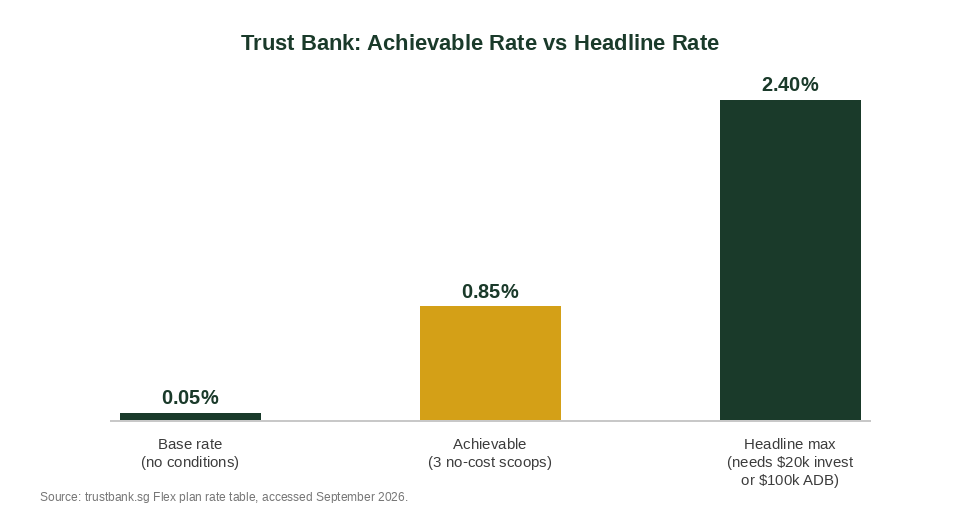
- A realistic Trust Bank rate is 0.85% p.a. (3 achievable scoops), not the 2.40% headline, which needs a S$20K investment or S$100K average balance.
- Lock a floor in GXS, keep a flex layer in Trust Bank, then route surplus above your buffer into FSMOne SRS investing at 0% sales charge.
Table of Contents
1. Why one savings account isn't enough
2. Trust Bank's achievable rate vs its headline rate
3. GXS Boost Pocket: the no-hurdle floor
4. Floor vs flex: the structural difference
5. The full split, step by step
6. When to graduate to FSMOne SRS
7. Risks and limits
8. FAQ
Why one savings account isn’t enough
A small car in Singapore easily costs S$1,000–S$1,500 a month once you count COE, insurance, petrol, parking and servicing. TribeCar lets you pay by the trip instead, which typically frees up S$400–500 a month for someone who drives occasionally.
Most guides tell you to park that freed-up cash in “the best savings account” and move on. That advice breaks down once you look closely at how digital banks actually pay their bonus interest. Some pay on your whole balance. Some pay only on the slice you lock away. Treating every bank the same way leaves yield on the table.
Trust Bank’s achievable rate vs its headline rate
Trust Bank markets its Flex plan as paying “up to 2.40% p.a.” That number is real, but it needs you to hit any 3 of 8 bonus “scoops” on top of the 0.05% p.a. base rate, per Trust Bank’s own savings account page.
The two highest-paying scoops are out of reach for someone simply parking freed-up car savings: a S$20,000 TrustInvest purchase (+0.70%) or a S$100,000 average daily balance (+0.30%). Referring a new credit card customer adds +1.20%, but that isn’t a savings decision — it depends on someone else applying and getting approved.
Three scoops are realistic with no extra spending or investing: crediting a S$1,500 monthly salary via GIRO (+0.45%), making 5 card spends of at least S$30 each (+0.20% for NTUC union members, +0.10% otherwise), and receiving S$1,500 in incoming PayNow transfers (+0.15%). Stack those three and you land at 0.85% p.a. (union) or 0.75% p.a. (non-union) — on your entire Trust Bank balance, not just part of it.
GXS Boost Pocket: the no-hurdle floor
GXS Boost Pocket works differently. There are no salary, spend or PayNow conditions to hit. Lock funds into a chosen tenure (1, 3, 4, 8 or 12 months) and you earn a base interest of around 0.88% p.a. credited daily, plus a bonus of up to 0.87% p.a. paid at maturity for the longest tenure — up to 1.75% p.a. total, per GXS Bank’s savings account page.
That is a higher rate than Trust Bank’s achievable 0.85%, with zero behavioural conditions to meet each month. The trade-off: your money is locked for the tenure you pick. Withdraw early and you forfeit the maturity bonus.
Floor vs flex: the structural difference
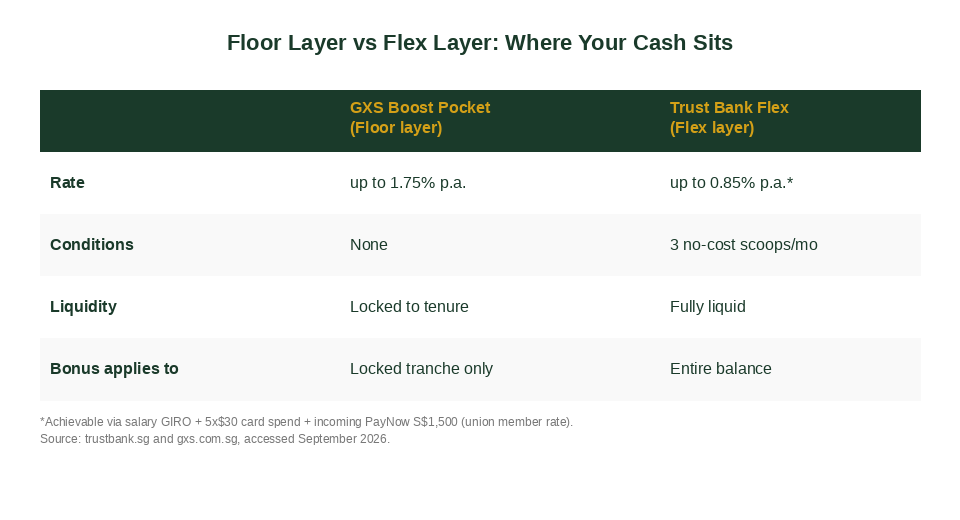
Here is the detail most comparisons miss. GXS pays its bonus only on the locked tranche — if you have S$500 in a Boost Pocket and S$1,000 sitting loose in the main GXS account, only the S$500 earns the boosted rate. Trust Bank’s Flex bonus, once unlocked, applies to your entire account balance for the month, whether that balance is S$500 or S$5,000, and the money stays fully liquid.
That makes GXS the right home for money you are comfortable locking away — your floor. It makes Trust Bank the right home for money you might need on short notice, or that you are still deciding whether to invest — your flex layer.
| GXS Boost Pocket (floor) | Trust Bank Flex (flex) | |
|---|---|---|
| Rate | up to 1.75% p.a. | up to 0.85% p.a.* |
| Conditions | None | 3 no-cost scoops/month |
| Liquidity | Locked to chosen tenure | Fully liquid, no lock-in |
| Bonus applies to | Locked tranche only | Entire account balance |
*Achievable via salary GIRO + 5x$30 card spend + incoming PayNow S$1,500 (union member rate). Source: trustbank.sg and gxs.com.sg, accessed September 2026.
The full split, step by step
Say TribeCar frees up S$450 a month. Here is one way to route it:
Step 1 — Build the floor. Direct the first few months of savings into a 12-month GXS Boost Pocket until you have roughly 3 months of buffer locked away, around S$1,350. This slice earns up to 1.75% p.a. and you accept you won’t touch it for a year.
Step 2 — Run the flex layer. Once the floor is locked, route new monthly surplus into your everyday Trust Bank account instead. Set up salary GIRO if you haven’t, keep 5 card transactions of S$30+ each month (many people hit this from groceries and transport alone), and route at least S$1,500 of PayNow transfers through the account. That unlocks the 0.85% p.a. rate on the growing flex balance, which stays withdrawable if an emergency comes up.
Step 3 — Graduate the surplus. Once the flex layer itself crosses roughly S$3,000 — a buffer most people are comfortable holding on top of the locked floor — route new monthly surplus past that point into FSMOne SRS investing instead of letting it sit as cash.
When to graduate to FSMOne SRS
FSMOne charges 0% sales charge on SRS fund purchases, which matters because every dollar of upfront fee is a dollar that never gets to compound. Singapore Citizens and PRs can contribute up to S$15,300 a year to their SRS account, and the amount you contribute reduces your taxable income for the year, per CPF Board’s SRS guidance.
Cash sitting in a savings account, even at 1.75% p.a., is losing ground to inflation over the long run. Once your locked floor and liquid flex layer together give you enough of a buffer, directing new surplus into SRS-wrapped index funds via FSMOne turns idle cash into long-term, tax-advantaged growth — without giving up the emergency cushion you already built.
Risks and limits
This split adds moving parts. You now track two savings accounts with different rules instead of one, which means more admin and more chances to miss a scoop or a tenure renewal date.
Locking money into a GXS Boost Pocket means it isn’t there if a genuine emergency hits before the tenure matures — you’d forfeit the bonus to withdraw early. Trust Bank’s scoops also reset every month; miss your card spend or PayNow threshold in a given month and your rate for that month drops back toward the 0.05% base.
SRS withdrawals before the statutory retirement age are taxed on 100% of the amount withdrawn, plus a 5% penalty, so only route money into FSMOne SRS that you are genuinely comfortable locking away until retirement age. Singapore T-bills remain a lower-effort alternative if you’d rather not manage a multi-account split at all.
TKN may earn a referral fee if you sign up through the links on this page, at no extra cost to you.
Get started
Sign up for TribeCar, Trust Bank, GXS Bank and FSMOne using TKN’s referral codes below. Each supports this site at no extra cost to you.
FAQ
Why not just put everything in GXS since it pays a higher rate?
What if I can't hit all 3 Trust Bank scoops every month?
Is GXS Boost Pocket or Trust Bank covered by deposit insurance?
How much can I contribute to SRS at FSMOne?
Does the union card-spend bonus require an NTUC membership fee?
Can I change which GXS tenure I lock in later?
This article was researched with the help of AI. While we strive to keep all information accurate and up to date, there may be errors. If you notice any discrepancies, please contact us.