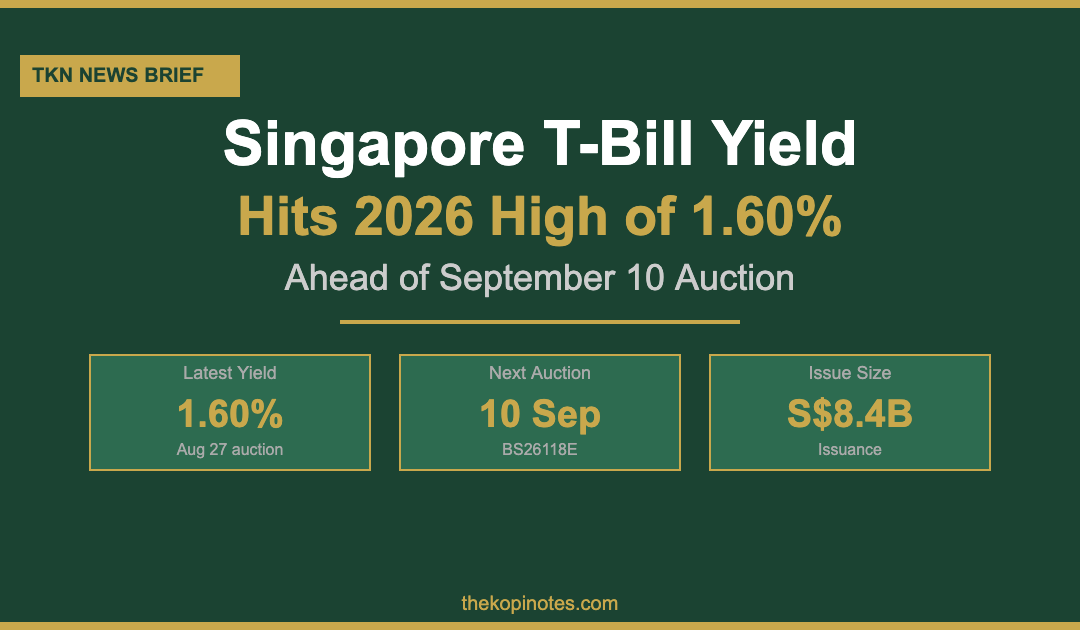
Singapore’s 6-month T-bill cut-off yield surged to 1.60% p.a. at the August 27 auction — the highest level of 2026 — reversing months of decline and catching many investors off guard. With the next auction (BS26118E) scheduled for September 10, investors have a narrow window to decide: apply, wait, or look elsewhere. This editorial breaks down what’s driving the yield rebound, what the September 10 auction is likely to produce, and how the current T-bill compares against the best fixed deposits, Singapore Savings Bonds, and CPF.
This is an editorial analysis. Not financial advice. Data verified as at 9 September 2026.
What Happened: T-Bill Yields Hit a 2026 High
Singapore’s 6-month Treasury Bill (T-bill) cut-off yields have staged a meaningful comeback. After bottoming out at just 1.46% p.a. in early July 2026 — a dramatic decline from 3.02% at the start of the year — yields have now climbed back to 1.60% at the August 27 auction. That surpasses the previous intra-year high of 1.59% set on July 30, making it the highest 6-month T-bill yield recorded in 2026.
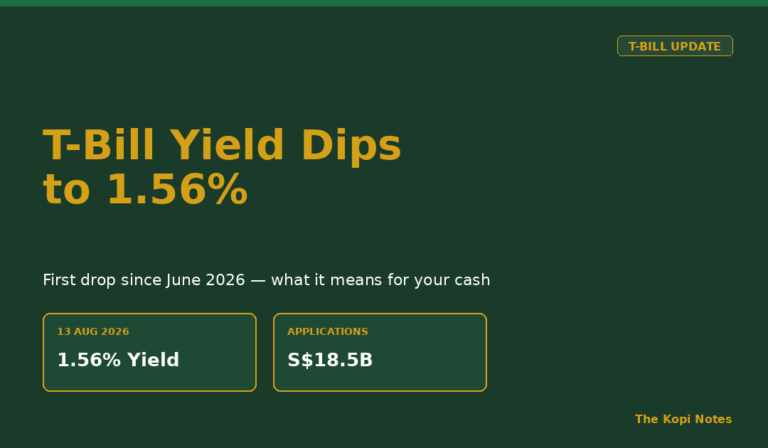
The August 27 auction (issue code BS26117A) issued S$8.7 billion of 6-month T-bills, with total applications of S$16.8 billion — down from S$18.5 billion at the preceding August 13 auction. Lower demand relative to supply translated directly into a higher cut-off yield: when fewer dollars are chasing each bond, the yield the government must offer to clear the auction rises. For investors who held off after the June low, the rebound is a welcome development.
For context on Singapore’s broader T-bill history and how to apply, see our full Singapore T-Bill Auction Results 2026 guide.
T-Bill Yield History 2026: The Full Picture
The yield trajectory in 2026 has been dramatic. T-bills started the year above 3%, riding the global high-rate environment inherited from 2024–25. As MAS signalled policy easing and global rate expectations shifted, yields fell sharply through Q2, hitting a 2026 trough of 1.46% on July 2. Since then, a combination of stronger Singapore GDP growth (revised to 5% for 2026 per the MAS September Survey), rising US Treasury yields, and cooling demand for T-bills has pushed yields back up.
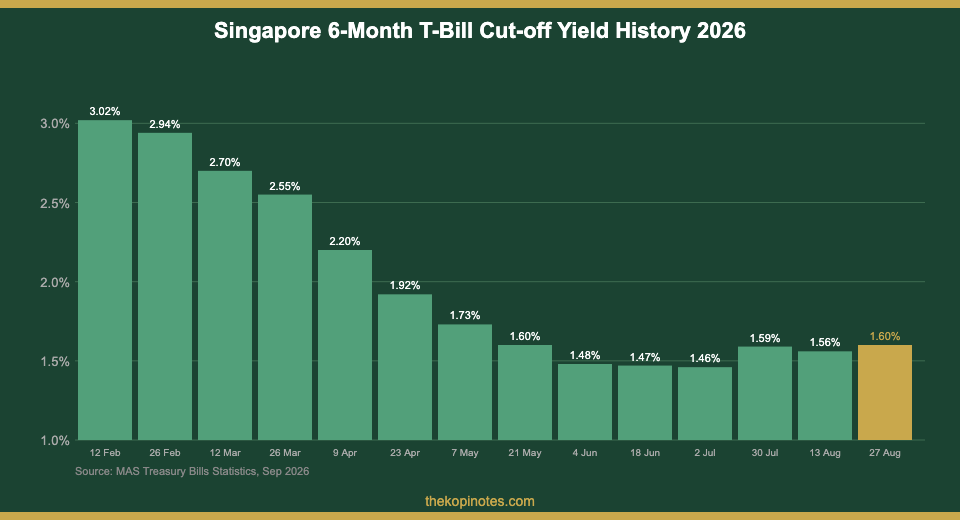
| Auction Date | Issue Code | Cut-off Yield | Change |
|---|---|---|---|
| 12 Feb 2026 | BS26103H | 3.02% | — |
| 26 Feb 2026 | BS26104D | 2.94% | −0.08% |
| 12 Mar 2026 | BS26105Z | 2.70% | −0.24% |
| 26 Mar 2026 | BS26106V | 2.55% | −0.15% |
| 9 Apr 2026 | BS26107R | 2.20% | −0.35% |
| 23 Apr 2026 | BS26108N | 1.92% | −0.28% |
| 7 May 2026 | BS26109J | 1.73% | −0.19% |
| 21 May 2026 | BS26110F | 1.60% | −0.13% |
| 4 Jun 2026 | BS26111Z | 1.48% | −0.12% |
| 18 Jun 2026 | BS26112T | 1.47% | −0.01% |
| 2 Jul 2026 | BS26113X | 1.46% | −0.01% |
| 30 Jul 2026 | BS26115P | 1.59% | +0.13% |
| 13 Aug 2026 | BS26116L | 1.56% | −0.03% |
| 27 Aug 2026 | BS26117A | 1.60% | +0.04% (2026 high) |
Source: Monetary Authority of Singapore (MAS) Treasury Bills Statistics, September 2026.
September 10 Auction (BS26118E): Key Details
The next 6-month T-bill auction is set for September 10, 2026 with the following confirmed parameters:
- Issue Code: BS26118E
- Auction Date: 10 September 2026 (Wednesday)
- Settlement Date: 15 September 2026
- Issuance Size: S$8.4 billion
- Cash Application Deadline: 9pm, 9 September 2026 (tonight)
- CPF OA via DBS/OCBC: 9pm, 9 September 2026
Important: If you plan to apply with CPF OA, check whether your bank’s CPF application deadline has already passed — UOB sometimes closes CPF OA applications one day earlier than the cash deadline. Verify on your bank’s internet banking portal before tonight.
The issuance size for the September 10 auction (S$8.4 billion) is slightly lower than the previous auction’s S$8.7 billion. A smaller issuance size, all else equal, means slightly higher competition per dollar of supply — which could exert modest downward pressure on the cut-off yield. Analysts tracking secondary market activity as of September 3 observed a closing yield of 1.57%, suggesting the cut-off range for September 10 is most likely 1.49%–1.66%, with a central estimate around 1.57%–1.62%.
Why Are T-Bill Yields Rising Again?
1. Strong Singapore GDP and MAS policy signals. The MAS September 2026 Survey of Professional Forecasters raised Singapore’s 2026 GDP growth estimate to 5.0%, up from 3.5% in the previous survey. AI-driven semiconductor and electronics demand has been a key driver. A stronger economy raises the odds that MAS will keep monetary conditions firm, putting upward pressure on short-term rates.
2. Higher US Treasury yields. The 10-year US government bond yield rose to 4.76% as of September 3, 2026 — up from 4.65% two weeks earlier. Singapore’s short-term rates are influenced by global rate sentiment, and a pickup in US Treasuries has filtered through to Singapore’s T-bill market.
3. Cooling T-bill demand. Applications for the August 27 auction fell to S$16.8 billion from S$18.5 billion in the prior auction. When investors pull back from T-bills — perhaps rotating into higher-yielding alternatives or equities — yields must rise to attract the necessary demand.
T-Bill vs Fixed Deposit vs SSB vs CPF OA (September 2026)
At 1.60%, the August T-bill yield is now more competitive — but it is still not the outright winner against all alternatives. Here is how the landscape looks for Singapore investors considering where to park cash in September 2026:
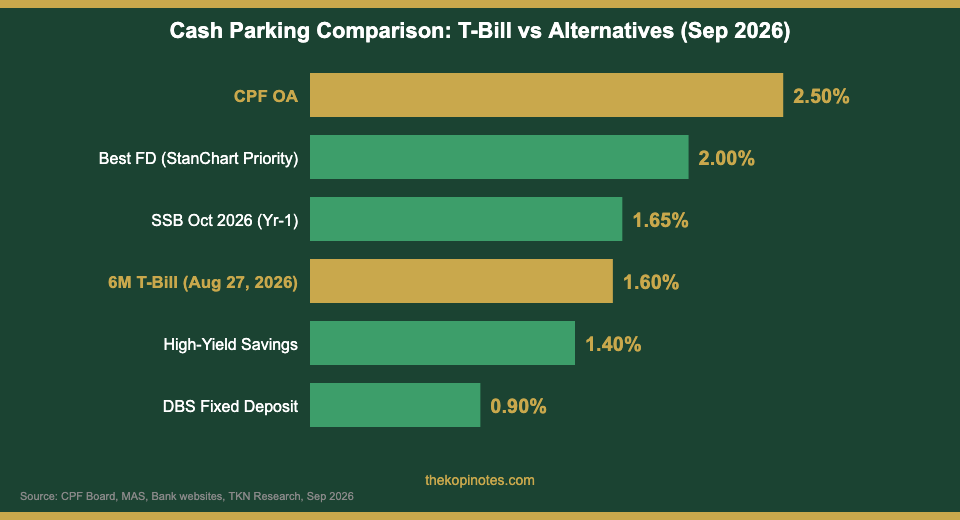
| Option | Rate (Sep 2026) | Tenor | Capital Safe? | Liquidity |
|---|---|---|---|---|
| CPF OA | 2.50% | Ongoing | ✓ Govt-guaranteed | Very Low |
| Best FD (StanChart Priority Private / Citibank Citigold) | 2.00% | 6–12 months | ✓ SDIC-insured | Low |
| CIMB FD (Preferred Banking, 9M/12M) | 1.75% | 9–12 months | ✓ SDIC-insured | Low |
| SSB Oct 2026 (Year 1 avg) | 1.65% | Up to 10 years | ✓ Govt-backed | High — redeem anytime |
| 6M T-Bill (Aug 27 2026) | 1.60% | 6 months | ✓ Govt-backed | Low (locked-in) |
| High-Yield Savings Accounts | 1.20–1.50% | No lock-in | ✓ SDIC-insured | High |
Source: CPF Board, MAS, Standard Chartered, CIMB, bank websites. Rates as at September 2026. SDIC = Singapore Deposit Insurance Corporation.
The key takeaway is nuanced. T-bills at 1.60% beat savings accounts and trail the best fixed deposits and CPF OA. However, T-bills remain the only government-backed, freely accessible (no minimum wealth requirement) 6-month instrument near this yield level — making them particularly appealing for retail investors without access to priority banking rates.
The SSB October 2026 offers 1.65% in Year 1 and a 10-year average of 2.32%, with flexible redemption. If liquidity matters to you, SSB narrowly beats the T-bill on Year-1 rate and offers far more flexibility. For a comparison of bond-style investments more broadly, see our Bond ETF Singapore Guide 2026.
CPF OA: Still the Benchmark That Beats All
The CPF Ordinary Account (OA) earns 2.50% per annum for Q3 2026 (July–September 2026), as confirmed by the CPF Board. This is the legislated minimum floor rate and significantly outperforms the current T-bill yield of 1.60% as well as most fixed deposits available to ordinary bank customers.
The implication is clear: if you have CPF OA money you are considering moving into T-bills, think carefully. You would be surrendering 0.90% per year in risk-free guaranteed return. CPF OA funds are best left in CPF unless you have a very specific short-term reason to move them. For strategies on maximising CPF returns, see our CPF Investment Strategy guide.
SRS (Supplementary Retirement Scheme) funds are a different matter — they earn just 0.05% if left uninvested, making T-bills and SSBs highly attractive deployment options.
Should Singapore Investors Apply for the September 10 T-Bill?
Apply if:
- You have idle cash (not CPF OA) you won’t need for 6 months
- Your bank’s best fixed deposit rate is below 1.60% — T-bills are a better alternative
- You are deploying SRS funds and want a short-term, capital-safe instrument
- You prefer direct government backing over SDIC-insured bank deposits
Consider alternatives if:
- You can access a fixed deposit at 1.65% or above — CIMB, Standard Chartered, or Citibank may beat T-bills outright (check our Standard Chartered FD rate guide)
- The money is from CPF OA — keep it in CPF at 2.5%
- You might need the cash before 6 months — SSB is far more flexible (redeem any month, no penalty)
- You want higher long-term returns with managed risk — consider S-REITs (see our Best S-REITs 2026 guide) or our overview of the best investments in Singapore 2026
Bottom Line for SG Investors
The Singapore T-bill yield is at its highest level of 2026 — 1.60% as of August 27 — and the September 10 auction offers a chance to lock in near that rate for 6 months with full government backing. The rebound from July lows reflects genuine macro shifts: stronger Singapore growth, higher US Treasury yields, and cooling investor demand. For cash investors without access to the best FD rates, the September 10 T-bill is among the most compelling risk-free options available this fortnight. For everyone else, weigh it carefully against SSBs (more flexible), FDs at your bank (potentially higher yield), and your CPF OA (the outright rate winner at 2.5%).
Tonight’s cash application deadline is 9pm on 9 September 2026. If you decide to apply, use a non-competitive bid to guarantee allotment at the auction cut-off yield.
Frequently Asked Questions
What is the latest Singapore T-bill cut-off yield?
The latest 6-month Singapore T-bill cut-off yield is 1.60% p.a., from the August 27, 2026 auction (issue code BS26117A). This is the highest cut-off yield of 2026. The September 10 auction cut-off yield will be determined after tonight’s application deadline — secondary market data as of September 3 suggests a range of approximately 1.49%–1.66%, with 1.57%–1.62% the most likely outcome.
When is the deadline to apply for the September 10 T-bill?
The cash application deadline for the September 10, 2026 T-bill (BS26118E) is 9pm on 9 September 2026 via DBS/POSB, OCBC, and UOB internet banking. CPF OA applications via DBS and OCBC also close at 9pm on 9 September — verify your bank’s exact deadline as UOB may differ.
Why did T-bill yields rise to a 2026 high in August?
Three main factors drove the rebound: (1) Singapore’s GDP growth forecast was revised up to 5% for 2026 in the MAS September Survey, signalling a firm policy stance; (2) the 10-year US Treasury yield rose to 4.76% by early September, lifting global short-term rate expectations; and (3) investor demand for T-bills cooled — applications dropped to S$16.8 billion in August from S$18.5 billion — requiring a higher yield to clear the auction.
Is the T-bill better than a fixed deposit in September 2026?
It depends on your bank and banking tier. Best FD rates in September 2026 reach 2.00% (Standard Chartered Priority Private, Citibank Citigold) and 1.75% (CIMB Preferred, 9M/12M) — both above the T-bill. However, most ordinary bank customers cannot access these priority banking rates. For them, T-bills at approximately 1.57%–1.62% are likely to match or beat their bank’s standard FD rate, plus carry the added benefit of direct government backing.
Should I use CPF OA funds to apply for the T-bill?
Generally no. CPF OA earns 2.50% p.a. (guaranteed, confirmed for Q3 2026 by CPF Board) — significantly more than the current T-bill yield. Moving CPF OA funds into T-bills sacrifices approximately 0.90% per year in guaranteed risk-free return. The main exception is if you have a specific liquidity reason to hold funds outside CPF. For most Singaporeans, keeping OA funds in CPF is the better financial choice.
How does the October 2026 SSB compare to the T-bill?
The SSB October 2026 issuance offers a Year-1 average rate of 1.65% — slightly above the recent T-bill yield of 1.60%. Crucially, SSBs allow flexible redemption at any month with no penalty and full principal returned. If you’re unsure when you might need the funds, SSBs are superior. T-bills are better if you’re certain you won’t need the money for exactly 6 months and want a defined maturity date.
What happens after I apply for the T-bill tonight?
MAS conducts the uniform-price auction on September 10, 2026. Results are typically published the same day. If allotted (guaranteed for non-competitive bids up to S$1 million), the T-bill settles September 15, 2026. On the maturity date (approximately March 16, 2027), the full face value plus interest is credited back to your bank account or CPF OA. You cannot access the funds before maturity without selling on the secondary market.
What is a non-competitive bid and should I use it?
A non-competitive bid means you accept whatever cut-off yield the auction produces — you don’t specify a minimum yield. Non-competitive bids are guaranteed allotment for individuals up to S$1 million, making them the standard recommendation for retail investors. Competitive bids require you to specify a minimum yield; if the auction cut-off is below your bid, you won’t be allotted. For most Singaporeans, a non-competitive bid is the simpler and safer choice.
This article was researched with the help of AI. While we strive to keep all information accurate and up to date, there may be errors. If you notice any discrepancies, please contact us.