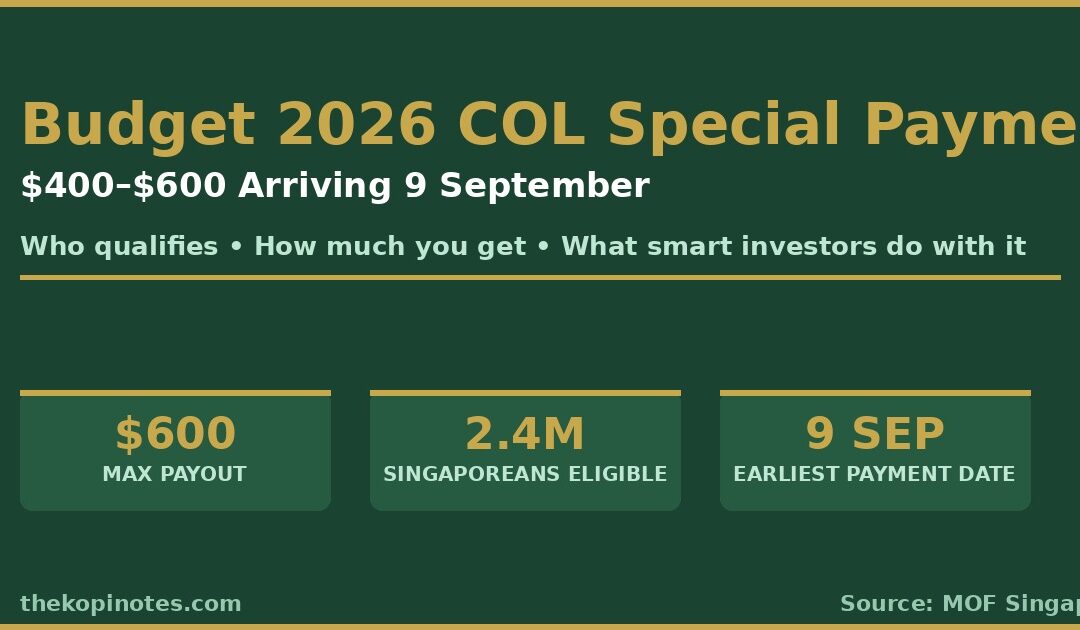
Over 2.4 million Singapore citizens will start receiving a one-off cash payout of $400 to $600 from 9 September 2026 — the Enhanced Budget 2026 Cost-of-Living (COL) Special Payment. If you’re a working Singaporean who earned under $100,000 and owns no more than one property, there’s a good chance money is already on its way to your PayNow account this week. Here’s exactly who qualifies, how much you’ll get, when it arrives — and what savvy local investors are doing with it.
This is an editorial analysis. Not financial advice. Data verified as at 2 September 2026.
What Is the Enhanced Budget 2026 COL Special Payment?
The Enhanced Budget 2026 Cost-of-Living (COL) Special Payment is a one-off government cash transfer designed to help Singaporeans cope with ongoing cost pressures. It was first announced by Prime Minister Lawrence Wong in Budget 2026 as a $200–$400 payout, then boosted by an additional $200 per eligible recipient following a Ministerial Statement on 7 April 2026 — bringing the current range to $400–$600.
This makes it one of the largest targeted cash payouts under the Budget 2026 support package, which also includes CDC Vouchers ($500 per household), U-Save rebates, and MediSave top-ups. The COL Special Payment is specifically focused on adult Singaporeans — not households — meaning each eligible citizen receives their own individual payment.
The Ministry of Finance issued the official announcement on 13 August 2026, with payments set to be automatically credited from 9 September 2026 for those with PayNow-NRIC linked accounts.
Am I Eligible? Quick Check
The eligibility criteria are straightforward. You qualify if you are:
- A Singapore citizen
- Aged 21 and above in 2026
- Have an Assessable Income (YA2025) of $100,000 or below
- Own no more than one property
The relatively high Assessable Income ceiling of $100,000 means this payment covers a very broad slice of working Singaporeans — not just lower-income households. If you’re a fresh graduate, a mid-career professional, or an HDB owner earning a combined household income under that threshold, you’re very likely eligible. Note: the Assessable Income refers to your individual income, not household income.
For Singaporeans who missed the 30 August PayNow-NRIC linking deadline, payments will still be credited automatically — just a little later. You’re not disqualified; you simply receive the money via bank crediting or GovCash on a later date.
How Much Will I Get? Full Payment Table
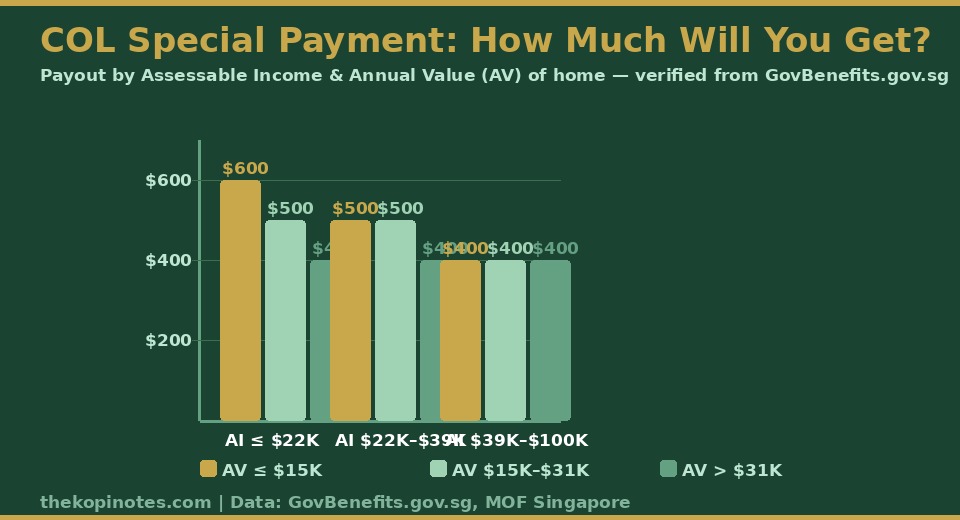
The exact payment amount is determined by two factors: your Assessable Income for Year of Assessment 2025 (your income from 2024) and the Annual Value (AV) of your residence as at 31 December 2025.
| Assessable Income (YA2025) | AV ≤ $15,000 | AV $15,001–$31,000 | AV above $31,000 |
|---|---|---|---|
| AI up to $22,000 | $600 | $500 | $400 |
| AI $22,001 – $39,000 | $500 | $500 | $400 |
| AI $39,001 – $100,000 | $400 | $400 | $400 |
Source: GovBenefits, Budget 2026 Measures / Ministry of Finance, 13 August 2026
What does Annual Value mean? AV is the estimated gross annual rent of your home if it were rented out, assessed by IRAS. Most HDB flats — including 4-room and 5-room units — have an AV well below $21,000, which means the majority of HDB dwellers fall in the lowest two AV brackets and receive a higher payout.
When and How Will I Get Paid?
Payment timing depends on how you’ve set up your account to receive it:
| Payment Method | Setup Deadline | Payment Date |
|---|---|---|
| PayNow-NRIC (default) | Link by 30 August 2026 | By 9 September 2026 |
| Bank crediting (GIRO) | Provide details by 31 August 2026 | By 17 September 2026 |
| GovCash | No action needed | By 24 September 2026 |
Source: Ministry of Finance, 13 August 2026
If you’ve already linked your NRIC to PayNow before the deadline, your money should land automatically by 9 September 2026 — no action required. If not, the payment still comes, just by 17 September (GIRO) or 24 September (GovCash).
Important scam alert: The government SMS from “gov.sg” will only tell you that your benefit has been credited. It will NOT ask you to click links, reply, or provide any personal or banking information. If you receive any such request, it is a scam. Call ScamShield at 1799.
5 Smart Ways Singapore Retail Investors Can Use This Payout
The COL Special Payment is designed to help with living expenses — and for many households, it genuinely will offset grocery bills, utilities, and transport costs. But if you’re already financially stable and want to make this windfall work harder, here are five moves worth considering. All of these are beginner-friendly and low-risk.
1. Top Up Your Emergency Fund First
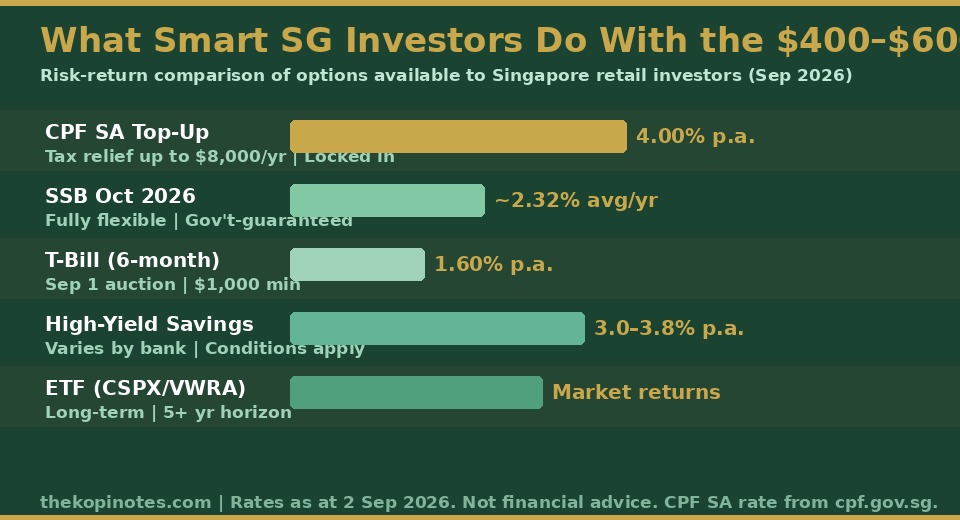
Before deploying any windfall into investments, check your emergency fund. The rule of thumb is 3–6 months of expenses in a liquid, accessible account. If yours is below that threshold, your $400–$600 COL payout is a painless way to top it up without touching your regular income. High-yield savings accounts from DBS, OCBC, and UOB, or digital banks like Chocolate Finance, currently offer 3.0–3.8% p.a. on balances up to a certain cap.
2. Put It in Singapore Savings Bonds (SSB)
For completely risk-free, flexible returns, the Singapore Savings Bond (SSB) is hard to beat. The October 2026 SSB tranche carries a projected 10-year average yield of approximately 2.32% p.a. — fully guaranteed by the Singapore government, no penalty for early redemption, and a minimum investment of just $500. The application window for October 2026 opens soon; you can apply via DBS/POSB, OCBC, or UOB internet banking using cash or SRS funds.
3. Apply for the Next T-Bill Auction
If you prefer a shorter commitment, 6-month Singapore Treasury Bills (T-bills) offer risk-free yields with a clear maturity date. The most recent 6-month T-bill auction (1 September 2026) had a cut-off yield of 1.60% p.a. Check the latest T-bill auction results and upcoming dates for the most current yields. You can apply with as little as $1,000 using cash or CPF-OA funds.
4. Start or Add to a Low-Cost ETF
For investors with a longer time horizon (5+ years), this payout can be the seed for an ETF investing strategy. Broad-market ETFs like CSPX (S&P 500 exposure), VWRA (global all-world), or IWDA (developed markets) are accessible on SGX and internationally through brokerages like Tiger Brokers, Syfe Trade, or moomoo. Investing even $400 regularly through dollar-cost averaging builds long-term wealth steadily. See our guide on what investments work best for Singapore investors.
5. CPF Voluntary Top-Up for Tax Relief
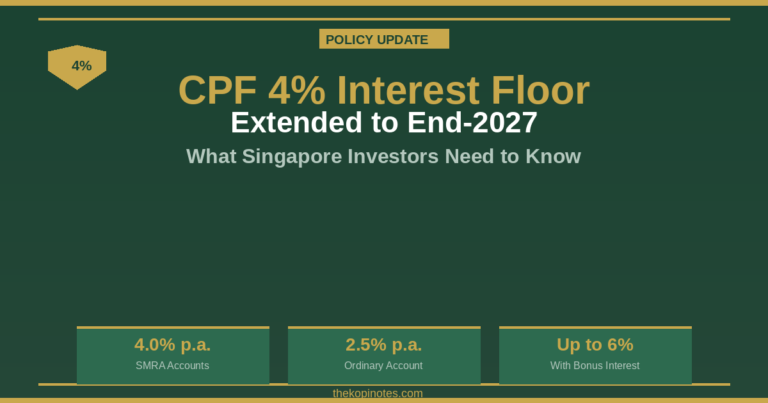
If you’re thinking ahead to retirement and want to reduce your income tax, a Retirement Sum Top-Up (RSTU) to your CPF Special Account (SA) or Retirement Account (RA) earns 4.0% p.a. guaranteed interest — and qualifies for tax relief of up to $8,000 per year for top-ups to your own account, plus another $8,000 for top-ups to family members. It’s locked in longer, but for retirement-focused investors, this is an extremely efficient use of unexpected cash. Read more about CPF and SRS strategies for Singapore investors.
What NOT to Do With Your COL Payout
The most common mistake Singaporeans make with government payouts is letting them dissolve into everyday spending without any deliberate allocation. While there’s nothing wrong with using it for groceries or bills — that’s exactly what it’s designed for — here are a few scenarios to avoid if you’re trying to build wealth:
- Don’t treat it as “free money” for discretionary splurges if you have high-interest debt. Any credit card balance above 26–27% p.a. should be cleared before investing.
- Don’t invest in products you don’t understand — structured deposits, unit trusts with high upfront fees, or unlicensed investment platforms should be approached with extreme caution.
- Don’t confuse a one-off payout with a repeatable strategy. The COL Special Payment is helpful, but building lasting financial resilience requires consistent monthly contributions to savings and investments — not depending on government payouts.
Context: How the COL Payment Fits Into Budget 2026’s Support Package
The COL Special Payment is one component of a broader suite of Budget 2026 cost-of-living measures, which include:
- CDC Vouchers — $500 per household (usable at hawkers, supermarkets, and heartland shops)
- GST Voucher – Cash — separate payment for lower-income Singaporeans
- U-Save Rebates — utilities rebates for HDB households
- MediSave Top-Ups — for seniors aged 65 and above
- Service and Conservancy Charges (S&CC) Rebates — for HDB residents
Taken together, these measures can add up to well over $1,000 in total benefits per eligible household for the year — a meaningful buffer in a high-cost environment.
Bottom Line for SG Investors
The Enhanced Budget 2026 COL Special Payment is free cash landing in your PayNow account from as early as 9 September 2026 — and for most Singaporeans, no action is needed to receive it. The payout ranges from $400 to $600 depending on your income and property Annual Value.
For retail investors, this is a low-friction opportunity to move from intention to action on a financial goal. Whether you park it in a Singapore Savings Bond, open a T-bill position, or add to a long-term ETF portfolio, even a single intentional deployment of this payout builds good investing habits. If you’re new to investing and not sure where to start, read our complete guide on how to start investing in Singapore.
Check your eligibility and exact amount at govbenefits.gov.sg using your Singpass.
Frequently Asked Questions
Do I need to apply for the Budget 2026 COL Special Payment?
No. The COL Special Payment is automatic — eligible citizens do not need to apply. Your eligibility is assessed based on data held by IRAS and HDB, and the payment is credited directly to your PayNow-NRIC linked account, bank account, or GovCash. Check your eligibility at govbenefits.gov.sg using Singpass.
I missed the PayNow-NRIC linking deadline of 30 August. Will I still get paid?
Yes. Missing the 30 August PayNow deadline does not disqualify you. You will still receive the payment — either by 17 September via bank crediting (GIRO) or by 24 September via GovCash, depending on your setup. No payment is lost.
What is Annual Value (AV) and how does it affect my payout?
Annual Value is IRAS’s estimate of how much your home would earn in annual rent if let out. Most HDB 4-room and 5-room flats have an AV well below $21,000, placing HDB dwellers in the lower AV brackets and qualifying them for higher payouts (up to $600 at the lowest income tier). You can check your AV on the IRAS myTax Portal or on your NRIC.
I’m a Singapore citizen living overseas. Am I eligible?
The COL Special Payment is for Singapore citizens. Certain criteria apply regarding your place of residence and the Annual Value of the property reflected on your NRIC. Check your specific eligibility at govbenefits.gov.sg or contact MOF for clarification.
Can I receive both the COL Special Payment and the GST Voucher Cash?
Yes, if you meet the criteria for both. They are separate schemes assessed independently. The GST Voucher Cash was paid in August 2026, while the COL Special Payment is paid in September 2026. You may qualify for both.
What should I do with the $400–$600 if I don’t need it for expenses?
Consider low-risk options like Singapore Savings Bonds (SSB) with ~2.32% projected 10-year yield for October 2026, a T-bill (1.60% cut-off yield for the 6-month auction on 1 September 2026), or starting a small ETF position. For longer-term planning, a CPF Special Account top-up earns 4.0% p.a. and provides tax relief. See our guide on the best investments in Singapore for 2026.
How do I check if I’ve received the payment?
If you’re a PayNow-NRIC user, your payment should appear in your linked bank account from 9 September 2026. You will also receive an SMS from “gov.sg” confirming the credit. You can also check govbenefits.gov.sg or your bank app transaction history.
This article was researched with the help of AI. While we strive to keep all information accurate and up to date, there may be errors. If you notice any discrepancies, please contact us.