Mapletree Industrial Trust Share Price: 2H FY2026/27 DPU Recovery, S$500M Divestment & Rate-Cut Opportunity (SGX: ME8U)
Last updated: 1 September 2026 | Category: S-REIT Deep Dives | Author: The Kopi Notes
Mapletree Industrial Trust (SGX: ME8U) share price hovers near S$2.08 in September 2026, offering a forward yield of approximately 6.1%. After a 4.9% year-on-year DPU dip in 1Q FY26/27 — mainly from divestments and one-off costs — the 2H FY2026/27 outlook is improving: a September FOMC rate cut, the S$500M capital recycling programme, and stabilising data centre occupancy all point toward gradual DPU recovery by FY2027/28.
Table of Contents
MIT Share Price & Key Metrics (Sep 2026)
Mapletree Industrial Trust has delivered steady long-term total returns since its 2010 SGX listing, evolving from a Singapore-focused flatted factory REIT into a diversified industrial-and-data-centre platform spanning three geographies. Here are the key metrics as of September 2026:
| Metric | Value |
|---|---|
| SGX Code | ME8U |
| Share Price (Sep 2026) | ~S$2.08 |
| FY2025/26 DPU (Full Year) | 12.71¢ |
| 1Q FY2026/27 DPU | 3.11¢ (−4.9% YoY) |
| Trailing Yield (FY25/26) | ~6.1% |
| Portfolio Value | S$8.3 billion |
| Number of Properties | 136 (SG 79 / NA 55 / JP 2) |
| Gearing Ratio | 37.5% |
| Fixed-Rate Debt | ~75% |
| Market Cap | ~S$5.1 billion |
For broader context on how MIT compares within the sector, see our guide to the best S-REITs in Singapore for 2026.
DPU History & 2H FY2026/27 Outlook
MIT’s DPU has trended lower since its FY2023/24 peak of 13.62 cents, reflecting the transition from mature industrial assets to higher-growth (but capital-intensive) data centres. The chart below illustrates the trajectory:
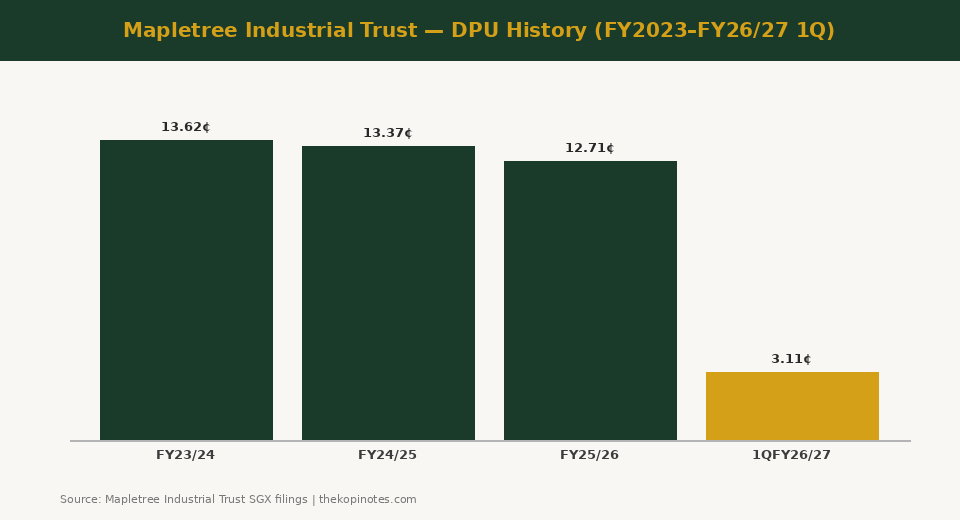
The 1Q FY26/27 DPU of 3.11 cents (versus 3.27 cents in 1Q FY25/26) reflects two main drags: income lost from divested assets, and higher financing costs on new DC debt. However, both factors should moderate in 2H:
- Divestment income gap narrows: The S$500M divestment plan is largely front-loaded; proceeds are being recycled into higher-yielding acquisitions or debt reduction, which flows through to distributions over 12–18 months.
- Rate cuts reduce financing costs: With 25% of MIT’s debt floating-rate, a 25 bps Fed cut in September saves approximately S$5–6M annually — translating to roughly 0.2 cents per unit per year.
- Hawthorne DC backfill stabilising: The Hawthorne data centre backfill, which created a temporary occupancy gap in North America, is progressing. Full occupancy contributes meaningfully to 2H NPI.
Our full-year FY2026/27 DPU estimate sits in the range of 12.2–12.5 cents, implying a yield of approximately 5.9–6.0% at S$2.08. A sharper rate-cut cycle or faster backfill completion could push this higher.
Portfolio Breakdown: Data Centres Now Dominate
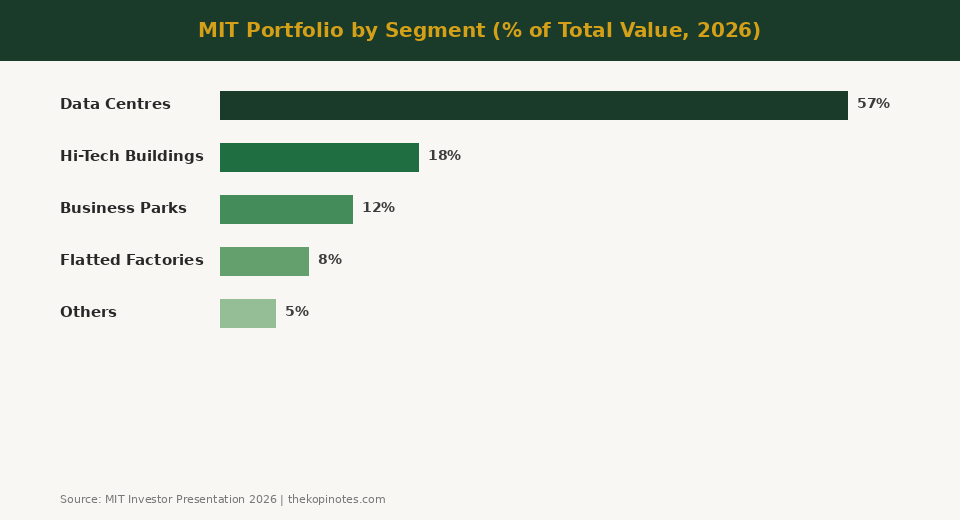
MIT’s portfolio transformation over the past five years has been dramatic. What began as a Singapore flatted factory REIT now derives the majority of its value from data centres — a structural shift with significant implications for growth and income stability.
| Geography | Properties | Key Asset Types |
|---|---|---|
| Singapore | 79 | Flatted factories, hi-tech, business parks, stack-up |
| North America | 55 (incl. 13 DCs) | Data centres (via 50/50 JV with Mapletree Investments) |
| Japan | 2 | Data centre assets |
The 13 North American data centres — held through the 50/50 JV with sponsor Mapletree Investments — account for a disproportionate share of portfolio value (~35–40% of total), despite representing only 25% of property count. This concentration in AI-adjacent infrastructure is a key reason why tech investors have increasingly shown interest in MIT alongside traditional REIT buyers.
Singapore assets (especially business parks and hi-tech buildings) provide income stability and strong occupancy (~92% as of the latest filing), while the US DC portfolio drives value-add growth. Compare this structure with our MIT vs Keppel DC REIT analysis.
Rate-Cut Catalyst: What the Sep 17 FOMC Means for MIT
The US Federal Reserve’s September 17–18, 2026 FOMC meeting is the most important near-term catalyst for MIT. Markets are pricing in a 25–50 basis point cut. Here is how the different scenarios play out:
| FOMC Scenario | DPU Impact | Share Price Reaction |
|---|---|---|
| 25 bps cut (base case) | +~0.2¢/unit/year | Mild positive; largely priced in |
| 50 bps cut (bullish) | +~0.4¢/unit/year | Strong rally across S-REIT sector |
| Hold (bearish) | Neutral to slight drag | Sector-wide selloff likely |
Beyond the direct financing cost savings, lower rates typically compress discount rates applied to REIT cash flows, which mechanically lifts NAV estimates. MIT’s estimated NAV of S$1.85–1.90 could be revised upward if the interest rate cycle turns decisively.
Importantly, MIT’s 75% fixed-rate debt hedging means the DPU uplift from rate cuts is gradual (as fixed-rate tranches mature and are refinanced at lower rates), rather than immediate. The full benefit could take 18–24 months to flow through completely.
Singaporean investors looking to build passive income exposure ahead of FOMC can consider Endowus or Syfe for fractional REIT access, or review our retirement planning calculator to stress-test yield scenarios.
S$500M Divestment Plan: Capital Recycling in Action
MIT’s management announced a S$500M asset divestment programme in FY2025/26, targeting older, lower-yielding Singapore flatted factory and light industrial assets. The rationale is straightforward: recycle capital from mature 5–6% NPI-yield assets into data centre and hi-tech developments delivering 7–9% stabilised yields.
Progress to date:
- Philadelphia data centre divested at US$14.5M (strategic disposal to simplify North American portfolio structure)
- Several Singapore flatted factory clusters identified for sale
- Total divestment completions as of 1Q FY26/27: estimated S$120–160M (programme roughly 25–30% complete)
The near-term DPU impact of divestments is negative — lost income from sold assets exceeds new income from reinvestment within the same quarter. But as recycled capital is deployed into acquisitions or development completions, the income gap closes. Management has guided that the programme will be DPU-accretive on a full-year basis by FY2027/28.
For investors, the key metric to track is the deployment speed of divestment proceeds. Any announcement of a new acquisition (particularly a data centre or hi-tech industrial park) within the next two quarters would be a strong positive catalyst for the share price.
For a comparison of how MIT’s divestment strategy stacks up against other large-cap S-REITs, see our Singapore REIT ETF guide which covers broader sector exposure options.
Risks to Watch
MIT is a well-managed, large-cap S-REIT, but several risks could impair the recovery thesis:
- US DC vacancy: The Hawthorne data centre backfill remains the biggest single risk. If occupancy lags into 2H FY26/27, NPI from the North American portfolio will undershoot estimates. Watch the 2Q FY26/27 results (expected November 2026) for updates.
- FX headwinds: MIT earns USD from its North American DCs. A weaker USD against SGD reduces distributable income in Singapore dollar terms. As of September 2026, roughly 30% of MIT’s income is USD-denominated; management hedges forward, but residual exposure remains.
- Interest rate reversal: If US inflation re-accelerates and the Fed pauses or hikes after September, the rate-cut thesis unwinds and MIT’s floating-rate debt servicing rises.
- Gearing headroom: At 37.5%, MIT has moderate headroom below the 50% regulatory ceiling, but significant debt-funded acquisitions could push gearing higher, limiting future deal capacity.
- Divestment execution risk: In a softer industrial market, achieving target pricing on Singapore flatted factory sales is not guaranteed. A shortfall would delay the capital recycling timeline.
Is MIT a Buy at S$2.08?
TKN Verdict: MIT at S$2.08 offers a near-term yield of ~6.1% and a credible 2H recovery story anchored on rate cuts and divestment-recycling. It trades at a slight premium to estimated NAV (~1.09–1.13x), which is reasonable given its data centre growth optionality. For long-term Singapore dividend investors with a 3–5 year horizon, MIT remains a quality hold-and-accumulate name — particularly if the September FOMC delivers a cut. Short-term traders may prefer to wait for the 2Q FY26/27 results in November for Hawthorne DC clarity. Not a screaming buy, but a dependable income compounder at current levels.
| Metric | MIT (ME8U) | Sector Average |
|---|---|---|
| Yield (FY25/26) | ~6.1% | ~5.8–6.5% |
| Gearing | 37.5% | ~35–42% |
| Data Centre Exposure | ~57% by value | Varies widely |
| Fixed Rate Debt | ~75% | ~70–80% |
Frequently Asked Questions (MIT / ME8U)
What is Mapletree Industrial Trust's current DPU and yield?
Is Mapletree Industrial Trust a data centre REIT?
What is MIT's gearing and is it safe?
How does a Fed rate cut affect MIT's DPU?
Can I buy MIT through CPF or SRS?
What is the S$500M divestment plan?
Start Building Your S-REIT Portfolio
MIT is one building block in a diversified Singapore dividend portfolio. Explore more of our S-REIT deep dives, or open an account with one of our preferred platforms to get started:
This article was researched with the help of AI. While we strive to keep all information accurate and up to date, there may be errors. If you notice any discrepancies, please contact us.