How to Invest in Singapore: The Portfolio Rebalancing Guide (2026)
You set your 65/35 equity-bond allocation last year. Markets ran. Now you’re sitting at 72/28 without lifting a finger. That’s portfolio drift — and ignoring it is one of the most common (and costly) mistakes Singapore investors make.
This guide covers exactly how to rebalance: calendar vs threshold strategies, how CPF, SRS, and cash accounts each play a different role, and a full cost breakdown across IBKR, FSMOne, Endowus, and Syfe.
Table of Contents
What is Portfolio Rebalancing?
When you first invest, you choose an asset allocation that matches your risk tolerance and time horizon — say, 65% global equities and 35% Singapore bonds. Over time, markets move and that ratio shifts. Rebalancing brings it back.
Think of it as routine maintenance. Just as you’d service a car to keep it running well, rebalancing keeps your portfolio aligned with the risk you actually want to take.
Singapore’s Unique Advantage: No Capital Gains Tax
In most countries, rebalancing triggers a taxable event when you sell appreciated assets. Not in Singapore. IRAS does not impose capital gains tax, which means you can sell your winners and rebalance freely without a tax bill. This makes rebalancing cheaper here than almost anywhere else in the developed world.
Why Portfolios Drift — and Why It Matters
Drift happens because different assets grow at different rates. If equities return 15% and bonds return 3% in a year, a 65/35 portfolio quietly becomes a 72/28 portfolio. You’re now taking on more risk than you signed up for — without making any decision to do so.
The problem isn’t just theoretical. More equity exposure means bigger swings. In a market crash, a 72/28 portfolio can drop 30% more steeply than a 65/35 one. For investors close to retirement, that’s the kind of gap that changes plans.
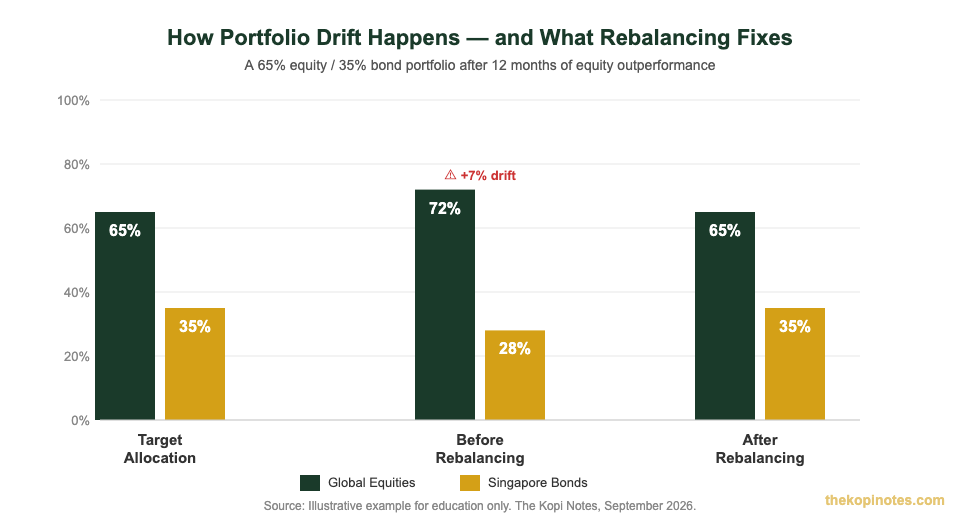
A 65/35 portfolio after 12 months of equity outperformance. Rebalancing restores the original risk profile.
The silver lining: drift creates a natural buy-low opportunity. When you rebalance, you’re selling assets that have run up (trimming high) and buying assets that have lagged (buying low). Done consistently, this can enhance long-term returns.
Calendar vs Threshold Rebalancing Strategies
There are two main approaches. Neither is universally better — the right one depends on how active you want to be and how much you pay per trade.
Calendar Rebalancing
You rebalance on a fixed schedule — once a year, twice a year, or quarterly — regardless of how far your portfolio has drifted. It’s simple and requires minimal monitoring. Most passive investors and robo-advisor users default to this.
| Frequency | Best For | Typical Cost (IBKR) |
|---|---|---|
| Annually | Long-horizon investors, low-cost platforms | S$10 (4 trades) |
| Semi-annually | Moderate volatility portfolios | S$20 |
| Quarterly | Active investors, robo-advisors | S$40 |
Threshold (Band) Rebalancing
You only rebalance when a position drifts beyond a set threshold — typically 5% or 10% from target. This means you might rebalance more often in volatile markets and less often in calm ones. It’s more responsive to actual drift but requires you to monitor your portfolio regularly.
A common hybrid approach: check quarterly, but only rebalance if any asset class is more than 5% off target. This limits transaction costs while preventing significant drift.
How to Rebalance Your Portfolio: Step-by-Step
Step 1: Check Your Current Allocation
Log into your brokerage and note the current market value of each asset class. If you have money across multiple platforms (e.g. Endowus + IBKR), add them together for your total picture.
Step 2: Compare to Target
Calculate each asset’s percentage of your total portfolio. Compare to your target allocation. Any position more than 5% off target is a candidate for rebalancing.
Step 3: Decide Your Method
You have three options: (1) sell overweight assets and buy underweight ones; (2) redirect new contributions to underweight assets until balance is restored; or (3) a combination of both. Option 2 is cheapest — no selling means no transaction costs.
Step 4: Place the Trades
On a low-cost platform like IBKR, this might mean selling some units of CSPX (S&P 500 ETF) and buying ABF Singapore Bond Index Fund. Always check bid-ask spreads and liquidity before trading.
Step 5: Record and Schedule the Next Check
Keep a simple log of your rebalancing: date, trades, new allocation. Set a calendar reminder for your next review. That’s it.
Rebalancing Across CPF, SRS, and Cash Accounts
Most Singapore investors don’t have a single pot of money — they have at least three: a CPF investment account (CPFIS), an SRS account, and a cash brokerage account. Each has different rules, and rebalancing across them requires a different playbook.
CPF (CPFIS-OA / CPFIS-SA)
The CPF Ordinary Account earns a guaranteed 2.5% floor rate. The Special Account earns 4%. Funds invested under CPFIS don’t earn these floor rates, so think carefully before moving CPF money into investments. When rebalancing within CPFIS, you’re limited to CPF-approved investment products — not all ETFs qualify. Your CPF account is also not fungible with cash; you can’t move CPF funds out easily, so treat it as a separate sleeve.
SRS (Supplementary Retirement Scheme)
SRS is tax-advantaged: contributions reduce taxable income in the year made (up to S$15,300 for Singapore citizens and PRs; S$35,700 for foreigners). Withdrawals after statutory retirement age (63, rising to 65 by 2030) are taxed at 50% of the amount withdrawn. This makes SRS ideal for holding growth assets you won’t need until retirement, and for managing rebalancing in a tax-efficient way. Since there’s no capital gains tax on rebalancing and SRS withdrawals are partially sheltered, SRS is a good home for your equity sleeve.
Cash Brokerage (IBKR, FSMOne, etc.)
Your cash account is the most flexible — buy and sell anything, transfer funds freely. Because Singapore has no capital gains tax, rebalancing here is entirely free of tax friction. This is where most active rebalancing happens. Use it for your core ETF holdings and for topping up underweight positions.
1. Rebalance within each account first (cheapest).
2. Direct new contributions to underweight sleeves.
3. Only transfer or sell across accounts if drift is severe (>10%).
For a deeper look at how to use CPF, SRS, and cash in the right order, see our account sequencing guide.
Platform Cost Comparison
How much does rebalancing actually cost? It depends entirely on where your money is and how often you trade. Here’s how the main Singapore platforms compare.
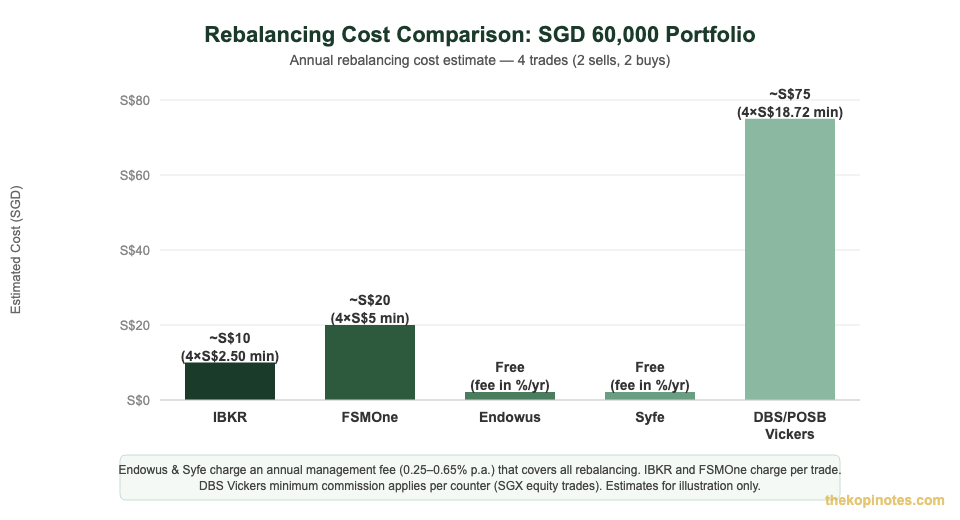
Estimated annual cost to rebalance a SGD 60,000 portfolio with 4 trades across platforms. Robo-advisors bundle rebalancing into their management fee.
IBKR is the cheapest for self-directed investors at S$2.50 minimum per SGX trade (0.08% of trade value, whichever is higher). FSMOne’s minimum is S$5. DBS Vickers minimum is S$18.72 — the most expensive option for small trades. If you use a referral code, you can open an IBKR account with this link (code: jianxiong368).
Robos like Endowus and Syfe include automatic rebalancing in their management fee (0.25–0.65% p.a.). This means there’s no incremental cost per trade — but you do pay the annual fee on your entire balance. For smaller portfolios, the robo fee is often worth the convenience and discipline it provides.
Our Endowus referral code (2V343) and Syfe referral code (SRPRFFFCD) each offer fee-free months for new accounts.
Common Rebalancing Mistakes (and How to Avoid Them)
1. Rebalancing Too Frequently
Monthly rebalancing creates unnecessary transaction costs without meaningfully improving outcomes. Annual or semi-annual is sufficient for most long-horizon investors.
2. Forgetting to Include All Accounts
If you have money in IBKR, Endowus, and your CPF, your true allocation is across all of them. Rebalancing only one account while ignoring the others gives you a false picture.
3. Reacting to Market Moves
The hardest part of rebalancing is selling winners and buying losers. When equities have just run 20%, it feels wrong to trim them. This is exactly when you should. Rebalancing is a rule-based discipline — not a prediction.
4. Ignoring Transaction Costs on Small Portfolios
On a S$10,000 portfolio, a S$10 trade is 0.1% of your balance — which adds up. Direct new contributions to rebalance instead of selling, until your portfolio is large enough for trading costs to be negligible.
5. Changing Your Target Allocation During Volatility
Market crashes are not the time to permanently shift your target allocation. If you’re genuinely reconsidering your risk tolerance, wait for markets to calm before making a structural change — not in the middle of a correction.
Worked Example: SGD 60,000 Portfolio
Let’s run through a real rebalancing exercise. You started with a SGD 60,000 portfolio targeting 65% equities / 35% bonds.
| Asset | Target | Target Value | Current Value | Drift | Action |
|---|---|---|---|---|---|
| Global Equities (VWRA) | 65% | S$39,000 | S$43,800 | +7% | Sell S$4,800 |
| SG Bonds (ABF) | 35% | S$21,000 | S$16,200 | -7% | Buy S$4,800 |
| Total Portfolio | 100% | S$60,000 | S$60,000 | — | 2 trades |
On IBKR, those 2 trades cost S$5 total (2 × S$2.50 minimum). On DBS Vickers, the same rebalancing costs S$37.44 (2 × S$18.72). The allocation is identical either way — only the cost differs.
If you prefer to avoid selling, you’d instead direct your next S$4,800 in contributions entirely to bonds. Same result, zero transaction cost — just takes a few months longer.
For guidance on building this kind of portfolio from scratch, see our beginner’s guide to investing in Singapore and our life-stage investment guide.
Frequently Asked Questions
How often should I rebalance my portfolio in Singapore?
Is portfolio rebalancing taxable in Singapore?
Can I rebalance my CPF investments?
What is a good rebalancing threshold?
Should I rebalance with new contributions or by selling?
Which Singapore platform is cheapest for rebalancing?
Ready to Start Investing in Singapore?
Open an account with one of our recommended platforms and get started with exclusive referral bonuses.
IBKR — Code: jianxiong368
Endowus — Code: 2V343
Syfe — Code: SRPRFFFCD
This article was researched with the help of AI. While we strive to keep all information accurate and up to date, there may be errors. If you notice any discrepancies, please contact us.