CPF Changes 2027 Singapore: Contribution Rates, Retirement Sums & What to Do Now
Updated August 2026 • 8 min read
📋 Table of Contents
CPF is changing again from 1 January 2027. Contribution rates for workers aged 55 to 65 will rise by up to 1.5 percentage points, and the Full Retirement Sum increases to approximately $114,100 for members turning 55 in 2027. The Ordinary Wage ceiling — already raised to $8,000 in 2026 — is set to climb further. Here is every confirmed change and what you should be doing now to prepare.
Not financial advice. All figures are for educational reference only. Data as at August 2026 unless noted.
- CPF contribution rates for ages 55–65 increase from 1 Jan 2027 (up to +1.5 percentage points total)
- The Full Retirement Sum for members turning 55 in 2027 rises to approximately $114,100
- The Ordinary Wage ceiling will rise beyond $8,000 — exact figure to be confirmed by CPF Board
CPF Changes 2027 — The Headline Numbers
Three major changes are coming to CPF on 1 January 2027. All were announced as part of Budget 2026 and are now confirmed by CPF Board.
| Change | Detail | Who It Affects |
|---|---|---|
| Contribution rate increase | +1.5pp (age 55–60), +1pp (age 60–65) | Senior workers & employers |
| Full Retirement Sum | ~$114,100 for members turning 55 in 2027 | Those approaching 55 |
| Ordinary Wage ceiling | Rising above $8,000 — exact figure TBC | Members earning above $8,000/month |
Source: CPF Board, Budget 2026 announcements, August 2026
All three changes push in the same direction: higher CPF contributions, higher retirement targets. For most senior workers, your take-home pay will dip slightly while your retirement nest egg grows faster.
Contribution Rate Increases for Workers Aged 55–65
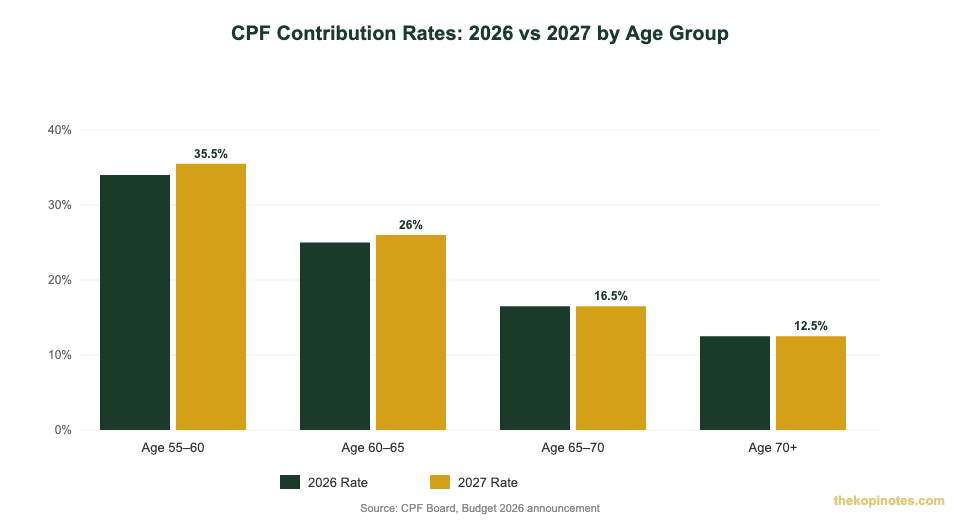
This is the biggest change for senior workers in 2027. CPF contribution rates for employees aged 55 to 65 will increase by up to 1.5 percentage points from 1 January 2027.
Here is the full breakdown by age group:
| Age Group | 2026 Total Rate | 2027 Total Rate | Increase |
|---|---|---|---|
| Above 55 to 60 | 34% | 35.5% | +1.5pp |
| Above 60 to 65 | 25% | 26% | +1pp |
| Above 65 to 70 | 16.5% | 16.5% | No change |
| Above 70 | 12.5% | 12.5% | No change |
Source: CPF Board, “CPF Contribution Changes from 1 January 2027”, Budget 2026
The increase is split between employer and employee. For workers aged 55–60, your employer pays 0.5pp more and you pay 1pp more. For workers aged 60–65, both sides pay 0.5pp more each.
Where does the extra money go? It flows into your Retirement Account (RA) first — up to the Full Retirement Sum. Once your RA hits the FRS, additional contributions go into your Ordinary Account instead, earning 2.5% per year.
The government is cushioning the impact for businesses. The CPF Transition Offset automatically covers half of each employer’s increased cost for eligible Singaporean and PR staff aged 55 to 65. No application needed — it applies automatically for the calendar year 2027.
2027 Retirement Sums: BRS, FRS & ERS
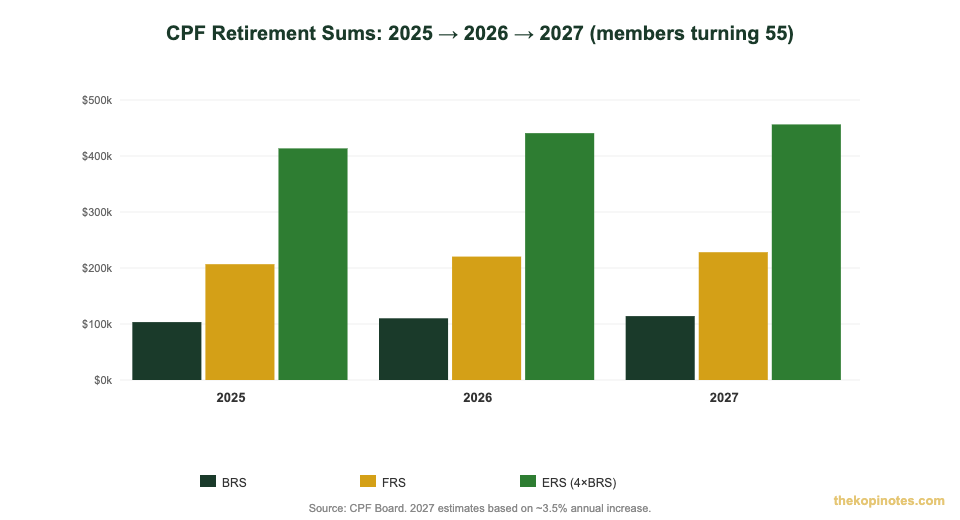
Each year, CPF adjusts the three retirement sums by roughly 3.5% to keep pace with inflation and rising living costs. For members turning 55 in 2027, here are the updated figures:
| Retirement Sum | 2026 Amount | 2027 Amount (est.) |
|---|---|---|
| Basic Retirement Sum (BRS) | $110,200 | ~$114,100 |
| Full Retirement Sum (FRS) | $220,400 | ~$228,200 |
| Enhanced Retirement Sum (ERS) | $440,800 | ~$456,400 |
Source: CPF Board. 2027 figures based on ~3.5% annual increase confirmed for 2027 cohort. Verify exact amounts at cpf.gov.sg.
The BRS is the minimum you need in your RA to start CPF Life payouts from age 65. Most Singaporeans aim for the FRS — it roughly doubles your monthly payout versus the BRS. The ERS (set at 4 times the BRS since 2025) is for those who want the maximum possible CPF Life payout.
If you are turning 55 in 2027 and want to reach the ERS, you need to set aside approximately $456,400 in your RA. You can use our Singapore retirement calculator to check whether you are on track.
For those who want to grow CPF balances faster before age 55, our guide on CPF investment strategy explains how to optimise your accounts.
Ordinary Wage Ceiling Rising Again
The Ordinary Wage (OW) ceiling is the monthly salary cap on which CPF contributions are calculated. In 2026, it jumped from $6,800 to $8,000 — one of the sharpest single-year increases in CPF history.
CPF Board has confirmed the OW ceiling will rise again from 1 January 2027, though the exact new figure had not been published as at August 2026. Based on the government’s phased roadmap, the ceiling is expected to move toward $8,500.
What this means for you: If you earn above $8,000 per month, a higher ceiling means more of your salary attracts CPF contributions. You contribute more to your OA, SA (for those under 55), and Medisave — but take home slightly less each month. If you earn below $8,000, there is no change to your CPF deductions from this adjustment alone.
We will update this article once CPF Board publishes the confirmed 2027 OW ceiling figure.
2026 Changes Recap: What Already Kicked In
Before looking ahead to 2027, here is a quick summary of the big CPF changes that already took effect in 2026.
| 2026 Change | What Happened |
|---|---|
| OW ceiling raised to $8,000 | Higher CPF contributions for those earning above $6,800 |
| ERS raised to 4× BRS ($440,800) | Higher voluntary top-up limit for maximum CPF Life payouts |
| BHS increased to $79,000 | Medisave savings target raised for members aged 65 and below |
| MMSS pilot launched | Government matches voluntary MediSave top-ups for ages 55–70, up to $1,000/year |
| MRSS expanded | Retirement savings scheme extended to members with disabilities of all ages |
Source: CPF Board, DBS, Budget 2026, August 2026
If you are aged 55 to 70, the MMSS (Matched MediSave Scheme) is one of the easiest wins in 2026. The government matches your voluntary cash top-ups to your MediSave account, dollar-for-dollar, up to $1,000 per year. That is free money — make sure you are using it.
What These CPF Changes Mean for Your Retirement
More CPF contributions is broadly good for your retirement. But you need to understand the real-world numbers.
If you are aged 55–60: Your total CPF contribution rate rises to 35.5% from January 2027. On a $7,000 monthly salary, that is $2,485 going into CPF — up from $2,380. The extra $105 per month adds up to $1,260 per year, all flowing into your RA to boost your future CPF Life payout.
If you are aged 60–65: Your total rate rises to 26%. The extra contributions go to your RA first. If you have already set aside your FRS, excess flows to your OA where it earns a guaranteed 2.5% per year.
The CPF gap is real. Even with these increases, CPF alone may not fully cover your retirement expenses — especially if you want to maintain your current lifestyle. CPF Life at the FRS pays roughly $1,200–$1,300 per month from age 65. That is a solid foundation, but for many Singaporeans it is not enough on its own.
Many people close the gap by combining CPF Life with SRS (Supplementary Retirement Scheme) investing, dividend stocks, or S-REITs. For more ideas on building passive income in Singapore, platforms like Endowus (referral code: 2V343) or Syfe (referral code: SRPRFFFCD) let you invest your SRS funds in diversified portfolios alongside your CPF savings.
3 Actions to Take Before 2027
With 2027 just months away, here are three concrete steps worth taking now.
1. Check your RA balance against the FRS target. If you are turning 55 before 31 December 2027, your FRS target is approximately $228,200. Log into the CPF app and see where you stand. If there is a shortfall, a voluntary cash top-up before year-end could help close it — and you may qualify for tax relief of up to $8,000 on top-ups made to yourself.
2. Use the MMSS before the year ends. If you are aged 55–70, make a voluntary top-up to your MediSave account before 31 December 2026. The government matches it dollar-for-dollar up to $1,000. Check your current MediSave balance first — contributions above the BHS ($79,000 for 2026) are not eligible.
3. Plan for the take-home pay adjustment. If you are 55–65, your take-home pay will dip slightly from January 2027 as your employee CPF contribution increases by 0.5–1%. Use a retirement planning calculator to model how the higher contributions compound over time. The long-term retirement benefit far outweighs the short-term income dip.
Frequently Asked Questions: CPF Changes 2027
What are the main CPF changes taking effect in 2027?
How much more will my CPF contribution increase if I am aged 55–60?
What is the Full Retirement Sum for 2027?
Will the OW ceiling increase affect me if I earn below $8,000 per month?
What is the CPF Transition Offset and how does it help employers?
Is there anything I need to do to benefit from the higher 2027 CPF contribution rates?
This article was researched with the help of AI. While we strive to keep all information accurate and up to date, there may be errors. If you notice any discrepancies, please contact us.