Diversified Commodity ETF Guide for Singapore Investors (2026)
ICOM vs CMOD vs DBC — one fund for gold, oil, copper and grains, and how to buy it tax-efficiently from Singapore.
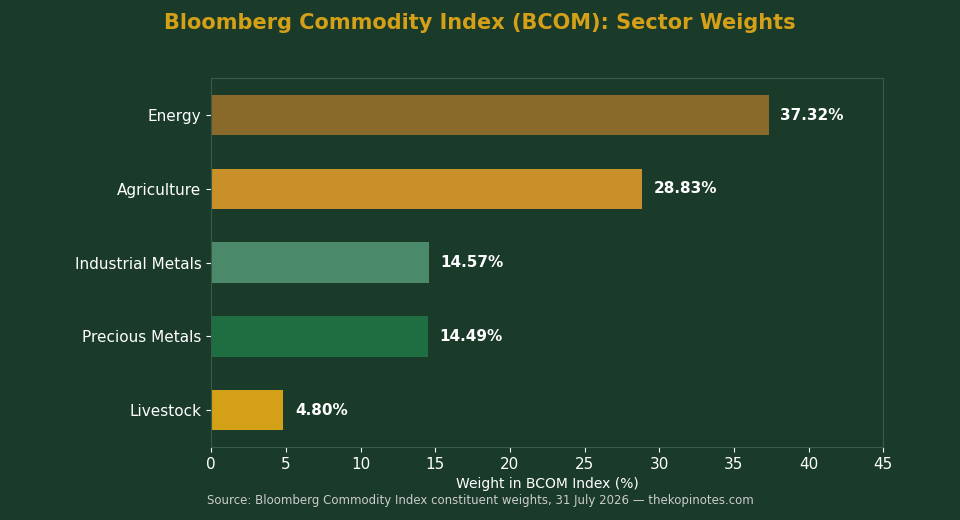
Diversified commodity ETFs like iShares ICOM and Invesco CMOD bundle gold, oil, copper, and grains into a single Ireland-domiciled fund tracking the Bloomberg Commodity Index. Singapore investors buy them on the London Stock Exchange to capture 2026’s broad commodity rally without picking individual winners. At a 0.19% expense ratio, they cost far less than the K-1-issuing US alternative, DBC, which charges 0.89%.
Not financial advice. All figures are for educational reference only. Data verified as at August 2026 unless noted.
- ICOM and CMOD give you gold, oil, copper and grains in one fund at a 0.19% TER — cheaper than buying single-commodity ETFs one by one.
- 2026’s rally is broad: gold is tracking toward Morgan Stanley’s US$4,400/oz forecast, silver is up roughly 96% year-to-date, and copper faces a ~590,000-tonne supply deficit driven by AI data centre demand.
- Buy on the LSE via IBKR, Saxo, or Syfe. Skip the US-listed DBC unless you’re prepared to file a Schedule K-1 form every year.
What Is Diversified Commodity Investing?
A “diversified” or “broad basket” commodity ETF holds futures contracts across many commodities and sectors instead of tracking just one, like gold or oil. Most track the Bloomberg Commodity Index (BCOM), a benchmark that spans energy, precious metals, industrial metals, agriculture, and livestock. Instead of betting on a single commodity, you own a slice of all of them, weighted by production and market liquidity.
The two main London Stock Exchange (LSE) options for Singapore investors — iShares Diversified Commodity Swap UCITS ETF (ICOM) and Invesco Bloomberg Commodity UCITS ETF (CMOD) — both track BCOM but use a swap-based (synthetic) structure. Neither fund holds the physical commodities or futures directly. Instead, each enters into a total return swap agreement with counterparty banks, which pay the fund the index’s return in exchange for a fee. That keeps costs low and avoids the K-1 tax paperwork attached to US-listed commodity pool structures.
Both funds are accumulating, meaning any income generated is reinvested automatically rather than paid out as cash — useful if you’re building long-term wealth and don’t need the income today.
Why Broad Commodity ETFs Are Trending in 2026
2026 has been an unusually broad commodity rally — not just gold, but silver, copper, and agricultural commodities are moving together. That’s exactly the environment a diversified commodity ETF is built for.
Gold has been the headline story. Morgan Stanley raised its 2026 gold forecast to US$4,400 per ounce, up sharply from its earlier US$3,313 call, citing anticipated Federal Reserve rate cuts, a weaker US dollar, and steady central bank buying (Morgan Stanley, 2026). Every 50 basis points of Fed easing adds roughly US$120 per ounce of price support to gold, according to Goldman Sachs estimates.
But silver and copper have actually outpaced gold this year. Silver is up roughly 96% year-to-date on a historic London supply crunch driven by Indian and ETF demand — you can see the full picture in our Singapore gold ETF guide. Copper’s rally is more structural: analysts project a global copper deficit in 2026 as AI data centre construction and renewable-energy grids pull supply away from traditional buyers, a theme we cover in our copper ETF guide for Singapore investors.
For a Singapore investor, this broad-based move is the point: guessing whether gold, silver, copper, or wheat leads the next leg is genuinely hard. A diversified commodity ETF removes that guesswork. You get exposure to all of it in the proportions the index rules define, rebalanced automatically once a year.
Best Diversified Commodity ETFs for Singapore Investors
Three funds cover most of what Singapore investors need to know about broad commodity exposure — two Ireland-domiciled UCITS ETFs on the LSE, and one US-listed alternative that’s cheaper to buy but more expensive to hold.
iShares Diversified Commodity Swap UCITS ETF (ICOM) is BlackRock’s LSE-listed option, tracking the Bloomberg Commodity Index Total Return with a 0.19% TER and net assets of USD 2.34 billion as at 26 August 2026 (iShares ICOM factsheet).
Invesco Bloomberg Commodity UCITS ETF (CMOD) tracks the same index, charges the same 0.19% TER, and is actually the larger of the two funds at roughly EUR 3.69 billion (justETF CMOD profile, August 2026). For most Singapore investors, ICOM and CMOD are close substitutes — check which one your broker lists with tighter bid-ask spreads.
Invesco DB Commodity Index Tracking Fund (DBC), listed on NYSE Arca, tracks a different benchmark (the DBIQ Optimum Yield index) and is structured as a US commodity pool. That structure means non-US holders receive a Schedule K-1 each year — an annual US partnership tax form most Singapore investors would rather avoid — and its 0.89% TER is more than four times ICOM’s or CMOD’s (etfdb.com, June 2026). A third US option, iShares S&P GSCI Commodity-Indexed Trust (GSG), shares DBC’s K-1 structure and skews even more heavily toward energy — it doesn’t solve the tax-paperwork problem either.
| Feature | ICOM (LSE) | CMOD (LSE) | DBC (NYSE Arca) |
|---|---|---|---|
| Full Name | iShares Diversified Commodity Swap UCITS ETF | Invesco Bloomberg Commodity UCITS ETF | Invesco DB Commodity Index Tracking Fund |
| Index Tracked | Bloomberg Commodity Index TR | Bloomberg Commodity Index | DBIQ Optimum Yield Diversified Commodity Index |
| Domicile | Ireland | Ireland | United States (Delaware) |
| Structure | Synthetic (swap-based) | Synthetic (swap-based) | Commodity pool / limited partnership |
| TER | 0.19% p.a. | 0.19% p.a. | 0.89% p.a. |
| Fund Size | USD 2.34bn (26 Aug 2026) | EUR 3.69bn (Aug 2026) | USD 1.87bn (Jun 2026) |
| Launch Date | 18 Jul 2017 | 9 Jan 2017 | Feb 2006 |
| Distribution | Accumulating | Accumulating | N/A — futures fund |
| Tax Form for SG Investors | None | None | Schedule K-1 (annual) |
Source: iShares ICOM factsheet (26 Aug 2026); justETF CMOD profile (Aug 2026); etfdb.com DBC data (Jun 2026).
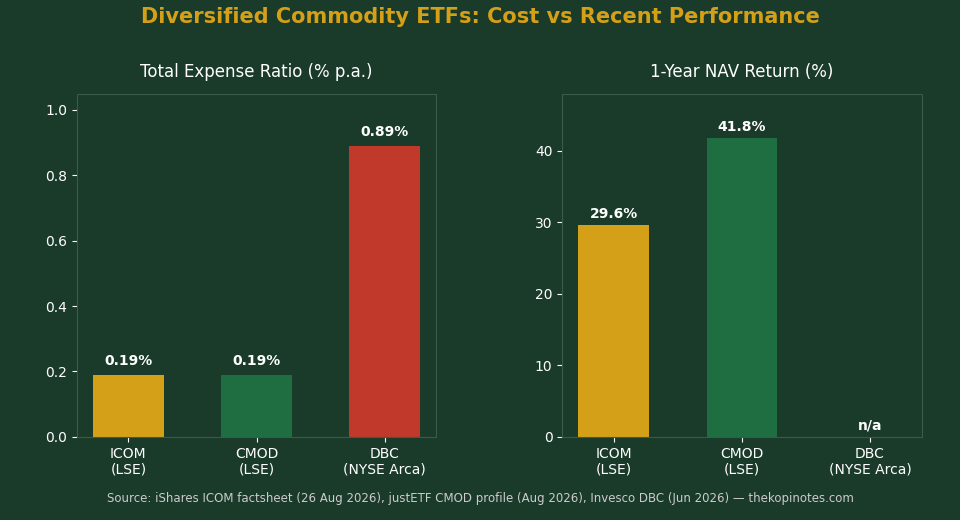
The Bloomberg Commodity Index itself isn’t evenly split across sectors — energy carries the single largest weight, though index rules cap any related group at 33% and any single commodity at 15% to prevent over-concentration.
| Sector | Weight in BCOM (31 Jul 2026) |
|---|---|
| Energy | 37.32% |
| Agriculture (grains, softs) | 28.83% |
| Industrial Metals | 14.57% |
| Precious Metals | 14.49% |
| Livestock | 4.80% |
Source: Bloomberg Commodity Index constituent weights, 31 July 2026.
On a SGD 50,000 position, ICOM or CMOD’s 0.19% TER costs about SGD 95 a year. The same position in DBC, at 0.89%, costs about SGD 445 a year — a SGD 350 gap before you even account for the extra admin of filing a US Schedule K-1 as a foreign holder. For most Singapore investors, that math alone settles the ICOM/CMOD-versus-DBC question.
How to Buy Diversified Commodity ETFs in Singapore
Both ICOM and CMOD trade on the LSE in USD and GBP share classes — make sure you select the correct currency listing, since GBP tickers (COMM for ICOM, CMOP for CMOD) and USD tickers use different codes.
Interactive Brokers (IBKR) is typically the most cost-effective choice for larger, buy-and-hold positions thanks to its low commission structure on LSE trades and tight FX conversion spreads. Fund your account, search “ICOM” or “CMOD,” select the London Stock Exchange listing, and place your order in USD.
Saxo Markets offers a similarly wide range of LSE tickers with a more beginner-friendly interface, though its commission structure suits less frequent traders better than active accumulators.
Syfe Brokerage and moomoo Singapore both list ICOM and CMOD and can work well for smaller, regular purchases. Compare their FX conversion fees carefully — on a USD-denominated fund, currency conversion often costs more than the trading commission itself. Syfe is a good pick if you want a simpler all-in-one platform for both ETFs and cash management.
Neither fund is CPFIS-approved, so you cannot use CPF Ordinary Account savings to buy them. Both are generally SRS-compatible if your broker supports overseas ETF purchases through your SRS account — check with your provider before assuming eligibility, and see our CPF investment strategy guide for what CPF money can and can’t buy.
Risks to Consider
Commodities are volatile and don’t produce dividends, interest, or earnings the way stocks and bonds do. Returns come purely from spot price changes and futures roll yield, which can turn negative in a contango market — when futures prices sit above spot prices, the fund effectively pays a cost to keep rolling its contracts forward.
ICOM and CMOD also carry swap counterparty risk since they use synthetic replication rather than holding physical assets or futures directly. If a swap counterparty bank defaults, the fund’s ability to track the index could be disrupted, though both funds use multiple counterparties and require collateral to limit this exposure.
The Bloomberg Commodity Index is currently around 37% weighted to energy, so a sharp oil or natural gas price crash would drag down the whole basket even if metals and agriculture are rallying. And because these funds are USD-denominated, Singapore investors carry USD/SGD currency risk on top of the underlying commodity moves — a stronger SGD erodes returns when converted back home, and a weaker SGD amplifies them.
Finally, remember why Singapore investors generally prefer Ireland-domiciled, LSE-listed funds over US-listed ones in the first place — read our breakdown of why Singapore investors prefer Ireland-domiciled ETFs over US-listed alternatives for the fuller picture on withholding tax and estate tax exposure, which applies to equity ETFs even if the K-1 issue here is specific to DBC’s partnership structure.
Frequently Asked Questions
What is a diversified commodity ETF and why do Singapore investors buy it?
A diversified commodity ETF holds a basket of commodity futures — energy, metals, and agriculture — instead of tracking a single one like gold. Singapore investors buy funds like ICOM or CMOD because they’re Ireland-domiciled, list on the London Stock Exchange, and give one-ticket access to a 2026 commodity rally spread across gold, silver, copper, and grains rather than concentrated in one asset.
Is ICOM the same as CMOD?
Not quite, though they’re very similar. Both iShares’ ICOM and Invesco’s CMOD track the Bloomberg Commodity Index, charge a 0.19% TER, and use a synthetic swap structure domiciled in Ireland. The main differences are fund size — CMOD is larger, at roughly EUR 3.69 billion versus ICOM’s USD 2.34 billion — and swap counterparty. For most Singapore investors, either works; check which one your broker lists with tighter spreads.
Can I buy diversified commodity ETFs using my CPF or SRS funds?
No, LSE-listed ETFs like ICOM and CMOD are not on the CPFIS list of approved investments, so you cannot use CPF Ordinary Account savings to buy them. They’re generally SRS-compatible if your SRS operator or brokerage supports overseas ETF purchases — check with your broker before assuming eligibility.
Which broker is best for buying ICOM or CMOD in Singapore?
Interactive Brokers (IBKR) is typically the most cost-effective for larger, buy-and-hold positions because of its low commission structure on LSE trades. Saxo Markets offers a wider range of LSE tickers with a simpler interface. Syfe Brokerage and moomoo also list both funds and can work well for smaller, regular purchases — compare their FX conversion fees, which matter more than commission on a USD-denominated fund.
Is DBC a better choice than the LSE-listed UCITS options?
For most Singapore investors, no. DBC’s 0.89% TER is more than four times ICOM’s or CMOD’s 0.19%, and as a US commodity pool it issues a Schedule K-1 each year — extra paperwork that most SG-based investors would rather avoid. DBC can make sense if your broker doesn’t offer LSE access at all, but that’s increasingly rare.
What are the risks of diversified commodity ETFs?
Commodities are volatile and don’t produce dividends, interest, or earnings the way stocks and bonds do — returns come purely from price changes and futures roll yield, which can be negative in a contango market. ICOM and CMOD also carry swap counterparty risk since they use synthetic replication, and the Bloomberg Commodity Index is currently around 37% weighted to energy, so an oil price crash would drag down the whole basket even if metals are rallying.
Ready to Diversify Beyond Stocks and Bonds?
Open a brokerage account and add broad commodity exposure to your portfolio. Use our referral link for an exclusive sign-up bonus.
This article was researched with the help of AI. While we strive to keep all information accurate and up to date, there may be errors. If you notice any discrepancies, please contact us.