TribeCar + Trust Bank + Endowus: The 3-Step Car-to-Cash-to-Growth Pipeline (2026)
Skip car ownership, bank the savings, then invest the surplus — a step-by-step cash flow plan for Singapore
Skipping car ownership through TribeCar’s car-sharing model can free up roughly S$1,278.84 a month for a typical Singapore household. Rather than letting that cash sit idle, a 3-step pipeline works better: park it in Trust Bank first to build an emergency buffer at up to 2.40% p.a., then redirect the ongoing surplus into Endowus once that buffer is full, where CPF/SRS access fees start at 0.40% p.a. and cash fees start at 0.60% p.a.
Not financial advice. All figures are for educational reference only. Data as at August 2026 unless noted.
- TribeCar can free up about S$1,278.84/month versus owning a car outright in 2026 — that’s real cash you can redirect
- Park the first 6–8 months of savings in Trust Bank (up to 2.40% p.a.) to build a S$10,000 buffer before you invest anything
- Once your buffer is full, send new surplus to Endowus so it isn’t just sitting idle earning near-zero interest
Contents — Click to expand
- Why Skipping Car Ownership Frees Up Real Money
- Step 1: TribeCar — Turn Your Car Payment Into Monthly Cash
- Step 2: Trust Bank — Build Your Buffer at Up to 2.40% p.a.
- Step 3: Endowus — Put the Surplus to Work
- The Numbers: Park-Only vs the 3-Step Pipeline
- What About a Lump Sum? S$20,000 Idle Cash Comparison
- Who Should Use This Pipeline (and Who Shouldn’t)
- How to Start All Three in One Weekend
- Frequently Asked Questions
Why Skipping Car Ownership Frees Up Real Money
Owning a car in Singapore is expensive. Between the Certificate of Entitlement (COE), loan interest, insurance, parking, and petrol, most owners spend well over S$1,600 a month just to keep a car on the road.
In the second COE bidding exercise of August 2026, Category A (cars up to 1,600cc) closed at S$128,501. That’s before you even pay for the car itself. Add loan interest, insurance, and running costs, and the true monthly cost of ownership for a typical mid-size car works out to roughly S$1,672.84.
TribeCar’s car-sharing model replaces that with pay-per-use access, averaging around S$394 a month for someone with moderate driving needs (a few trips a week, not a daily commute). That leaves a gap of S$1,278.84 a month — cash that used to disappear into car ownership and now sits in your bank account instead.
Here’s the problem this article solves: most people who make this switch either let the freed-up cash sit in a low-interest current account, or they jump straight into investing it without any buffer. Both are mistakes. What you actually need is a sequence — a pipeline. That’s what Steps 1 to 3 below walk through.
Step 1: TribeCar — Turn Your Car Payment Into Monthly Cash
TribeCar is a peer-to-peer and fleet car-sharing platform that lets you book a car by the hour or day, instead of owning one outright. You pay only when you drive, and there’s no COE, no loan, no insurance premium, and no parking season fee to worry about.
For someone who drives a few times a week — weekend errands, the occasional airport run, visiting family — TribeCar access typically costs around S$394 a month. Compare that to the S$1,672.84 a month it costs to own and run a mid-size car in 2026, and the gap is substantial.
This isn’t a call to give up driving. It’s a reallocation. The S$1,278.84 difference doesn’t vanish — it becomes available cash flow that you get to decide what to do with. That decision is where Steps 2 and 3 come in.
Step 2: Trust Bank — Build Your Buffer at Up to 2.40% p.a.
Before you invest a single dollar, you need a cash buffer. This is money for emergencies — a medical bill, a job gap, an urgent home repair — that you can access instantly without selling investments at a bad time.
Trust Bank is a good home for this buffer because of its bonus interest structure. As at August 2026, Trust Bank pays a base rate of 0.05% p.a., plus bonus interest of up to +2.35% p.a. for a total of up to 2.40% p.a. on balances up to S$1.2 million — a far higher cap than most competing digital banks.
You choose from three plans: Flex (pick any 3 bonus categories from a longer list), Signature (fixed to salary credit, card spending, and saving), or Zen (a flat 0.50% p.a. with zero conditions). If you already credit your salary and spend on a card monthly, hitting 3 bonus categories — salary credit, S$500 card spend, and a rising month-on-month balance — gets you to the full 2.40%.
Here’s the plan: redirect your entire S$1,278.84 monthly TribeCar saving into Trust Bank for the first 6–8 months. At that pace, you’ll have roughly S$10,231 banked by month 8 — a reasonable starter emergency fund for most single people or couples without dependents. Your Singapore dollar deposits here are also protected by the Singapore Deposit Insurance Corporation (SDIC) for up to S$100,000 per depositor, per SDIC.
Only once that buffer is built do you move to Step 3.
Step 3: Endowus — Put the Surplus to Work Once Your Buffer Is Full
Once your Trust Bank buffer hits its target, every additional dollar of TribeCar savings is surplus — money you won’t need on short notice. Leaving it in a savings account, even at 2.40%, means it barely keeps pace with inflation over the long run. This is where Endowus comes in.
Endowus is a robo-advisor style platform that gives you access to institutional-class unit trusts and ETF portfolios, and — unusually for Singapore — lets you invest using CPF Ordinary Account, SRS, and cash, all through one platform. As at August 2026, Endowus charges a flat 0.40% p.a. access fee for CPF and SRS investments, while cash investments use a tiered fee starting at 0.60% p.a. for the first S$200,000 and stepping down to 0.50%, 0.35%, and 0.25% at higher tiers. Short-Term Cash Management goals (their cash-parking fund options) charge a flat 0.15% p.a. regardless of how many funds you hold.
There are no sales charges, no switching fees, and Endowus rebates 100% of the trailer commissions that fund managers would otherwise keep. On top of the access fee, the underlying funds themselves carry expense ratios, typically 0.10%–0.50% p.a. for the institutional share classes available on the platform.
Redirecting your post-buffer TribeCar savings here — instead of letting it accumulate in a savings account — is what turns a car-ownership decision into a long-term wealth-building habit.

The Numbers: Park-Only vs the 3-Step Pipeline
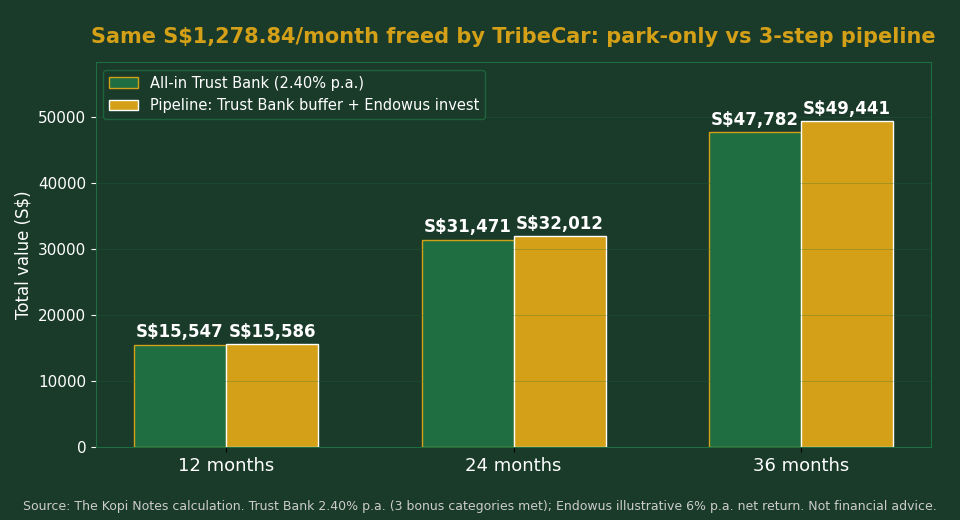
How much difference does the 3-step approach actually make compared to just leaving everything in Trust Bank indefinitely? We ran the numbers on the same S$1,278.84 monthly TribeCar saving, comparing two paths:
| Timeframe | All-in Trust Bank (2.40% p.a.) | 3-Step Pipeline (buffer + Endowus invest) | Difference |
|---|---|---|---|
| 12 months | S$15,547.05 | S$15,585.68 | +S$38.63 |
| 24 months | S$31,471.36 | S$32,011.75 | +S$540.39 |
| 36 months | S$47,782.09 | S$49,441.49 | +S$1,659.40 |
Source: The Kopi Notes calculation, August 2026. Assumes 8-month S$10,230.72 buffer built in Trust Bank at 2.40% p.a., remaining monthly contributions invested via Endowus at an illustrative 6% p.a. net return. Not financial advice.
The gap widens over time — from about S$39 after year one to over S$1,650 after three years — because the invested portion compounds at a higher rate once it moves past the buffer stage. This is a modest, not dramatic, illustration deliberately: the point of the pipeline isn’t to gamble the buffer, it’s to stop long-term surplus cash from sitting idle once the safety net is already in place.
What About a Lump Sum? S$20,000 Idle Cash Comparison
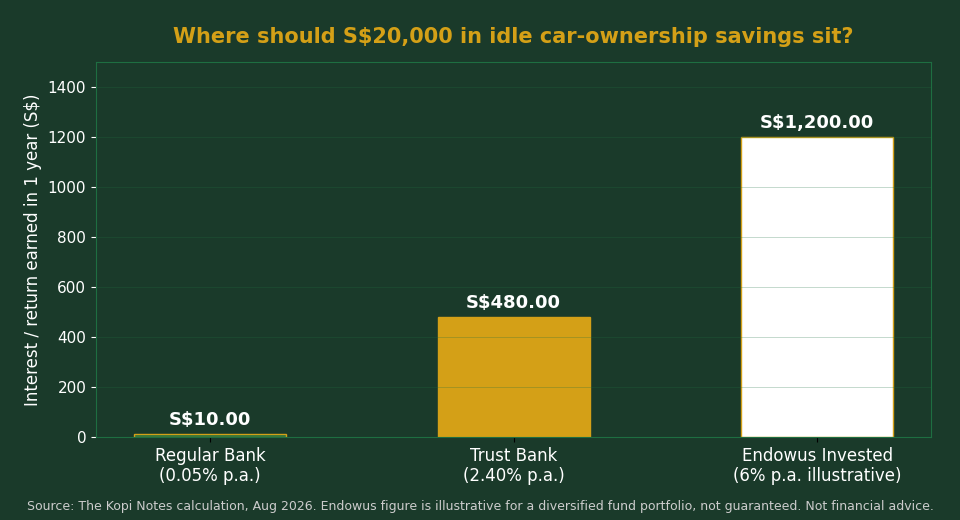
Say you’ve already built a S$20,000 buffer — maybe from selling your old car, or from a bonus. Where should that sit for the next year? Here’s the same comparison, but as a one-off lump sum instead of a monthly drip:
| Where S$20,000 sits | Rate | 1-Year Return |
|---|---|---|
| Regular bank savings account | 0.05% p.a. | S$10.00 |
| Trust Bank (3 bonus categories met) | 2.40% p.a. | S$480.00 |
| Endowus (invested, illustrative) | 6% p.a. | S$1,200.00 |
Source: The Kopi Notes calculation, August 2026. Endowus figure is illustrative for a diversified fund portfolio net of fees, not guaranteed — actual returns vary with markets. Not financial advice.
This is exactly why the pipeline separates buffer money from surplus money. Your buffer needs to stay liquid and capital-safe — that’s what Trust Bank is for. Your surplus, money you genuinely won’t need for years, can afford to take on some market risk in exchange for a meaningfully higher expected return via Endowus.
Who Should Use This Pipeline (and Who Shouldn’t)
This 3-step approach works best if you:
- Drive infrequently enough that TribeCar’s pay-per-use model genuinely costs less than car ownership for your usage pattern
- Don’t already have a fully-funded emergency buffer of 3–6 months of expenses
- Can commit to a multi-year horizon before touching the invested portion
- Already have (or can set up) salary crediting and regular card spending, to unlock Trust Bank’s full bonus rate
It’s probably not for you if:
- You drive daily for work or have a large family that needs a car on standby — TribeCar’s per-use pricing adds up fast under heavy usage
- You already have a solid emergency fund and just need a place to grow surplus cash — in that case, skip straight to Endowus directly and skip the buffer-building step
- You need the invested money within the next 1–2 years — short time horizons don’t suit market-linked returns, and you’re better off keeping it all in Trust Bank or a T-bill
How to Start All Three in One Weekend
Setting this pipeline up doesn’t take long. Here’s a realistic weekend plan:
Saturday morning: Sign up for TribeCar
Download the TribeCar app, verify your driving licence, and browse available vehicles near you. Use referral code zZDeg during sign-up. Book your first trip to get a feel for the booking flow before you commit to giving up your own car.
Saturday afternoon: Open your Trust Bank account
Download the Trust app, verify your identity via Singpass, and enter referral code HTWYQP95. Choose the Signature plan if you already have salary crediting and card spending sorted, or Flex if you want to pick your own 3 bonus categories. Set up a standing instruction to transfer your TribeCar savings here every month.
Sunday: Open your Endowus account (but don’t fund it yet)
Sign up for Endowus using referral code 2V343 and complete the risk profiling questionnaire so your account is ready. Don’t transfer money in yet — wait until your Trust Bank buffer hits your target (roughly 6–8 months of TribeCar savings), then start directing new surplus here instead.
For a deeper walkthrough of Endowus itself — fees, CPF/SRS access, and fund choices — our TribeCar + Endowus guide (linked below) covers the direct two-platform version of this strategy in more detail, and our dedicated Trust Bank guide (also linked below) explores its full rate breakdown against GXS and MariBank.
Once your CPF and retirement planning are in shape, you may also want to revisit your broader strategy using our CPF investment strategy guide (linked below) and model your long-term numbers with the retirement planning calculator.
Frequently Asked Questions
How much money does switching from car ownership to TribeCar actually free up?
Why park the savings in Trust Bank first instead of investing immediately?
What is Trust Bank's maximum interest rate and how do I earn it?
What does Endowus charge in fees?
How big should my Trust Bank buffer be before I start investing?
Is TribeCar actually cheaper than owning a car for everyone?
Can I use CPF or SRS money in this pipeline?
Related Digital Bank Guides on The Kopi Notes
This article was researched with the help of AI. While we strive to keep all information accurate and up to date, there may be errors. If you notice any discrepancies, please contact us.