IREIT Global 1H2026 Results: DPU Falls 48% YoY to €0.37 Cents as Leverage Hits 45.5% (SGX: UD1U)
A euro-denominated small-cap S-REIT is quietly testing the edges of MAS’s revised leverage rules. Here’s what the 1H2026 numbers actually show.
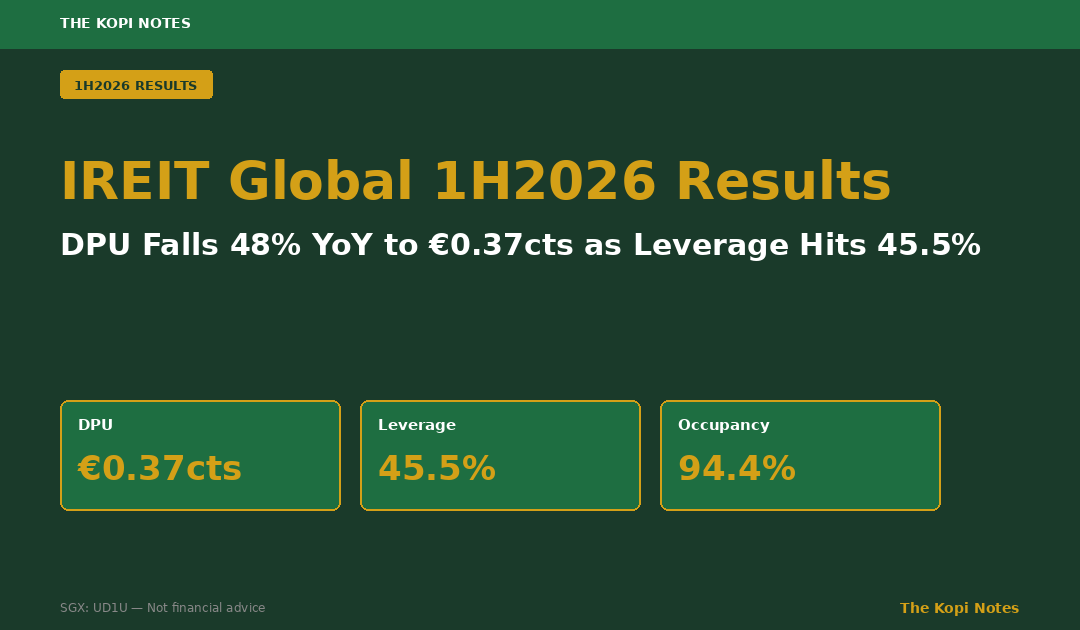
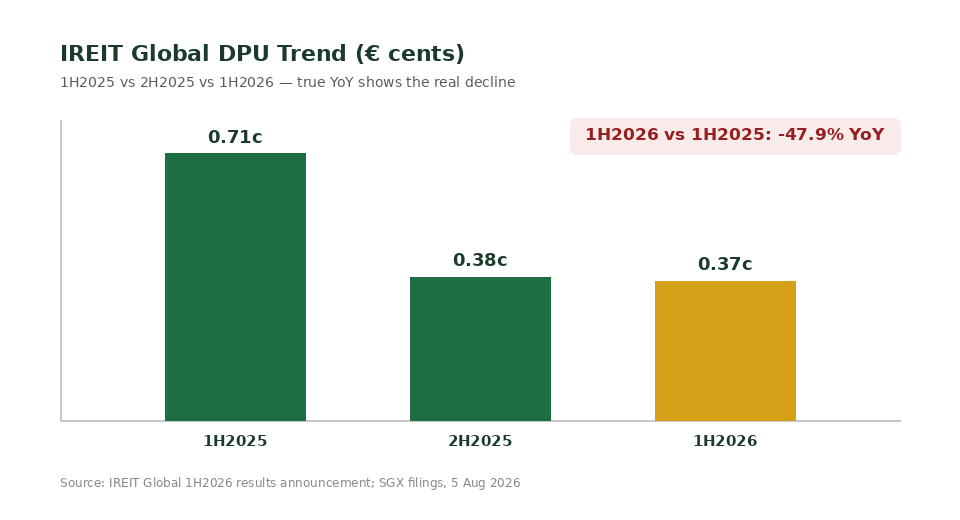
IREIT Global (SGX: UD1U) reported 1H2026 distribution per unit (DPU) of €0.37 cents, down 2.6% from €0.38 cents in 2H2025 — but down a much sharper 47.9% from €0.71 cents in 1H2025. Aggregate leverage climbed to 45.5% and interest coverage fell to 1.8x, both moving closer to MAS’s regulatory limits, even as occupancy improved to 94.4% (excluding Berlin Campus).
Not financial advice. All figures are for educational reference only. Data as at August 2026 unless noted, sourced from IREIT Global’s 1H2026 results announcement (5 August 2026).
- DPU is down 47.9% year-on-year — the half-on-half comparison most reports lead with (-2.6%) hides how much distributions have fallen since 1H2025.
- Leverage (45.5%) and interest coverage (1.8x) are both drifting toward MAS’s regulatory limits (50% cap, 1.5x floor) — not breached, but headroom is shrinking fast.
- Occupancy is genuinely improving (94.4% ex-Berlin) and the Berlin Campus repositioning is on track for 3Q2027 — the operating story is better than the balance sheet story.
Table of Contents
What Is IREIT Global?
1H2026 Results: The Numbers
Why the YoY Number Matters More Than HoH
Leverage and Interest Coverage: How Close to the Limit?
Berlin Campus and Occupancy Recovery
Refinancing Outlook
Should You Hold or Buy IREIT Global?
FAQs
What Is IREIT Global?
IREIT Global (ticker: UD1U) is a Singapore-listed REIT that owns office, retail, and mixed-use properties in Germany and Spain. If you’ve never heard of it, that’s fair — it’s one of the smaller S-REITs, with a portfolio worth about €792.1 million (roughly S$1.16 billion), and it reports its results in euros, not Singapore dollars.
You’ll usually see IREIT Global grouped with a handful of other overseas-focused small-cap S-REITs like Elite UK REIT and United Hampshire US REIT. These REITs give you exposure to foreign real estate through a Singapore-listed vehicle, but they also come with extra layers of risk — currency exposure, foreign interest rates, and local European leasing dynamics that most Singapore investors don’t track closely.
That’s exactly why the 1H2026 results matter. The headline numbers look “stable” if you only compare this half to the last one. Compare it to a year ago, and the picture changes.
1H2026 Results: The Numbers
Here’s the full financial snapshot IREIT Global released on 5 August 2026, covering the six months to 30 June 2026:
| Metric | 1H2026 | 2H2025 | HoH Change |
|---|---|---|---|
| Gross Revenue | €25.97m | €23.87m | +8.8% |
| Net Property Income | €17.09m | €14.82m | +15.3% |
| Finance Costs | €7.02m | €4.56m | +53.7% |
| Income Available for Distribution | €5.02m | €5.11m | -1.9% |
| DPU | €0.37 cents | €0.38 cents | -2.6% |
Source: IREIT Global 1H2026 results announcement, 5 August 2026.
Net property income actually grew a healthy 15.3% half-on-half — the underlying properties are performing better. The problem sits below the operating line: finance costs jumped 53.7% in the same period, chewing through almost all of that NPI gain before it reaches unitholders.
Why the YoY Number Matters More Than HoH
Most coverage of these results led with the half-on-half comparison: DPU “only” fell 2.6% from 2H2025. That’s technically accurate. It’s also misleading if you’re a unitholder trying to figure out whether your income has actually shrunk.
Go back one full year, to 1H2025, and DPU was €0.71 cents. That means 1H2026’s €0.37 cents is 47.9% lower than a year ago — not a rounding error, a near-halving of your half-year payout.
Why the gap between the two numbers? Berlin Campus was already largely vacant through 1H2025 as the hotel-conversion project began, so 2H2025 was already a depressed base to compare against. If you only look at HoH change, you’re comparing a bad half to another bad half and calling it “stable.” The YoY comparison against a stronger, pre-repositioning 1H2025 shows the real scale of the income hit unitholders have absorbed over the past 12 months.
This matters if you’re relying on IREIT Global for passive income. A REIT that looks “stable” quarter-to-quarter can still be paying you roughly half of what it paid a year ago — check the full-year trend, not just the most recent comparison, before you judge a REIT’s distribution reliability. For a broader view of how S-REITs stack up on distribution consistency, see our guide to the best S-REITs in Singapore 2026.
Leverage and Interest Coverage: How Close to the Limit?
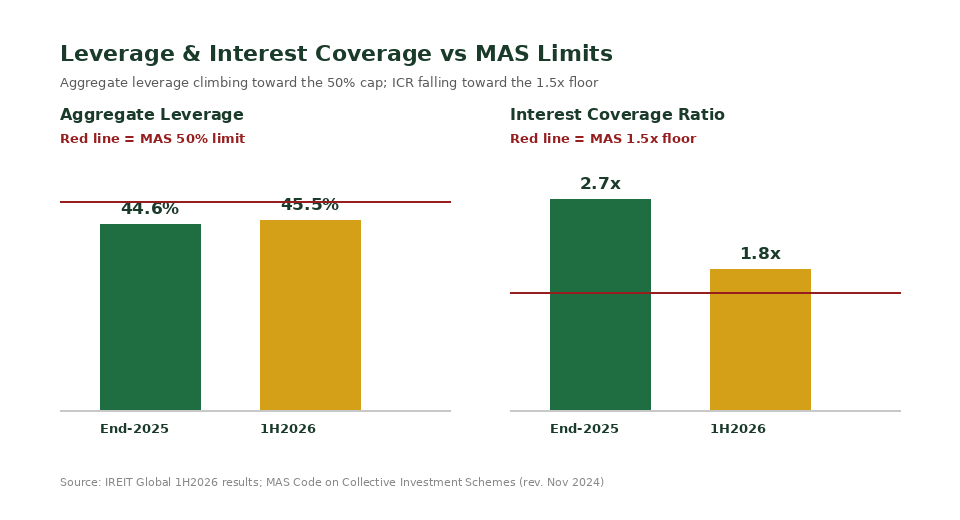
Under MAS’s Code on Collective Investment Schemes (revised November 2024), every Singapore REIT must keep aggregate leverage at or below 50% and maintain a minimum interest coverage ratio (ICR) of 1.5x. Interest coverage ratio, in plain terms, is how many times over a REIT’s operating income can pay its interest bill — the lower it gets, the less breathing room a REIT has if rates rise further or income falls.
IREIT Global isn’t breaching either limit. But both metrics moved in the wrong direction this half:
- Aggregate leverage: 44.6% (end-2025) → 45.5% (1H2026) — 4.5 percentage points of headroom left before the 50% cap
- Interest coverage ratio: 2.7x (end-2025) → 1.8x (1H2026) — a much sharper fall, leaving 0.3x of headroom above the 1.5x floor
The weighted average interest rate on IREIT Global’s borrowings rose from 2.8% to 4.3% over the same period, even with 97.4% of borrowings hedged. That’s the direct cause of the ICR compression — more expensive debt eating into the coverage cushion faster than NPI can grow to offset it.
This kind of gradually tightening leverage and coverage profile is exactly the trend worth tracking across the S-REIT sector as refinancing costs stay elevated into 2027.
Berlin Campus and Occupancy Recovery
The more encouraging part of the results is on the operating side. Portfolio occupancy (excluding Berlin Campus) rose to 94.4%, up from 92.2% the previous quarter. Weighted average lease expiry (WALE) sits at 5.3 years, which gives reasonable income visibility.
Berlin Campus itself — the asset dragging down blended occupancy to 76.9% including it — is mid-repositioning under what management calls “Project RE(O”: converting part of the vacant office space into hospitality use. Hotel construction is progressing, with delivery targeted for 3Q2027. Office leasing for the remaining space is ongoing with prospective tenants, but nothing has been signed yet as at this results release.
Elsewhere, IREIT Global secured a 10-year lease with a federal government tenant for close to 5,000 sqm at its Darmstadt Campus, and its Barcelona office asset (Parc Cugat Green) reached close to 100% occupancy for the first time since acquisition. Spain is doing the heavy lifting on leasing momentum right now; Germany is recovering more slowly.
Refinancing Outlook
IREIT Global’s German portfolio debt was refinanced in October 2025 — a €200 million facility extending maturity to July 2029, plus a separate €20 million facility earmarked for Berlin Campus capex. That part of the balance sheet is settled for now.
The Spanish portfolio is the next item on the list. Lenders have confirmed covenant compliance and the REIT is finalising documentation to extend that facility to December 2029. Once that closes, IREIT Global says it will have no refinancing requirements until July 2027 — useful runway, assuming European rates don’t spike further in the meantime.
Two undrawn capex facilities — €20 million from UniCredit and €12.5 million from CDL — remain available for the Berlin Campus conversion, so the REIT isn’t relying on distributable income to fund that project.
Should You Hold or Buy IREIT Global?
If you already hold IREIT Global units, the operating trend (occupancy up, leasing momentum in Spain, fair value losses narrowing sharply from €77.2m to €29.4m) is genuinely improving. The distribution trend is not — a near-50% YoY DPU cut is a real cost to bear while you wait for the European office cycle and Berlin Campus repositioning to play out.
IREIT Global also trades at a meaningful discount to its NAV per unit of €0.31 (roughly S$0.46) — a pattern common across several smaller S-REITs right now. If you want to understand how that discount compares across the sector, our S-REIT discount to NAV guide breaks down which REITs trade cheapest relative to book value and why that gap doesn’t always close on its own.
If you don’t hold it yet, the case for waiting is straightforward: leverage and interest coverage are both trending toward MAS’s limits, Berlin Campus won’t fully deliver until 3Q2027, and the Spanish refinancing still needs to close. None of these are red flags on their own, but stacked together they suggest patience is the more defensible position until at least one of them resolves. For a sense of how IREIT Global compares with another overseas-focused small-cap S-REIT navigating similar dynamics, see our coverage of Elite UK REIT’s 1H2026 results.
You can also read our original iREIT Global investor guide for the fuller picture on its portfolio structure, sponsor backing, and longer DPU history.
Whatever you decide, building diversified income outside of a single small-cap REIT is worth thinking through as part of your broader retirement planning — our Singapore retirement calculator can help you map out how much passive income you actually need. If you’re investing through a robo-advisor or brokerage that offers sign-up incentives, check our Endowus referral code page before you open a new account.
Frequently Asked Questions
What was IREIT Global's DPU for 1H2026?
Why did IREIT Global's DPU fall so much year-on-year?
Is IREIT Global's leverage close to breaching MAS limits?
What is Project RE(O and when will it complete?
Does IREIT Global trade below its net asset value?
What currency risk does IREIT Global carry for Singapore investors?
Building a Diversified Singapore Income Portfolio?
Compare IREIT Global against other S-REITs, or explore robo-advisor and brokerage sign-up offers before you top up your portfolio.
This article was researched with the help of AI. While we strive to keep all information accurate and up to date, there may be errors. If you notice any discrepancies, please contact us.