How Much Money Do You Need to Start Investing in Singapore? (2026 Guide)
A myth-busting look at real account minimums — from $0 brokerage accounts to $1,000 platforms — so you know exactly how much you need before you start.
You can legally start investing in Singapore with $0 down at brokers like Interactive Brokers, moomoo and Tiger Brokers, or with no minimum at all through a robo-advisor like Syfe. But “minimum to open” isn’t the same as “minimum to actually build a portfolio.” This guide breaks down real 2026 minimums across brokers, robo-advisors, SSB, T-bills, CPF and SRS — and how much you genuinely need.
Not financial advice. All figures are for educational reference only. Data verified as at 19 August 2026 against official platform pricing and help pages, MAS and CPF Board, unless otherwise noted.
- Several brokers and robo-advisors — Interactive Brokers, moomoo, Tiger Brokers and Syfe — have no minimum deposit at all. You just need enough cash to cover one trade.
- StashAway has no hard minimum either, though it recommends around $10 SGD so your money deploys efficiently. FSMOne’s Regular Savings Plan starts from $50 a month.
- Government and fund products have real floors: $500 for Singapore Savings Bonds, $1,000 for T-bills, and $1,000 for Endowus’s Fund Smart.
Table of Contents
Contents — Click to expand
- The Real Minimum: What Platforms Actually Require in 2026
- Why “Minimum to Open” Isn’t “Minimum to Actually Invest”
- Minimum Amounts for CPF, SRS and Cash Accounts
- How Much You Need Depends on What You’re Buying
- Worked Example: $100 vs $1,000 vs $10,000
- What Singapore Investors Should Actually Start With
- Frequently Asked Questions
The Real Minimum: What Platforms Actually Require in 2026
Ask five Singaporeans how much money you need to start investing, and you’ll get five different answers. That’s because the true minimum depends entirely on which platform and product you’re comparing.
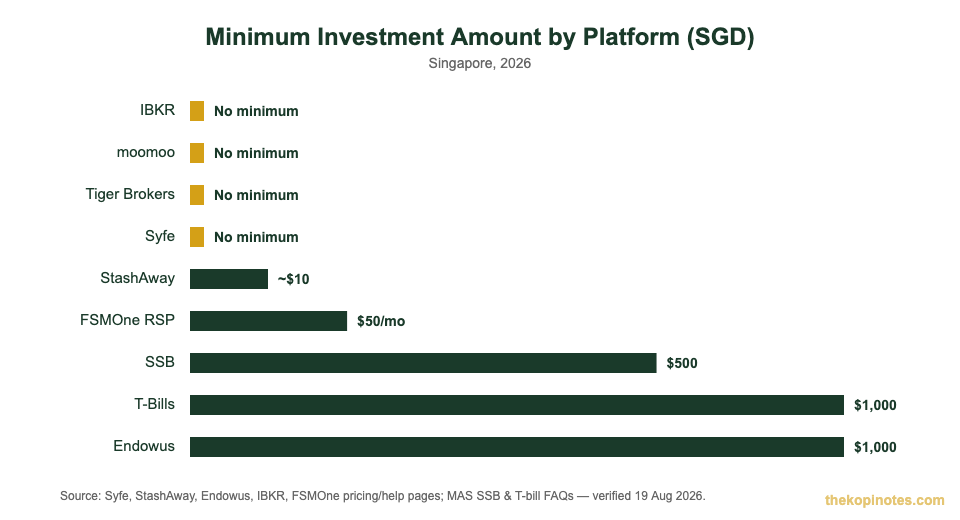
At one end, Interactive Brokers (IBKR), moomoo, Tiger Brokers and Syfe all let you open and fund an account with $0 down — you only need enough cash to actually buy something. At the other end, government products like Singapore Savings Bonds (SSB) and T-bills have hard floors, and some fund platforms need a four-figure sum to get started.
The table below shows real 2026 minimums across the platforms Singapore investors use most.
| Platform | Type | Minimum to Start | Notes |
|---|---|---|---|
| Interactive Brokers (IBKR) | Cash brokerage | No minimum | $0 account minimum and $0 inactivity fee for Individual, Joint and Trust accounts (IBKR Pro or Lite) |
| moomoo Singapore | Cash brokerage | No minimum | Promo tiers reward $100–$3,000 deposits, not a requirement to trade |
| Tiger Brokers | Cash brokerage | No minimum | SGX trades carry a $1.98 minimum commission |
| Syfe | Robo-advisor | No minimum | No minimum or maximum deposit; no minimum monthly top-up |
| StashAway | Robo-advisor | ~$10 | No hard minimum; StashAway recommends at least $10 SGD so funds deploy efficiently |
| FSMOne Regular Savings Plan | RSP (unit trusts/ETFs) | $50/month | Access to 40+ counters on SGX, HKEX and US exchanges |
| Endowus | Robo-advisor / Fund Smart | $1,000 ($100 after) | Same structure for Cash, CPF and SRS accounts |
| Singapore Savings Bonds (SSB) | Government bond | $500 | Multiples of $500; $200,000 per-investor cap |
| Singapore T-bills | Government bill | $1,000 | Multiples of $1,000; CPF OA and SRS eligible |
Source: Syfe, StashAway, Endowus and IBKR pricing/help pages, and MAS SSB and T-bill FAQs, verified 19 August 2026.
Notice the pattern: brokerage accounts and robo-advisors, where your money buys shares, ETFs or a managed portfolio directly, tend to have the lowest — often zero — minimums. Products with fixed unit sizes, like SSB and T-bills, have higher floors because you’re buying whole units of a government-issued instrument, not fractional shares.
If your goal is simply to start investing with whatever you have, a robo-advisor like Syfe or a brokerage account with no minimum is the fastest way in. If your goal is a specific product like SSB or an Endowus-managed portfolio, budget for the $500–$1,000 floor before you begin.
Why “Minimum to Open” Isn’t “Minimum to Actually Invest”
A $0 minimum sounds like anyone can start investing today with any amount. Technically, that’s true — but it doesn’t mean a token deposit buys you a meaningful, diversified portfolio.
Here’s the gap most beginners miss. Opening an account and funding it usefully are two different steps. IBKR, for example, has no minimum deposit, but a single share of a US-listed or LSE-listed ETF can easily cost well over $100. Unless your broker supports fractional shares, a small deposit might not stretch to buying anything at all.
Robo-advisors solve this differently. Syfe, StashAway and Endowus pool your money with other investors’ money to buy fractional exposure to a diversified basket of ETFs and funds. That’s how Syfe can accept any amount, even $1 — you’re not buying a whole share of anything, you’re buying a small slice of a professionally managed portfolio.
The practical takeaway: a $0 or no-minimum account is genuinely useful for testing a platform or building the habit of investing. But if you want your money to actually be diversified across many holdings from day one, a robo-advisor or unit trust structure usually does more with a small starting amount than a single-stock brokerage account does.
Minimum Amounts for CPF, SRS and Cash Accounts
The account type you’re funding also affects your practical minimum — and the rules differ from a straightforward cash account.
CPF Ordinary Account (OA). You must keep the first $20,000 of your OA balance untouched at all times — this money isn’t available for CPF Investment Scheme (CPFIS) investing no matter which platform you use. Above that $20,000 set-aside, platforms like Endowus and FSMOne let you invest with broadly the same minimums as their cash accounts.
Supplementary Retirement Scheme (SRS). Opening an SRS account itself has no minimum. But once you want to actually invest that cash instead of leaving it earning close to 0.05% a year, you’ll hit the same platform minimums as a cash account — $1,000 on Endowus, no minimum on Syfe.
Cash accounts. This is where the lowest minimums live — IBKR, moomoo, Tiger Brokers and Syfe all have no set minimum.
Working out which account to fund first, and in what order, matters more than the minimum amount itself for most Singaporeans. We cover the full sequencing logic, including when SRS should come before CPF OA investing, in how to invest your CPF, SRS and cash in the right order.
One rule worth flagging here: CPFIS-OA rules cap shares, property funds and corporate bonds at 35% of your investible OA savings, with a separate 10% cap on gold ETFs and gold products. That ceiling doesn’t change with your starting amount — a small CPF top-up into equities is capped the same way a large one is. For a deeper walkthrough of these limits, see our CPF investment strategy guide.
How Much You Need Depends on What You’re Buying
Your realistic minimum also depends on what you’re trying to buy, not just which platform you use.
Government bonds and bills. Singapore Savings Bonds require a $500 minimum, in multiples of $500, with a $200,000 cap per investor. Singapore T-bills need a $1,000 minimum, in multiples of $1,000 — and you can fund a T-bill purchase from CPF OA (above the $20,000 set-aside) or SRS, not just cash.
Robo-advisor portfolios. Syfe has no minimum deposit or monthly top-up requirement at all. StashAway doesn’t enforce a hard minimum either, though a small SGD amount (around $10) ensures your money is actually deployed rather than sitting uninvested. Both build a diversified, professionally allocated portfolio regardless of how little you start with.
Managed unit trusts. Endowus requires $1,000 to open a Fund Smart or advised portfolio, then $100 for each top-up after that — whether you’re funding it with cash, CPF or SRS.
Recurring investment plans (RSPs). The FSMOne referral code page details its Regular Savings Plan, which lets you commit as little as $50 a month across more than 40 counters on the SGX, HKEX and US exchanges — a middle ground between a robo-advisor’s low entry and a brokerage account’s per-share cost.
Individual shares and ETFs. This is the least predictable category. With IBKR, moomoo or Tiger Brokers, your real minimum is simply the share price of whatever you want to buy, plus a small commission — as low as $1.98 per SGX trade on Tiger Brokers. A cheap SGX-listed stock might cost under $10 a share; a single unit of a UCITS ETF typically trades at several hundred US dollars.
The common thread: if you want predictability with a small, fixed amount, a robo-advisor or RSP is more forgiving than trying to buy individual shares with a small budget.
Worked Example: $100 vs $1,000 vs $10,000
Numbers make this concrete. Here’s what a $100, $1,000 and $10,000 starting amount can actually do in Singapore in 2026, and roughly what each could grow to over 10 years at an illustrative 6% p.a. return, before fees and taxes.
| Starting Amount | What It Can Actually Buy | Illustrative Value After 10 Years* |
|---|---|---|
| $100 lump sum | Fractional exposure via a robo-advisor (Syfe, StashAway) | ~$179 |
| $1,000 lump sum | 2 SSB bonds, 1 T-bill, or an Endowus Fund Smart entry | ~$1,791 |
| $10,000 lump sum | A diversified robo portfolio, CPFIS unit trusts, or several ETF holdings | ~$17,908 |
| $100/month (RSP) | FSMOne, Syfe or StashAway recurring purchases | ~$16,388 after 120 months** |
*Assumes 6% p.a. compounded annually, before fees and taxes — illustrative only, not a guaranteed or projected return. **Assumes $100 invested monthly for 10 years (120 months) at 6% p.a. compounded monthly. Calculations by The Kopi Notes, 19 August 2026.
$100. Too small for a single SSB or T-bill, and short of Endowus’s $1,000 entry point. But it’s more than enough for Syfe, StashAway or a first FSMOne RSP instalment — all of which put that $100 into a diversified basket of assets, not a single stock.
$1,000. This unlocks nearly everything: two SSB bonds, one T-bill, or Endowus’s minimum entry for a Fund Smart or advised portfolio. It’s also enough to buy several shares of most SGX-listed stocks or a handful of units in a lower-priced ETF.
$10,000. At this level, the constraint stops being the platform minimum and starts being your own diversification strategy — spreading across CPFIS unit trusts, a robo-advisor’s managed portfolio, and individual SGX or LSE-listed ETFs.
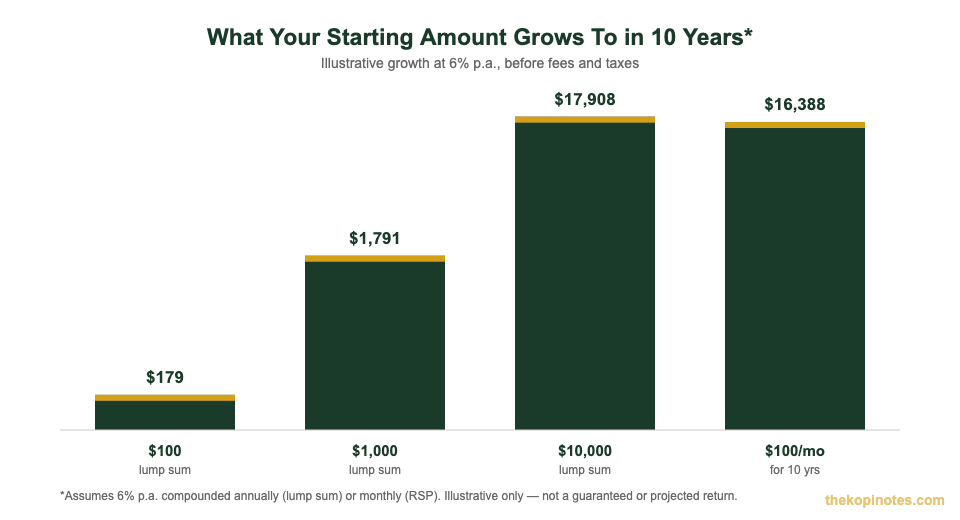
The fourth bar in the chart above — $100 invested every month for 10 years — makes a separate point: a small, disciplined monthly contribution can end up worth more than a much larger one-off lump sum, simply because far more total capital goes in over time. That $100 monthly plan puts in $12,000 of your own money over 10 years, compared with a single $1,000 lump sum that only ever puts in $1,000. It’s the practical case for starting small but starting now, rather than waiting until you’ve saved a bigger lump sum.
What Singapore Investors Should Actually Start With
If you’re deciding where to put your first dollar, here’s a practical starting point based on the numbers above.
If you have under $500 to start: Open a robo-advisor account — Syfe or StashAway — and set up a recurring monthly contribution, even if it’s just $50–$100. You’ll be invested in a diversified portfolio from day one, and you can always increase the amount later.
If you have $500–$1,000: You can now consider a Singapore Savings Bond for a guaranteed, government-backed return, or use that $1,000 to unlock Endowus’s Fund Smart if you want a specific unit trust rather than a broad managed portfolio.
If you have $1,000–$10,000 and want more control: A brokerage account with IBKR, moomoo or Tiger Brokers lets you pick your own ETFs and stocks with no platform minimum standing in your way — though check each fund’s actual share price before committing.
If you’re investing through CPF or SRS: Remember the $20,000 OA set-aside and the platform-specific minimums still apply. Read our guide on the right order to invest CPF, SRS and cash before moving money into CPFIS or an SRS-linked portfolio.
Whatever you start with, the amount matters far less than starting a consistent habit. A Singapore retirement calculator can help you work out how much you’d actually need to invest each month to hit a long-term goal, once you’ve picked a platform.
Not financial advice. All figures are for educational reference only. Data verified as at 19 August 2026.
Frequently Asked Questions
What is the minimum amount to start investing in Singapore in 2026?
There’s no single answer — it depends on the platform. Interactive Brokers, moomoo, Tiger Brokers and Syfe all have no minimum deposit, and StashAway has no hard minimum either. Government products have higher floors: $500 for Singapore Savings Bonds and $1,000 for T-bills.
Can I really start investing in Singapore with just $1?
Yes, through a robo-advisor like Syfe, which has no minimum deposit or monthly top-up requirement at all. $1 buys fractional exposure to a diversified portfolio rather than a whole share of anything, so it’s genuinely invested from day one, though at that size growth in dollar terms will be very small.
Do I need $1,000 to invest with Endowus?
Yes. For Endowus’s Fund Smart and advised portfolios, the minimum initial investment is $1,000, with a $100 minimum for each top-up afterwards. This applies whether you’re funding the account with cash, CPF or SRS.
What's the minimum investment for Singapore Savings Bonds and T-bills?
Singapore Savings Bonds require a $500 minimum in multiples of $500, up to a $200,000 cap per investor. Singapore T-bills require a $1,000 minimum in multiples of $1,000, and can be funded from cash, CPF Ordinary Account (above the $20,000 set-aside) or SRS.
Is there a minimum amount for investing my CPF or SRS savings?
The minimum depends on the platform you invest through, not the account type itself. Endowus requires $1,000 for both CPF and SRS investing, while Syfe has no set minimum. Your CPF OA also has a fixed $20,000 set-aside that’s never available for CPFIS investing, regardless of platform minimums.
Which platform has the lowest minimum investment in Singapore?
Interactive Brokers, moomoo, Tiger Brokers and Syfe all currently have no minimum deposit requirement for a standard account in Singapore, making them the most accessible starting points regardless of how little you have to invest.
Ready to Put Your First Dollar to Work?
Compare platforms, check your CPF/SRS sequencing, and start with whatever you have.
This article was researched with the help of AI. While we strive to keep all information accurate and up to date, there may be errors. If you notice any discrepancies, please contact us.