Mapletree Industrial Trust Share Price 2026: 1Q FY26/27 Results Preview Ahead of 23 July
SGX: ME8U reports its next business update in three days. Here’s the DPU trend, gearing picture, and data centre pivot to watch before you buy.
Mapletree Industrial Trust (SGX: ME8U) owns data centres, hi-tech buildings, and business parks across Singapore, North America, and Japan. Its 1Q FY2026/27 business update lands on 23 July 2026 — three days from now. Trading near S$1.94 with a trailing 6.5% yield, the REIT enters the update on a four-quarter DPU losing streak. Here’s what could move the share price next.
Not financial advice. All figures are for educational reference only. Data as at 20 July 2026 unless otherwise dated.
- MIT’s 1Q FY2026/27 update lands 23 July 2026 — the first checkpoint since a fourth straight quarter of falling DPU.
- Gearing is drifting up toward ~37.5% as MIT redeems and reissues perpetual securities. Still well under the MAS 50% cap, but worth watching.
- Data centres now make up 55.9% of AUM after a Tokyo acquisition — MIT is quietly becoming a different REIT than its name suggests.
Table of Contents
Contents — Click to expand
- MIT Share Price Today: Key Numbers at a Glance
- When Are 1Q FY26/27 Results Due?
- DPU Trend: Four Straight Quarters of Decline
- Three Things to Watch in the 1Q Update
- The Bigger Story: MIT’s Pivot to Data Centres
- Balance Sheet and Gearing Headroom
- What Analysts Are Saying
- How to Buy Mapletree Industrial Trust in Singapore
- Frequently Asked Questions
MIT Share Price Today: Key Numbers at a Glance
Mapletree Industrial Trust units traded around S$1.93 to S$1.95 through mid-July 2026, giving a trailing 12-month yield of roughly 6.5% on FY2025/26’s 12.71 cent DPU. That’s still a healthy income stream. But you should read the numbers alongside the trend, not just the snapshot — and the trend has been softening for a year.
| Metric | Value |
|---|---|
| Ticker | SGX: ME8U |
| Sector | Industrial / Data Centre REIT |
| Price (mid-July 2026) | ~S$1.93–S$1.95 |
| Trailing FY25/26 DPU | 12.71 cents (-6.3% YoY) |
| Trailing Yield | ~6.5% |
| Portfolio Occupancy | 91.2% |
| Aggregate Leverage | 34.0% (31 Mar 2026) |
| Total AUM | S$8.3 billion (136 properties) |
Source: Mapletree Industrial Trust 4Q & FY25/26 results announcement, 28 April 2026; share price range as at mid-July 2026.
When Are 1Q FY26/27 Results Due?
Mapletree Industrial Trust will release its 1Q FY2026/27 business update on 23 July 2026, after trading hours. That’s just three days after this article was published.
MIT’s financial year runs from 1 April to 31 March, so “1Q FY26/27” covers the quarter from April to June 2026. Unlike most industrial S-REITs, MIT only reports a detailed business update at 1Q and 3Q — full financial statements come out at the half-year (2Q) and full-year (4Q) marks. That means the 23 July release won’t include a full P&L, but it will cover DPU-equivalent figures, occupancy, and portfolio updates.
Update, 23 July: results day is here — see our 1Q FY26/27 results-day scenarios and live tracking guide for DPU scenarios and where to watch the release land.
DPU Trend: Four Straight Quarters of Decline
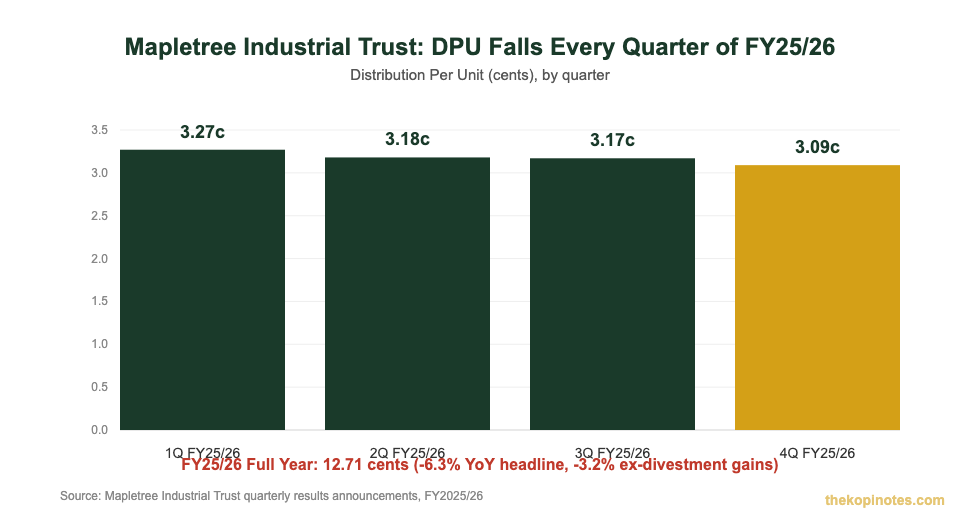
Here’s the pattern you should know before 23 July. MIT’s DPU has fallen every single quarter of FY2025/26:
| Quarter | DPU (cents) | QoQ Change |
|---|---|---|
| 1Q FY25/26 | 3.27 | — |
| 2Q FY25/26 | 3.18 | -2.8% |
| 3Q FY25/26 | 3.17 | -0.3% |
| 4Q FY25/26 | 3.09 | -2.5% |
| FY25/26 Full Year | 12.71 | -6.3% YoY |
Source: Mapletree Industrial Trust quarterly results announcements, FY2025/26.
That 6.3% headline decline looks worse than the underlying business performance. FY2024/25’s DPU included one-off divestment gains that FY2025/26 didn’t fully repeat. Strip those out, and the like-for-like decline was a smaller 3.2%. Still a decline — but the gap between “headline” and “underlying” matters when you’re deciding whether the trend is a business problem or an accounting one.
Revenue and net property income fell too: gross revenue dropped 5.5% year-on-year to S$673.0 million, and net property income fell 5.9% to S$500.4 million for FY25/26. The main drivers were the absence of prior-year divestment gains, lost income from properties MIT sold off, non-renewal of some North American leases, and unfavourable currency movements on its US dollar and yen income.
Three Things to Watch in the 1Q Update
If you’re holding MIT or thinking about buying before 23 July, here’s what actually matters in the release — not just the DPU-equivalent headline number.
1. Does North American occupancy stabilise?
North American portfolio occupancy slipped to 87.4% in FY25/26, down from 89.3% the year before, mainly due to non-renewed leases. Two leases expired in May 2026 that together made up about 3.5% of MIT’s overall portfolio by gross rental income: a global colocation provider at Hawthorne, California (1.0%), and AT&T Inc. at San Diego (2.5%). The 1Q update should show whether MIT has backfilled that space or is still carrying the vacancy.
2. Does the DPU decline finally bottom out?
Four consecutive quarterly declines is a real pattern, not noise. With the one-off divestment gains now fully out of the comparison base, 1Q FY26/27 is arguably the first “clean” quarter-on-quarter comparison in over a year. If DPU stabilises or ticks up here, it’s a genuinely useful signal. If it falls a fifth straight quarter, the market will likely take that harder.
3. Does gearing land where management guided?
MIT flagged that gearing would rise to roughly 37.5% after its perpetual securities transaction (more on this below). The 1Q update is the first chance to confirm that actually happened, and whether management still frames that level as comfortable.
The Bigger Story: MIT’s Pivot to Data Centres
Here’s what the quarterly DPU noise can distract you from: MIT is turning into a different REIT than the one you bought five years ago.
Data centres now make up 55.9% of MIT’s total AUM, up further after MIT agreed to acquire a West Tokyo facility for JPY 14.5 billion (about S$100.5 million) in a 98.47% effective interest, to be redeveloped into a new data centre. The 319,300 sq ft site includes an existing data centre, back-office space, and training facilities on a 91,200 sq ft plot.
At the same time, MIT completed S$550.6 million in divestments in FY2025/26 — two business park buildings and a hi-tech building in Singapore, plus a data centre in Georgia, USA — all sold at a premium to book value. Management has flagged a further S$500 million to S$600 million of targeted North American divestments, as MIT rebalances away from lower-growth US industrial assets and toward higher-quality data centre exposure in Asia-Pacific and Europe.
For you as an investor, the practical takeaway is this: MIT’s “Industrial Trust” name is increasingly a legacy label. You’re really buying a REIT that’s becoming majority data-centre-exposed, with the growth (and concentration risk) that comes with that shift. That’s worth weighing against pure-play data centre REITs like Keppel DC REIT, whose own 1H2026 results preview we covered separately.
Balance Sheet and Gearing Headroom
MIT’s balance sheet remains conservative by S-REIT standards, but the direction of travel is worth watching alongside the DPU trend.
| Metric | Figure |
|---|---|
| Aggregate leverage (31 Mar 2026) | 34.0% |
| Guided leverage post-perpetual securities transaction | ~37.5% |
| MAS regulatory leverage ceiling | 50% (up to 60% if ICR > 2.5x) |
| Interest coverage ratio (ICR) | 4.3x headline (3.9x base sensitivity) |
| Weighted average debt maturity | 3.4 years |
| Estimated debt headroom to MAS ceiling | ~S$1.6–2.0 billion |
Source: Mapletree Industrial Trust FY25/26 results, 28 April 2026; MAS leverage limit framework.
A quick note on terminology, since it trips people up: MIT’s own management often talks about a roughly 40% “comfort level” for gearing — that’s an internal, self-imposed benchmark, not a regulatory limit. The actual MAS regulatory ceiling is 50% aggregate leverage, rising to 60% only if a REIT’s interest coverage ratio stays above 2.5x. MIT’s ICR of 4.3x is comfortably above that threshold, so even at 37.5% projected gearing, MIT has real headroom before hitting any binding constraint — roughly S$1.6 to S$2.0 billion of debt capacity before the 50% regulatory line.
Where it gets a little tighter is refinancing timing: about 42% of MIT’s debt matures in FY2027/28. That’s not an immediate concern given the 3.4-year weighted average maturity, but it’s a line item worth checking in each quarterly update as global interest rates evolve.
What Analysts Are Saying
Sell-side views on MIT are mixed heading into the 23 July update — not a strong conviction call either way.
| Broker | Rating | Price Target |
|---|---|---|
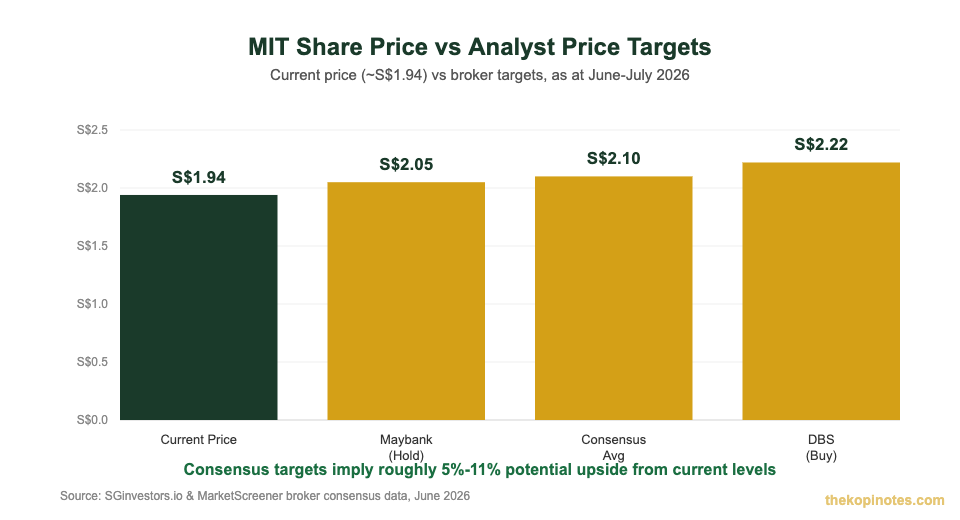
| Maybank | Hold | S$2.05 |
| DBS | Buy | S$2.22 |
| Consensus (as at June 2026) | Mixed / Hold-leaning | ~S$2.04–S$2.15 |
Source: Broker research as compiled by SGinvestors.io and MarketScreener consensus data, June 2026. Individual broker targets and dates vary — treat as directional, not precise.
At a share price around S$1.94, consensus targets imply roughly 5% to 11% potential upside, depending on which estimate you use. The main bull case analysts cite is falling US Federal Reserve interest rates, which would lower MIT’s borrowing costs and support distributable income. The main bear case is the ongoing DPU erosion and North American occupancy softness discussed above. For a deeper breakdown of individual broker calls, see our separate Mapletree Industrial Trust price target analysis.
How to Buy Mapletree Industrial Trust in Singapore
MIT trades on the SGX Main Board under ticker ME8U, in board lots of 100 units. You can buy it through any Singapore brokerage that offers SGX access.
If you want to hold it inside a tax-advantaged wrapper, MIT is CPFIS-OA approved, meaning you can use CPF Ordinary Account savings above the S$20,000 threshold to buy units through CPF-eligible brokers such as FSMOne or DBS Vickers. It’s also SRS-eligible, which lets higher-income earners reduce their chargeable income today while deferring tax on gains until statutory retirement age.
Using CPF OA savings (which earn a guaranteed 2.5% p.a.) to buy a REIT yielding around 6.5% creates a yield spread of roughly 4 percentage points — though remember that unlike your CPF OA balance, S-REIT prices and distributions can fall. If you’re building a broader income portfolio rather than a single-REIT position, our best S-REITs in Singapore 2026 comparison is a useful next read, and our retirement planning calculator can help you model how a REIT allocation fits your broader CPF and SRS strategy.
For brokerage options, CPF-eligible platforms like Endowus and FSMOne let you buy MIT directly with CPF OA funds, while a standard brokerage account (see the CTA buttons below) works for cash and SRS purchases. TKN may earn a referral fee if you sign up through our referral pages, at no extra cost to you.
Frequently Asked Questions
When does Mapletree Industrial Trust report its next results?
Mapletree Industrial Trust releases its 1Q FY2026/27 business update on 23 July 2026, after SGX trading hours. This will be a business update covering DPU-equivalent figures and occupancy, not a full set of financial statements — MIT only publishes complete P&L statements at the half-year (2Q) and full-year (4Q) marks.
Why has MIT's DPU been falling for four straight quarters?
The main drivers in FY2025/26 were the absence of one-off divestment gains that boosted the prior year’s DPU, lost rental income from properties MIT sold, non-renewal of some North American leases, and unfavourable foreign exchange movements on US dollar and yen income. Excluding the one-off divestment gains, the underlying DPU decline was a smaller 3.2%, versus a 6.3% fall on a headline basis.
Is Mapletree Industrial Trust's gearing ratio a concern?
Not immediately. Aggregate leverage stood at 34.0% as at 31 March 2026, and is guided to rise to about 37.5% after a perpetual securities transaction. Both figures sit well below the MAS regulatory ceiling of 50% (up to 60% for REITs with an interest coverage ratio above 2.5x, and MIT’s ICR of 4.3x clears that bar comfortably). It’s worth watching the trend, but there’s no near-term regulatory or covenant pressure.
Can I buy Mapletree Industrial Trust with my CPF or SRS?
Yes. MIT is approved under the CPF Investment Scheme for Ordinary Account funds (CPFIS-OA) above the mandatory S$20,000 threshold, purchasable through CPF-eligible brokers like FSMOne or DBS Vickers. It’s also eligible for purchase using Supplementary Retirement Scheme (SRS) funds.
Is Mapletree Industrial Trust turning into a data centre REIT?
It’s heading that way. Data centres made up 55.9% of MIT’s total AUM after its latest Tokyo redevelopment acquisition, and management continues to target further North American industrial divestments while redeploying capital into data centre assets in Asia-Pacific and Europe. It’s not a pure-play data centre REIT yet, but the portfolio mix is shifting steadily in that direction.
What is the analyst consensus rating for Mapletree Industrial Trust?
As at June 2026, sell-side views were mixed and leaning toward Hold, with individual price targets ranging from around S$2.05 (Maybank) to S$2.22 (DBS). Consensus targets imply roughly 5% to 11% upside from a share price near S$1.94, with US Federal Reserve rate cuts cited as the main bull catalyst.
Building a Singapore Income Portfolio?
Compare S-REITs, model your CPF and SRS allocation, and open a brokerage account — all in one place.
This article was researched with the help of AI. While we strive to keep all information accurate and up to date, there may be errors. If you notice any discrepancies, please contact us.