Prime US REIT Share Price 2026: DPU Doubles, 83% Occupancy — Is the Recovery Real? (SGX: OXMU)
A data-driven look at Prime US REIT’s 2026 turnaround — and how it compares to Manulife US REIT and KORE US REIT.
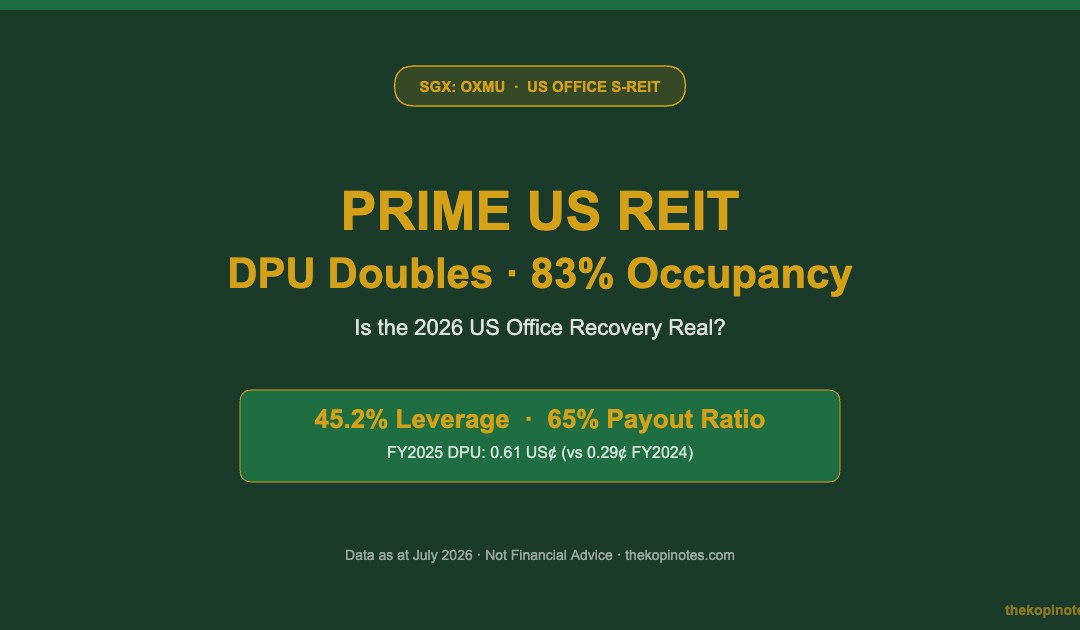
Prime US REIT’s (SGX: OXMU) FY2025 distribution per unit (DPU) more than doubled to 0.61 US cents from 0.29 cents in FY2024, as portfolio occupancy climbed to 83.1% — its fourth straight quarterly gain. The Manager restored the payout ratio to 65% in 4Q2025. It’s a real recovery, but it follows two years of a defensive 10% payout, and peers like Manulife US REIT remain fully suspended.
Not financial advice. All figures are for educational reference only. Data as at July 2026 unless otherwise noted.
- Prime US REIT’s FY2025 DPU doubled to 0.61 US cents and occupancy hit 83.1% — the strongest recovery among Singapore’s three listed US office REITs.
- Aggregate leverage is stable at 45.2%, well within MAS’s 50% cap, and four analysts rate it a Buy — though UOB Kay Hian actually cut its target this year.
- The recovery is real, but it’s still early. Occupancy remains below pre-pandemic norms and Manulife US REIT shows what can go wrong if leasing momentum stalls.
Table of Contents
Contents — Click to expand
- What Is Prime US REIT? (SGX: OXMU)
- 1Q2026 Results: Four Straight Quarters of Occupancy Gains
- DPU History: How the Payout Doubled in FY2025
- Is the Recovery Real? Prime vs Manulife US REIT vs KORE US REIT
- Portfolio Snapshot: 13 Class A Freehold US Offices
- Balance Sheet: Is 45.2% Gearing Safe?
- Analyst Price Targets: Bulls vs the One Bear
- Risks to Watch Before You Buy
- How to Buy Prime US REIT in Singapore
- Is Prime US REIT a Buy in 2026?
- FAQs
What Is Prime US REIT? (SGX: OXMU)
Prime US REIT listed on the SGX Main Board on 19 July 2019. It’s a pure-play US office landlord — it owns Class A freehold buildings in secondary “non-gateway” American cities like Denver, Sacramento and Salt Lake City, not New York or San Francisco.
That focus mattered a lot after 2022. When US office values crashed and remote work hurt occupancy across the board, Prime US REIT — like most of its Singapore-listed US office peers — had to slash its payout ratio to a defensive 10% from 2H2023 to preserve cash and pay down debt. Distributions are now recovering. Here’s the current snapshot.
| Metric | Figure |
|---|---|
| Ticker | SGX: OXMU |
| Unit price (17 Jul 2026) | US$0.155 |
| Market capitalisation | ~US$240 million (May 2026) |
| Portfolio | 13 Class A freehold offices, ~US$1.4 billion carrying value |
| Committed occupancy | 83.1% (31 Mar 2026) |
| WALE | 5.6 years |
| Aggregate leverage | 45.2% (31 Mar 2026) |
| FY2025 DPU | 0.61 US cents (vs 0.29 cents FY2024) |
Source: Prime US REIT 1Q2026 business update and FY2025 results, primeusreit.com, Beansprout (accessed 17-19 Jul 2026).
1Q2026 Results: Four Straight Quarters of Occupancy Gains
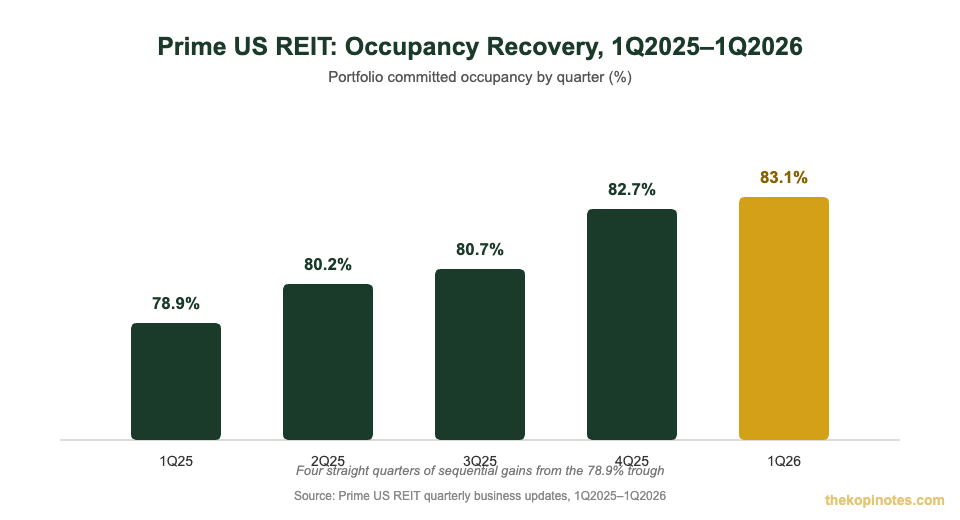
Occupancy is the number to watch for any office REIT. Prime US REIT’s committed occupancy bottomed at 78.9% in 1Q2025. Since then, it has climbed every single quarter — 80.2% in 2Q2025, 80.7% in 3Q2025, 82.7% in 4Q2025, and 83.1% as at 31 March 2026.
The standout deal in 1Q2026 was an 11-year, roughly 40,000 sq ft lease with S&P Global at Village Center Station I in Denver. That single lease pushed the building’s occupancy from 63.0% to 80.1%. Across the whole portfolio, Prime US REIT signed about 99,000 sq ft of new leases in 1Q2026 at a healthy +4.0% rental reversion — meaning new leases are being signed at higher rents than the leases they replace.
That’s 11% of committed occupancy sitting in the pipeline, already signed but not yet contributing rental income. As those leases come online through 2026 and 2027, management expects a further step-up in cash property income — and potentially higher distributions. According to JLL’s 1Q2026 US Office Market Dynamics report, gross leasing activity across the US grew 7.6% year-on-year, net absorption was positive for a third straight quarter, and new office supply fell to multi-decade lows — a combination that supports pricing power for landlords holding quality assets like Prime US REIT’s.
DPU History: How the Payout Doubled in FY2025
From 2H2023 through 1H2025, Prime US REIT’s Manager kept the distribution payout ratio at a defensive 10% of distributable income. The rest was retained to fund capital expenditure, tenant incentives, and debt paydown while the US office market found its footing. That’s why unitholders saw very little cash during those two years, even though the REIT never fully suspended payouts the way Manulife US REIT did.
In 4Q2025, with occupancy climbing and 2026-2027 loan maturities becoming more manageable, the Manager restored the payout ratio to 65%. The result: FY2025 DPU of 0.61 US cents, more than double the 0.29 US cents paid out in FY2024.
| Period | Payout Ratio | DPU (US cents) |
|---|---|---|
| 2H2023 – 1H2025 | 10% (defensive) | Minimal |
| FY2024 (full year) | Mostly 10% | 0.29 |
| FY2025 (full year, 65% from 4Q) | 10% → 65% | 0.61 |
Source: Prime US REIT FY2025 results announcement, Feb 2026.
At the current unit price of US$0.155, an annualised run-rate close to the FY2025 DPU works out to roughly a 3.9% distribution yield — modest by S-REIT standards, but the real story here is the direction of travel, not the absolute yield today.
Is the Recovery Real? Prime vs Manulife US REIT vs KORE US REIT
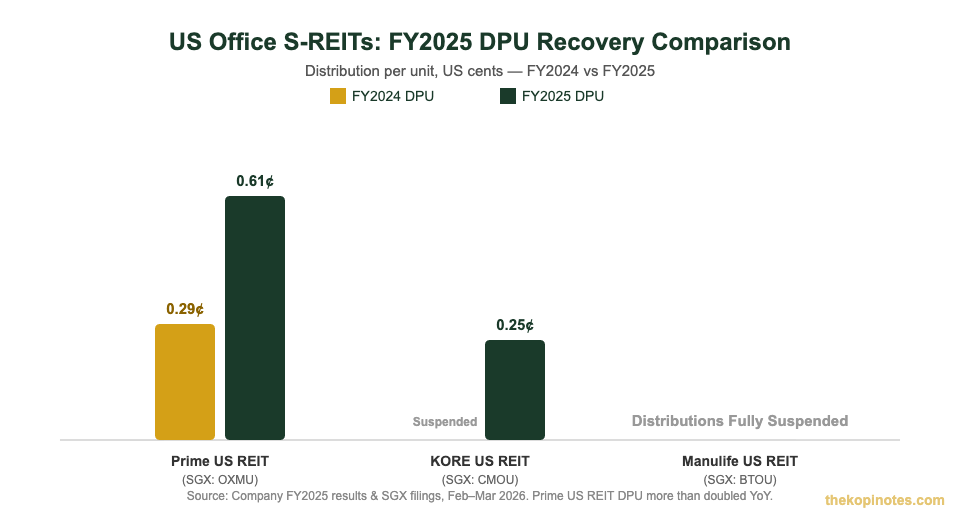
Singapore investors can currently choose between three SGX-listed US office REITs, and all three went through some form of capital crisis between 2023 and 2025. Comparing them side by side is the clearest way to judge whether Prime US REIT’s recovery is genuine or just a lucky quarter.
| REIT | FY2025 DPU | Distribution Status | Key 2026 Development |
|---|---|---|---|
| Prime US REIT (OXMU) | 0.61¢ | Restored to 65% payout | DPU more than doubled YoY; occupancy at 83.1% |
| KORE US REIT (CMOU) | 0.25¢ | Resumed early | Concluded Recapitalisation Plan; renamed from Keppel Pacific Oak US REIT on 5 Feb 2026 |
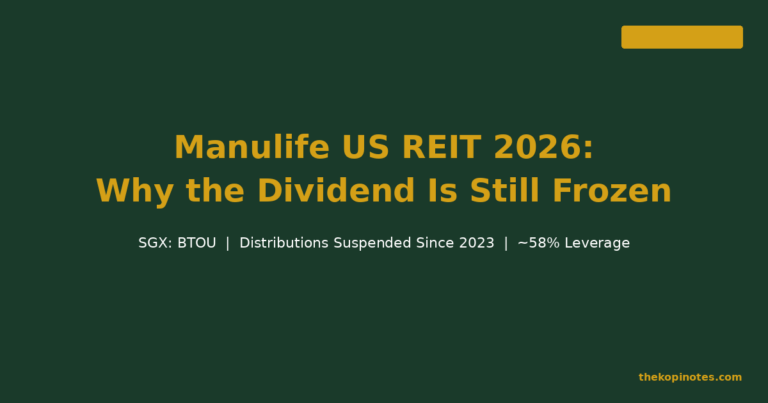
| Manulife US REIT (BTOU) | 0¢ | Fully suspended since 2023 | FY2025 gross revenue down 32% YoY; divesting Figueroa (LA) for US$92.5m to cut debt |
Source: Company FY2025 results, SGX filings, Keppel/KORE announcements, Feb–Mar 2026.
The pattern is telling. All three REITs hit the same wall — overleveraged balance sheets colliding with falling US office valuations and a wave of loan maturities. Prime US REIT and KORE US REIT both worked through recapitalisation and are now paying unitholders again. Manulife US REIT hasn’t gotten there yet: its FY2025 gross revenue fell 32% year-on-year, and it’s still selling buildings (like the Figueroa tower in Los Angeles for US$92.5 million) mainly to repay debt, not to return cash to unitholders.
That divergence matters. It tells you Prime US REIT’s turnaround isn’t just a sector-wide tailwind lifting every US office REIT — it reflects company-specific execution: a freehold, non-gateway-city portfolio that held occupancy better than office towers in expensive downtown cores, plus a Manager willing to hold the payout ratio down long enough to fix the balance sheet before turning the taps back on.
Portfolio Snapshot: 13 Class A Freehold US Offices
Prime US REIT owns 13 Class A freehold office properties across 12 key US markets, valued at roughly US$1.4 billion as at 31 March 2026. “Class A” means top-tier build quality and amenities. “Freehold” matters too — unlike some US office structures held on leasehold land, Prime US REIT owns the land outright, which removes a layer of lease-expiry risk that trips up other landlords.
The REIT deliberately avoids the most expensive, most troubled gateway cities like San Francisco and New York. Instead, it targets secondary markets — Denver, Sacramento, Salt Lake City, and similar metros — where rents are lower but so is the glut of empty trophy towers that has weighed on gateway-city office values since 2022.
Recent leasing wins reinforce that strategy. Beyond the S&P Global deal in Denver, Prime US REIT signed long-term renewals at Park Tower in Sacramento and Waterfront at Washingtonian in Gaithersburg, Maryland — both examples of large, credit-worthy tenants committing to multi-year terms rather than downsizing or leaving.
Balance Sheet: Is 45.2% Gearing Safe?
Aggregate leverage stood at 45.2% as at 31 March 2026, essentially unchanged from prior quarters. Under MAS rules effective 28 Nov 2024, Singapore REITs face a single 50% aggregate leverage cap, rising to 60% only if the interest coverage ratio (ICR) stays above 2.5x. Prime US REIT’s 45.2% sits comfortably under that ceiling, but with less headroom than many blue-chip S-REITs, which typically run gearing in the 33-40% range.
The REIT completed a US$25 million private placement in early 2026, using more than half the proceeds (53.6%) for tenant improvement allowances and capital expenditure — the cash landlords spend to win and keep tenants — with the remainder going toward debt repayment. That’s a sign management is still prioritising balance sheet repair over aggressive unit buybacks or expansion, which is the right call this early in a recovery.
Analyst Price Targets: Bulls vs the One Bear
As at mid-2026, four research houses cover Prime US REIT — and all four rate it a Buy. But their targets tell a more nuanced story than a simple “Strong Buy” headline suggests.
| Analyst | Date | Rating | Target Price |
|---|---|---|---|
| DBS Research | 13 May 2026 | Buy | US$0.330 |
| Phillip Securities | 22 Jun 2026 | Buy | US$0.320 |
| RHB Research | 13 Feb 2026 | Buy | US$0.280 (raised from $0.250) |
| UOB Kay Hian | 23 Mar 2026 | Buy | US$0.210 (cut from $0.310) |
Source: Beansprout analyst ratings aggregation, 2026.
Three houses raised or held bullish targets through the year as the recovery data came in. UOB Kay Hian is the outlier — it cut its target by nearly a third in March 2026, even while keeping a Buy call. That’s worth noting: not every analyst is equally convinced the re-rating has further to run from here, even among the bulls. The average target of roughly US$0.285 implies meaningful upside from the US$0.155 unit price, but a spread that wide between the highest and lowest target (US$0.330 vs US$0.210) signals real disagreement about how much of the recovery is already priced in.
Risks to Watch Before You Buy
The recovery story is genuine, but it’s still early. Here are five things to weigh before buying.
1. Occupancy is still below pre-pandemic norms. 83.1% is a big improvement from 78.9%, but many US office landlords ran at 90%+ occupancy before 2020. There’s no guarantee the climb continues in a straight line.
2. Leverage has less buffer than blue-chip S-REITs. At 45.2% gearing, Prime US REIT has less room to absorb a valuation shock than a Mapletree or CapitaLand-managed REIT running 33-40% leverage.
3. Distributions are paid in US dollars. Singapore investors face currency risk on both the unit price and the distributions. A weaker USD/SGD rate eats into your actual take-home yield even if the REIT’s US dollar DPU keeps climbing.
4. Analysts don’t fully agree on upside. UOB Kay Hian’s target cut from US$0.310 to US$0.210 in March 2026 is a reminder that “four Buy ratings” doesn’t mean unanimous conviction on how much of the recovery is left to capture.
5. The whole sub-sector was recently in crisis. Prime US REIT, KORE US REIT and Manulife US REIT all had to slash or suspend payouts within the last three years. That history doesn’t repeat itself automatically, but it’s a reminder that US office REITs carry more balance-sheet and macro risk than a defensive S-REIT like a suburban mall or a data centre.
How to Buy Prime US REIT in Singapore
Prime US REIT trades on the SGX Main Board under the ticker OXMU, in US dollars. You’ll need a brokerage account that supports USD-denominated SGX counters — most major Singapore brokers do.
- Open or fund a brokerage account that trades SGX counters in USD.
- Search for “OXMU” or “Prime US REIT” and check the live bid-ask spread before placing an order.
- Confirm whether your broker charges an FX conversion fee on USD-denominated counters — this can add up if you trade frequently.
- Decide whether you’re buying with cash, or check with your CPF agent bank whether Prime US REIT is on the current CPFIS-OA approved investment list before assuming CPF-OA eligibility — the list changes over time and isn’t limited to Singapore-only REITs.
- SRS accounts generally have a broader approved list and can typically buy any SGX-listed counter, including Prime US REIT, through your broker’s SRS trading facility — but verify with your broker.
If you’re comparing brokers for SGX trading fees and promo offers, see the referral links at the end of this article.
Is Prime US REIT a Buy in 2026?
| If you… | Consider |
|---|---|
| Want exposure to a genuine, data-backed US office recovery story | Prime US REIT looks like the strongest of the three SGX-listed US office REITs right now |
| Need stable, predictable income today | A ~3.9% run-rate yield with a 3-year history of payout volatility may not fit — look at established blue-chip S-REITs instead |
| Are uncomfortable with USD currency risk or 45%+ gearing | This is a higher-risk, higher-recovery-potential holding, not a core income position |
This isn’t a recommendation to buy, hold, or sell. Prime US REIT’s turnaround is backed by real, verifiable data — rising occupancy, a doubled DPU, and stable leverage — which is more than can be said for Manulife US REIT right now. But investors should size any position according to their own risk tolerance and portfolio, and keep watching the occupancy and leverage numbers each quarter to confirm the recovery holds.
Related Reading & Tools
Before you decide, it’s worth checking Prime US REIT’s leverage against the broader S-REIT universe using our S-REIT Gearing Ratio & ICR Calculator. For a broader shortlist of established, income-focused S-REITs, see our best S-REITs in Singapore 2026 roundup. And if you’re building a diversified retirement income plan, our Singapore retirement calculator can help you see how a higher-risk holding like this should fit into the bigger picture.
FAQs
Is Prime US REIT paying distributions again?
Yes. After holding its payout ratio at a defensive 10% from 2H2023 to preserve cash, the Manager restored the payout ratio to 65% in 4Q2025. FY2025 DPU came in at 0.61 US cents, more than double the 0.29 US cents paid in FY2024.
What is Prime US REIT's share price today?
As at 17 July 2026, Prime US REIT (SGX: OXMU) traded at US$0.155 per unit. Prices move daily — check a live SGX data source such as your brokerage app before trading.
Is Prime US REIT safer than Manulife US REIT?
On the numbers available in mid-2026, yes, in the sense that Prime US REIT is paying distributions again and its occupancy has risen for four straight quarters, while Manulife US REIT’s distributions remain fully suspended and its FY2025 gross revenue fell 32% year-on-year. That said, “safer” is relative — both are higher-risk than a typical blue-chip S-REIT, and Manulife US REIT’s asset sales could eventually stabilise its own balance sheet too.
What is Prime US REIT's aggregate leverage?
45.2% as at 31 March 2026, stable versus prior quarters. That’s within MAS’s 50% aggregate leverage cap for Singapore REITs (up to 60% if interest coverage ratio exceeds 2.5x), but higher than the 33-40% gearing typical of blue-chip, sponsor-backed S-REITs.
What do analysts think of Prime US REIT in 2026?
All four covering analysts (DBS Research, Phillip Securities, RHB Research, UOB Kay Hian) rate it a Buy as at mid-2026, with price targets between US$0.210 and US$0.330. Note that UOB Kay Hian actually cut its target during the year, from US$0.310 to US$0.210, showing the bullish consensus isn’t unanimous on magnitude.
Can I buy Prime US REIT with my CPF or SRS funds?
SRS funds can generally be used to buy any SGX-listed counter, including Prime US REIT, through your broker’s SRS trading facility. CPF-OA (CPFIS-OA) eligibility is different and depends on whether the counter is on the current approved list — check with your CPF agent bank (DBS, OCBC, or UOB) before assuming eligibility, since the list is periodically updated.
How many properties does Prime US REIT own?
13 Class A freehold office properties across 12 key US markets, with a portfolio carrying value of roughly US$1.4 billion as at 31 March 2026. The portfolio deliberately avoids expensive gateway cities like New York and San Francisco in favour of secondary markets such as Denver and Sacramento.
What is Prime US REIT's WALE?
The portfolio’s Weighted Average Lease Expiry (WALE) stood at 5.6 years as at 31 March 2026, up from 4.7 years in 2Q2025 as the REIT signed longer-term leases with tenants like S&P Global.
Building a Diversified Singapore Portfolio?
Compare brokers and robo-advisors that give you exposure to S-REITs, global ETFs, and more.
Not financial advice. This article is for educational purposes only and does not constitute a recommendation to buy or sell any security. Prime US REIT and other US office REITs carry currency, leverage, and sector-specific risks. Do your own research and consult a licensed financial adviser before investing. Data as at 17-19 July 2026, sourced from Prime US REIT’s official announcements, SGX filings, Beansprout, and JLL research as cited above.
This article was researched with the help of AI. While we strive to keep all information accurate and up to date, there may be errors. If you notice any discrepancies, please contact us.