How to Invest in Singapore: Complete Cost & Fee Guide (2026)
What CPF, SRS, robo-advisors and brokerages actually cost you — compared side by side, with real SGD numbers.
Investing in Singapore isn’t free — CPF and SRS offer tax relief and guaranteed interest, robo-advisors charge 0.2%–0.8% a year, and brokerages charge per-trade commissions from under S$1 to a flat S$8.80. This guide breaks down exactly what each route costs in 2026, so you can pick the cheapest path for your portfolio size and stage.
Not financial advice. All figures are for educational reference only. Data verified as at July 2026 unless otherwise noted.
- CPF’s Special, MediSave and Retirement Account pays a guaranteed 4% p.a. (Ordinary Account: 2.5% p.a.) with zero fees — the cheapest “investment” most Singaporeans already have.
- Robo-advisors cost 0.2%–0.8% a year for hands-off investing; self-directed brokerages charge a one-time commission (as low as S$0.99–S$8.80 per trade) but give you no advice or rebalancing.
- SRS contributions cut your income tax bill immediately — up to S$15,300 a year for Citizens and PRs — on top of whatever your SRS investments go on to earn.
Why Fees Matter More Than You Think
Every fee you pay eats into your returns before they even reach your pocket. That’s true whether it’s a CPF rule, a robo-advisor’s annual charge, or a broker’s commission.
Here’s a concrete example. Say you invest a lump sum of S$50,000 and it grows at 6% a year for 20 years. Left alone, that becomes roughly S$160,350. But if a platform charges 0.5% a year in fees, your effective return drops to 5.5%. Over the same 20 years, you’d end up with about S$145,890 instead — a gap of roughly S$14,460.
That’s the cost of a single half-percent fee, compounded. It doesn’t mean fees are bad — a good robo-advisor or CPF’s guaranteed interest can be worth every cent. But you should know exactly what you’re paying before you commit.
There’s also a cost most comparisons miss: Goods and Services Tax (GST). Singapore’s 9% GST applies to commissions and advisory fees charged to Singapore tax residents. A robo-advisor quoting “0.5% p.a.” may mean 0.5% plus GST on top — always check whether the number you’re comparing is GST-inclusive.
This guide is a companion to our complete beginner’s guide to investing in Singapore — read that first if you haven’t opened an account yet, then come back here to compare what each option actually costs.
CPF & SRS: Your Tax-Advantaged Starting Point
Before you touch a brokerage app, look at what you already have: your CPF and SRS accounts. Both are tax-advantaged, and neither charges you a management fee.
Your CPF Ordinary Account (OA) earns 2.5% p.a. Your Special, MediSave and Retirement Account (SMRA) balances earn 4% p.a. — and the government has extended this 4% floor through 31 December 2026, according to the CPF Board.
On top of the base rate, you earn extra interest. If you’re below 55, you get an extra 1% on the first S$60,000 of your combined CPF balances (capped at S$20,000 from your OA). If you’re 55 or older, you get an extra 2% on the first S$30,000 and an extra 1% on the next S$30,000.
| Account / Scheme | Rate / Cap | Key Detail |
|---|---|---|
| CPF Ordinary Account (OA) | 2.5% p.a. | Can be invested via CPFIS; also used for housing |
| CPF Special / MediSave / Retirement Account | 4% p.a. (floor to 31 Dec 2026) | Guaranteed by the government, zero fees |
| Extra interest (below 55) | +1% on first S$60,000 combined (capped S$20,000 OA) | Credited into SA/RA |
| Extra interest (55 and above) | +2% on first S$30,000, +1% on next S$30,000 | Credited into RA |
| SRS cap — Citizens / PRs | S$15,300 / year | Reduces chargeable income dollar-for-dollar |
| SRS cap — Foreigners | S$35,700 / year | No CPF tax relief, hence the higher cap |
Source: CPF Board, “CPF interest rates from 1 July to 30 September 2026”; IRAS, “SRS contributions and tax relief” — as at July 2026.
Supplementary Retirement Scheme (SRS) works differently from CPF. It isn’t an investment by itself — it’s a tax-relief wrapper. Every dollar you contribute, up to the cap, reduces your chargeable income for that year, dollar for dollar. Singapore Citizens and Permanent Residents can contribute up to S$15,300 a year. Foreigners, who don’t get CPF tax relief in the first place, can contribute up to S$35,700 a year, according to IRAS.
That relief is immediate. If you’re a Citizen or PR in the 15% marginal tax bracket and contribute the full S$15,300 cap, you cut your tax bill by roughly S$2,295 that same year — before your SRS investments have earned a single dollar. A foreigner in the same bracket contributing the full S$35,700 saves roughly S$5,355. Your actual saving depends on your specific income bracket, so treat these as illustrative, not a promise.
Once your SRS money sits in the account, it earns almost nothing until you invest it. That’s where the platform fees below come in. For a full walkthrough of opening and using an SRS account, see our SRS account guide.
Robo-Advisor Fees Compared
If you’d rather not pick individual funds yourself, a robo-advisor builds and rebalances a portfolio for you — for an annual fee.
| Platform | Annual Fee | Fee Basis |
|---|---|---|
| Endowus | 0.25%–0.60% (regular); 0.40% flat for CPF | Tiered by AUM; flat rate for CPF portfolios |
| Syfe | 0.35%–0.65% | Tiered by AUM — 0.65% under S$50,000, tapering to 0.35% above S$1 million |
| StashAway | 0.20%–0.80% | Varies by portfolio type and risk level |
Source: Syfe pricing page; Endowus pricing page; StashAway.sg — as at July 2026.
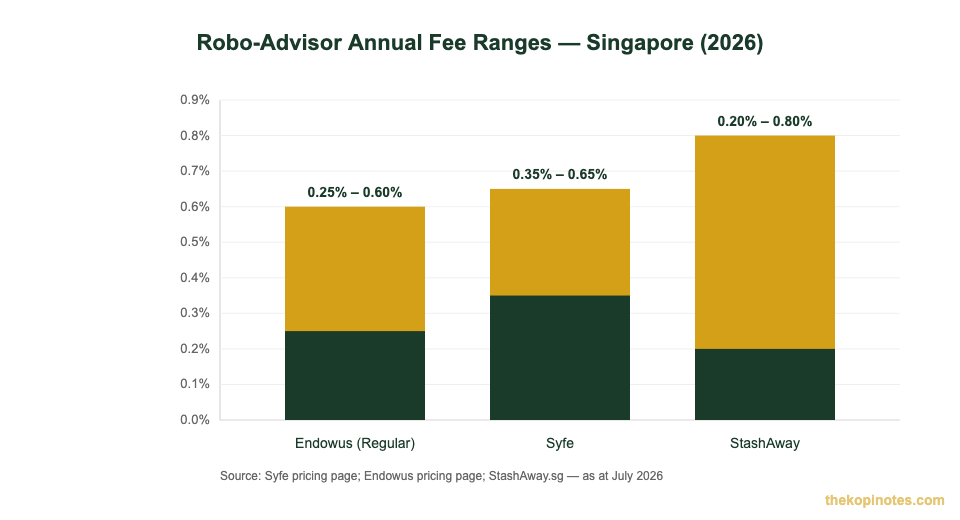
Endowus charges an access fee of 0.25% to 0.60% a year on regular cash portfolios, tapering down as your invested amount grows. If you invest your CPF savings through Endowus, the fee is a flat 0.40%, regardless of how much you put in.
Syfe’s fee ranges from 0.65% a year on balances under S$50,000 down to 0.35% for balances above S$1 million, according to Syfe’s pricing page. Its Cash+ portfolios remain fee-free.
StashAway sits in the widest range — 0.20% to 0.80% a year — depending on which portfolio and risk level you choose.
None of these fees include the underlying fund’s own expense ratio, which sits on top. Before you sign up, check both numbers, not just the headline one. You can compare all three platforms in more depth in our best robo-advisors in Singapore roundup, and get a sign-up bonus through our Syfe referral code.
Self-Directed Brokerage Fees Compared
If you’re comfortable picking your own ETFs or stocks, a self-directed broker charges you per trade instead of a recurring percentage — usually far cheaper for a buy-and-hold strategy.
| Broker | Fee Structure | Cost on S$20,000 SGX Trade |
|---|---|---|
| Interactive Brokers (IBKR) | 0.08% of trade value, min S$2.50 | S$16.00 |
| FSMOne | Flat S$8.80 per SGX trade | S$8.80 |
| moomoo | 0.03%, min S$0.99 (waived first year) | S$6.00 (S$0 in year one) |
Source: Interactive Brokers Singapore pricing; FSMOne pricing; moomoo SG fee schedule — as at July 2026.
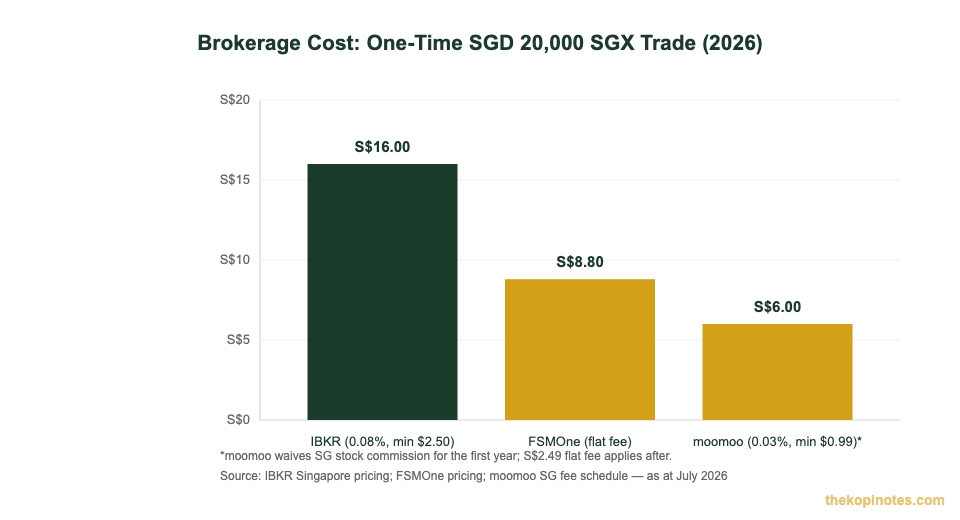
Interactive Brokers (IBKR) charges 0.08% of the trade value for SGX-listed stocks and ETFs, with a minimum of S$2.50, according to IBKR’s Singapore pricing page. On a S$20,000 trade, that works out to S$16.00. IBKR also offers commission-free US stock and ETF trading for eligible Singapore residents through its IBKR Lite tier.
FSMOne charges a flat S$8.80 per SGX trade — cheaper than IBKR’s percentage-based fee unless your trade is very small.
moomoo charges 0.03% of the trade value, with a S$0.99 minimum, and waives Singapore stock commissions entirely for your first year on the platform. After that, a flat S$2.49 fee applies per trade.
All of these commission figures are before GST. Singapore tax residents pay 9% GST on top of brokerage commissions and robo-advisory fees, so a S$16.00 commission becomes about S$17.44 after GST.
The catch with self-directed investing: you do the fund selection, allocation, and rebalancing yourself. There’s no advisory layer. If that sounds like more work than you want to take on, a robo-advisor’s fee may still be worth paying.
Real SGD Cost Example
Numbers are easier to compare side by side. Here’s what a S$50,000 portfolio, held for 20 years, could look like under different cost structures — assuming a 6% gross annual return before fees.
At 6% gross with no fees, S$50,000 grows to about S$160,350. Shave off a 0.5% annual fee — roughly the middle of Endowus’s fee range — and your effective return drops to 5.5%. Over the same 20 years, you’re left with around S$145,890. That’s a difference of about S$14,460, purely from a half-percent fee compounding over time.
A self-directed brokerage doesn’t charge that ongoing percentage. You’d pay a one-time commission — S$8.80 to S$16.00 on a S$20,000 SGX trade, per the table above — and keep the full 6% compounding from day one. The tradeoff is that you’re responsible for choosing what to buy and when to rebalance, work a robo-advisor does for you automatically.
There’s no single “cheapest” answer that fits everyone. It depends on how hands-on you want to be, and how large your portfolio already is. Our Singapore retirement calculator can help you model how different fee levels affect your long-term numbers, using your own income and savings rate.
Which Platform Should You Choose?
Match the platform to your situation, not the other way round.
If you’re just starting out with a small, irregular amount, a robo-advisor’s fee is a small price to pay for automatic diversification and rebalancing. You don’t need to know what a REIT ETF is on day one — the platform handles that for you.
If you already have a clear idea of what to buy — say, a global equity ETF you plan to hold for 20 years — a self-directed broker like IBKR or FSMOne will almost always cost less over time, because you’re not paying an ongoing percentage on money you don’t plan to touch.
If you have idle CPF Special Account savings and won’t need the money for decades, consider simply leaving it where it is. A guaranteed, fee-free 4% p.a. is hard to beat, especially in a flat or falling interest rate environment.
Many Singapore investors end up using a mix: CPF and SRS for the guaranteed, tax-advantaged portion; a robo-advisor for a hands-off core portfolio; and a self-directed broker for larger, buy-and-hold positions where fees matter most. If you’re not sure where to start at all, our step-by-step guide to building your first portfolio walks through the decision in more detail, including which account to fund first.
Not financial advice. Fees, rates and contribution caps are accurate as at July 2026 based on publicly available pricing pages and official sources, and may change — always check a platform’s current fee schedule before investing.
Frequently Asked Questions
What is the cheapest way to start investing in Singapore?
For most beginners, a low-cost robo-advisor like Endowus (0.25%–0.60% p.a.) or a flat-fee broker like FSMOne (S$8.80 per SGX trade) is cheapest to start with. If you already have CPF Special Account savings, leaving them untouched earns a guaranteed 4% p.a. with zero fees — often hard to beat.
How much does it cost to invest via CPF or SRS in Singapore?
CPF itself charges no fees — your Ordinary Account earns 2.5% p.a. and your Special, MediSave and Retirement Account earns 4% p.a. automatically. SRS is a tax-relief wrapper, not an investment; once you invest your SRS funds through a broker or robo-advisor, you pay that platform’s normal fees on top.
Is a robo-advisor or self-directed brokerage cheaper for Singapore investors?
Self-directed brokerages are usually cheaper for buy-and-hold investors — you pay a one-time commission, as low as S$0.99 to S$8.80, rather than an ongoing percentage fee. Robo-advisors cost more over time (0.2%–0.8% p.a.) but include automatic rebalancing and portfolio construction you’d otherwise have to do yourself.
How much extra interest can I earn on my CPF savings?
If you’re below 55, you earn an extra 1% on the first S$60,000 of your combined CPF balances, capped at S$20,000 from your Ordinary Account. If you’re 55 or older, you earn an extra 2% on the first S$30,000 and an extra 1% on the next S$30,000.
What is the SRS contribution cap for 2026?
Singapore Citizens and Permanent Residents can contribute up to S$15,300 a year to their SRS account. Foreigners, who don’t receive CPF tax relief, have a higher cap of S$35,700 a year.
Do I have to pay GST on brokerage and robo-advisor fees in Singapore?
Yes. Singapore’s 9% GST applies to commissions and advisory fees charged to Singapore tax residents, even when the underlying service is partly provided overseas. Always check whether a quoted fee is inclusive or exclusive of GST before comparing platforms.
Ready to Compare Platforms and Start Investing?
Open an account with a platform that matches your cost profile. Use our referral links for exclusive sign-up bonuses.
This article was researched with the help of AI. While we strive to keep all information accurate and up to date, there may be errors. If you notice any discrepancies, please contact us.